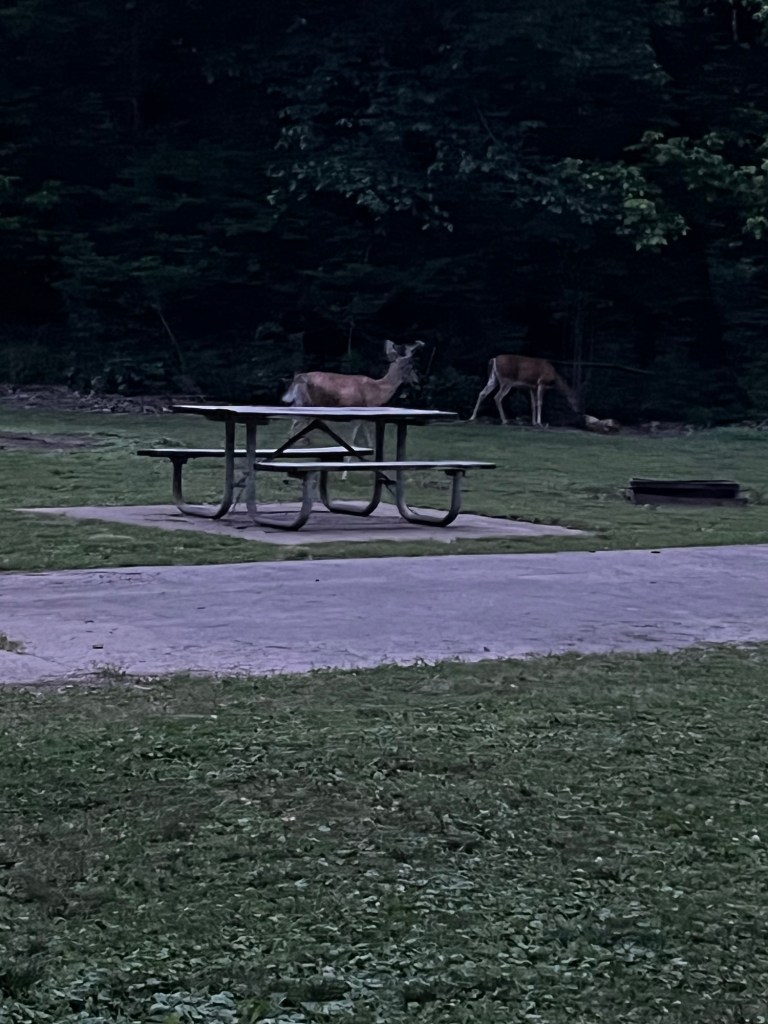
Encounters in nature are calming and peaceful. Sayings like ‘leave only footprints, take only pictures and kill nothing but time’, remind us that our wild spaces should be protected. Every outdoor enthusiast seems to understand the gift and works hard to protect and preserve natural spaces. Unfortunately, there are others that are not so in tune with the natural surroundings.
Working as a campground host has been eye opening. We have encountered individuals who revel in the outdoors and find ways to enjoy natural spaces while helping to care for the park. They keep a tidy camp and help protect the shared spaces at the playground, shower house, trails, caves, and riverside. You can easily identify former scouts by the way they clean a campsite. Many hikers respect the trail and carry out litter they find along the way. Often, guests who understand sustainable practices are helpful in cleaning up the mess left by others.
Campers come from all walks of life. They come solo and in large family groups. They bring all manner of equipment. Some have almost none, while others bring everything one would find in a large house. Plenty of guests sleep directly under the stars in make shift bedding in order to enjoy the tranquility of a night sky. However we also get campers who seemingly hate being outdoors. They pull in to their site and never come out of their rolling fortress. They light up the outside of their rig like Las Vegas, drowning out the campfire glow of their neighbors and disrupting the nocturnal patterns of the local wildlife. They play televisions and radios at top volume using both indoor and outdoor speakers ensuring that though other campers rarely see them…..we all know they are near. They run washers and dryers. They use leaf blowers. I suppose they enjoy a sterile camping environment where dirt, smoke, bugs, animals, and plants are kept to a minimum and where all the comforts of home are at their fingertips. While I don’t personally understand why you would go to the woods only to recreate the exact environment you have at home, to each their own. Other than the light and noise pollution….you hardly know they are in the park as they are rarely outdoors.
To me, the campers that cause the most concern in a campground are those that seemingly think only of themselves. Whether they are novice campers and don’t know camping etiquette or are just generally self centered, this category of campers creates 90% of campground work and 95% of environmental damage. They are why campground rules are invented. Unfortunately, this group often believes that rules don’t apply to them. Examples range from the seemingly harmless gathering of flowers and rocks, to the egregious and deliberate destruction of habitat.
Children frequently gather wildflowers and rocks. It seems like a pretty harmless encounter with nature. I myself love to gather wildflowers on our own property. As a child, I loved going on nature walks on the farm. My grandfather would take me foraging in the forest and it made me feel alive. The joy of discovery and the lure of natural beauty is intoxicating. The problem with specimen collecting in public parks is that hundreds of visitors come each day. If every visitor gathered a bouquet there would be none left to enjoy. So look, smell and admire… but don’t gather. The birds, deer and other critters depend on the vegetation.
Being close to a river, the park has lot of rocks for skipping and stacking along the gravel bars that hug the shore. The naturalists advise against stacking rocks in the river as it displaces the natural environment for crawfish and other river dwellers. But it is hard to deny a child a smooth river rock to add to their collection. It is also hard to understand the volume of rocks we find in the campground. They are left stacked on tables, in fire pits, in the showers, and in the grass at the campsites. These piles sometimes look like full scale excavations. Even small piles have to be picked up and removed back to the river so that park mowers don’t break blades and tent campers don’t end up sleeping on rocks.

Adults also can’t resist the urge to forage. Usually the prize to be found is firewood. I admit that the first thing I do in a campsite is scour the ground for sticks, which I gather in a small bucket to use for fire starter. Campers are allowed collect wood in the mowed areas of the park. Small sticks and branches can be removed from any mowed areas. Guests are prohibited from going into the wooded areas and gathering logs and felled trees. Naturalists tell us that these rotting logs are very important to the ecosystem as they shelter a variety of woodland creatures.
Never the less, almost every morning we encounter a campsite where someone has entered the woods and drug back a log the size of a small bicycle. It probably seems like a logical idea. The tree is already dead, it is just laying there, and firewood is expensive. It doesn’t hurt anything, right? Unless of course, you count the path of destruction where the “firewood” was pushed out of the woods, killing plants, leaving ruts, and a trail of broken branches. Because the wood is not chopped and often not dry, it does not easily burn. When guests leave, the log is often left in the fire pit, charred. A 50 pound log laying half in and half out of the fire pit, covered in char ensures that whoever has to remove it will be covered in black soot. Nothing says “thank you campground volunteers” like being left with a monster piece of wood that has to be wrestled onto the golf cart and hauled down a long gravel road to the ash pit.
At least I understand the logic of foraging downed wood. What I will never understand is people that bring hatchets (and yes, we even had a guy bring a chain saw to use secretly in the middle of the night) to harvest limbs from live trees or even to fell the entire tree. This wood is too green to burn, so users cover it in lighter fluid. Because the leaves and limbs are still attached, there is often a huge blaze and a strong smell. The fire flares quickly and then goes out leaving…. you guessed it….. charred limbs and lots of smelly ash. Because the Paul Bunyan wannabes don’t take time to chop their limbs; the ash, leaves, and twigs are scattered all over the campsite. Not only have they illegally destroyed the forest, they have created a lengthy clean up at the campsite. I encountered a pile of limbs (8x8x4) covering the fire pit. It took multiple trips to the ash dump to get the site clean.
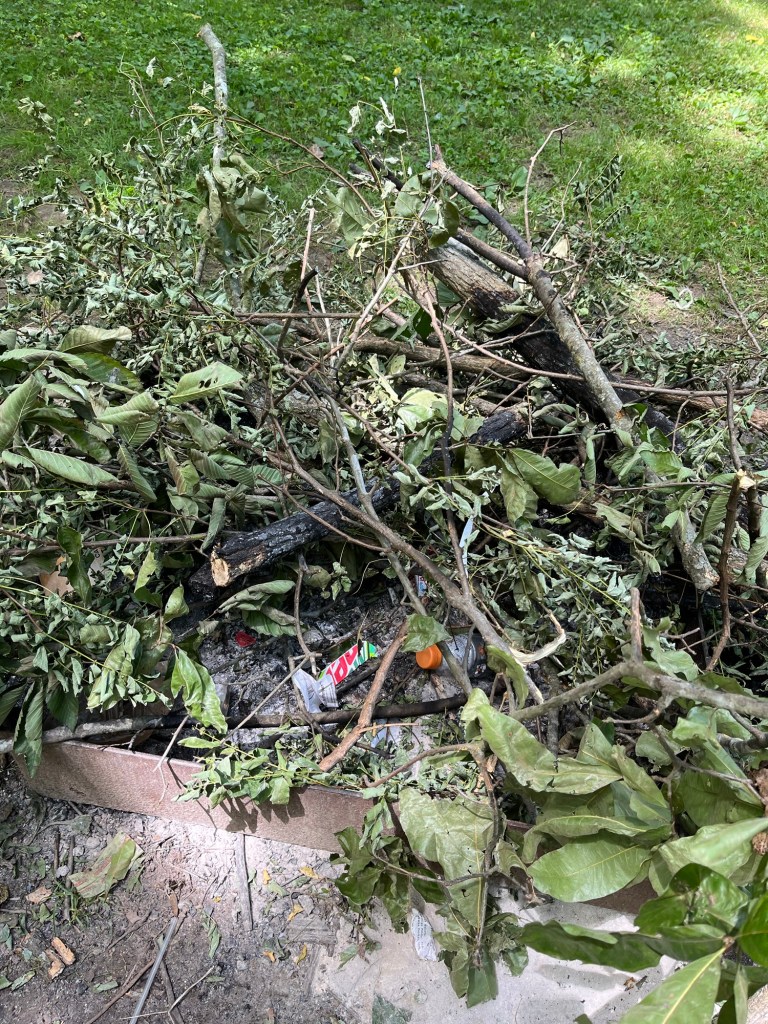
As I was spending the hour cleaning up after the great chain saw massacre, I thought of Woodsy the Owl. If you aren’t old enough to remember Woodsy, he was a giant owl mascot of the National Park Service. His catch phrase was “give a hoot…don’t pollute”. Woodsy would be appalled at the “I will harvest my own wood by chopping down anything I think will burn” people and the “it isn’t really trash if I throw it in the fire pit and cover it with ash and limbs” people. Apparently if you throw trash in the fire pit and cover it with ash, wood, and limbs it is not necessary to throw anything away. Out of sight. Out of mind.
Keep in mind that the park has over 10 large dumpsters conveniently located at the ends of each and every camping loop and at the common areas and parking lots. Never the less, each weekend, I find a few fire pits mounded with limbs and after I get done lifting, breaking, and loading the limbs into a manageable shape for transport….I find a buried treasure of trash. The trash has to be separated and lifted out of the fire pit, before the ash can be removed. This is dirty and unnecessary work.
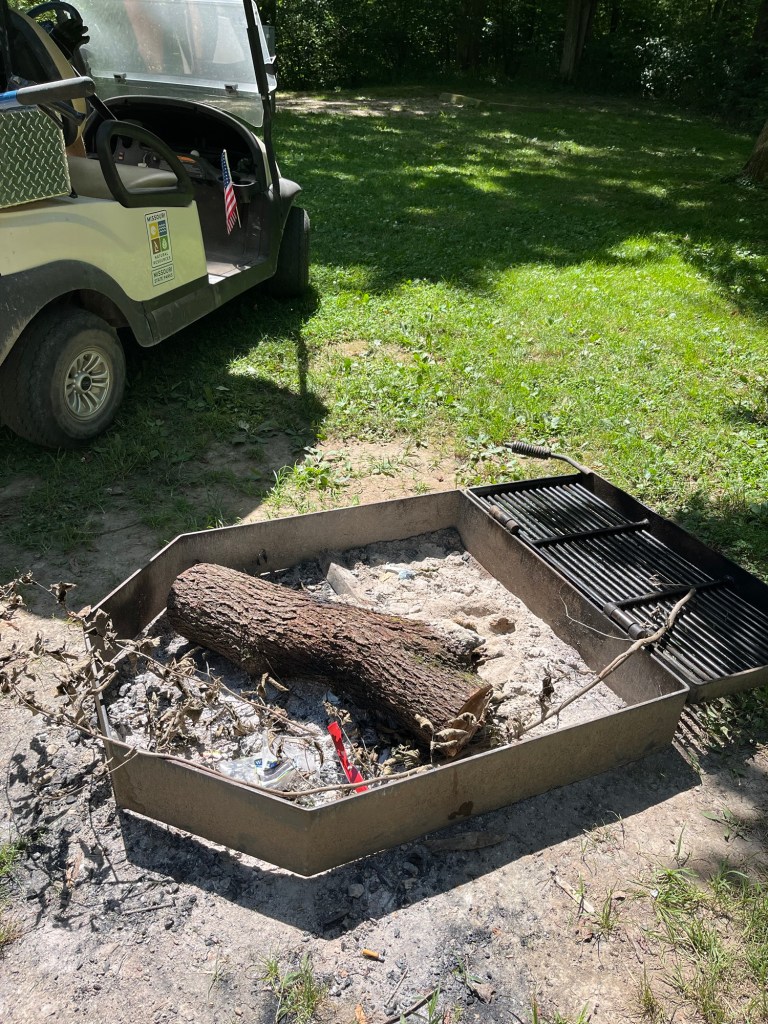
Smokers leave dozens of cigarette butts in the grass and in the pits. Where there are butts, there is always cellophane wrap lingering nearby. The party crown leaves beer cans, soda cans, jello shot containers, liquor bottles, smores sticks, bottle caps, broken glass. We find rotten vegetables, chicken parts, dog feces, underwear, and dirty socks. It is a real treat to find these items covered in ash at the bottom of a fire pit. But hey, it isn’t trash if it is covered in a pit, right? Throw up in your lawn chair? Just leave it in the fire pit with a limb on top….who will notice? Too far to walk to the bath room, just take a squat over the fire pit…. if I put a charred log that is too heavy to move over it, no one will know … right? I wish I were making up these scenarios…but alas. Sometimes people do make a partial effort. They bag their trash and leave it hanging on the utility pole instead of taking it to the dumpster. The raccoons think that is a great idea…the volunteers aren’t quite as happy, but it sure beats digging trash out of a fire pit.
Speaking of animals and the strange behavior of people hiding trash or abandoning trash instead of just putting it in the dumpster…. Perhaps the most puzzling behavior is the numerous dog owners that take the time to use a doggie bag to clean up after their little fur ball only to throw the nicely bagged doggie doo into the woods or along the side of the road. Is it better to have plastic bags of dog poop all over the riverbanks and roadsides? Does a plastic bag of poop scream please throw me in the woods or in the firepit? I don’t get it.
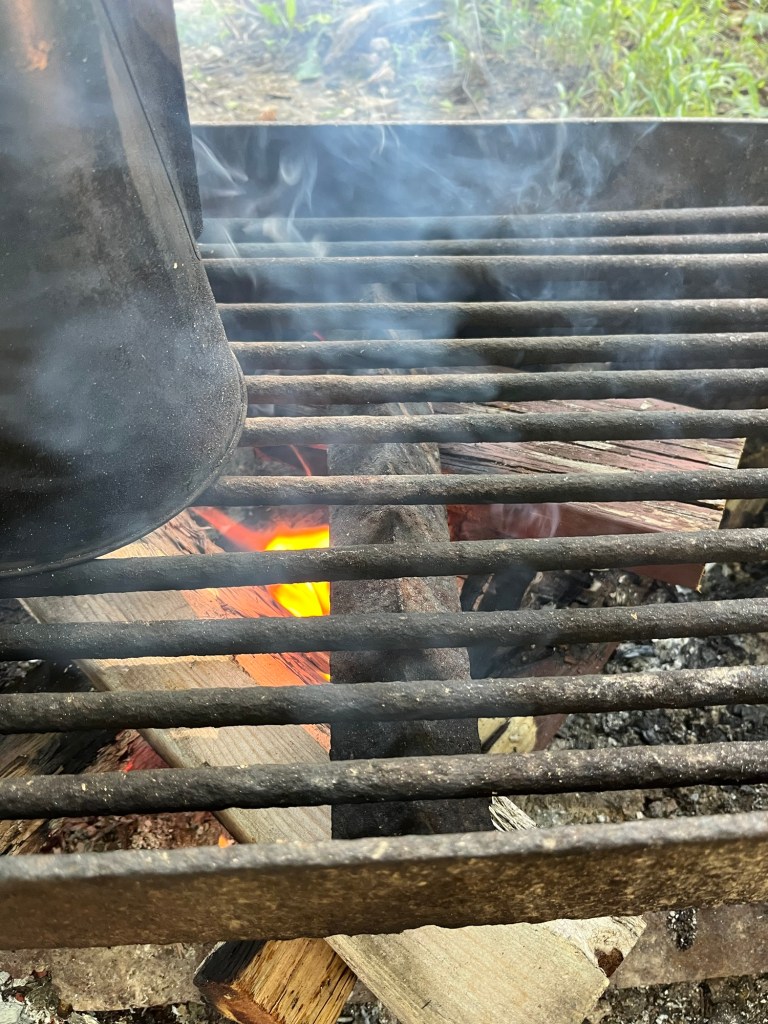
The idea of a fire must just cause a primal need, because brain cells seem to go out the window with the prospect of making fire. On one site, I noticed that the campers had dug up the lawn and created a giant hole between tents that they had filled with wood and cardboard. This, despite the fact that there were two large fire pits already on the site. As I was requesting that they refill the hole and that they use only the designated fire pits, I wondered what their reaction would be if I showed up at their house and dug a giant hole in their yard and filled it with wood and trash.
So if you find yourself in the wild or in a campground, be like Woodsy. Respect your surroundings. Respect your neighbors. Pack out your trash. Use the provided receptacles. Be mindful of the wildlife. Give a hoot….don’t pollute. Your fellow campers and the campground volunteers will be grateful.
 Prisoner of Hopes