
Over the years, I have met some characters. I have definitely been accused of being a “character” and probably was guilty as charged. But this week, I have been training adults (my day job) and I have discovered an uncomfortable truth. Okay, discovered is dramatic. I noticed once again a pattern among humans. The Ancient Greeks wrote about it long ago.

Humans struggle to talk about what they value and how those values shape their actions. Many (maybe most) people can’t tell the difference between human character and a human characteristic. In fact, we have very limited English words to even try to discern the clear distinction. When I talk about character, I am referring to the moral and ethical values that guide how a person thinks, feels, and acts.
Ask a human to describe a personal character strength that they possess and they almost always default to a specific action. It seems we are really good at noticing what we do, or a specific outcome that action produces. A human characteristic is just a neutral label for an attribute like physical looks, a skill, or personality. It takes no effort or intention to have a characteristic. Whatever happens is a characteristic. Whatever currently exists is a characteristic. I am smart, old, beautiful, poor, etc….
Characteristics seem obvious. I have always been what I like to call “built like a Roman goddess”. You might in American slang say that I am chubby. It is perhaps in my genetics or perhaps a learned response to family norms around food or maybe a response to a highly processed food supply. If I say, “that just the way I am”, it implies that the characteristic is immutable. While being chubby is a physical characteristic, it works the same for emotional and personality related characteristics. Such as “I was born with a bad temper. Therefore I am bad tempered. Therefore, you should expect that I will react to you in ways that are undesirable.” Being bad tempered is a defining characteristic…..but is it the person’s character? Does the conversation change for either scenario if we talk about the character trait/virtue of temperance?

Character is formed. It is shaped through what you learn, what you experience, what you see modeled, the relationships you have, what you value and think about, and what you intentionally practice. Character is about intentionally living out your values in ways that are meaningful, consistent, and purposeful. Character traits can be divided into categories including: ethical/moral, performance, intellectual, and civic.
If you have managed to read this far, you may be asking yourself why is she yammering on about this? It is because this week I realized that in setting after setting, when I asked professional and educated people to describe good character, they could always tell me specific things they wanted other people to do (be on time, show respect, consider my ideas, etc). But they struggled mightily to come up with the character trait (core value) itself. Adults could not identify the underlying values beyond the preferred actions.
This is not the first time I have noticed this phenomena. When this happens in a group discussion , I ask the following questions. Why is that action important to you? If you needed to be “respectful” instead of simply doing something “respectful” how would that change your ideas? How do you help someone value kindness instead of simply performing a kind act in order to get something in return? Will punishing people who are late help them develop respect for other people’s time (fyi. It won’t.)?

Increasingly, Americans struggle with these conversations. In some circles, just asking if actions live up to ideals written in our founding documents is enough to start an argument. How did we get from the age where Ben Franklin created a list of 13 virtues that he meditated on and practiced throughout his lifetime to a nation struggling to even consider the concept of empathy? How can it be that even in houses of worship sermons are more likely to tell us “3 things you need to do this week” than encourage us to examine ourselves in light of a moral truth? Maybe because “just do it” is easier than self reflection. Perhaps holding your actions up to ideals sometimes feels defeatist. A checklist with three easy steps seems accessible and brings instant gratification. Truthfully, it sometimes makes people down right uncomfortable to talk about abstract and aspirational ideals, particularly if the discussions are about shared values and personal character. Just ask Socrates.
At his trial for “corrupting the youth” of Athens, Socrates famously said “the unexamined life is not worth living”. He chose death over the inability to ask moral questions within his society and publicly refuted the idea that it was unpatriotic (anti-Greek) to ask people if their actions really reflected their ideals. Socrates believed that a good life requires questioning your own habits, beliefs, and goals rather than blindly following. He taught that reflection and introspection allow people to recognize their own ignorance and strive to become better human beings. He feared that living without reflection would cause humans to accept whatever society hands you without truly understanding your own purpose and power to affect positive change. He asserted that personal ambitions must be tempered with the common good. He believed that a society thrived only when it looked beyond its outward characteristics and cultivated moral excellence (good character).
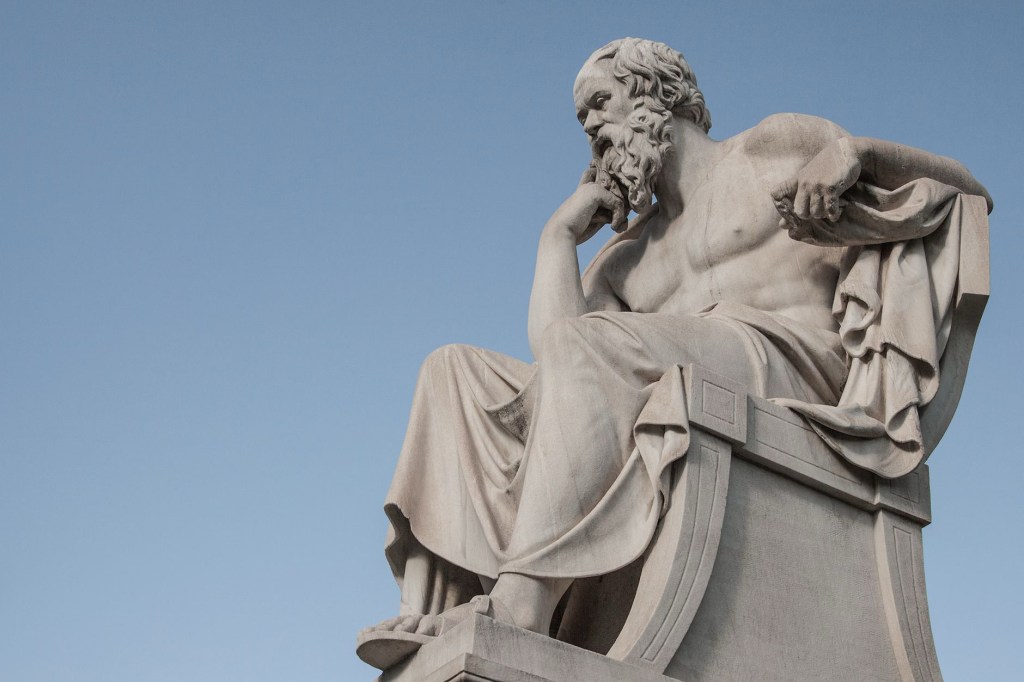
And so this week in the heartland of America, I am pondering when we stopped talking about character, values, and shared ideals. When did the subtle shift occur in which we can all talk about what we are supposed to do, what we have, what we want, and what we think and yet struggle to talk about why that action or idea is a reflection of what we value? When life is reduced to doing only the right “actions” or having the right “things “ devoid of what they mean, people lose discernment.
Isolated actions can be manipulated and misused. Rewards and punishment become the only behavioral drivers. We become “controlled” by what’s in it for me. Justification of our actions is unlimited without reflection against our ideals. For example, “I want to make money” is a frequently stated action. It is not grounded in any particular character trait. Rich is a characteristic not a character strength. But if the characteristic is what you are chasing, any action is permissible as long as it makes money. A concrete action becomes the ideal.
Sometimes the distinction is even trickier. Obedience can be viewed as character strength, but most people treat it as a transactional characteristic. We use “do what you are told” in order to avoid a punishment or gain a reward. We use the characteristic of obedience to encourage compliance. But what if you are told to do something that harms someone else? Do you do it? When obedience is balanced with critical thinking, it maintains social order and teamwork, but practiced blindly, it can lead to ethical risks.
People who cannot see beyond concrete action are certainly not well positioned to see the nuances in values. There is a continuum that must be acknowledged. It is possible to have too much of a character trait, just as it possible to have too little. Courage is a virtue right up to point where a person takes unnecessary risks and endangers self and others. Honesty is a virtue. But is truthfully telling an elderly person struggling to unload their cart that they are slowing down the grocery line, kind or necessary? And so it goes. Actions can be illustrative, but separate from the underpinning values they can be amoral; Operating purely on logic, instinct, or mechanics without ethical judgment, or based strictly on utility, survival, or data.
Like Socrates, I believe that character matters. Like Franklin, I understand that character is formed. Because, your character is shaped through what you learn we have to take time to understand concepts of character. Because your character is informed by what you experience and what you see modeled we have to reflect and discuss what is happening against what we value. Because character is influenced by the relationships you have, people should take time to talk about what we value collectively. If we are serious about character, we have to identify what we value and then intentionally practice the variety of specific actions that become habits that improve our lives.

Characteristics can just happen. Character is formed. Character, it turns out, does indeed matter. And it takes work. So in an effort to live what I believe, I will be blogging occasionally in a new series called I am calling, Character Matters. I hope to explore specific character traits. Together, I hope we can discuss and examine shared values, ideas about the identified value over time, individual actions associated with the value, what the character trait looks like on a spectrum of too little or too much, and how a commitment to the development of the trait might be practiced.
Ambitious? Probably. Esoteric? Perhaps, but shouldn’t be. Critically needed in public discourse? Absolutely. Character Matters. Shared ideals and commitments strengthen society. Personal character formation builds the internal compass that guides action. I hope you join me as we work to get better at identifying what we value and strengthening character.

