
We find ourselves in Ketchikan, Alaska with time to kill. We walk Creek Street and the harbor. But there is still a lot of port time ahead. Cruise ships give you random amounts of time that are simultaneously too short to head too far afield and too long for port side exploration.
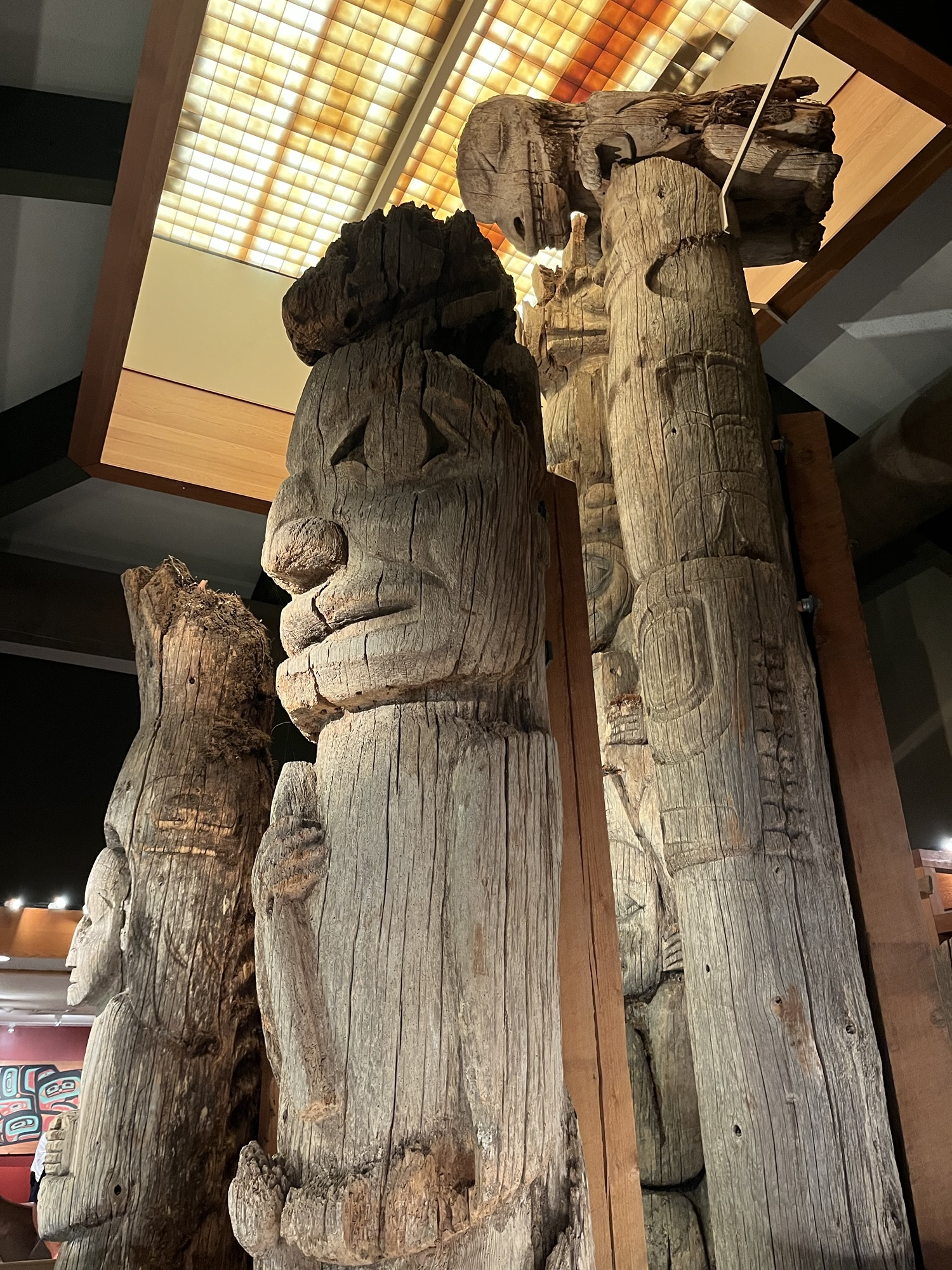
However, in Ketchikan, a short walk uphill takes us away from the crowds and to the Totem Heritage Museum. Operated by the city of Ketchikan, the museum opened in 1976. The Heritage Center houses one of the world’s largest collections of unrestored 19th century totem poles. The poles were recovered from uninhabited Tlingit settlements.

The ancient poles are housed inside and are in various stages of decay. Outdoors, modern replicas line the entrance. They are colorful and inviting. The center promotes the traditional arts and crafts of the Tlingit, Haida, and Tsimshian peoples. In addition to totem poles, there is weaving and other art forms on display.
I am interested in the totem as a visual record of clan history. Poles were raised and validated during a potlatch (a ceremonial feast and redistribution of property). Witnesses validated the claims carved into the pole, making it a living part of tribal law and social history.

There were different types of poles for different purposes. Memorial poles were raised to honor a person who has passed away. Other poles held the ashes of deceased community members. Welcome poles were placed near water’s edge to welcome or warn newcomers. Totems could be freestanding or used as structural pillars to support clan houses. Poles were even constructed to publicly shame wrongdoers.
As a historian, I thoroughly enjoy learning more about this important art form that celebrates and bears witness to tribal history. But the museum is small and too soon, we are on our way.

We find ourselves in the park and wander beside a lovely stream. We find a fish hatchery and then walk along neighborhood houses with lovely gardens. It is fun to be aimless.

Back in town, the cruise crowd flits around like ants. We find solace in a museum dedicated to the Tongass National Forest. Apparently there are many history nerds on cruise ships. The museums are delightfully uncrowded.
Afterwards, we find a small out of the way pizzeria and have a slice of pepperoni and a cold soda. I need nourishment to fight my way back to the ship.

Near the docks, there are a variety of statues and signs. I stop to take pictures but it is a challenge. How can I get a photo without a plethora of women in spandex and polyester or old men in plaid? What angle will mask the fact that 200 people are crowding the sidewalk? It becomes a game.
As we return to the ship, I think that we had a really good day. Ketchikan has a number of delightful experiences. Unfortunately, too many cruise ships dock at once, making it over crowded. We did our best to find places and spaces away from the hordes and were largely successful. I consider Ketchikan a cruise ship success.
