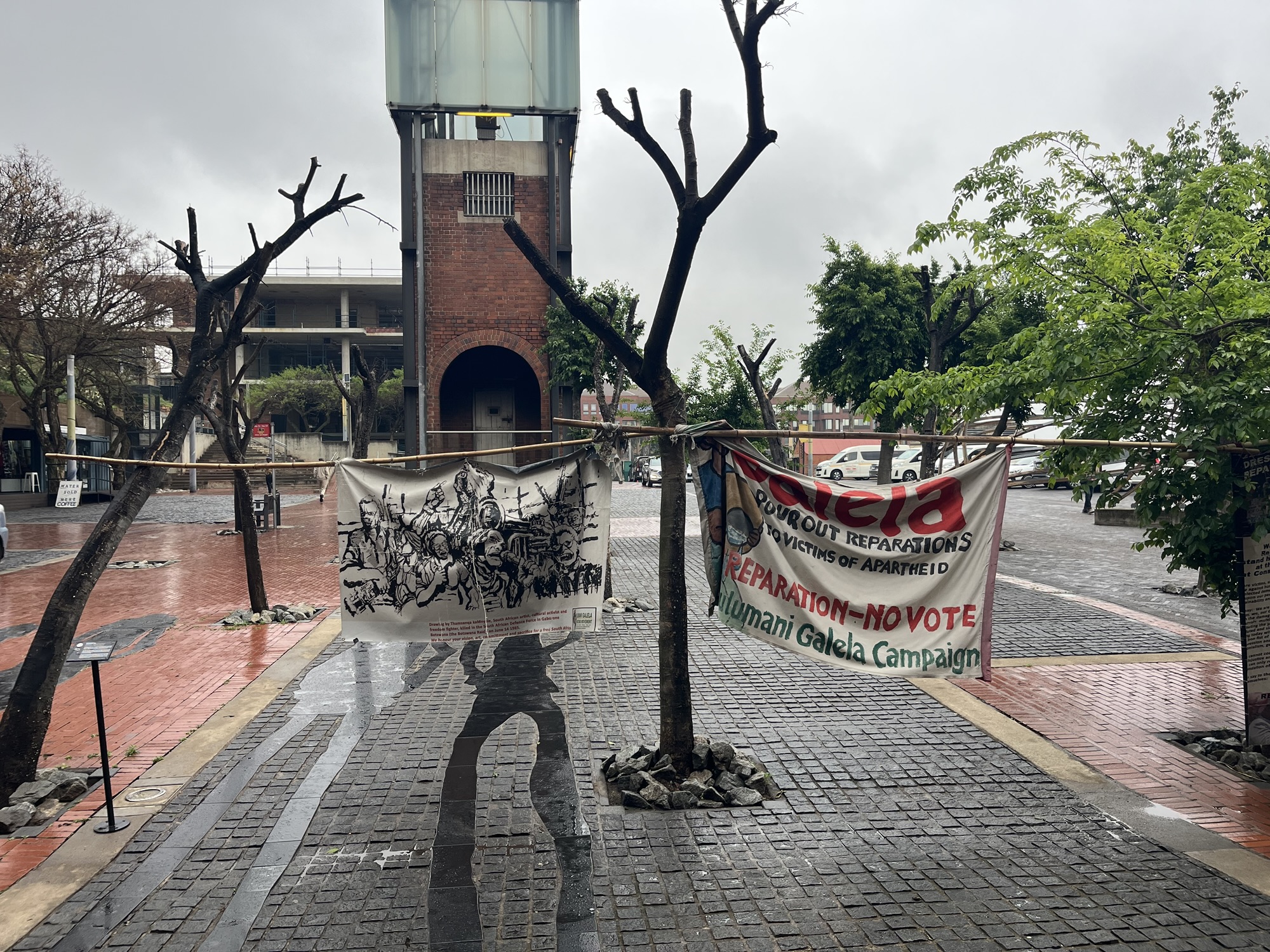

I experience so many emotions as we arrive at Constitution Hill in Johannesburg. It is the site of the Constitutional Court of South African and also the sight of one of the country’s most notorious prisons. Today the highest court of justice sits deliberately adjacent to a place synonymous with racial and political injustice.
The hill is busy today. There are political rallies being held all around. Busloads of people gather to hear fiery speeches and musical entertainments. We aren’t going near the rally, but our ride share driver has to crawl through the dense traffic to drop us off near the eternal flame of democracy memorial. We can hear the chants of the rally as we approach the prison.

Our first stop is the notorious men’s Prison known as “number four”. Both Gandhi and Mandela were held here, years apart. Both were young lawyers protesting apartheid. Both were held for refusing to accept that any human was worth less because of the color of their skin. Both were willing to risk imprisonment and death to fight unjust laws. Both suffered unimaginable indignities alongside hundreds of others.
At reception, a nice young man shakes my hand and thanks me for coming. He looks me in the eye and says, “thank you for being here. Please tell your countrymen not to believe the lies that are being told about us.” I reply that I don’t believe the rhetoric that distorts history and that I am well versed in the history of South Africa. I share that we are hear to honor the struggle and the hard work that it takes to have a diverse and thriving democracy. His smile lights up the room.

We enter the notorious jail and stand in the courtyard where prisoners were forced to squat in the courtyard, mere feet away from an open latrine to eat their meager meals of mashed grain and water. We read panels that describe how men were forced the indignity of the tauza dance (a deeply dehumanizing forced routine in which men had to strip naked, leap and clap, and land bent over with legs apart for a body cavity search). It is hard to imagine the treatment people endured. It is hard to imagine the people who reveled in apartheid and celebrated the cruelty. And yet, I realize history is full of men who claim superiority as an excuse for atrocities. I find myself swallowing hard as I am confronted with the reality of this place.

In the cell blocks, we discover people existed often with just a single blanket and a slop bucket for human waste. The cells are dark and crowded. Men were pitted against each other as a means of control. Others were forced onto elevated racks for punishment, beaten, and moved to tiny solitary confinement cells if the resisted the dehumanizing treatment. As a form of protest and self preservation, prisoners built blanket animals, designed games out of scraps and wrote beautiful poetry. I am amazed at the resilience of the human spirit. There are tiny sparks of hope in the darkest of places.
Signs ask us to consider who is a criminal. Is it a man who was out walking in the town of his birth two minutes past curfew? Or the man who lost his government issued id card that labeled him non-white? Is it the man who is kicked off a train because he objected to the seat he paid for being given to a white while he was only “colored”? Perhaps it is a white miner who went on a strike for better working conditions? Maybe it is the men who showed up looking for work without a permit? Is it a hungry child who stole a piece of bread? Maybe it is a student who protested the law that required all teachers to use Afrikaans at all times, ensuring that black in townships did not receive an education? Unjust laws seem to make everyone a potential criminal, even school children just asking for the right to an education.

One cell block hostsan exhibit honoring Ghandi, whose career in nonviolence and advocacy started here in Johannesburg. It explores how one man’s conviction and sense of justice influenced the trajectories of multiple nations. In another, photos of a young Mandela accompany writings in which he declares he is prepared to give his life for a South Africa that values all of its people.
I stand and read the quotes in the place where thousands of men bore the full force of unjust apartheid laws and the air is forced out of my lungs. What am I willing to sacrifice for justice? Do justice, love mercy and walk humbly. Scripture tells me this is what God requires of us. What am I willing to give? Gandhi and Mandela made difficult choices that honored this command…. at great personal cost. They changed the world.
It should be easy to live in love. Why do men create systems that aggressively demand the opposite of justice while claiming they are only following God’s will? Subjugation, racism, and hypocrisy over and over again. This prison is a mirror. And a heavy weight of consciousness has settled on me.
Ghandi stood here in the face of evil and made a choice. Mandela stood here in the face of evil and made a choice. The school children of Soweto stood here in the face of evil and made a choice. I am standing here and realize I must choose and keep choosing. The work will not be finished. We must choose unfailingly for ourselves and for the generations yet to come.

With heavy thoughts and prayers for God’s mercy , we head across the street to the Constitutional Court of South Africa. The highest court in the land now sits at the entrance to the prison where apartheid did some of its worst work. The flame of democracy burns bright in the courtyard between the door of oppression and the doors of justice. It is a powerful visual reminder.

The art selected for the court’s vestibule is symbolic. The court belongs to the people and the interior design reinforces the principal. People are seated in long benches. Equality and access are reinforced even in the seating design. Large windows look out onto the street to reinforce the idea of transparency. African decor reminds the nation of its rich heritage. The national flag represents unity among its people.

Across the courtyard and up the hill, the old fort sits as a silent sentinel from the colonial past. Originally built as a defense in the Boer War, when the British seized Johannesburg the Old Fort was converted into prison buildings for the incarceration of Boers. Some were executed here. An “awaiting trial block” was built in the 1920’s. Over time the fort was used as a way to implement and enforce race based apartheid. Today, the fort holds meeting rooms and public spaces. More famously, the room where Mandela was held in 1962 while awaiting the Rivonia trial and then while awaiting transport to Robben Island. Only whites were held in the Old Fort prison buildings, but Mandela was moved into the infirmary after the government received a tip-off regarding a potential escape attempt.

I am a little awestruck to be standing in the place where Mandela awaited trial. His meticulous calendars that he kept during his years on Robben Island are stacked in a nearby glass case. His handwriting is precise and ordered. Every visitor and activity is accounted for. “The Long Walk to Freedom” is one of my favorite books. To be here with in this space, with artifacts and sources that Mandela described so thoroughly in his seminal work is surreal.

Next, we head down the hill and to the women’s prison. Women were detained here for many reasons. In the section for white women, a tidy cottage served as cell for Daisy de Melker who killed two husbands and a son with poison. Next door, a harsh confinement area held black women whose crimes ranged from brewing beer to leading a women’s march protesting apartheid. Winnie Mandela and Albertina Sisulu were both detained here for their work with the African National Congress. I stand in a cell and stare at the graffiti. “Where are my children?” My mother’s heart is grieved.

In the yard where black women prisoners toiled over laundry vats, green grass now grows. The prison is part museum and part women’s center. The place of oppression is now a place of hope. There is a conference and luncheon being held outside the solitary confinement wing. I can’t help but eavesdrop. The topic is “how to improve the lives of women and empower them to have more voice in governance”. I am uplifted.
At the beginning of the day, we entered a notorious prison where people entering in past decades had no hope. I am leaving the compound with a renewed understanding that freedom is worth fighting for. Human dignity is God given. Democracy requires sacrifice. And even the most oppressive systems can not resist a people who insist (at all costs) on dignity, freedom, and equality under the law. As we leave, I find myself whispering “God bless South Africa and may God bless us all.”
