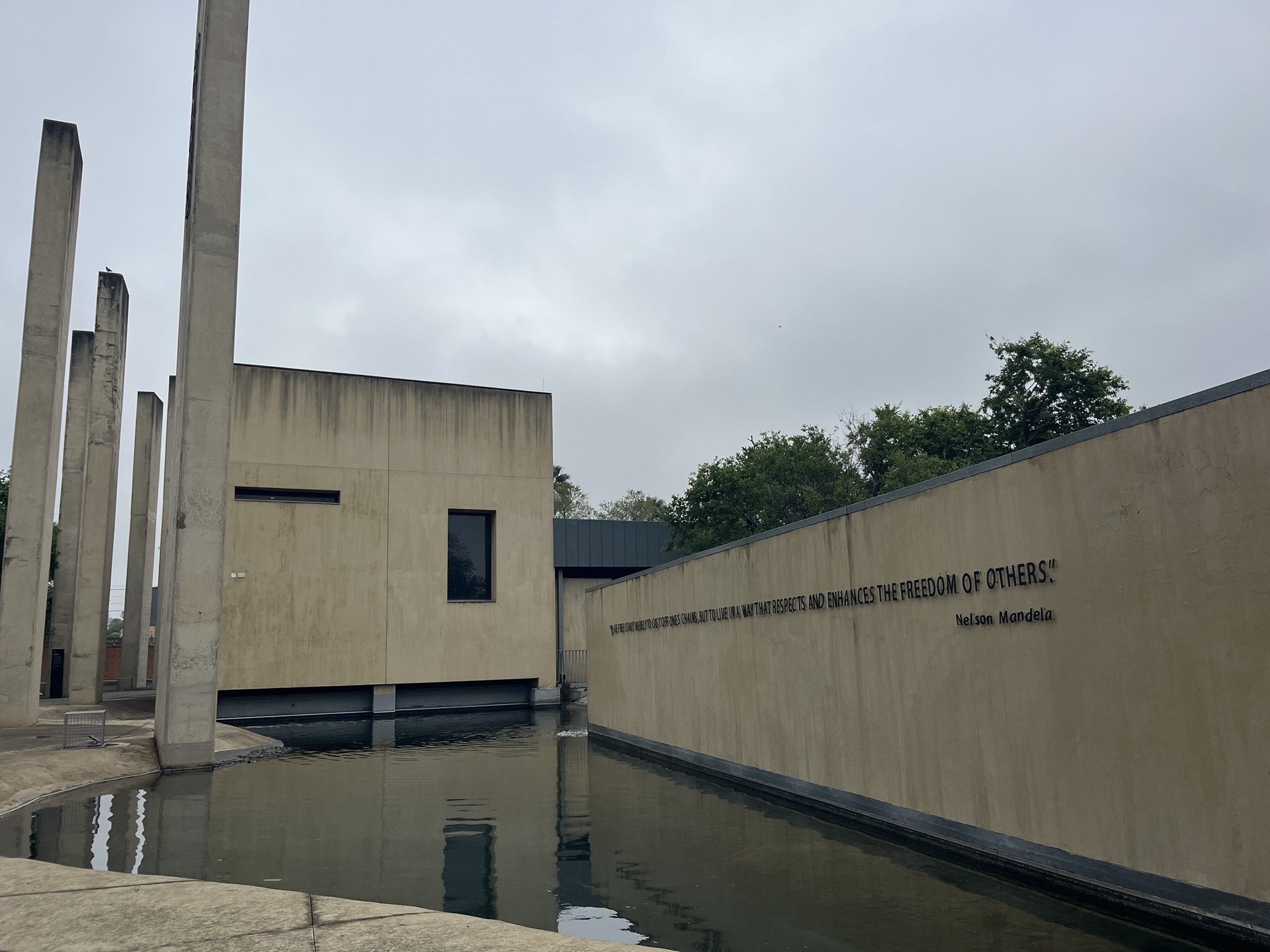

I don’t know what to expect as we arrive at the Apartheid museum in Johannesburg. The exterior of the building is bleak. Drab concrete slabs and the seven pillars of the constitution engraved on seven equally drab concrete pillars comprise the entrance.
When we purchase our tickets, we are given a pass with our assigned race. It determines which door we can enter and what we are allowed to see and experience in the first exhibit. My husband enters the white entrance. I am not allowed. I am denied entry to the exhibit and must take the long way around through separate doors. There is a wire cage keeping me in my place.

Finally out of the building, we reconnect at the base of a hill. The Journeys exhibit stretches along the steep uphill climb. We see the backs of people walking uphill as we walk among them. If we bother to turn around we can see their faces. If we are too busy climbing, the are just nameless, faceless shapes to walk around.
Inside, we learn their names and their stories. There are artifacts from their lives and stories about how apartheid has affected their experience as a South African. The message is clear. Everyone has had an uphill climb, but some have been more burdened by a stacked system. All are uniquely South African. All have value.

There are fabulous, special exhibits honoring Nelson Mandela and Desmond Tutu. There photos, quotes, video clips, artifacts, and even a car. It is a national celebration of two extraordinary men who managed to do the impossible. To quote Mandela, “It always seems impossible until it is done.”

After watching clips celebrating Mandela and the end of apartheid, we begin the long journey through apartheid history. We start with a film about the indigenous peoples and their first encounters with Europeans. We then learn about the Boers and their struggles with the English. We discover that after the fall of the Nazis and the Second World War, apartheid begins to intensify in South Africa.
We encounter the wall of laws, which become increasingly restrictive of black Africans. It is hard to look at the signs and objects of oppression. As a historian, I think I understand authoritarianism and racism, at least in the abstract way of scholars. But I will never know the visceral impact of one who has suffered. I will never understand the arrogance and hatred of the oppressors. I am horrified in its presence.
This museum doesn’t sugar coat and it doesn’t moralize. It just relentlessly lays out the facts in its bare, ugly, tangible witness. Exhibit A: a pass book restricting access to cities and relegating black citizens to designated townships. Exhibit B: work permits that restrict where, when, and how blacks are allowed to work. Exhibit c: laws stating only whites can own land outside of the townships. Exhibit d: video clips of white men talking about black workers (who are obviously in horrible working conditions in the gold mines) stating that they have to be “trained” to work. On and on it goes. It is brutal honesty, stacking the facts and artifacts into walls of horror.
I am tired by the time we get to the late 1970’s and early 1980’s. My brain cannot comprehend such intentional cruelty. I remember some of the footage from the evening news. I would have been a child watching American television. I rewatch the clip of the students protesting in Soweto, asking just for the right to be educated. I see police firing shots at the students. I see Hector Peterson, 12 years, waiting for his little sister at the corner after school so he could walk her home. I see Hector shot and killed. I realize now that Hector and I are the same age. I understood it then, but I didn’t understand what it meant.
This struggle moved me then. I have always loved school. Surely children should not be shot for wanting to learn? I followed the bloody struggle in Soweto. The shootings continued. The “necklacing” of police informants in the townships horrified me then and still horrifies me now.
As I stand here under the shadow of an armored Casspir truck, I think about the students marching, fists in the air chanting “we have the power.” I wonder…. Where does that courage come from? Is it desperation or the cry of the human soul demanding the sacred dignity of self worth? It resonates to my very core. And the little children shall lead them. Suddenly, I remember speaking out against racism as a young teen and having a close friend say “I think you like black people better than you like white people”. And I remember thinking “what a stupid thought that you have to pick sides against humans….isn’t being human enough?”

As I read the stories of the hundreds of not thousands who risked everything to demand justice, I am humbled. What have I had to risk in the struggle for human freedom? Not much. I am occasionally ridiculed by friends for being “woke”. If that means I see humans and honor their worth and dignity then sign me up. I want to feel raw and crushed in the face of human suffering if it means that I see people as image bearers of God and have the capacity for empathy and love. I am reminded of watching “Cry Freedom” with Denzel Washington playing a dramatized version of Steven Biko years ago and crying. I am grieved in the same way today. This struggle is for the very soul of humanity. It is visceral and real and ongoing. There has been an incredible human cost. The very least I can do is accept the discomfort of bearing witness.

If a man can decide another man is not “human enough” to have rights. If a man can decide that he is superior and therefore is allowed to treat the other in what ever way he sees fit. If we are not willing to be in “good trouble” (to quote John Lewis) to ensure our shared humanity is honored….then we cheapen what it means to be human. We dishonor the God in whose image we are made. Racism is sin.
The final galleries allow us to walk through weapons from decades of armed struggle now melted into rubble. I stand in front of the handwritten notes Mandela took at the CODESA talks in which a new vision of freedom was formed. I watched testimony at the reconciliation hearings where people confessed their part in apartheid. “And the truth shall set them free.” There is a way forward. It is long and messy. It is a long walk to freedom.

In the final room, I am encouraged to pick up a rock. It symbolizes my own struggles to carry and my own acts to confess. I am asked to lay it on the mound of other stones and realize that I am not alone and I can’t do it alone. The African concept of Ubuntu suggests that a person is a person through another person. I need you and you need me. I see you and you see me. You are my other me. What I do affects you. What you do affects me. We rise and fall together.
I silently pick up my rock. I hold it and feel the cold heaviness in my hand. I choose to rise. I choose to the best of my ability lift others with me. I lay down my burden. I add my rock to thousands of others beneath the South African flag, and leave this museum feeling lighter. Freedom isn’t free.
