-
Tromso Love Is True, But I Hate Their Airport: Travel Goals
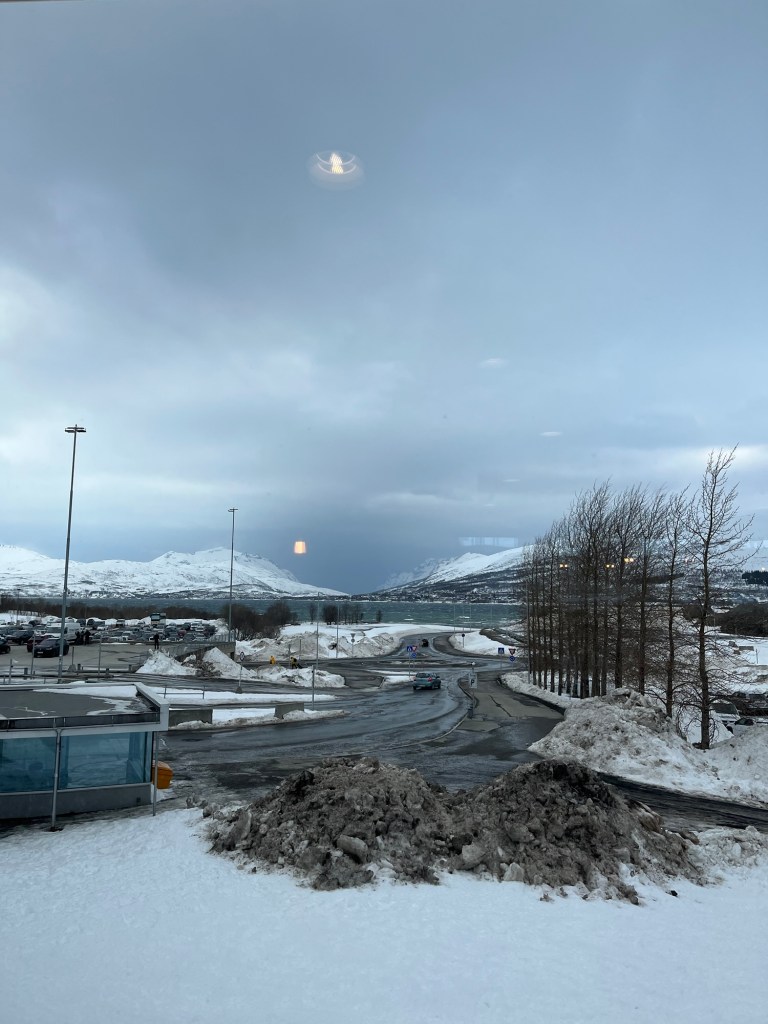
I mention in each travel day post that I dislike air travel. It feels chaotic and uncivil in ways other forms of transport avoid. Each airport and airline has its own system that you can’t know if you have not been there before. Sometimes your experience is different due to the people you encounter. Add in tight time constraints, and I have a recipe for stress.
To combat my airport anxiety, we usually leave earlier than we need. This is especially true if we are staying in a residential neighborhood and we don’t speak the language. Thankfully, my Uber app works in Norway. An actual taxi shows up in under five minutes (I no longer have to think about bus routes ….and back up plans…..check).
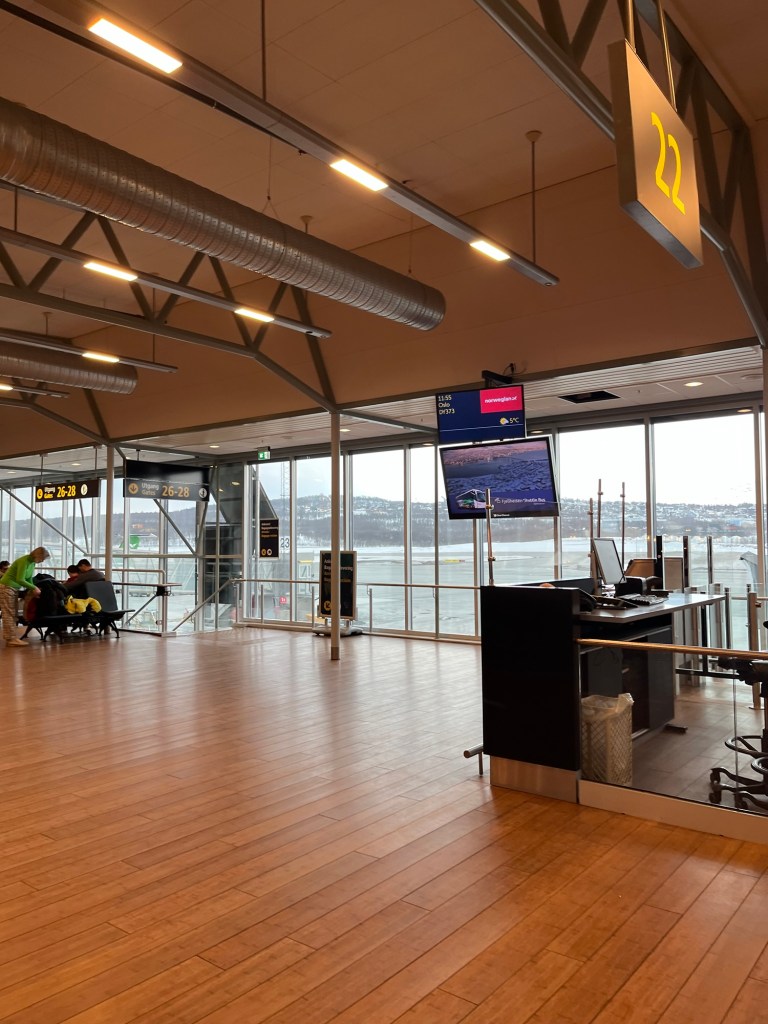
I relax as we pull into the small airport. We have more than enough time. Too much time. That makes me happy. There are no workers visible as we make our way to baggage drop. We realize that we have to get our own baggage tags, but we aren’t sure where. We find the self service kiosks after wandering around. There are literally no workers helping anyone. The lines are long. An elderly woman asks for our help. I help her get her documents and we wait for our turn. I put in our information and we get a boarding pass ….but no luggage tag. I try again and again on a different machine… no tags.
Now what? I go to the only human that looks official, standing alone, and looking at her phone. She tells me she only works for her airline ……not ours. Find your sign she says. I look everywhere and see a board with dozens of small emblems. A worker pushes past me in the crowd, I try to ask…she keeps walking. I notice that several other passengers are in the same situation.
Finally a worker that I track down as she races away from me tells me to get in line for counter three. We do, and are 8th in line. The line for counter four is 30 people deep. We wait. Twenty minutes go by and the worker is still assisting the same family. The crowd grows restless. I try a ticket machine again. Still not working… I ask for help from a passing person in an airport jacket, and am ignored. Someone appears and is randomly helping people in the back of our line. We wait. Forty minutes and the line finally moves.
Two from the front of the line now and an agent appears and moves the people in front of us over behind a tape barrier. She asks why we are in line. I tell her we were unable to get baggage tags. She tells me I have to go to a machine. I tell her I have. She gets mad and tells us to come with her to a machine. My husband stays in line, we are giving up our place as there are now dozens of people in line.
I follow her back to a kiosk. She tells me how to work the machine. I tell her I have already done the things she suggests multiple times and was able to help others successfully. She yells, “I am trying to explain to you.” I say okay. She tries again. It doesn’t work…again. She says “maybe it was out of paper the first time, lots of people have this problem, I need to understand what is happening to help.”
I get sent back to the line and we get moved behind the tape barrier. She then turns and proceeds to tell the many people in line behind us that they have to move to the end of an even longer line four. This is when the mutiny happens.
People who have been standing in line for almost an hour with no movement and no assistance are being told to move into a line that doesn’t even show they service the correct airline. They refuse to move. The airline agent tells them she needs to clear the aisle for safety. They refuse. She tells them they have to listen, that she is in charge. They refuse. She keeps saying I understand……I know it is unfair ……but you have to do as I say. They refuse.
I honestly don’t know what happens next. It takes all of two minutes to print our baggage tags. I suspect if she spent as much time opening a new computer as she spent yelling at passengers who could not navigate faulty self service equipment she could have cleared the ticketing area in short order. There are only two counter agents in an entire airport trying to cover passages for over a dozen airlines. Welcome to the post technology hellscape of travel.
Security lines are long but moving. For whatever reason everyone with a camera is being detained and having a residue check. So I wait. There was no room to wait so I shield my belongings and dodge passengers dashing to their planes. Eventually my coat and very old camera are released.
Finally, a few hours after we get to the airport, we are able to sit and have a croissant. The view from the airport windows of snow on the fjord makes the Tromso waiting areas among the most beautiful I have ever seen. Unfortunately the inside of this airport is chaos. The tagline for tourism social media here is Tromso love. My hot take on the airport is Tromso hate.
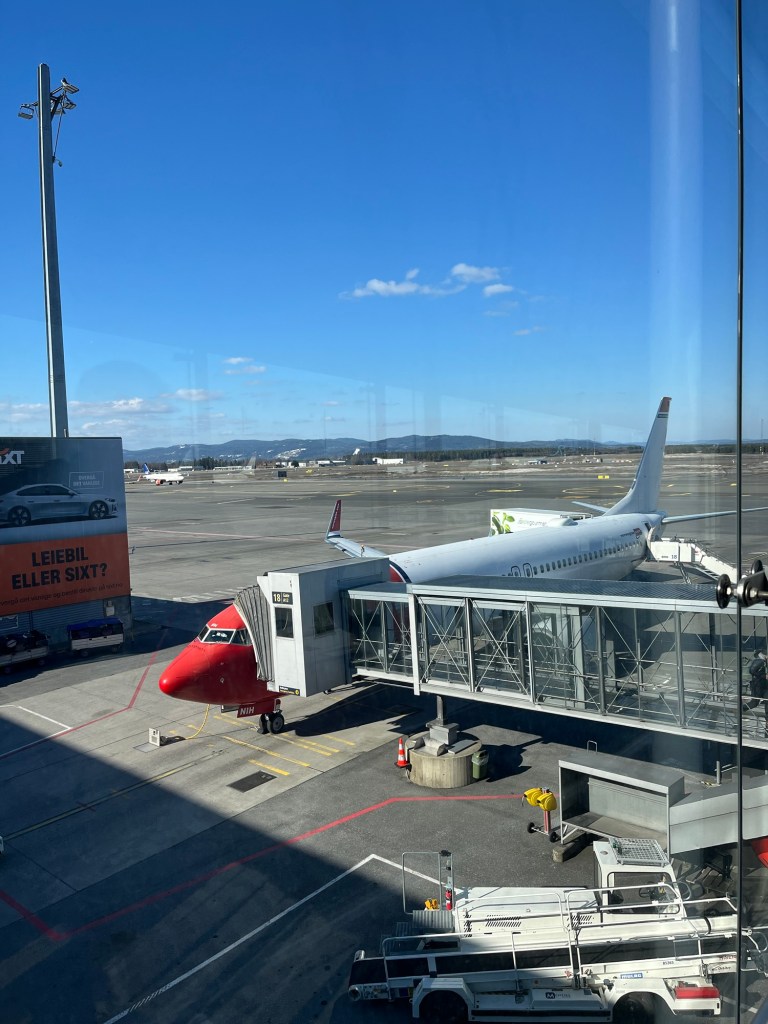
It all becomes a little clearer when the same counter agents from downstairs appeared to check in passengers for at least three flights. So it appears that three, maybe four, people are providing check in service and boarding services for a dozen airlines! I predict in the next iteration of cost cutting we will be self serving snacks (which you have to pay for on a domestic flight) and possibly serving as co-pilot.
-
Chasing the Northern Lights: Travel Goals
One of the best reasons to come to Norway in winter is to see the Northern Lights. We brave the cold and the snow. We take a boat up the coast far beyond the arctic circle. We encounter six nights with low clouds and wind and snow. With only one night left, we sign up for a light “chasing” tour guide. Honestly, I don’t hold out much hope because it is still very cloudy.
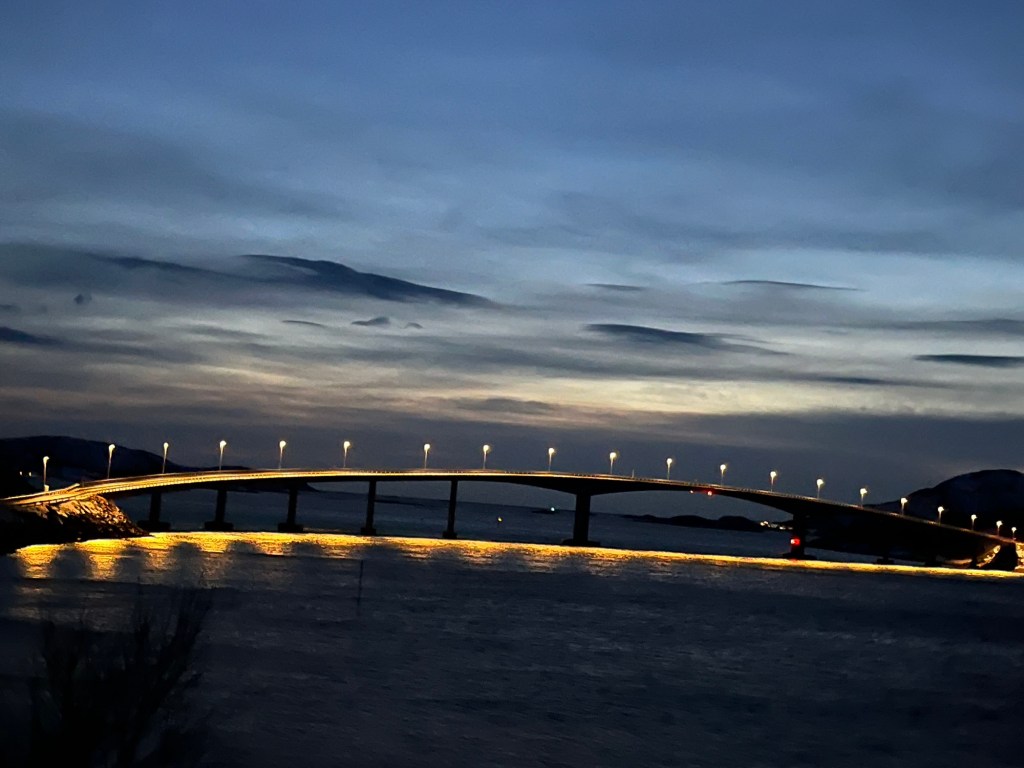
We meet our guide, a French man named Matthieu, at the cruise terminal. About twelve people set out with us in a van. A French guide with a Polish driver escorts Americans, Japanese, Brazilians, and Canadians on an international quest to find the lights. I am not sure how to feel when Mattie announces that we will be heading toward the coast to “wait out the clouds” and “see what happens”. He explains that tonight isn’t really a chase, but rather a waiting game for the clouds to break along the coast. I read earlier that the best chance to see lights was to go inland to Finland, and we had even been encouraged by the “find your guide” organization to bring the passports in case we were stopped in Finland. Now, our guide decides to go the opposite direction to the coastal islands. I am skeptical.
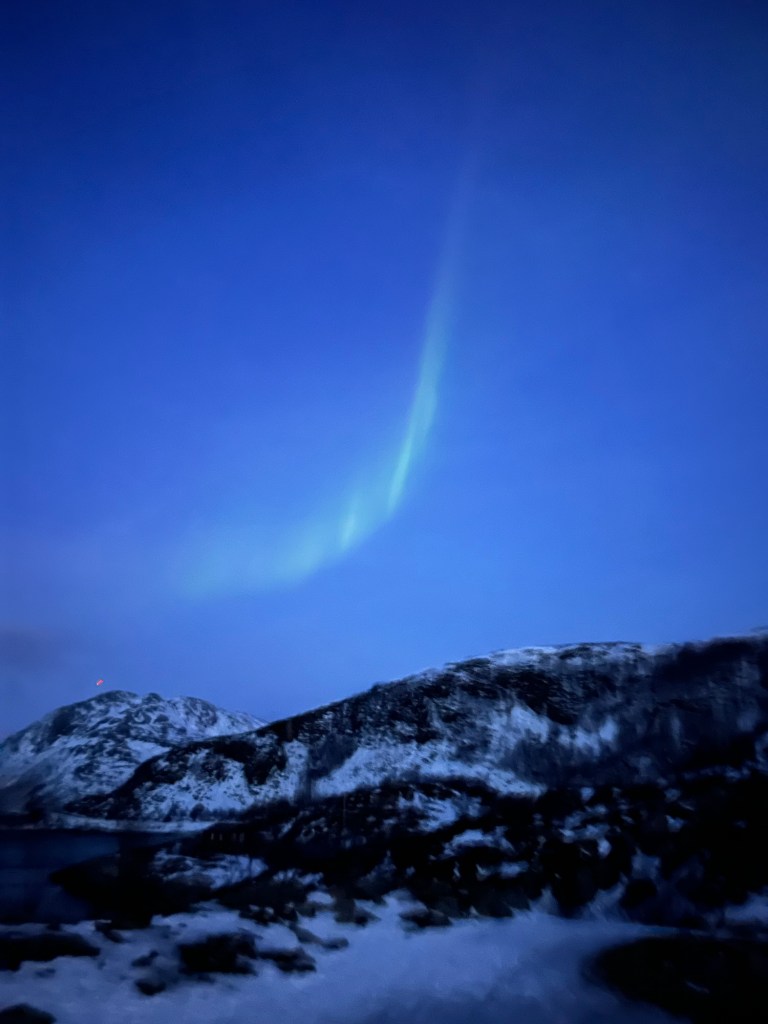
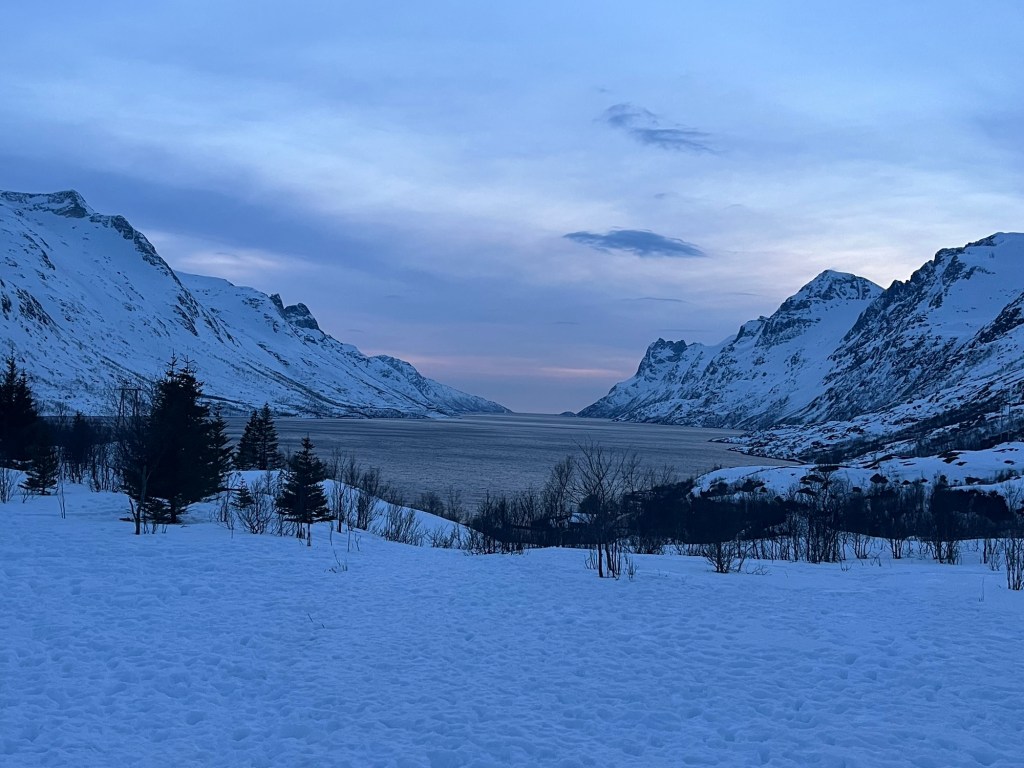
First we stop at a fjord just before dark and it is truly beautiful. Even if we don’t see lights, the scenery is spectacular and worth the price of the guide. Back in the van, we drive over the mountains, around fjords, and to a sheltered spot along the fjord on an island. We are barely out of the van standing in the lingering daylight when Matthieu tells us to look up. The lights have appeared.
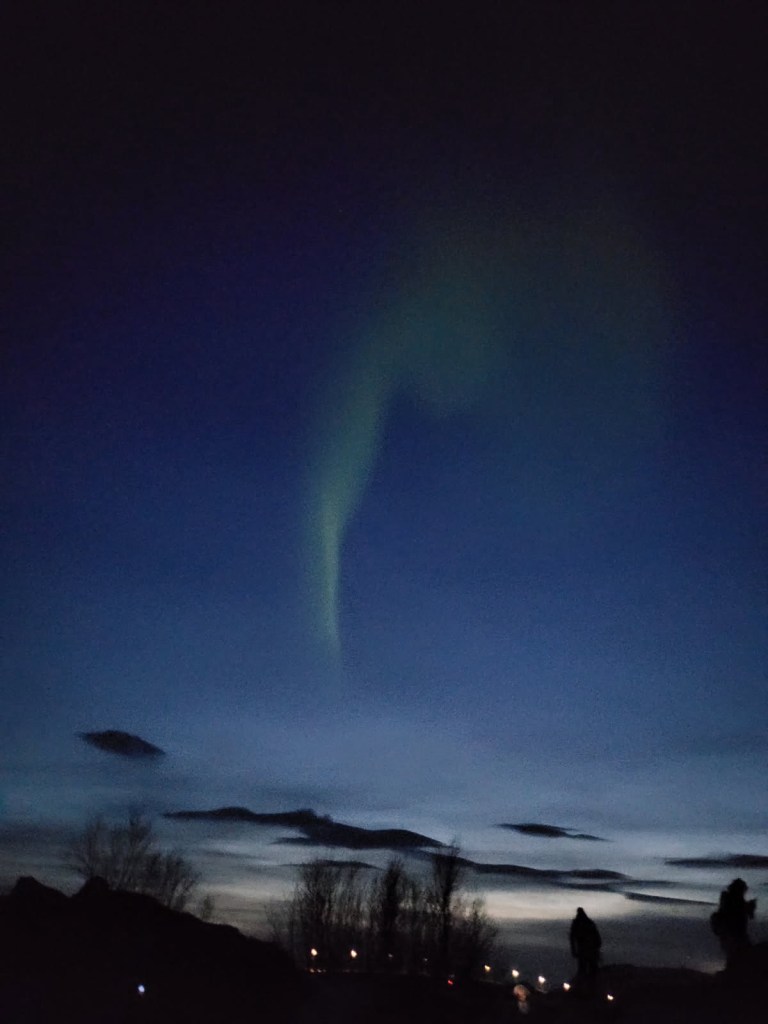
It is thrilling, those first glimpses of colored streaks of light. At first they almost look like thin contrails. I realize that our guide knows his business as the light grows brighter and begins to bend and stretch. I don’t know where to look and find myself turning circles to monitor the sky.
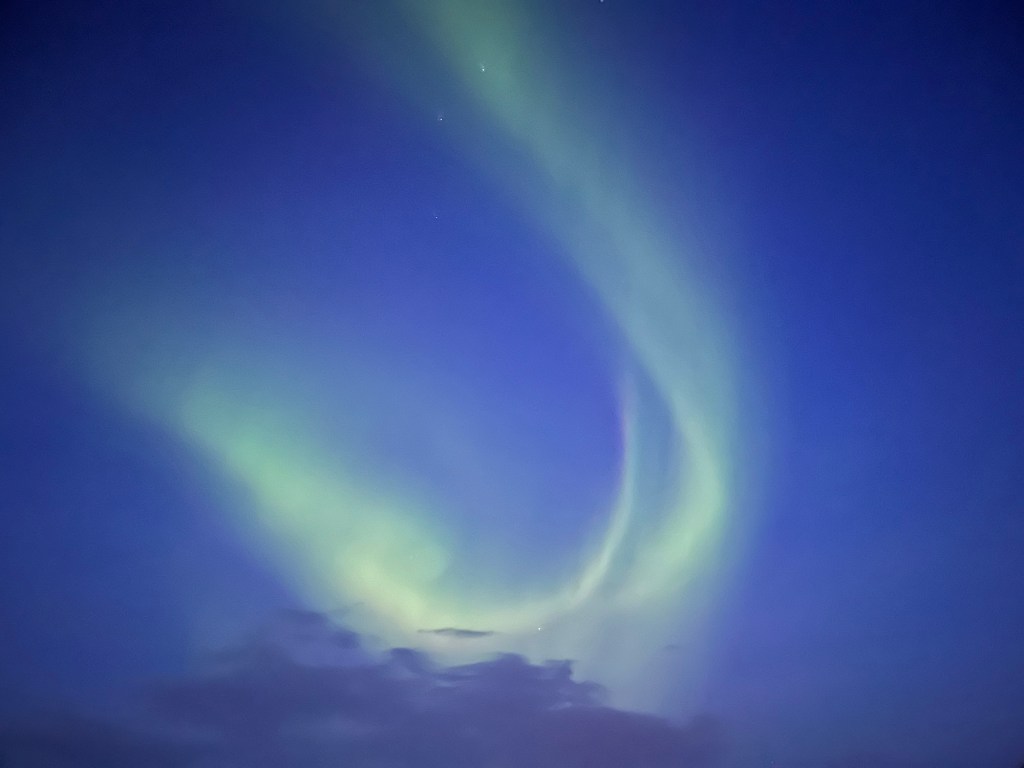
I make my way down to the water. Halfway down the hill, the snow gives way and I fall up to my knees in a snow bank. I lose a crampon spike , but luckily a fellow traveler retrieves it. I don’t care, I am only looking up at the incredible light show. Once I am safely on the beach, I find a rock to serve as my lounge chair. The show just keeps getting better. It strengthens until it disappears momentarily, and then strengthens again.
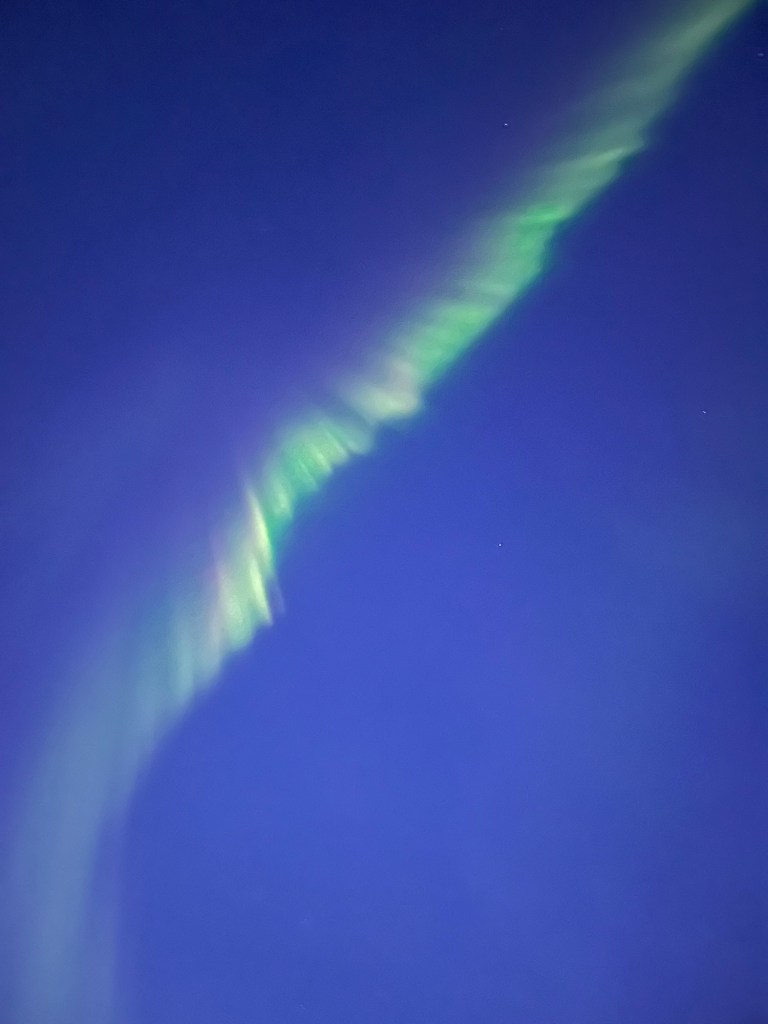
It dawns on me, that a six hour northern lights expedition means two hours travel and four hours sitting in the high winds and cold …..On a rock….in snow….. ice…..by the arctic ocean. I pull my parka tighter and listen to the peaceful sounds of the water against the shore. I strain to see anything that might be the lights. Our guide sits silently and patiently. He tells us that we are lucky to have a warm night. He says that the wind feels much colder when the temps are several degrees below zero. I am very thankful that I purchased an eider down coat for the trip. Only my feet (close to the ice) are cold (despite two layers of wool socks).
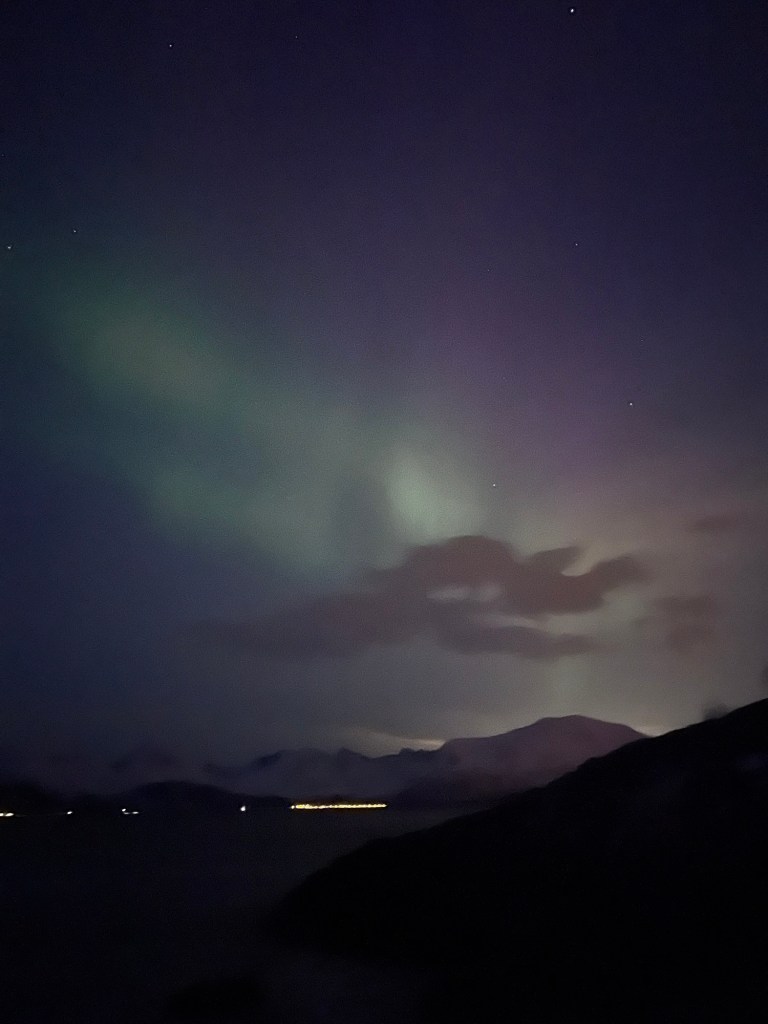
When the lights come to life, I forget to be cold, but there are long stretches in between. We have some hot chocolate and get in the van to warm our frozen phalanges. After a short stay, it is back to the wind. To experience the lights you have to be in the dark open sky. When it seems that my toes would snap or my camera would explode from too many snaps, we load the van to head back to Tromso.
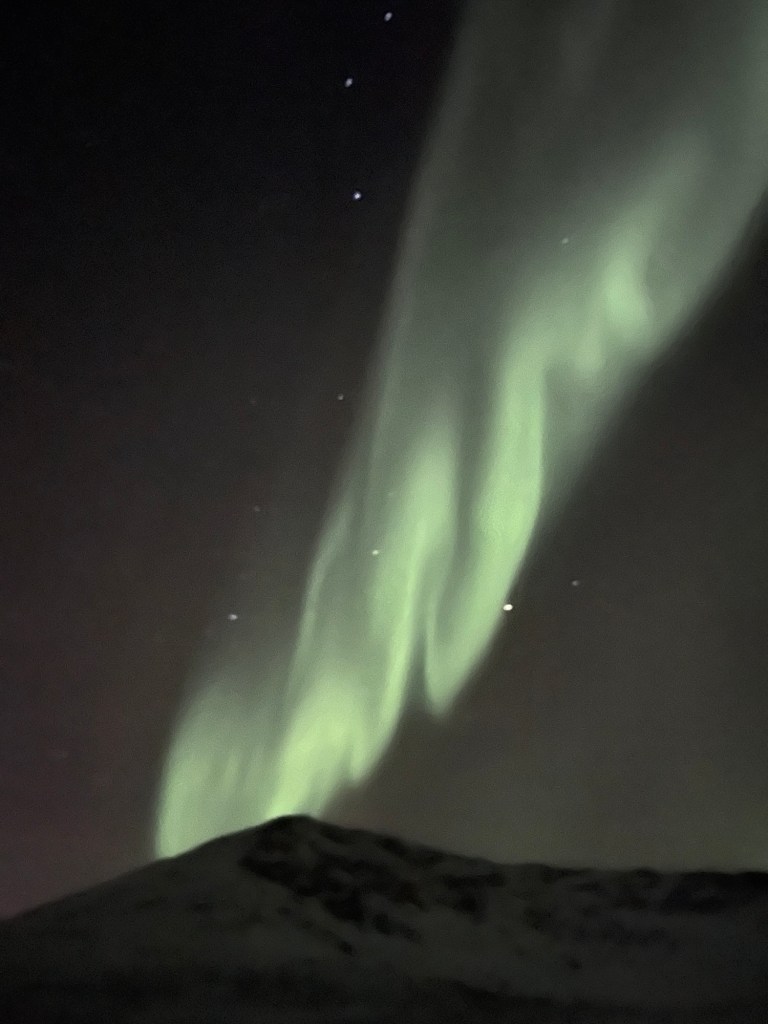
In between mountains in a completely uninhabited area, we pull into a parking lot and hurriedly exit the van. The guide spots an explosion of light and stars. He is yelling in excitement. It looks like spotlights are shooting off the top of the mountains. The lights dance and glow. There are thousands of stars…Spirals of light and stardust. Magical. Ethereal. On the last night in the Artic, the heavens put on a show I will never forget. I am breathless and joyful. We chased the lights and caught them. They will always live in my memory.
-
Accidental Tromsø: Travel Goals
Some days you just stumble onto fun. We are walking to the polar museum, but run across a house that says restaurant and museum. So, of course, in we go. There are no people. None. A self pay machine let us in. The building has been a warehouse on the dock. It houses a fun collection of Sami cultural artifacts, fishing artifacts, tools, and films about the Northern lights. Nothing flashy, just lots of interesting objects up close and personal. There are only six people in the place, none of us work here.
I am trying to imagine a scenario where a museum in the U.S. would trust you to let yourself in and behave yourself among the artifacts. We take our time and enjoy the collections.

A few doors down, the polar exploration museum is crowded with tour buses. Yuck! I hate crowds and tour bus crowds aren’t always the most pleasant tourists. So we keep walking across the bridge where other tour bus tourists are paying $100 plus apiece to don a wet suit and float in the bay for 20 minutes. Seems like a strange way to spend your money, but nobody asks me. I happily keep my opinion to myself. If they are happy, then money well spent. We wander around the harbor and take a walk on an icy and windy causeway. This is only happening because I feel confident in my new ice crampons.
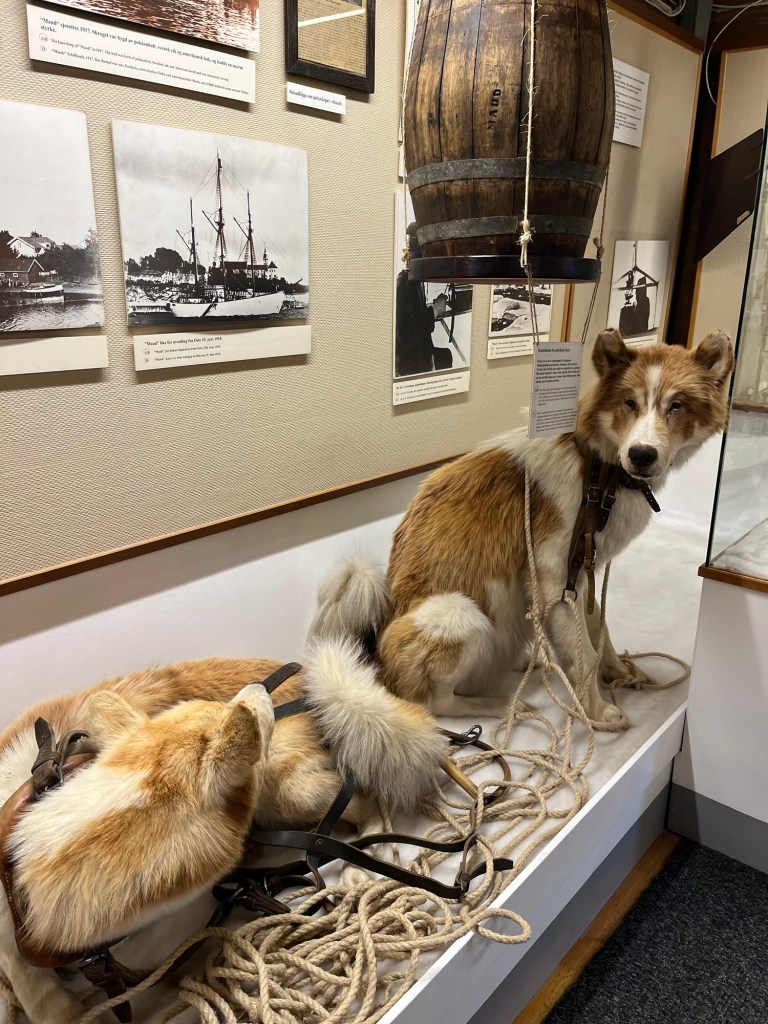
Eventually we head back to the polar museum. It is still busy, the the three big buses are gone. Inside, artifacts from many polar expeditions including the Fram (an early expedition to the North Pole with connections to Tromso) are on display. There are recreations of cabins, stuffed animals, and numerous artifacts from life at the arctic. The small museum seems a little crowded for the number of people, but the exhibits are interesting. I try not to be bothered by the five, seven foot tall dudes who keep surrounding me as I try to read the interpretive signs.
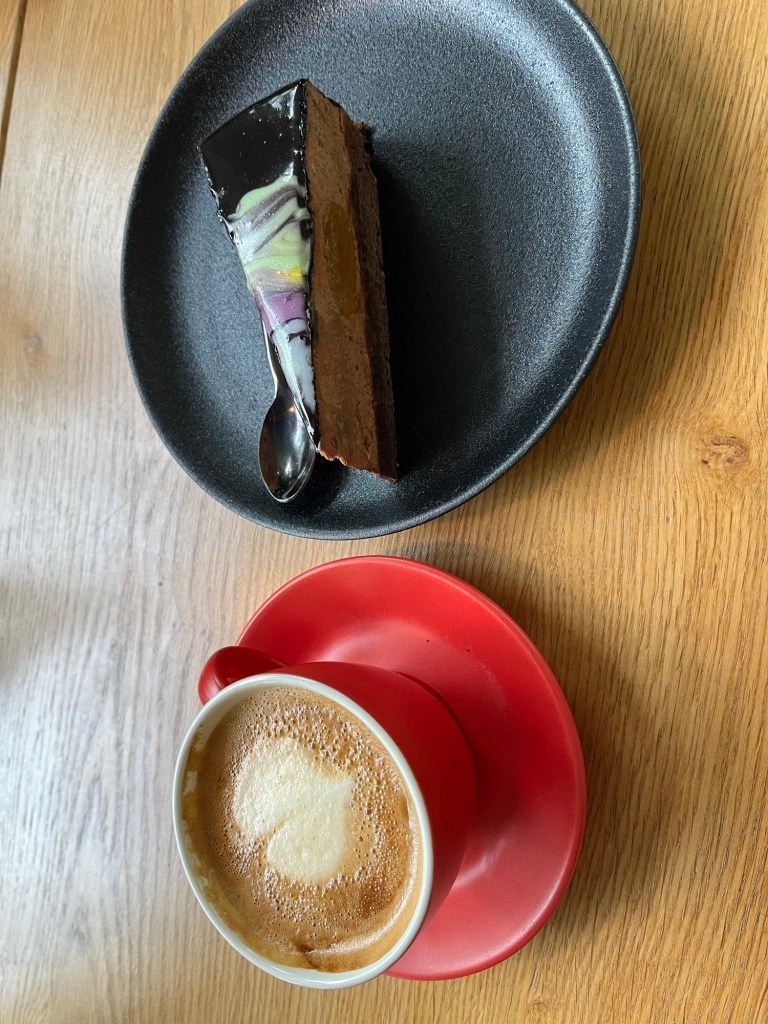
After the harrowing tales of adventure, we are hungry. We are not yet ready for a full meal so we find a shop with cake and coffee. It is full of locals enjoying their weekend. The best kind of place, tucked away from tourists, a hidden gem.
The northern lights cake with a caramel center certainly make my Saturday. But it is weird that I have to ask for a computer chip tag to take downstairs to the mall bathroom. I place the chip on a monitor, and wait for the access code. Norway is very protective of their toilets. At least I didn’t have to use a credit card to use this one.
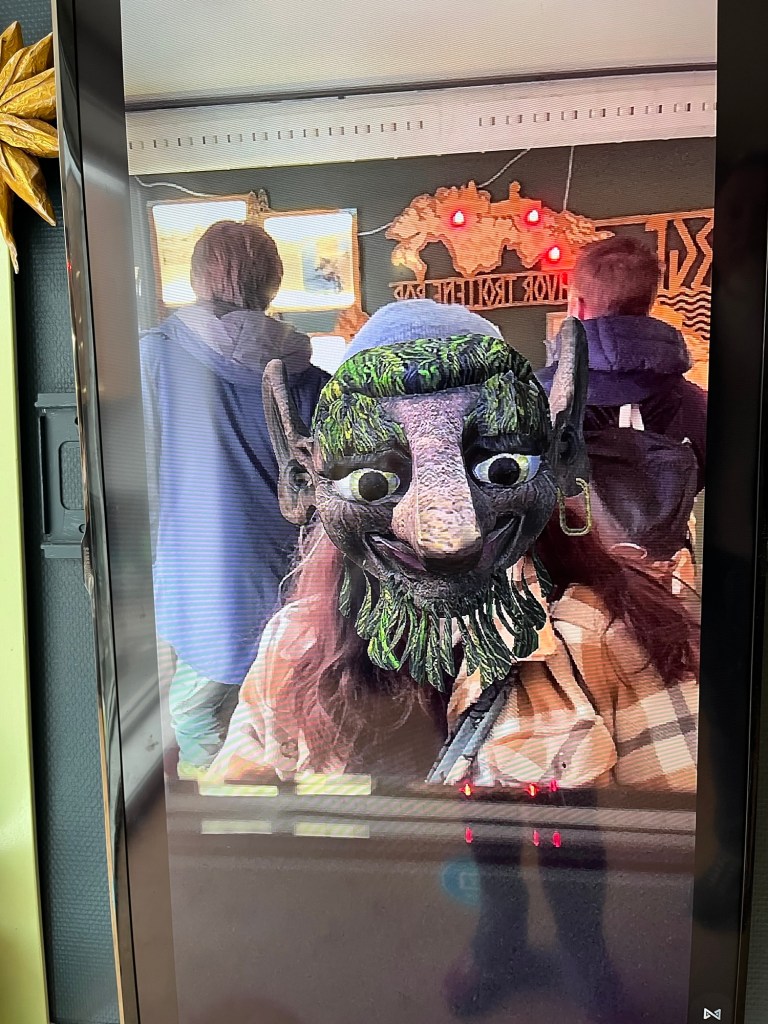
Refreshed, the next crazy adventure involves a lot of trolls. We wander into the Troll museum attraction on a lark. The ticket seller sounds Irish, so I ask what county he is from. He says,Carlow. I say “we rented a house in Rathvilly not to long ago.” He says “my Dad is from there!” I say, “it was beautiful. We love it there, a perfect place to hike.” He says “thanks for giving me perspective. Maybe it isn’t a fecking shitehole after all.” That is when I know he really is from county Carlow. The Irish always make me smile.
The Troll museum is fun and interactive. It highlights the Norwegian tales of trolls. Water trolls, stone figures, sirens, and mountain trolls abound. It is cheesy, corny, and all the other adjectives you can think up. Yet we kill an hour having fun and playing like children. We move sand to create a troll habitat, become trolls through the magic of virtual reality and take photos with trolls.

Eventually we have to eat a real meal and opt for Chinese. The restaurant is beautiful and the food is spicy and fresh. Anywhere in the world, we can always count on pizza, Chinese, and an Irish pub.

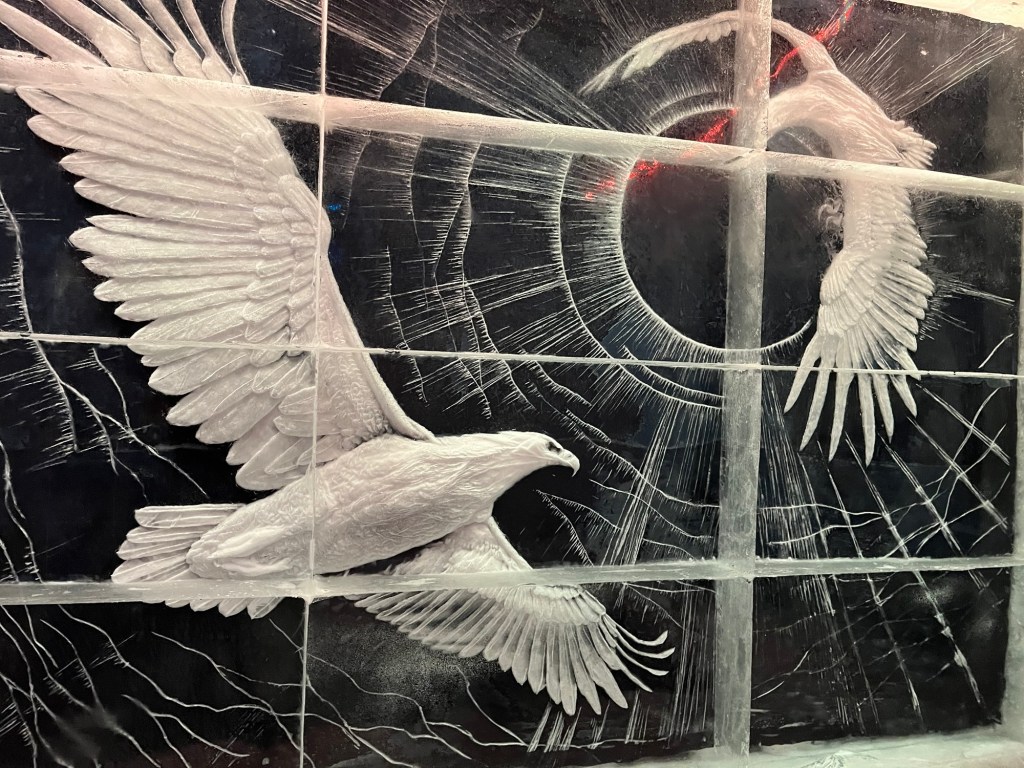
What you can’t usually find everywhere is an ice bar. We pay to enter and Magic Ice Tromso gives us a heavy arctic overcoat for the -4 c experience. The rooms are all made of carved blocks of ice. Music makes us dance. My husband isn’t usually much of a dancer, but he needs to stay warm. Even the welcome drink is in a glass made of ice. Reindeer hides allow us to sit on blocks of ice or even an ice throne. It made for strange but luxurious comfort. We couldn’t stay long, but it was unexpected fun. When in the arctic, always say yes to an icy adventure. Which is why we reluctantly leave the ice bar and head to meet the guide we hired to help us find the Northern lights.
-
Traipsing through Tromso: Travel Goals

I am up early, charting our course. The sun is shining and the snow has stopped, at least for now. It is a beautiful day for exploring the arctic town of Tromso. We start our day at Polaria aquarium, solely based on the fact that it was one of the few places open earlier in the day.
Walking to Polaria from the bus station, we notice that Main Street has heated sidewalks so most of the walk is clear. In some areas, though, we navigate several inches of ice and snow. The streets are not heated and icy, so crossing traffic is interesting. But eventually we make it across town unscathed. Walking downhill to the entrance was more like a slip n slide.
We arrive just in time for the feeding of the seals. Long whiskers and expressive faces make the seals extremely popular. They swim and eat fish with abandon, oblivious to the watching crowd. Dozens of onlookers watch as they are weighed and perform training behaviors as part of wellness checks. Afterwards, they eat the ice that preserved their fish. I tease my husband that they may be related to him (white bearded, ice loving, and mischievous).

Polaria has great aquarium tanks and interactive technology. We spend a few hours learning about arctic wildlife. We play interactive games that teach us about food chains and habitat. Climate change maps encourage more responsible behavior from all of us.
After all that play time, we need nourishment, so we head across the street to the infamous Mack brewery pub, Ohallen. Founded in 1877, Mack’s claims to be the northernmost brewery in the world. The interior is warm and has a nautical vibe. It is warm and cozy, therefore a great place to rest.
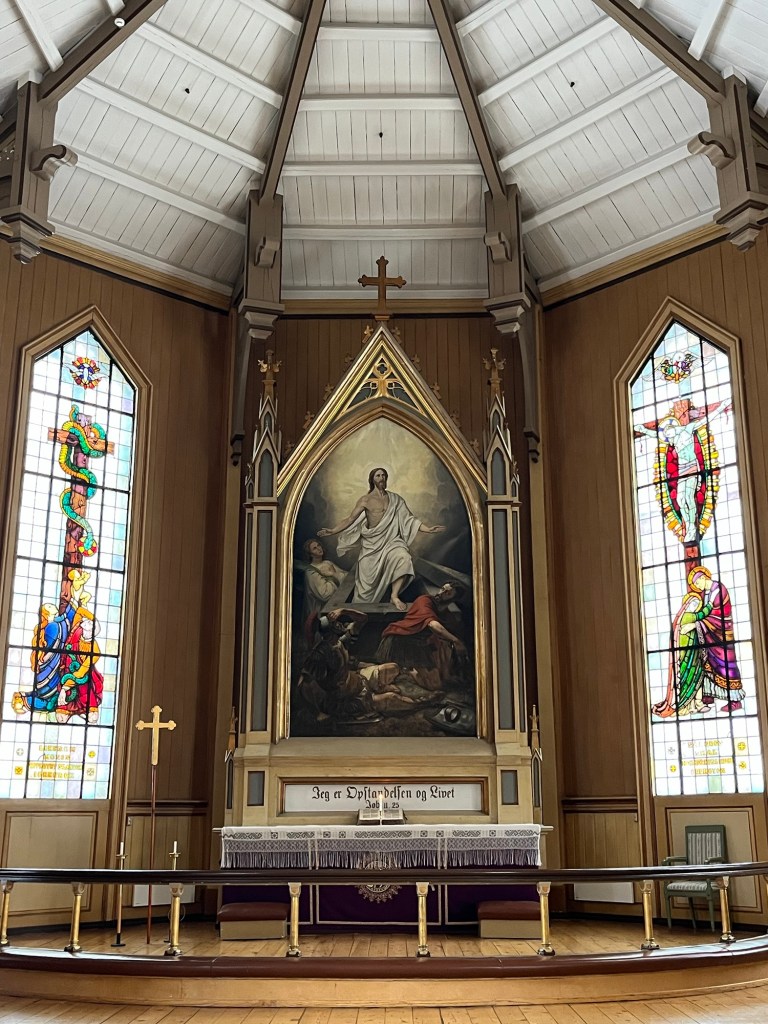
Just down the street is Tromso cathedral. Situated on the main square, it is a hub of tourist group activity. Tour groups came and went with regularity. We step inside and find a quiet sanctuary. The simple wood interior and clean lines direct attention to the altar where Christ ascends in a somber portrait. The centerpiece is flanked by two stained glass windows. One window depicts a serpent twined on a cross. An interesting choice for a Christian house of worship.
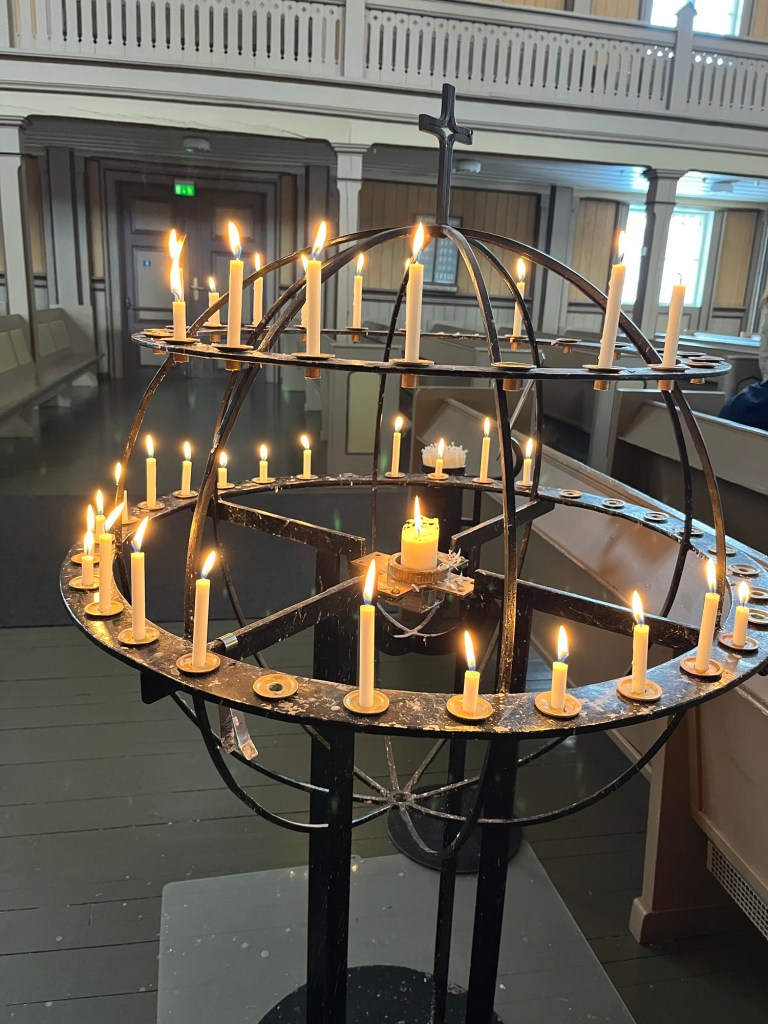
At the back of the church, an illuminated globe provides opportunity to light a candle in prayer. Nearby, a tree for Ukrainian peace is hung with paper doves. Next to that, we are invited to decorate a tree with tied colored strings for world healing. I linger awhile to send my prayers and tie my string.

A pedestrian only zone across the street from the church is lined with interesting shops and restaurants. While it isn’t exactly crowded, a surprisingly steady stream of tourists and locals line the walkways. I am sure that I would not like the summer crowds.
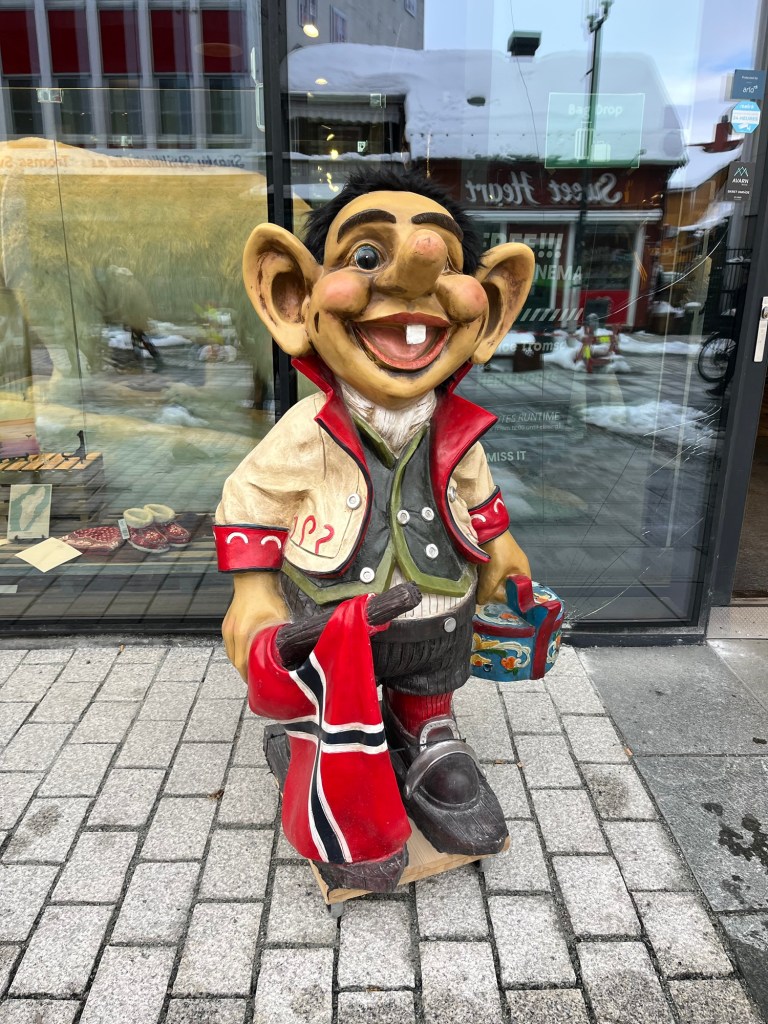
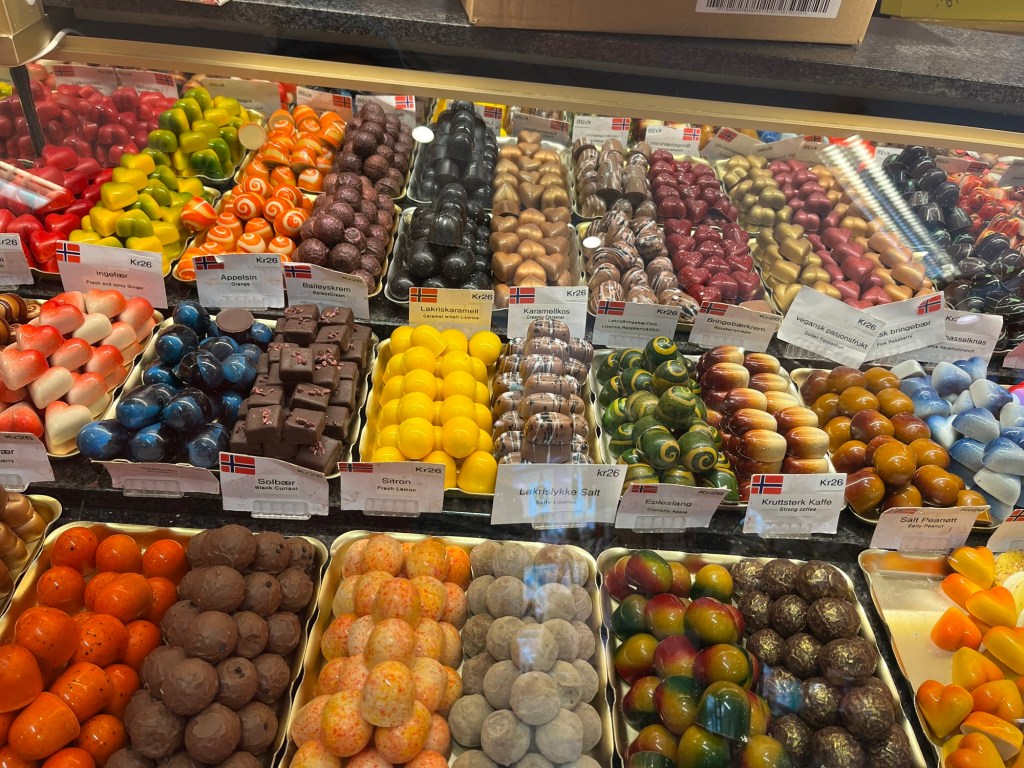
After unsuccessfully shopping for souvenirs (things are too expensive), I do buy some crampon spikes to slip over my shoes. I am tired of slipping on the ice. They work like a dream. After my big purchase, we stop at a chocolate shop. I buy a chocolate lemon macaron. My husband gets his bag of chocolates. The candies are beautiful works of art. I almost hate eating my lovely macaron….but not enough to keep me from wolfing it down.
Revived from our snack, we take the bus across the bridge to the Arctic Cathedral. I have been looking forward to this all day. It is one of the things I most want to see in Tromso as the stained glass and architecture are highlighted in the articles I read to prepare for the trip.
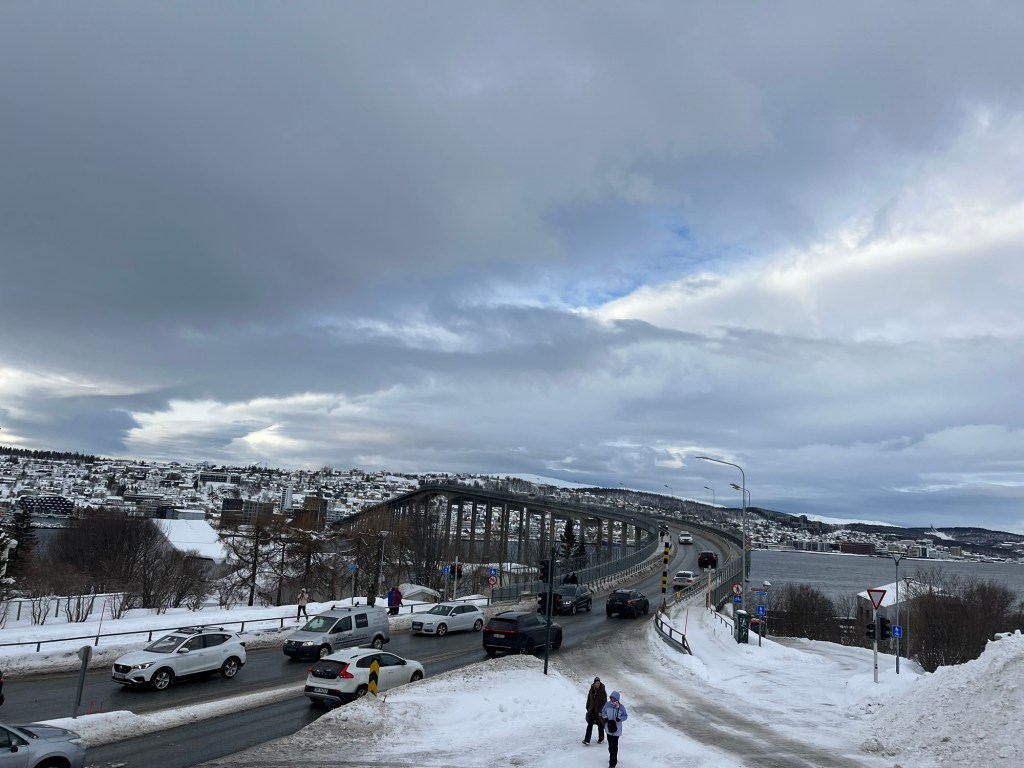
The views from the outside are spectacular. The bridge, the fjord, and the mountains make a spectacular backdrop. My spikes make the climb up the hill so much easier. I am no longer worried about sliding headlong into traffic as I walk along the ice covered roadways.
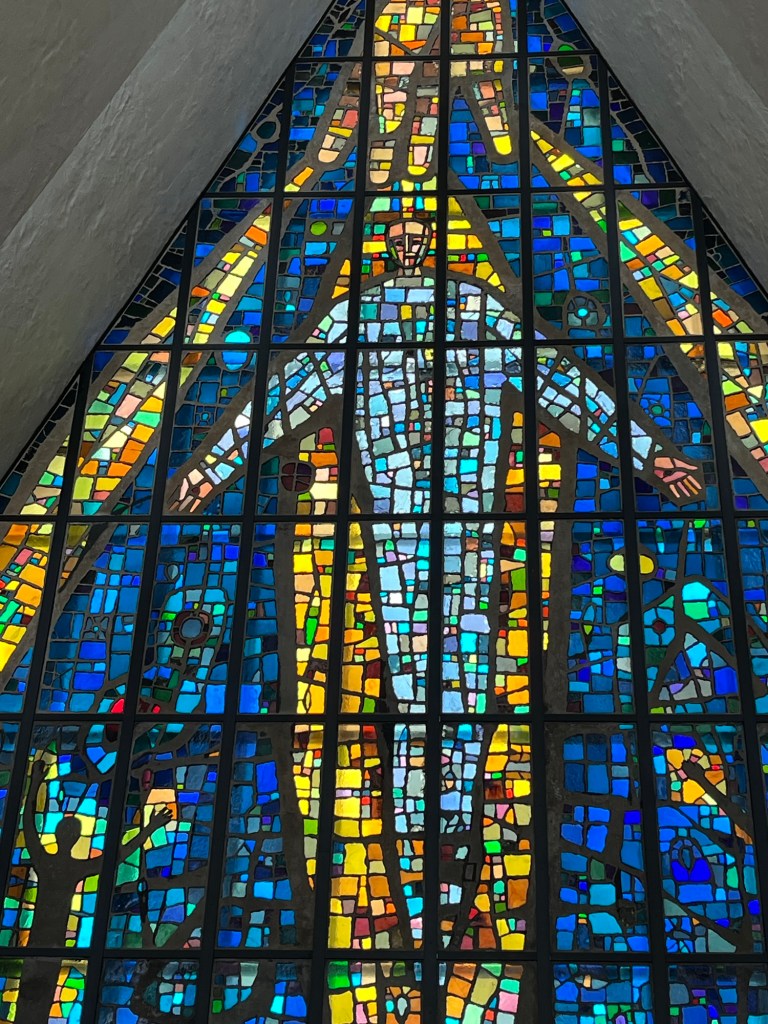
The entrance to the church is $8.00 (800 NOK). It seems silly to charge entrance to a church, but there are likely maintenance costs so I happily pay. Happily, until I enter. The “cathedral” is only a large, plain white room. The pews are reminiscent of my 1970’s childhood. There is a large stained glass window at one end but the view is obstructed by three modern chandeliers. I walk to the front and kneel down to see the glass.
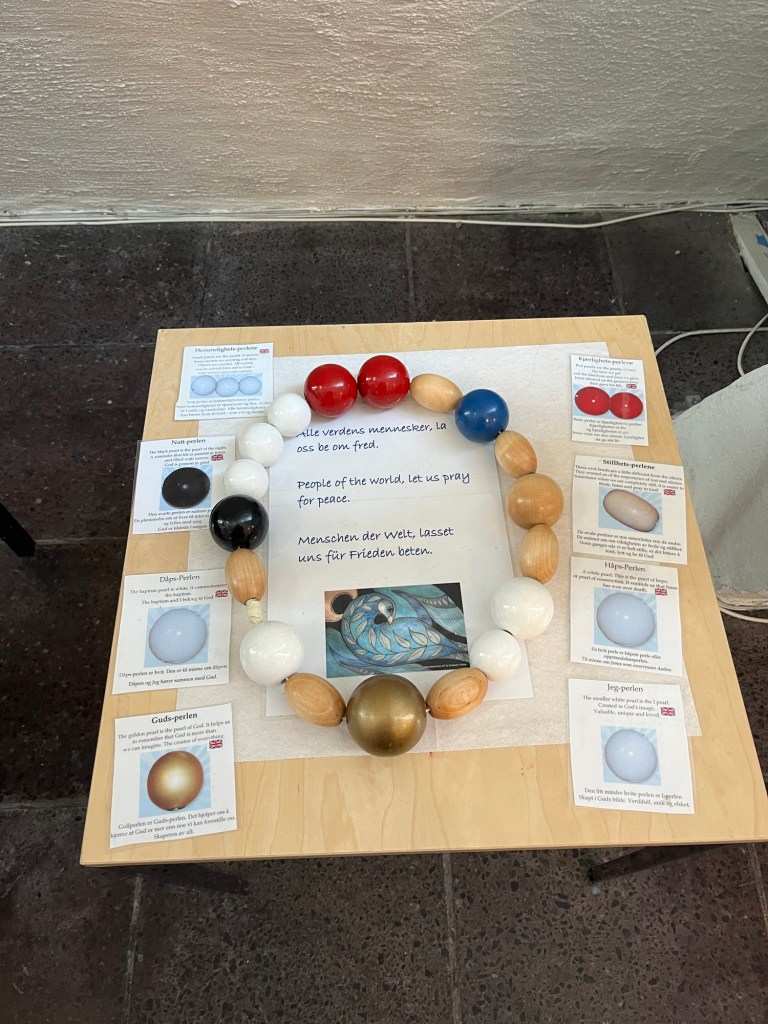
My husband says he feels robbed and I agree. We have been in the church exactly two minutes and have exhausted the view. I find an interesting prayer circle in the back of the church. The colorful wooden beads suggest different prayers. After several minutes, I see a sign that says photo display and restrooms. I figure that an $8.00 admission should at least cover a bathroom break (public toilets in Norway have been credit card controlled in many places). The photo display consists of a few framed photos of the Northern lights in a hallway by the bathrooms that otherwise looks like a locker room. Needless to say, as much as I love visiting churches, this one does nothing for me. It feels like a sterile, Hollywood soundstage, not a place of worship.
And so, we walk back down the slippery hill, get back on the bus, and ride all the way to our neighborhood. After the disappointing cathedral, I want to find a new adventure. So, I talk my husband into walking to a shopping mall nearby. At least we try to walk there.
The GPS keeps directing us to turn where there is no road. Upon closer inspection, I find footprints over an eight foot snow bank. Emboldened with my spikes, I climb the bank. I see what I assume is a park. Snow reaches halfway up the lamp posts. The tracks I can see are several inches deep. A no go without snow shoes. Ten minutes slugging through several feet of snow would surely take at least 30 minutes. It would also ensure we were wet and freezing cold. A snug evening at home with pizza and a movie suddenly seems like a great choice.
-
The Struggle: Travel Goals
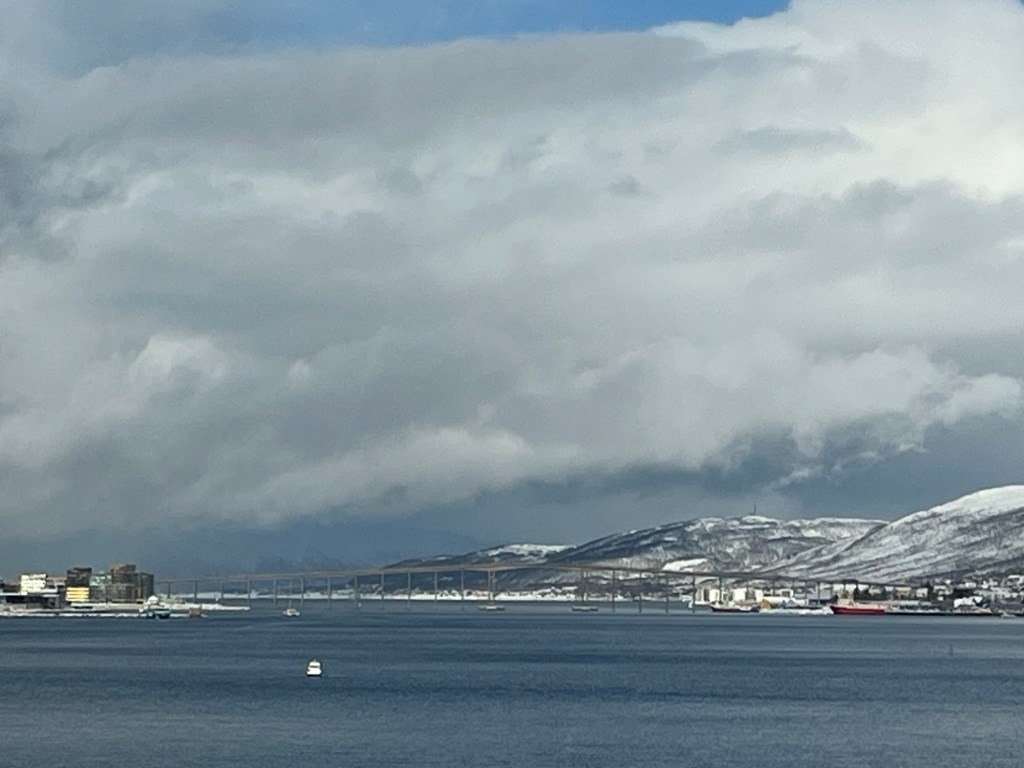
Excitement is high as we land in Tromso. It is beautiful. Mountains and fjords merge together under a cloudy sky. Dramatic is the only word to describe the landscape. Here we disembark.
We wait impatiently for others to leave the ship. Many only have a few hours to experience Tromso and we will stay a few days. So we wait until others have cleared the port area. The entry to the visitors center is locked. No one seems to know how to open it. We watch from an upper deck as men on radios consult each other and passengers are stranded in the snow between boat and entry.

Finally, we reach the dock. The port building is modern, with escalators, gift shops, visitor information, and a bus port.
After getting our bearings, we figure out that we need to walk to a bus station at wi-fi (the actual name of the stop). The 28 bus runs all the way to our rental house. The bus stop appears to be only a few blocks away.
It sounds like an easy walk, except the roads and most sidewalks are covered in ice and snow. My suitcase is too heavy to carry that far, and it is difficult to drag through snow drifts. We walk on, but I slide around on the ice like a drunken figure skater. My husband lends a hand as his shoes seem to be gripping the ice.
We finally reach the station and buy a ticket. There are a lot of people on the bus. We try to swipe the tickets, but realize no one else is. This is different than our usual public transportation experience. I wedge myself between a baby buggy and the wall. I don’t want to block the aisle with my backpack.
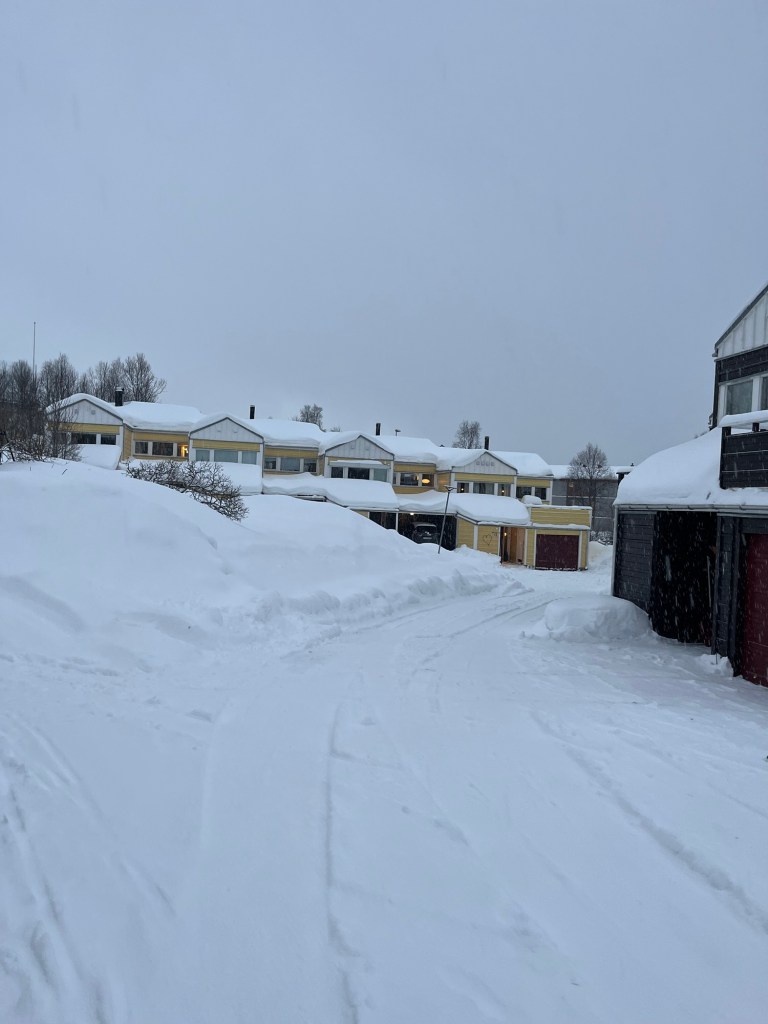
The roads are ice covered and snow banks several feet high line the roadways. Meanwhile on the sidewalks (which I can’t tell from the road), people ski, sled, cycle, jog, push baby carriages, and walk dogs. When you live in the arctic, the heavy snow is just every day life.
We stop at Klimavegen. The snow is thick. The gps tells me we have arrived at our house, but all I see are ten to twelve foot snow banks. We watch two teenagers climb the bank and walk down the other side. I think to myself that odds are good that I am heading back to a hotel if that is the only option of getting into the neighborhood. Luckily, the car entrance was actually plowed. Walking in only involved navigating up an icy hill. Two steps up. One slide back. But eventually we arrive.

Once inside, I feel like we are living in an IKEA showroom. It is small, cozy and comfortable. We unpack and soon realize we have no food. The gps shows a 10 minute walk to a shopping center. Unfortunately the path is through a park with eight foot drifts and snow/ice covered paths. Slogging through snow up to my thighs doesn’t seem like a great option.

After a brief rest, we head back to town to buy a few groceries. Breakfast and a few meals at home will save us from the expensive Norwegian restaurants. Groceries, while slightly more expensive than home, are a much cheaper option than restaurants which seem to be double or even triple the costs.
At end of day, we figure out how to use the tv (streaming only), the washer (settings listed in Norwegian), the heating, and the lighting (each panel has six flip switches, a circular dial, and a small button to push). We have to operate heated floors, outdoor vents, ceiling lights, accent lights, and a few things we can’t figure out.
The day has been a struggle, but in a good way. We are experiencing a different way of life. In the last few days we have conquered the elements, figured out how to best enjoy a ship, triumphed over snowy bus routes, figured out how to access a house hidden behind a wall of snow, and bought strange ingredients for meals (such as mash of cow…aka hamburger). Struggles make travel memories. And we are making a lot of memories. Into the arctic and headlong into adventure.

-
Into the Arctic: Travel Goals

I wake up quite early and realize it had been snowing through out the night. Steady sleet pounds the windows and I smile. Just as dawn breaks, I emerge onto the upper deck. Today we cross the artic circle and venture far beyond.
We entered the boat in Bergen and will not disembark completely until Tromso. Between now and then are many, many miles of snow.

We hear announcements that we are approaching the arctic circle. I have been prepped to look for a small globe to mark the spot. It is an imaginary line that captures my imagination. Polar expeditions. Ice boats. Polar bears. And the Northern Lights. I hope to encounter at least one.
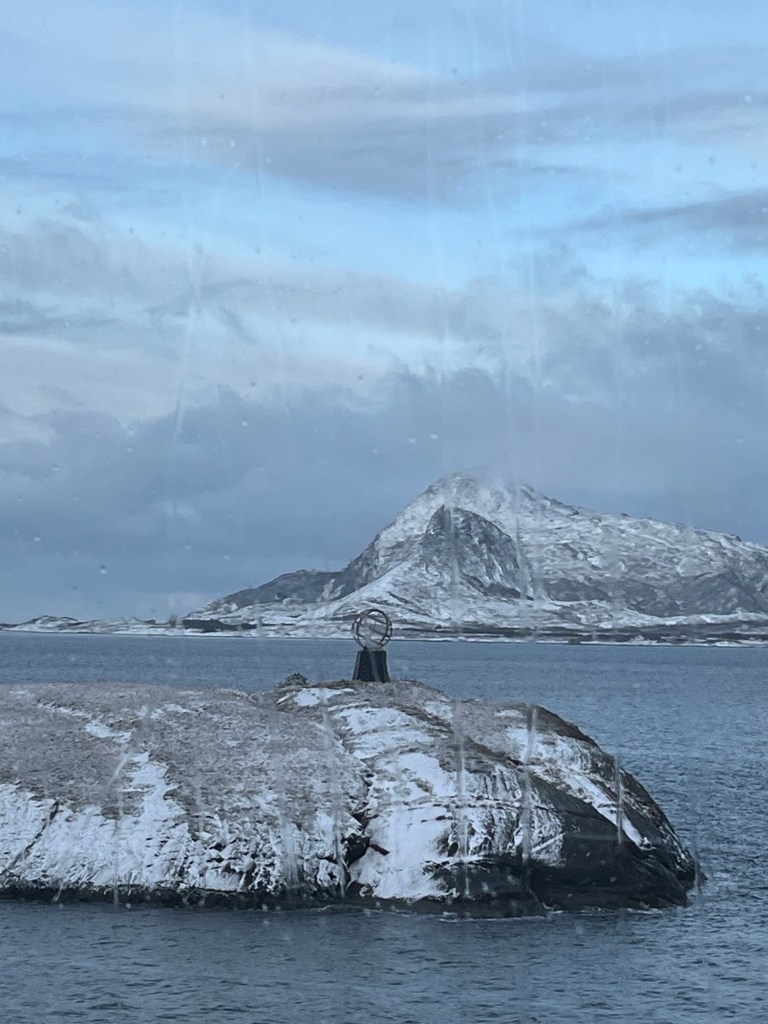
Shortly after the crossing, the ship Carrie out a ritual for all first timers. A sea creature appears on deck, a god of the sea who decides to bestow good luck after he pours ice water down your back. I decide to risk his displeasure and head back inside.
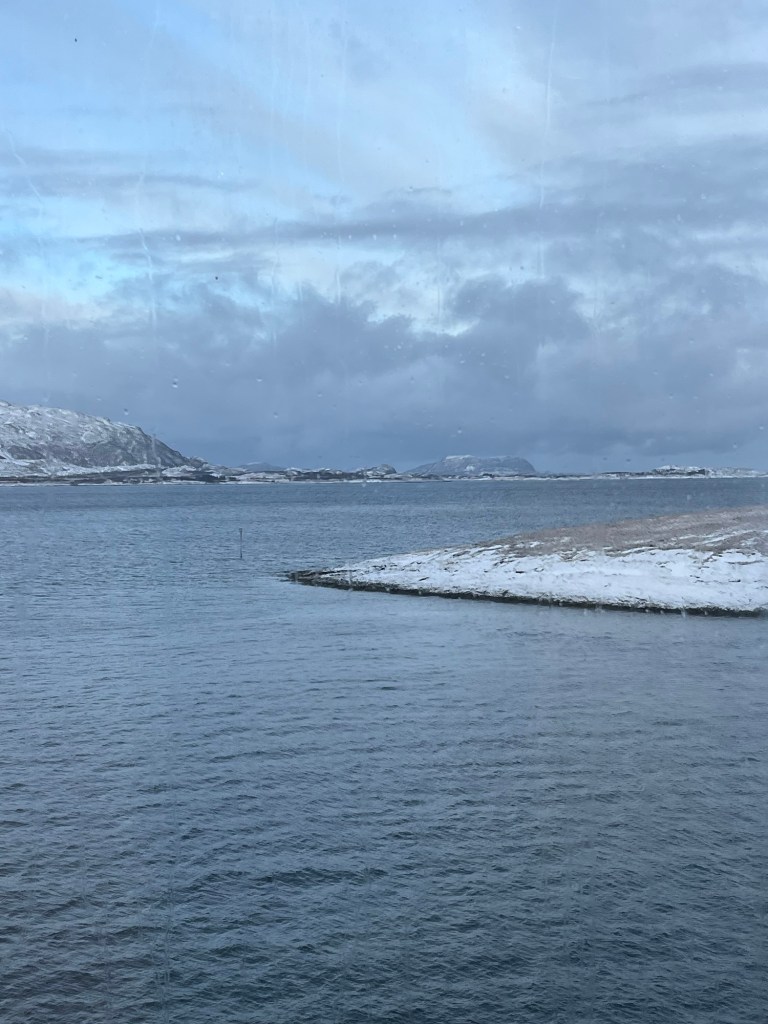
We sail on as the snow picks up and the wind howls. Eerily, there is no wildlife visible. No fish, no birds, no seals. It is barren wilderness all around. What happened to the animals? I have looked everyday for a fish. I have seen exactly zero.

We disembark in the heavy snow in Bodø. The town is small and non-descriptive. It had been completely razed by the Nazis. When it was rebuilt, it was functionality over aesthetics. Bodo is cold and windy. Snow continues to fall.
We walk into town and find a grocery store to buy snacks. I wander the mall to kill time. We find the high street and take pictures in the snow. I get excited when I find a Salvation Army fretex shop. I love the sustainability of resale. Each piece has a story to tell. I select a wool sweatshirt. I have a feeling I am going to need it. It is cold and wool is warm.
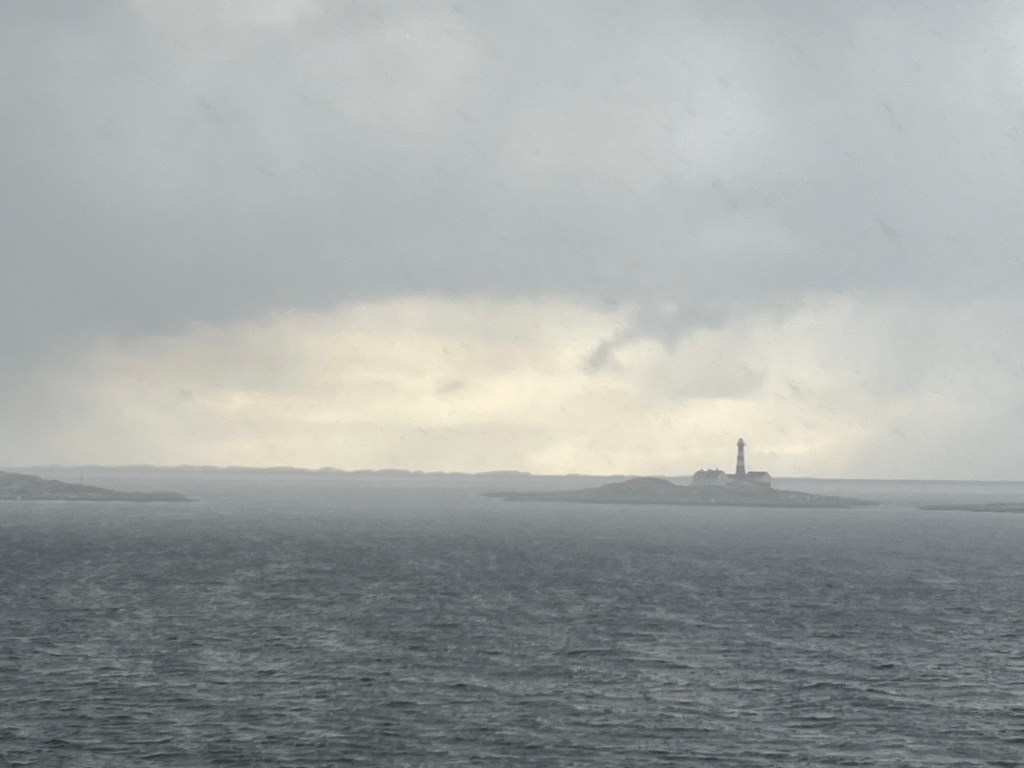
Back on board, we find a spot at the back of the boat to shelter from the stormy weather. It is on the outer deck, so we have a great viewing spot for photos of the shifting landscape. The clouds and the snow make a dramatic backdrop.

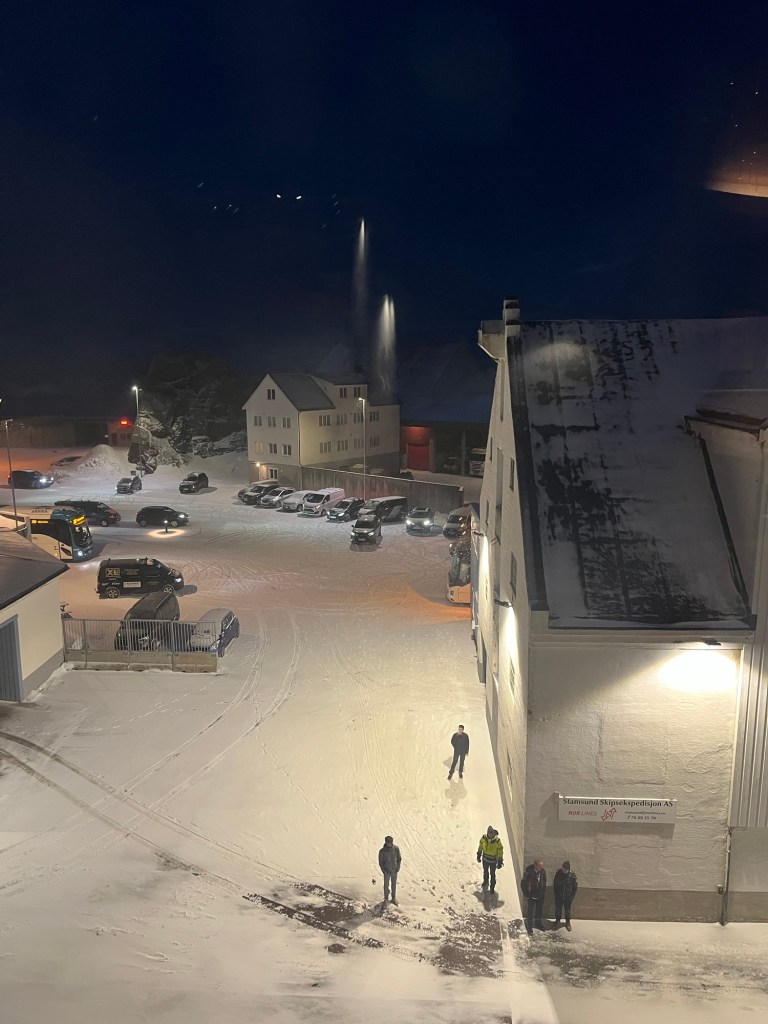
Dinner is a local feast of reindeer and klipfish. We enjoy the regional meal and then head to the game room. The sea is rough and we are bored. We play battleship. People that wander by, joke that maybe it isn’t the best game for the evening. Since it is the only entertainment available, we play on. It is slow going due to snow storms and rough sea. We reach Svolvær, there is no time to visit. Just a port in the dark and then we head for a dark crossing of the trollfjord. We stay up for the hot drinks and fish soup on the upper deck. But eventually, the bunk is calling. Tomorrow we arrive at our final destination and I want to be rested.
-
Travel Goals: Watching the World Go By

I love to be at sea. Early in the morning, I am often the only one on deck. As morning breaks over the water, at first only shadows appear. Slowly the landscape takes shape amid an orange glow. The waves are shadowy and alive.
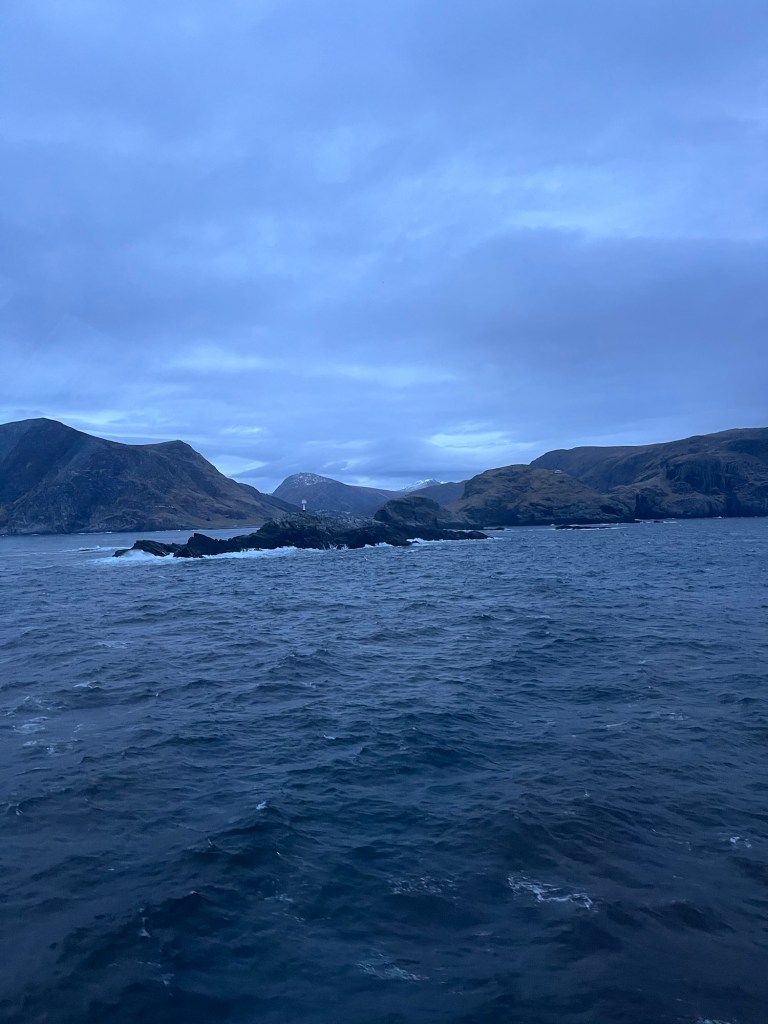
The air smells clean and the wind is brisk. It is silent and peaceful. Slowly, though, the boat awakens with soft murmurs as other early risers join the gathering. Eventually the peaceful morning is disturbed by the talkative ones. People who are never silent are a blight on the beautiful day….at least initially. I am always resentful of the intrusion on the beautiful sounds of nature and/or silence.

Once the ship is bustling and I am past my regret that the early morning couldn’t last. It is time for coffee and a little work. Perhaps a walk around the outside decks to get some exercise.
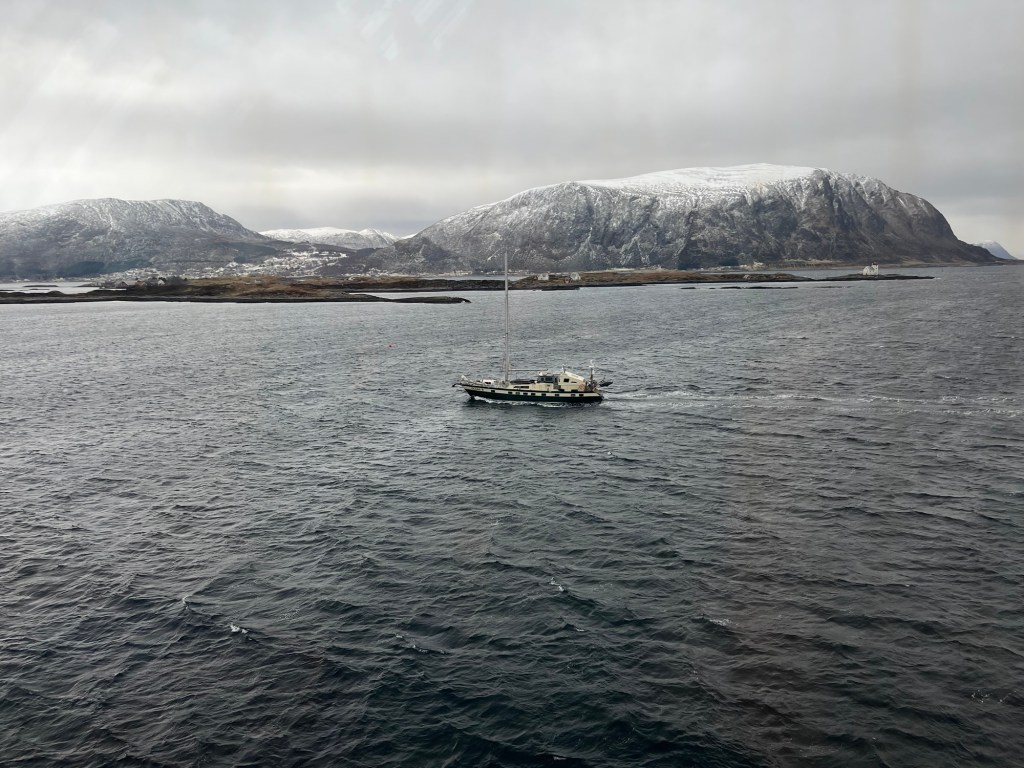
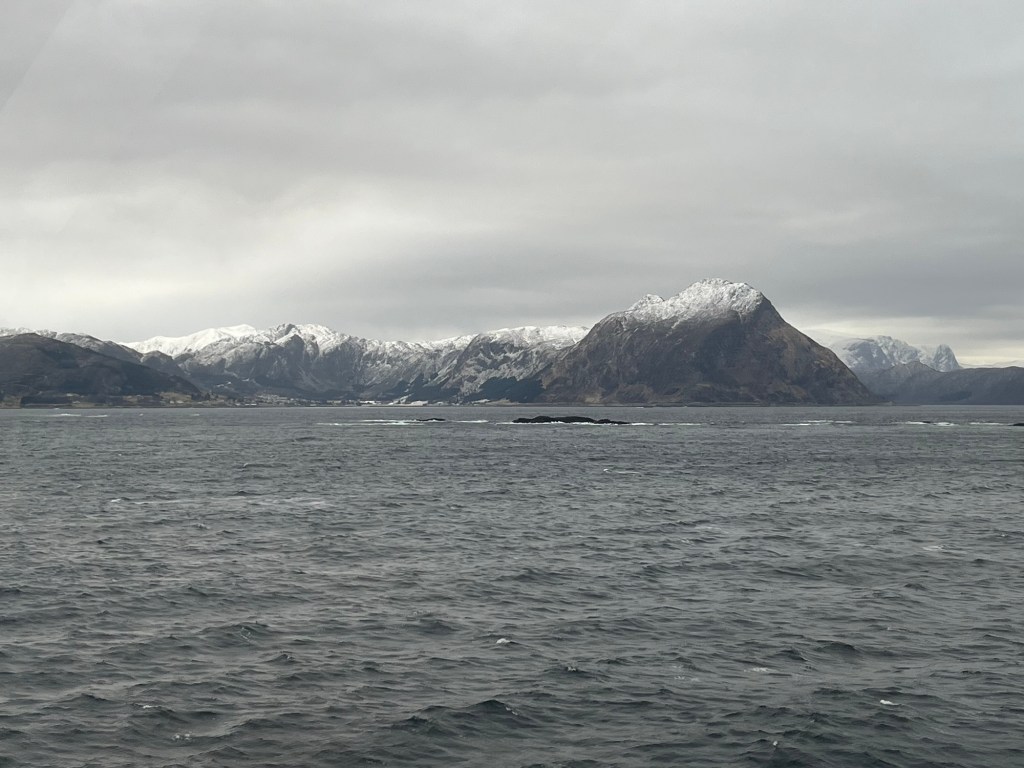
This boat is big, but not a cruise ship. It is comfortable, but there is not much to do. The common areas are clean and spacious and the outdoor scenery is beautiful when not obscured by clouds, rain, or snow. But after a few days, the beautiful mountains begin to look alike.
I try to work from a common room and a German tourist is upset because I took a zoom call near him. No matter that several others had done the same. I upset his peace and quiet. Not matter that I was there quietly working when they came and sat by me. He felt I should work in my cabin. The WiFi is not as strong in my cabin so that is not an option. My husband says it does sound loud.
I don’t want to disrupt someone’s peace, so I get up and work standing in a hall where the WiFi still works. The man is upset (I ruined his vacation peace) and I am also upset (I am working in a common room where I was sitting alone when they entered and taking a client zoom call.) I picked the spot because another man was doing the same kind of work when I entered. I avoided the quiet of the library and the observation lounge. No matter. Neither of us were happy. Maybe it was a clash of cultures… maybe he felt the way I feel when the loud talkers show up in the morning.

By the third day, I am a little stir crazy. The one organized program each day is not very informative, but it is the only diversion on offer. So I go hear information that is not that helpful or entertaining just to have something to do. At least they try. It is after all a cargo ferry.
We also struggle with food options. There is no where to get coffee until 8:30, and I have already been up for a few hours. Pastry is fine. I try to order waffles, but am told they only have enough batter for one. The good news is that they give it to me free of charge. Four days on board and the same limited menu is served each day with the same daily special. We can order reindeer sandwich, reindeer steak, fish, or a hamburger. While I like all of the options, eating eight meals with four choices is….well….monotonous.

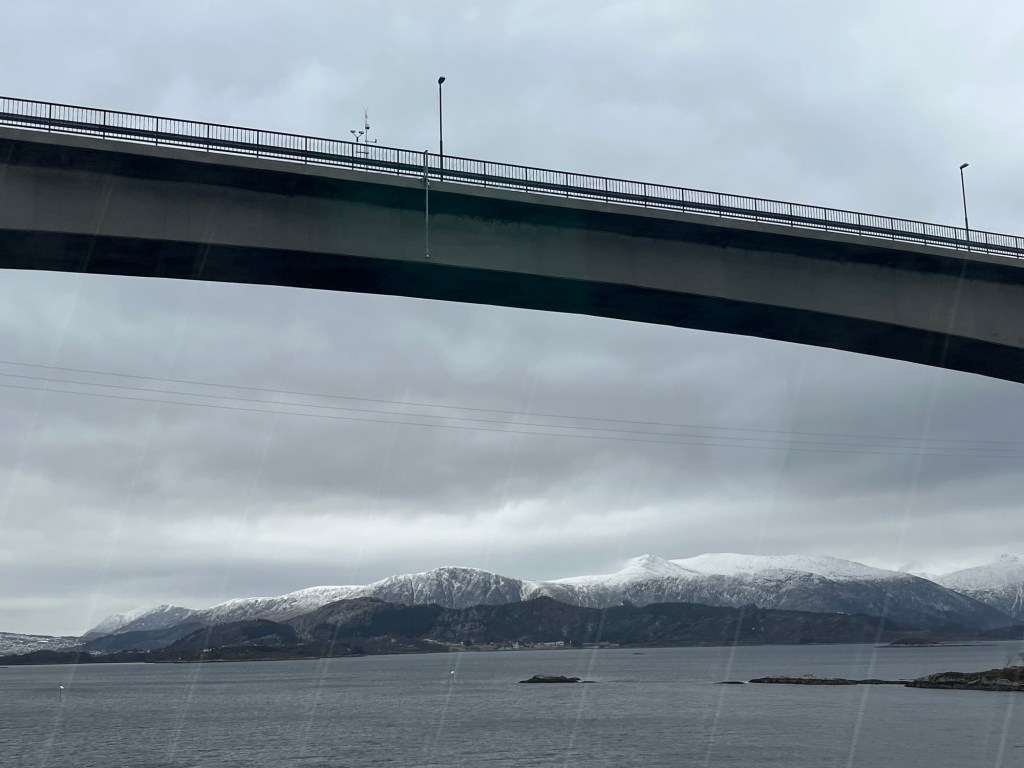
The daily excitement occurs as ports come into view. Most are 15 minute stops. There is not enough time to disembark or explore. But there is plenty of time to snap a few pictures of places I would likely never otherwise see. Peering over the railing, I can watch the dock hands and get a glimpse of a life far removed from my own.

By nightfall, I am ready to head to the library for a game of battleship or rummikub. After dinner coffee, signals the day is coming to an end. Retreating to the cabin, I climb into the top bunk and snuggle into the comforter. The rocking of the ship is better than a lullaby. There is something about the sea air….
-
Trondheim Pilgrimage to Nidaros: Travel Goals
We dock in the cold, cold rain. Coming down the gangway, the wind blows water into our faces. My husband struggles into his rain suit while I wrestle with my umbrella. We try to follow directions to exit the docks into the town. In the blowing rain, it is unclear which way to go, so we pick a direction and take our chances.
At a fork in the road, the signs seem to contradict each other. We again follow the old adage, “when you come to a fork in the road take one”. Eventually we exit an alley between buildings and emerge between the waterfront and train tracks. The wind and rain pick up as we climb stairs to an overpass walkway into town. A small bridge gives a picturesque view of the small boat harbor. But it is too windy to linger or my umbrella may break.
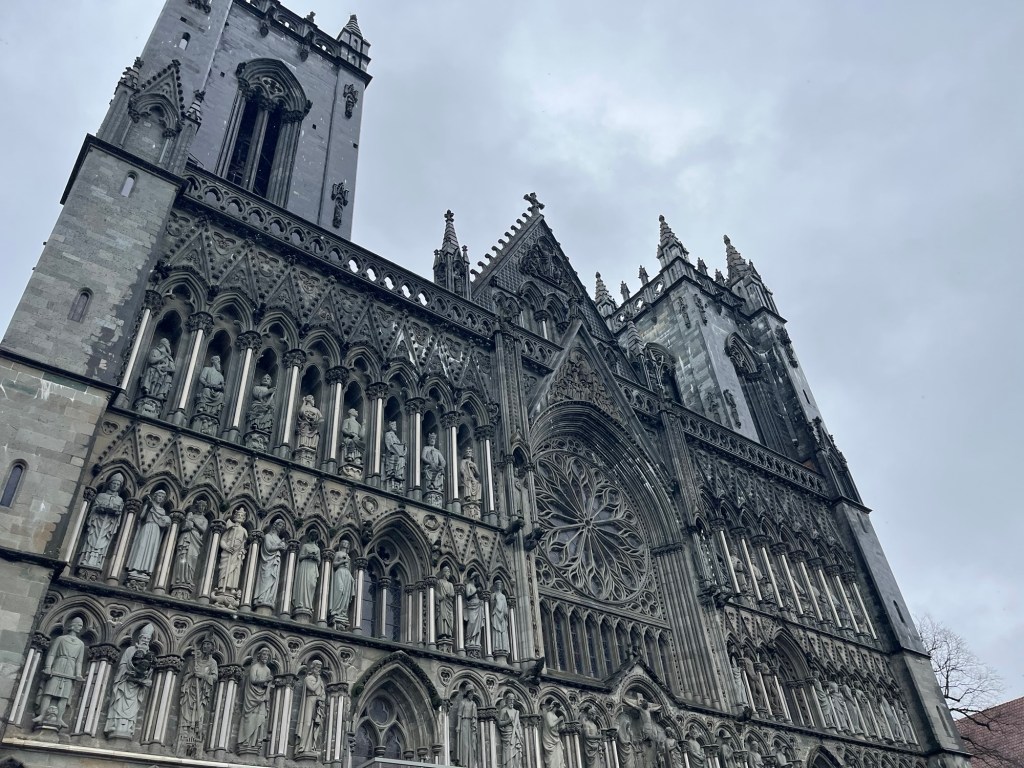
Once in town, the rain stops and the wind abates. I am finally able to appreciate the quaint buildings. Bright yellows, reds, and greens cover business facades. We pass larger government buildings done in neoclassical style, but we keep up a fast pace. We are in search of the Nidaros Cathedral, a Norwegian pilgrimage site, and we are on a tight schedule.
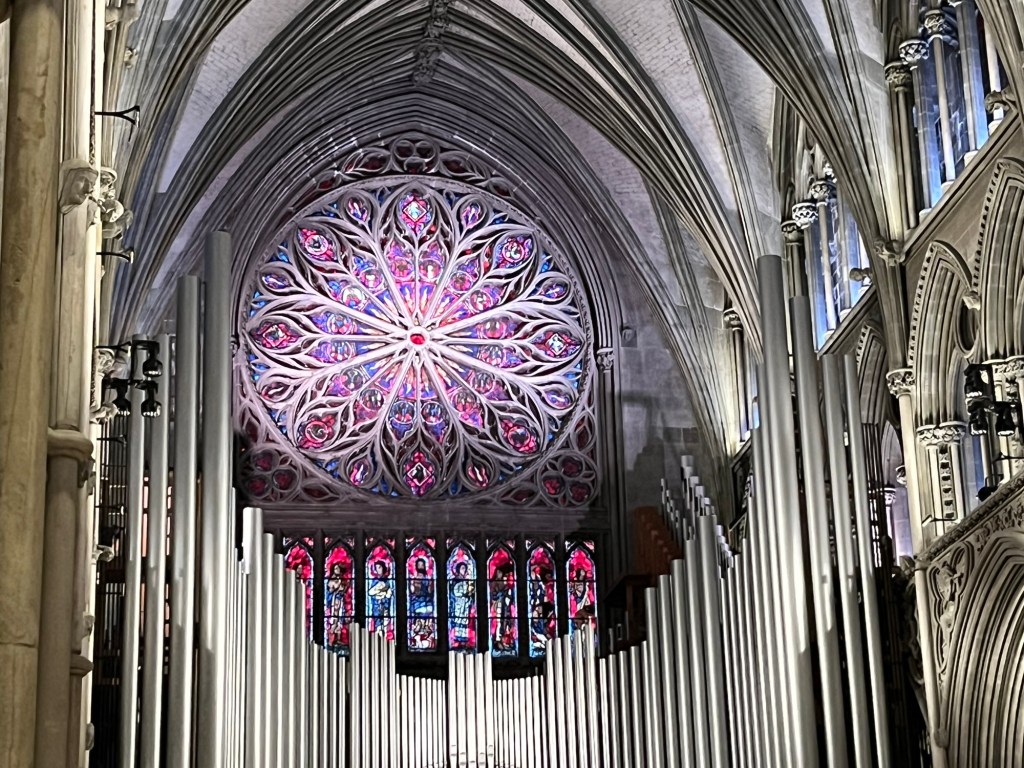
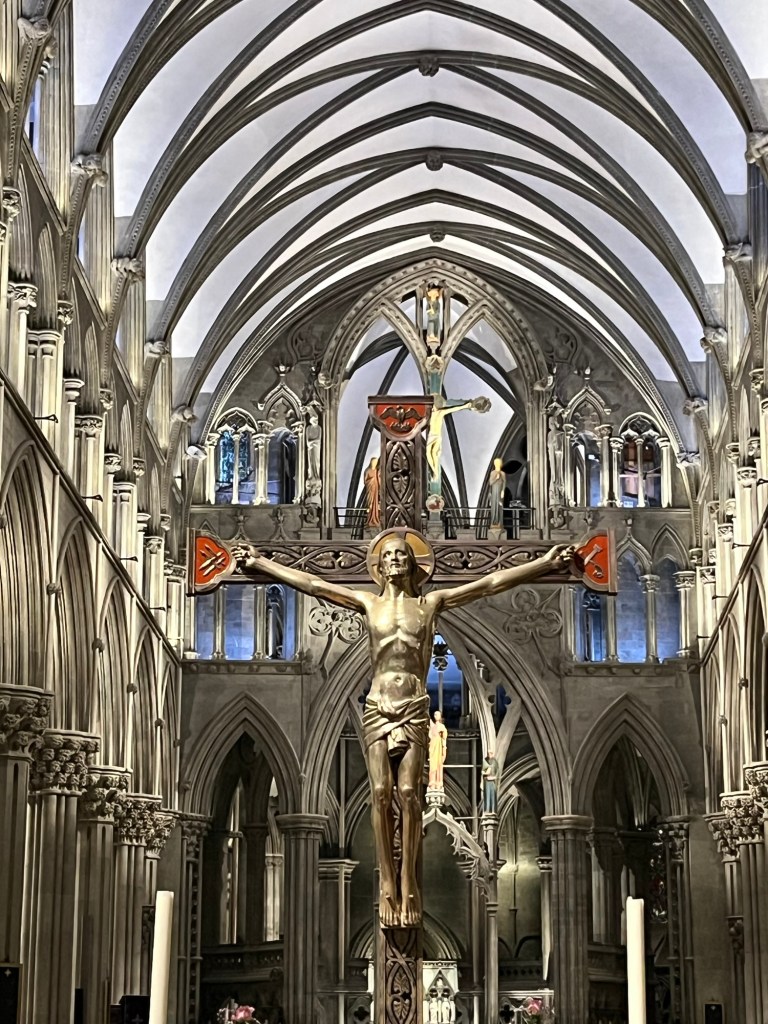
This cathedral is the site of all royal weddings and christenings. It is the burial place of King Olav II, the patron saint of Norway. Construction started in 1070 A.D., making it the northernmost medieval cathedral in the world. The cathedral or “Domkirke” has been Lutheran since the Reformation.

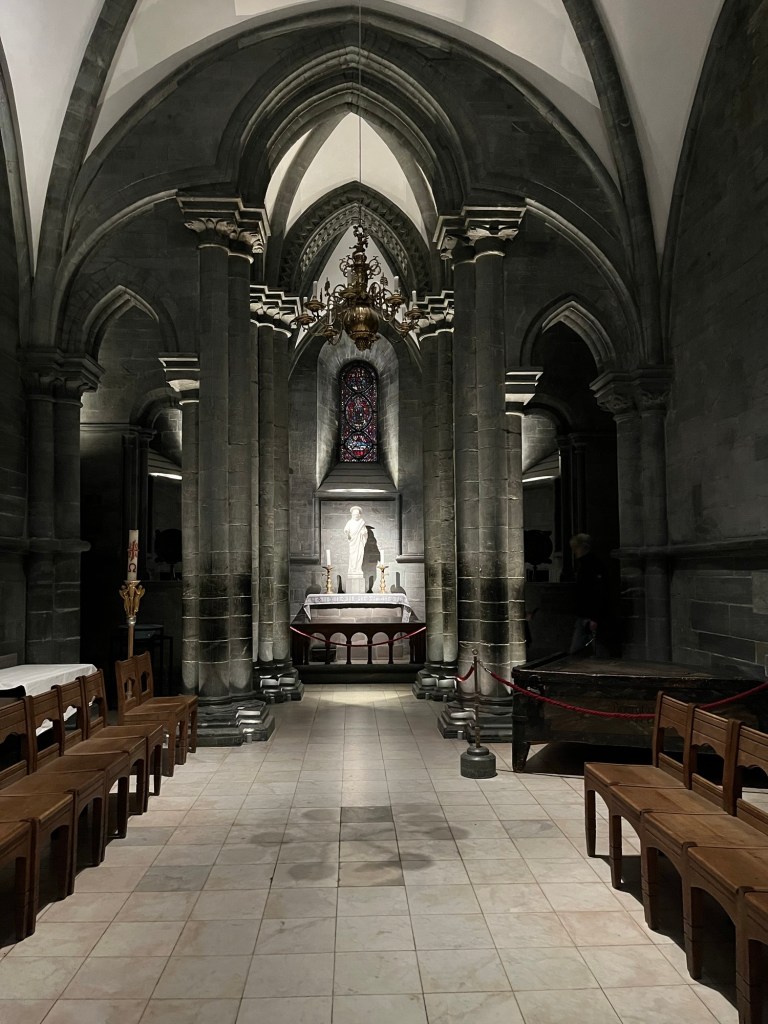
It is a large and impressive structure, laid out in the familiar pattern of the cross. The flying buttresses, support the massive stone roof. Each area holds side chapels and stained glass masterpieces. It, like all great cathedrals, is awe inspiring. I pause to light a candle and give thanks for the health and recovery of our parents. I pray for peace and goodwill for humanity. I pray for our divided nation.

We slowly walk the perimeter, taking time to appreciate the stone work, the carvings, the paintings, and the furnishings. It is amazing what people have been able to achieve over the centuries. This place reminds us that humans are infinitely capable of beauty and greatness.

I find a small abandoned chapel and I stop to again pray for my country. I am saddened by the divisiveness and take a moment to unburden myself of the worry of it all. Refreshed, we head out to explore the old town.
We stop at the arched bridge. According to legend, if you kiss under the arch you will have lifelong happiness. We decide that it is a tradition we should support and pause for a quick kiss under each arch. The scenery is beautiful and the sun is actually shining. We attempt to dry out as we walk.
Most things in the old town sector are closed and our time is running short. So we walk and admire the old wooden buildings. We finally find the last bridge that can take us back to town and the harbor. Unfortunately, there is no time to stop for lunch. We quickly walk towards the harbor, dodging the hundreds of school children on the street. We notice that Norwegian children are often out and about in the towns. I am not sure when they are actually in class. Every day we pass preschoolers in bright yellow vests and students of all ages out exploring.
As we approach the bridge over the train tracks, the rain and wind return. We walk quickly in the cold as we return to the boat. I chuckle as we once again run the gauntlet of weather along the docks.
But, it is warm inside and time for lunch. I love the reindeer and lingonberry sandwich. I am having it again and I may have it a third or fourth time before we get off this boat. Who knew reindeer was so delicious? Happily munching away, I watch the lighthouses and mountains go by.
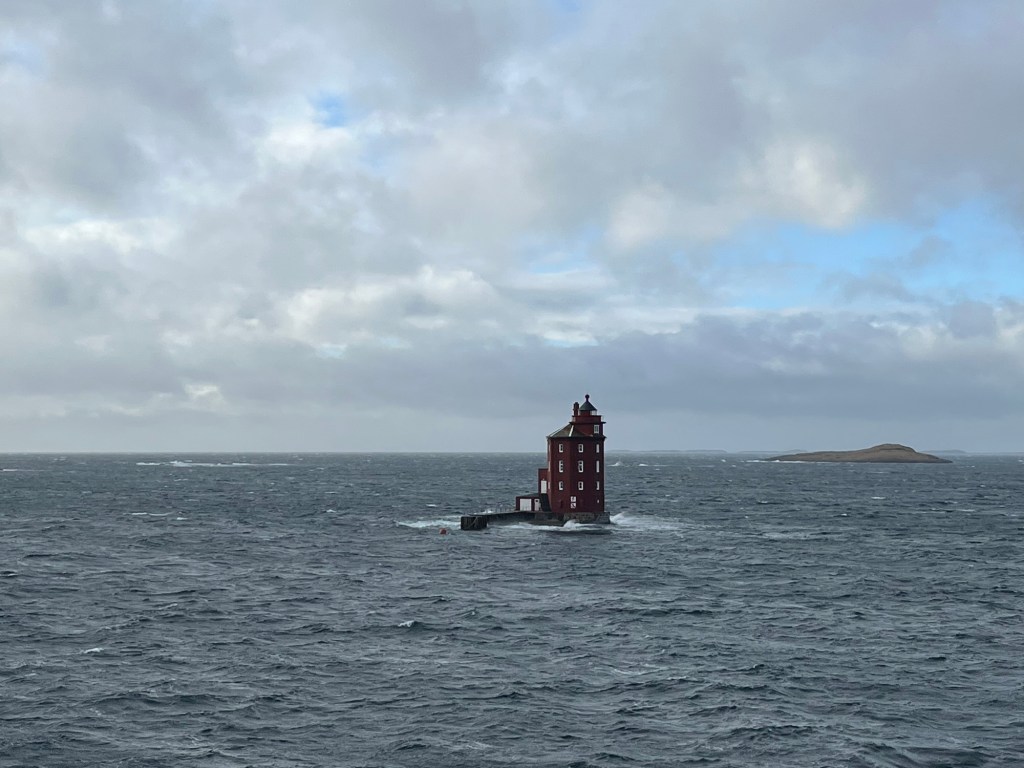
We decide that it would be fun to watch the world go by from the hot tub. It is 30 degrees, but the hot tub is warm. However, the winds pick up to over 40 and 50 miles per hour. The water blows into our eyes and nose. We sink further into the water to minimize exposed skin. It isn’t too bad, until we realize that we will need to get out into the ever increasing intensity of the wind. We can’t stay in here forever. We need to climb out of the hot tub and then down some stone (think river rocks) decorative steps and into an outdoor shelter to get our towels, shoes, and shirts. No one wants to go first. I decide to be brave.
We make it inside with shivering and laughter. I head straight the sauna and my husband to the blankets in the cabin. We each pick our preferred way to thaw. Outdoor hot tubbing on a moving boat in the arctic is clearly not for everyone. But it is definitely an adventure.
-
Travel Goals: Alesund is Closed
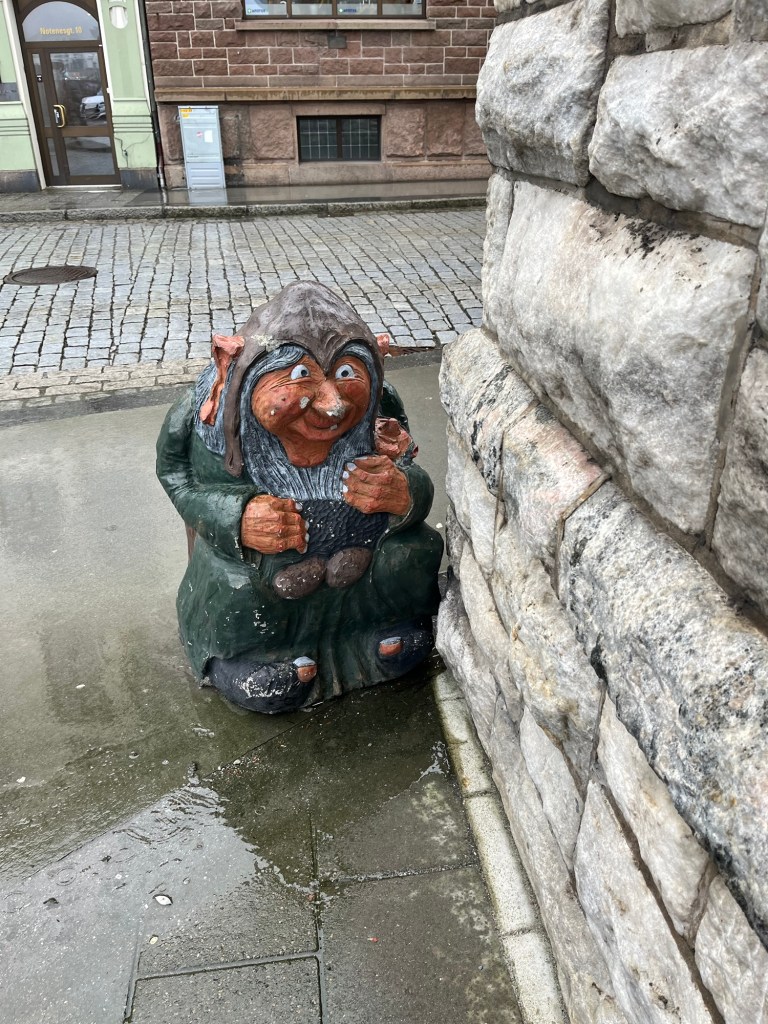
The Midnatsol pulled into the port in Alesund, Norway early morning for an 8 hour stop. We disembark onto a rainy dock and navigate toward the city center. To get out of the cold rain, we walk to the Alesund museum. After walking up the steep hill in the wind and rain…. Closed….. it was not what we expected. Now we need a plan b.
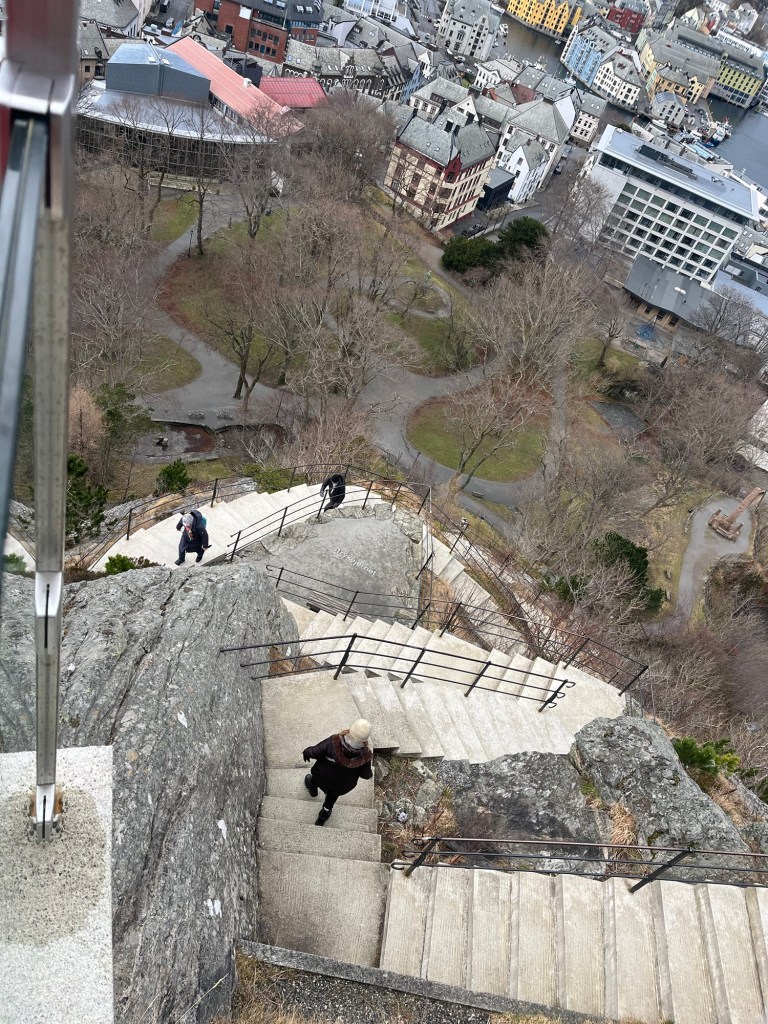
We walk down the hill and to the next best stop. Closed. The rain stops, so I decide to climb the large hill in the park to take in the view. I leave my husband in the park and begin to climb the many switchbacks. About halfway up the cliff. A staircase of 428 steps to the top begins. The wind and rain periodically lash my face. The higher I climb, the fiercer the wind blows. At a glass floor observation platform, I feel like I will be blown off the mountain. I hold my hat with one hand and camera with the other. I lean into the wind and stumble when the gust abates.

I climb with a new friend a I meet on the trail, who said we were on a pilgrimage and that the Virgin Mary had better be on top to greet us. I laugh with her and tell her that after the climb I may need to be resurrected. The birds in the tree tops chatter their agreement. Or else they are mocking us.
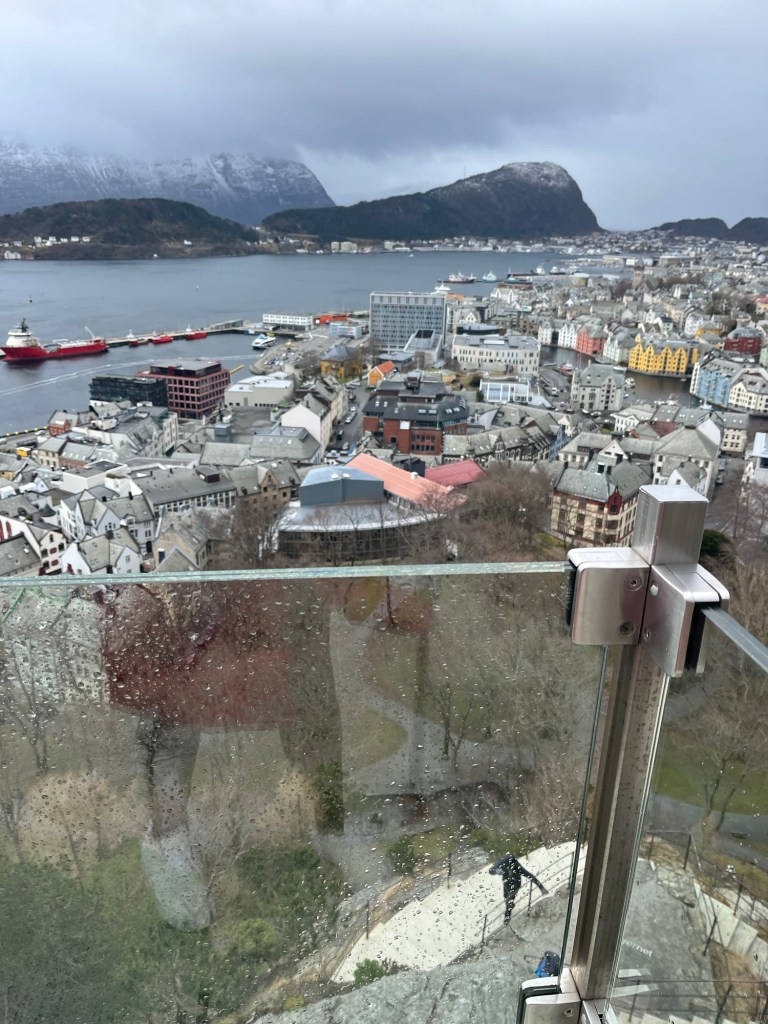
Despite the cold and wind, the views are spectacular. Small glass walkways suspend out over the cliff and allow for photo stops. I need these diversions to catch my breath. The mountains are surrounded in clouds and the light rain continues to pelt my face in the high wind. With one hand still on my hat, I keep heading upward.
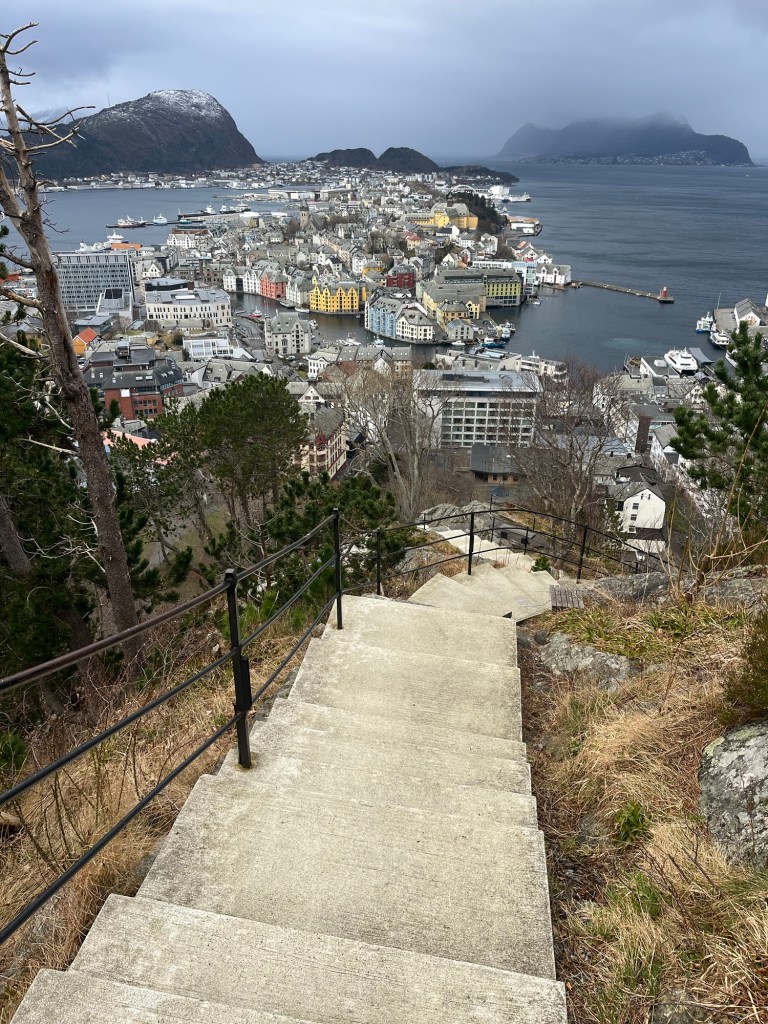
Once at the top, the art nouvea city stretches before me. The entire city burned to the ground in the early 1900s . It was rebuilt in the same architectural style of the time. Today the symmetrical buildings in bright colors are stunning from the top of the mountain. It feels worth the climb as the sun tries to peak out of the clouds.
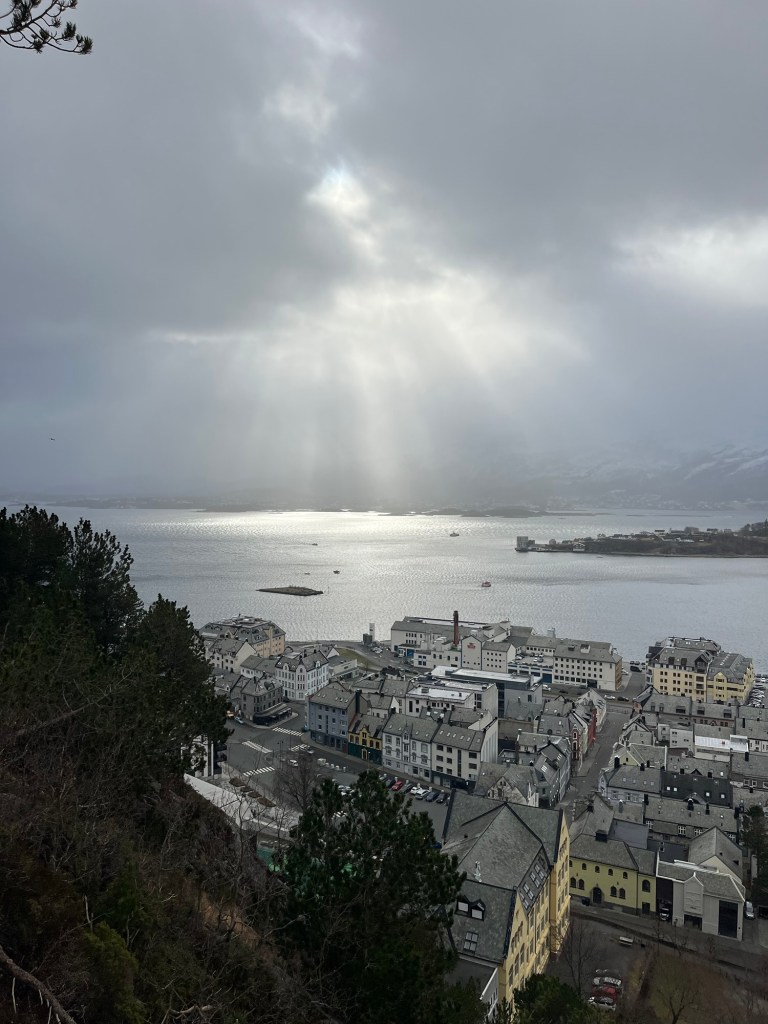
The light shifts again and again as the clouds roll in. As the wind picks up, I make a hasty descent to meet my husband. We head across town to the architectural museum. Guess what….Closed. Oh well, it St. Patrick’s day. We decide to visit the Irish pub. Seriously….closed.
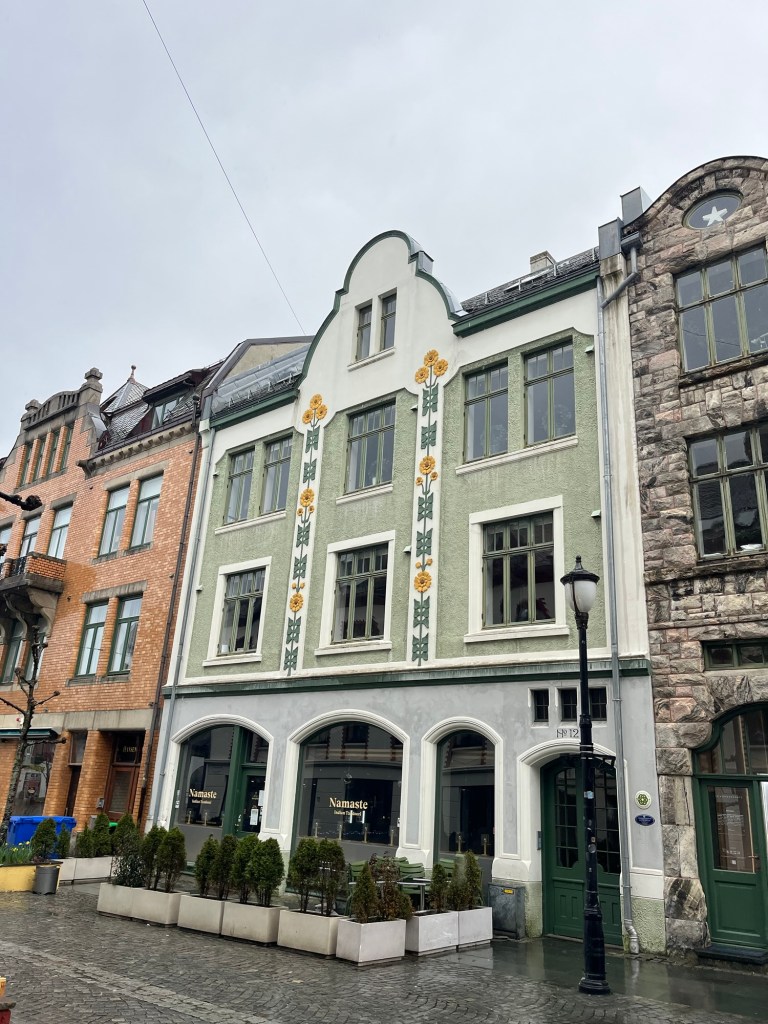
We do a long walk around the town. Closed. Closed. Closed. Heading back to the dock, we find an open gift shop. It feels like success, so I buy a few trinkets. We find a small cafe where we have a good meal. As we are relaxing and warming, our neighbor texted that we may have some water issues at home on our property. Relaxation over, my husband works the phone to resolve the issue. It seems when the electricity goes out for 24 hours, the pumps don’t work and when it comes back on they work overtime. When that happens the water runs into the neighbors yard. But all is well, the professionals tell us everything is working properly and will resolve itself. I wander a small mall while he works out the details and informs the people who need to know what is happening.
Eventually, we head back to the ship. Along the way, we find a grocery to provide cheese and chips for an evening snack. With our bag of goodies in hand, we climb the gangway to find no one to welcome us onboard. Unsure what to do, we wait until someone appears to tell us we needed to scan ourselves in. Huh…that is a new experience.
At this point, my husband decides a little tv time would be his afternoon strategy. I opt for the outdoor arctic hot tub and sauna combo. I think I made the better choice. Warm water and cold air are relaxing, And thankfully the facility is open.
As I soak, I think about our day. Nothing we set out to do happened. We spent almost an hour trying to verify if we had a major water leak at our home. And yet, I am relaxing in a beautiful location. I had a great walk and saw a beautiful town. I met new people and experienced new things (including some form of fried seafood that was completely black). It was a good day.
I run through the cold, across the upper deck and enter the hot sauna. Heaven. I just get settled where I can recline and look out the glass observation window when I get company. A little disappointing, but not my private sauna. I don’t have to give up my spot as the sauna is good sized. The woman announce that she is naked and wants to know if it bothers me. I said, “you do you”. I am in her country, it is normal here, and if I just look out the window I will never know the difference. Ålesund was closed, but the sauna is open. This day is about making the most of what is available despite the obstacles.
-
Travel Goals: The Arctic Awaits
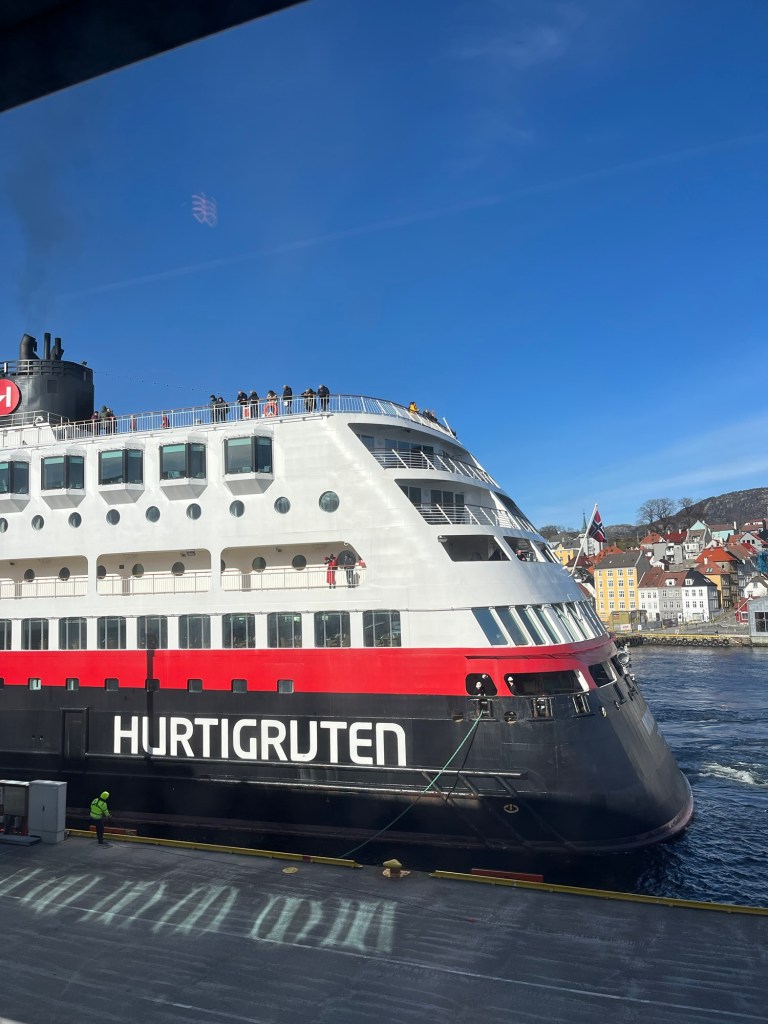
Today we leave Bergen aboard the Hurtigruten Coastal Express. This ferry system has traversed the length of Norway since 1893 and is our home for the next four nights. Norway has the second longest coastline in the world (which we sailed last Spring). Hurtigruten means the fast route because it runs 24 hours a day. They carry people, mail, goods, and cars. We picked the boat because of the local history and the fact that it is a local boat that is connected to the community.
After carefully putting our rental house in order, we walk across town to the Hurtigruten ferry terminal. It is about a mile and we have heavy rolling luggage so we take our time. It is thankfully a downhill walk.

With Hurtigruten docks in sight, we stop at a French cafe for lunch. We pile our baggage in a corner, hoping it is out of the way. I imagine we are not the first or last to do so. Waiting for our meal and talking about our boat, we notice a small dachshund wearing a winter sweater wandering by. He stops to chat. After an impromptu photo shoot, we part friends.
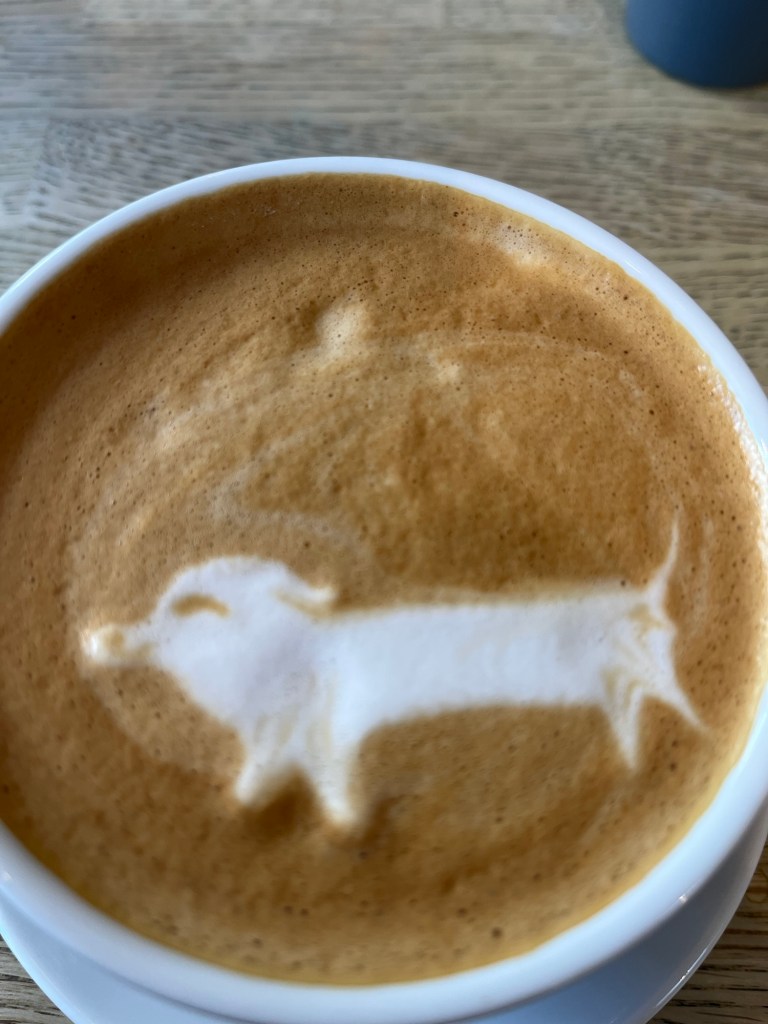
My Italiane pastry is excellent and the coffee divine. The barista sends me coffee with a dachshund shaped in cream. He says he was inspired by the little guy. My desert doesn’t arrive. I seek out the owner, because I need my French pastry. He laughs and brings me a large slice with an apology. I am happy here among dogs, and smiles, and pastry.

Just a block away, the ferry terminal beckons. Donning the backpack and towing my luggage, we trek onward. We are thankfully able to quickly check in our luggage. The Hurtigruten staff are friendly, professional, and efficient. In short order, we are directed to a lounge where we play cards and drink coffee. There are also fresh, hot cinnamon rolls. Unlimited coffee and warm pastries make for a pleasant afternoon. I am directed to join their membership program to access the WiFi. I need to do remote work on the boat so I make sure to gain access while I still have cellular data access. Who knows what happens in the Norwegian Sea? The time passes quickly and soon we can officially check in and proceed to watch the safety briefing.

Once aboard, the ship is bright and clean. Our room has lots of storage and a spacious bathroom. Unfortunately it also has narrow single beds. I take a top bunk that pulls down from the wall at night. This way I won’t be annoyed when my husband wants to watch tv and I want to sleep. The thick down comforter looks welcoming, even if we have bunk beds. I will try not to roll off and kill myself.
After unpacking, we explore the ship. With nine levels, the ship holds about 500 passengers as well as heavy cargo and vehicles moving up the coast. The levels for passengers is not unlike a cruise ship. It is very clean and comfortable. I am surprised that there is a large British tour group aboard.

We find three restaurants, two hot tubs, saunas, a fitness room, laundry, library, and several lounges. The introductory session with the expedition crew is very dry and uninformative. We get helpful tidbits like, “don’t clog the toilets.” This was definitely not an entertainment cruise ship experience. It seems they are all business. But then, I thrive on quirky.
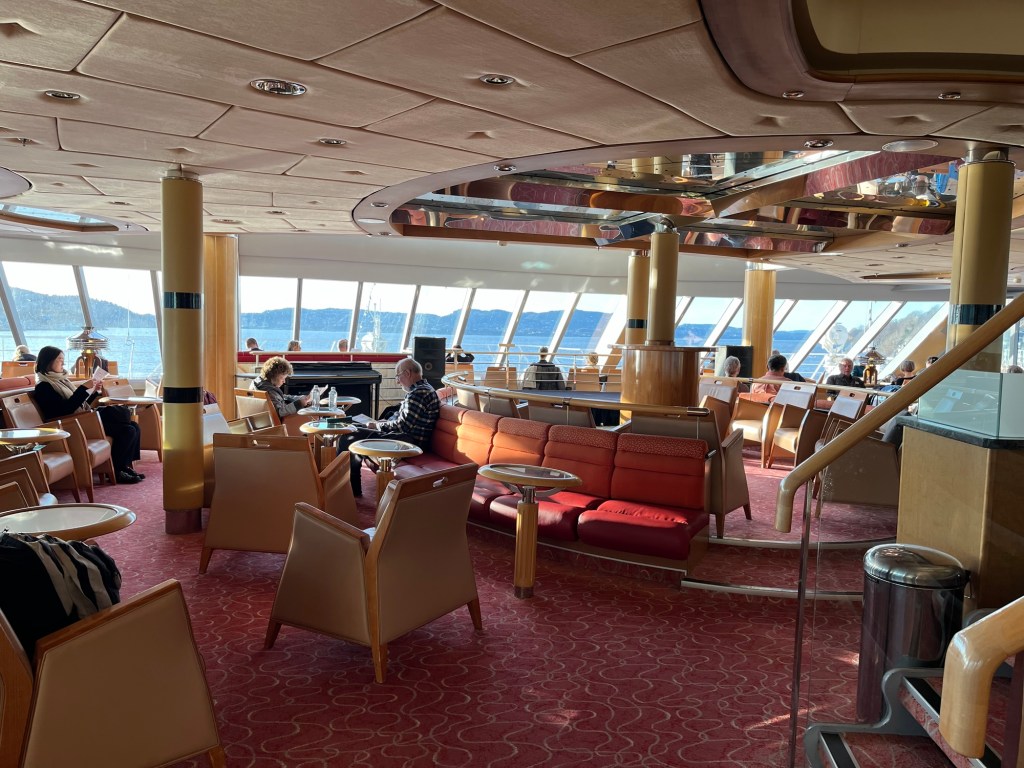
The passengers appear to be much older… seniors from Germany and England. While there are a few other Americans, we are largely outnumbered. The good news is that in an international crowd, English is the lingua franca.

The bad news is that my finicky eating travel mate is going to have a hard time these next few days. The ship specializes in local Norwegian cuisine, which means lots of fish and lamb. Seaweed, fish soup, and reindeer round out the menu. At our first meal aboard, I try the reindeer sandwich and it is delicious! Turns out that this midwestern girl who doesn’t really like meat, loves reindeer.
Belly full, I return to the cabin and climb up into my bunk. The down comforter is as comfortable as it looks and the rocking of the ship sends me sound asleep. I hope to dream of Northern lights and polar bears. An adventure into the arctic has begun.
-
Subscribe
Subscribed
Already have a WordPress.com account? Log in now.
 Prisoner of Hopes