-
Sleepy Little Town: Travel Goals

When the Olympics were held in Lillehammer, pundits called it a sleepy little town in Norway. I can’t say if it is “sleepy”. I can say I find it charming. The train trip from Oslo follows endless lakes. This early in the Spring, they are mostly frozen, making the scenery a magical land of sun, greenery and ice.
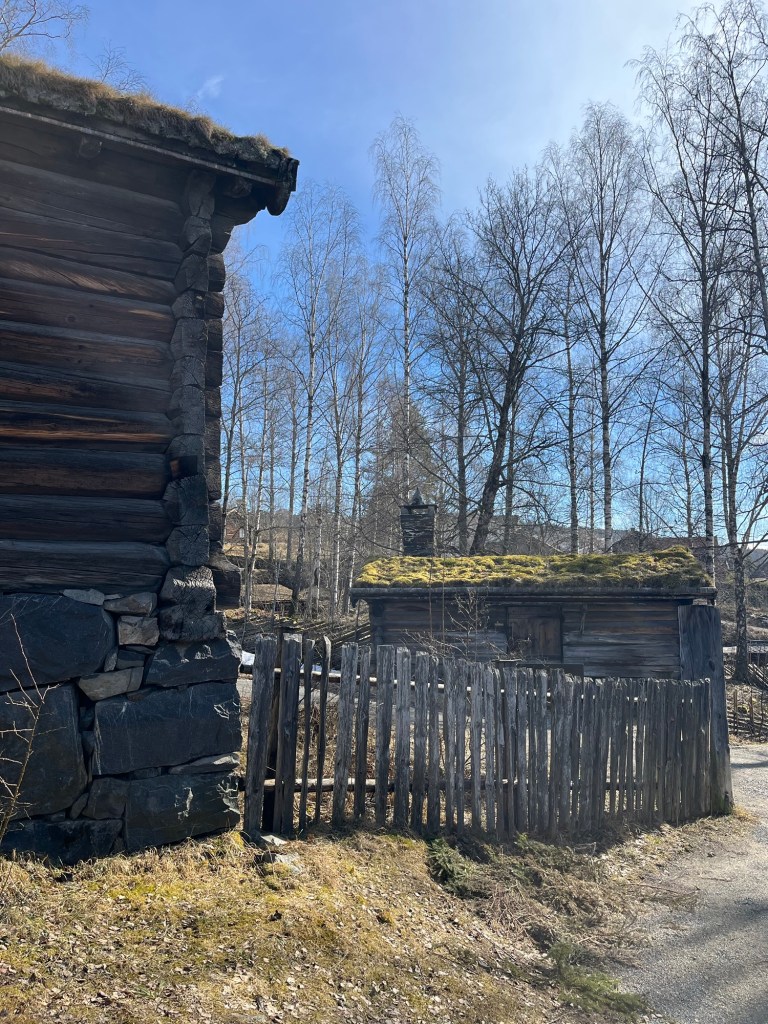
Departing the train station we set off on an uphill walk to the Olympic museum. What we don’t know, is that admission is actually to a much larger Maihaugen complex. The outdoor living history museum has acres of lakes and forests populated with various houses, barns and churches representing life through the centuries.
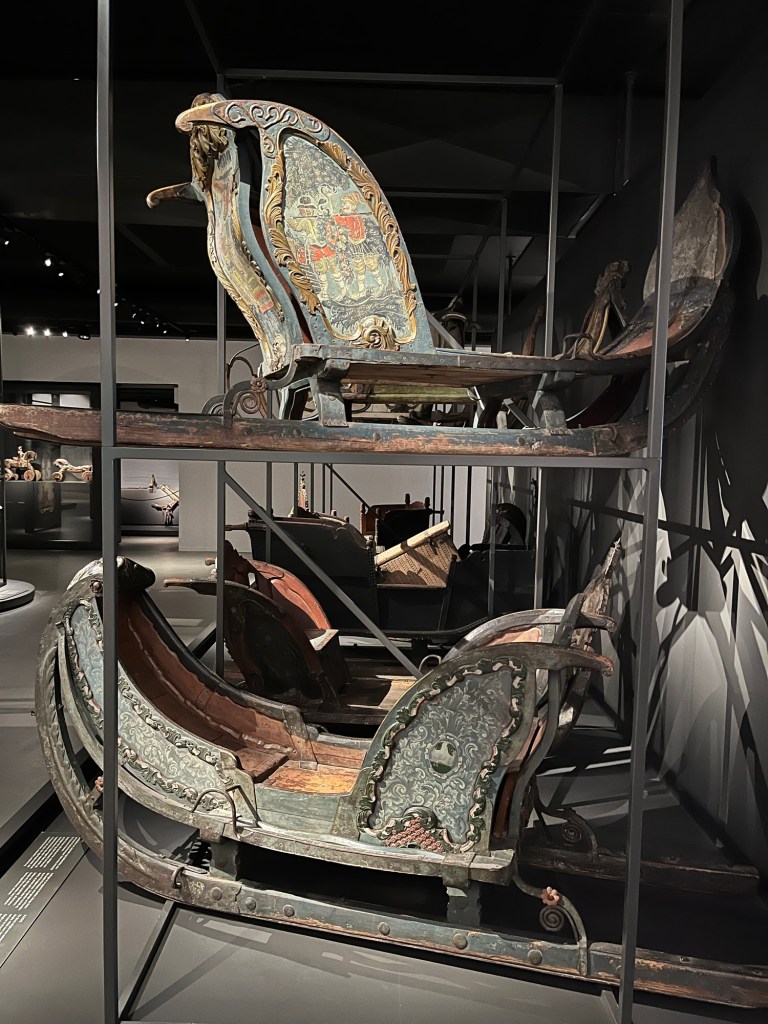
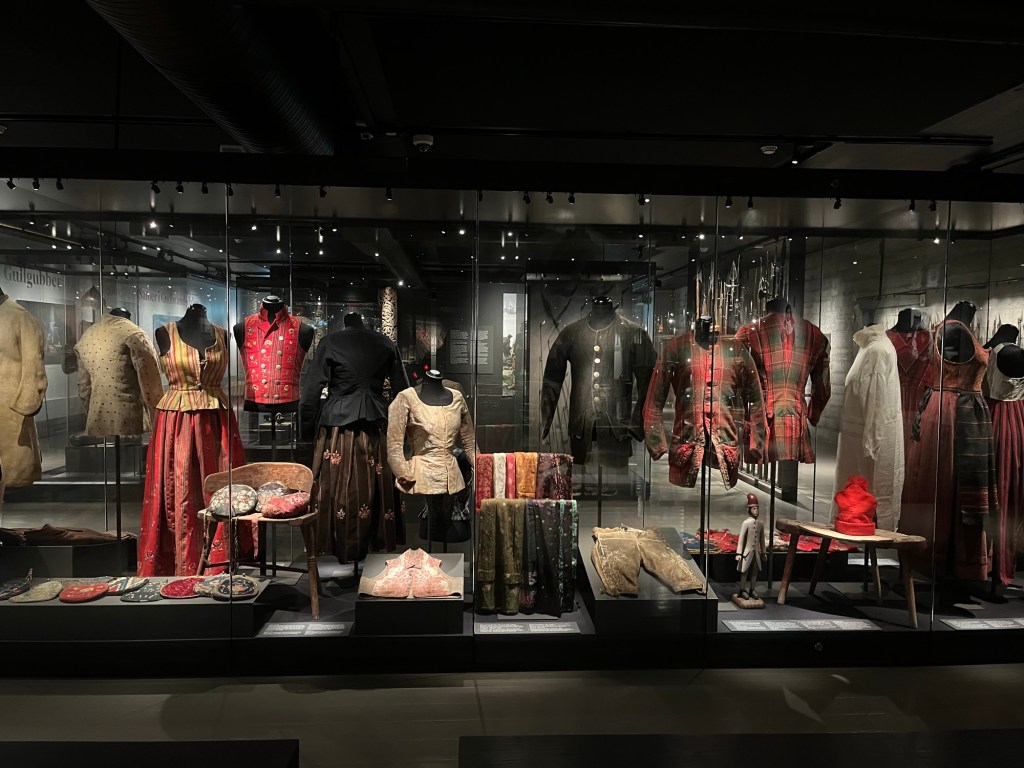
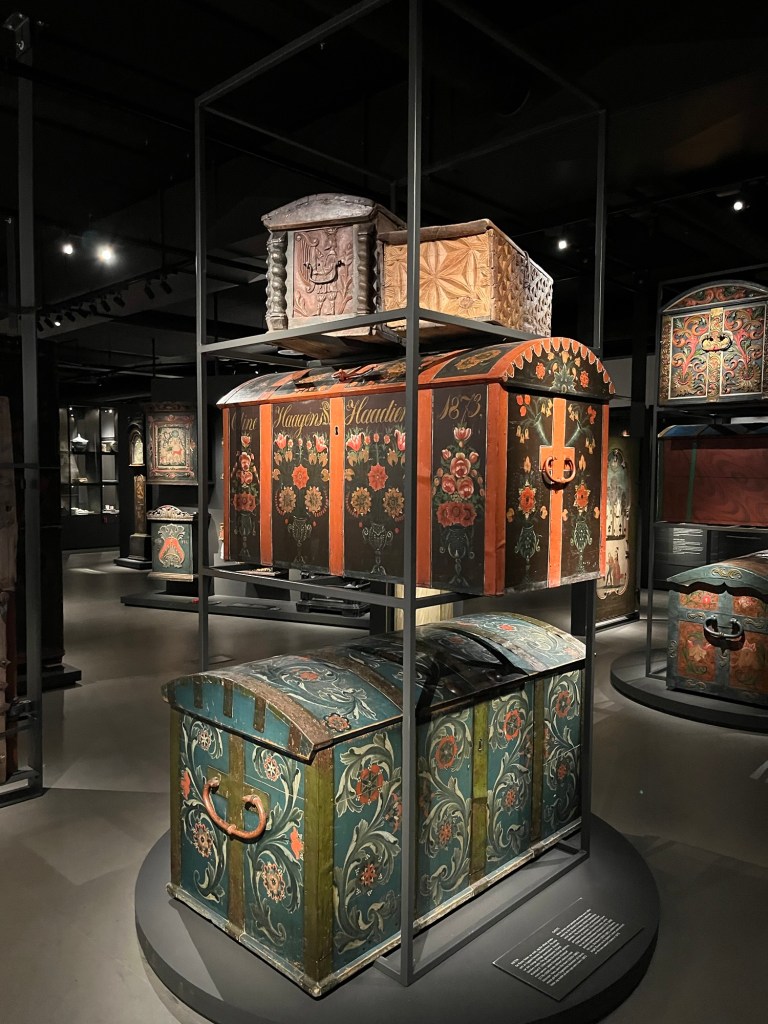
The collections of the museum complex are broad. The Olympic museum is interesting, but the hundreds of artifacts at Maihaugen representing everyday life is spectacular. Sleds, chests, tapestry, carvings, toys, dance costumes, church relics, weapons. Everywhere we look, we find something of interest. We listen to recordings of ancient instruments and wander around a gallery of clothing.
Outside, the view looking over the lakes sleeping under bright blue skies is inspiring. I can feel my breath changing as I relax in the sunlight. Most buildings are only viewable from the outside, but many are open for inside touring. So many innovations, advanced for so long ago. While I would not want to gather firewood or visit an outhouse on a regular basis, I think could otherwise be quite comfortable in a medieval townhouse.
The farm roofs of birch bark and sod are a marvel. Each time I see one, I think how sustainable and ingenious they truly are. Earth protects and gives life to those who will use its treasures wisely. I happily walk among the farmsteads until closing time. We venture towards the exit and the more modern houses. There is for each decade, including the one that Queen Sonia grew up in. A merchants house for the commoner queen. Her marriage to Prince Harold was celebrated throughout Norway. I only know about the romance because of a Netflix series about the couple. The house here looks like the house in the series (maybe it was filmed on site).
Remembering our roots is always a worthy endeavor. It reminds us that we are not half as clever as we think we are. That we need a lot less than we think we need. That modern is not always better. Simpler lives may be richer. My musings go on and on. But it is now after three and we are hungry. The museum will kick us out if we don’t leave soon.
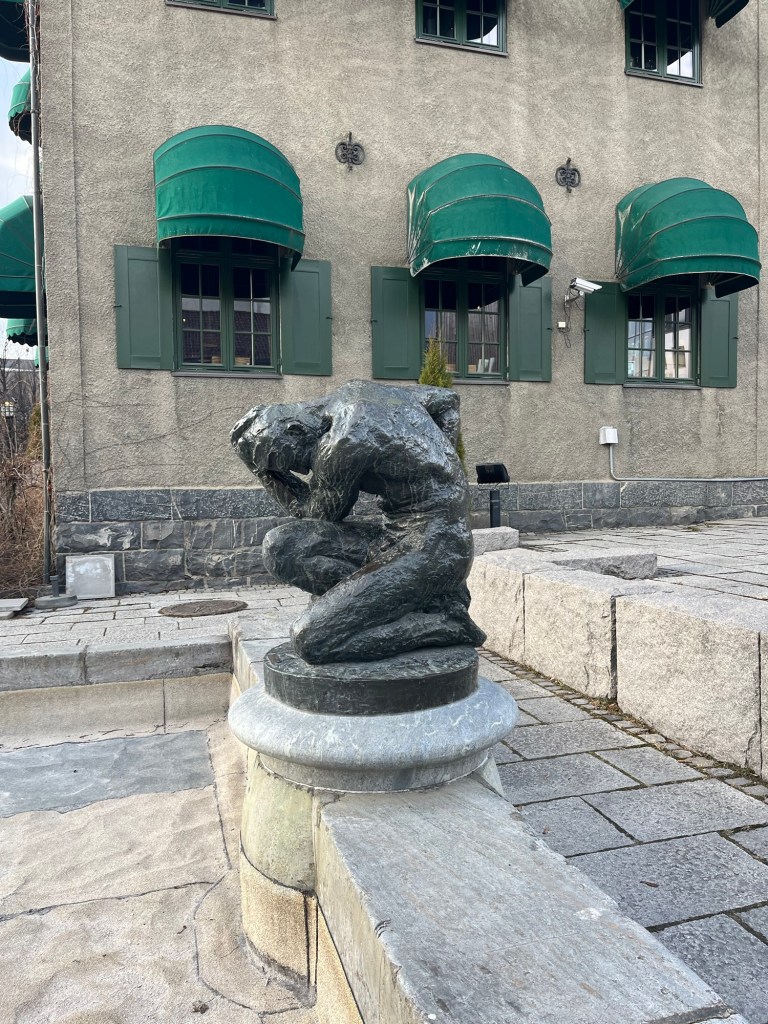
We find a restaurant on the high street. It is a mishmash of Norwegian, Italian, and Turkish food. Something for everyone. Nothing fancy, just tasty, warm, solid food. While we enjoy our meal, I spot a charity shop across the way. It yields a cheery shamrock sweater. Yay! I love resale. Sustainable and every item tells a story.
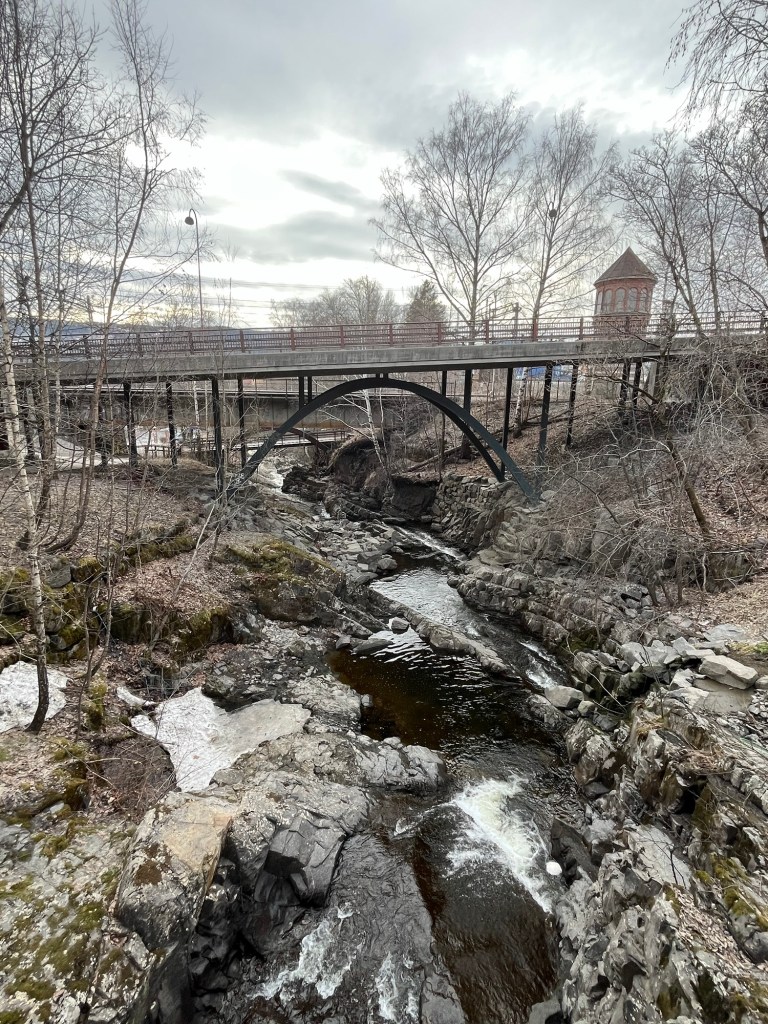
We realize that the shops have closed and we are out of things to do. I walk to a waterfall for a few pictures and we settle in to wait for a train. The train station is unmanned. The ticket counters are closed. This country seems to suffer the same tech mania as many others. Serve yourself and too bad if you have a question.
I try a google query to see if we can take an earlier train if we have an unassigned ticket. No answers there. I ask an engineer, he says he thinks yes but to ask a guard. He does not tell me where to find a guard. We walk to the platform. I ask the next uniform that passes. He says no, we bought a “low fare” ticket and we can’t take the next train but to ask the conductor anyway. He does not tell me where to find the conductor.
I walk the length of the train and don’t see a soul. We wait until a few minutes before the train is scheduled to leave. No conductor. Just as we are giving up and heading back to the waiting area, she appears. We ask to leave on the train pulling out in a few minutes. She explains that we do, in fact, have a low fare ticket, but the train is largely empty so she will allow an exception this once. We are grateful to board a full hour before our scheduled departure.
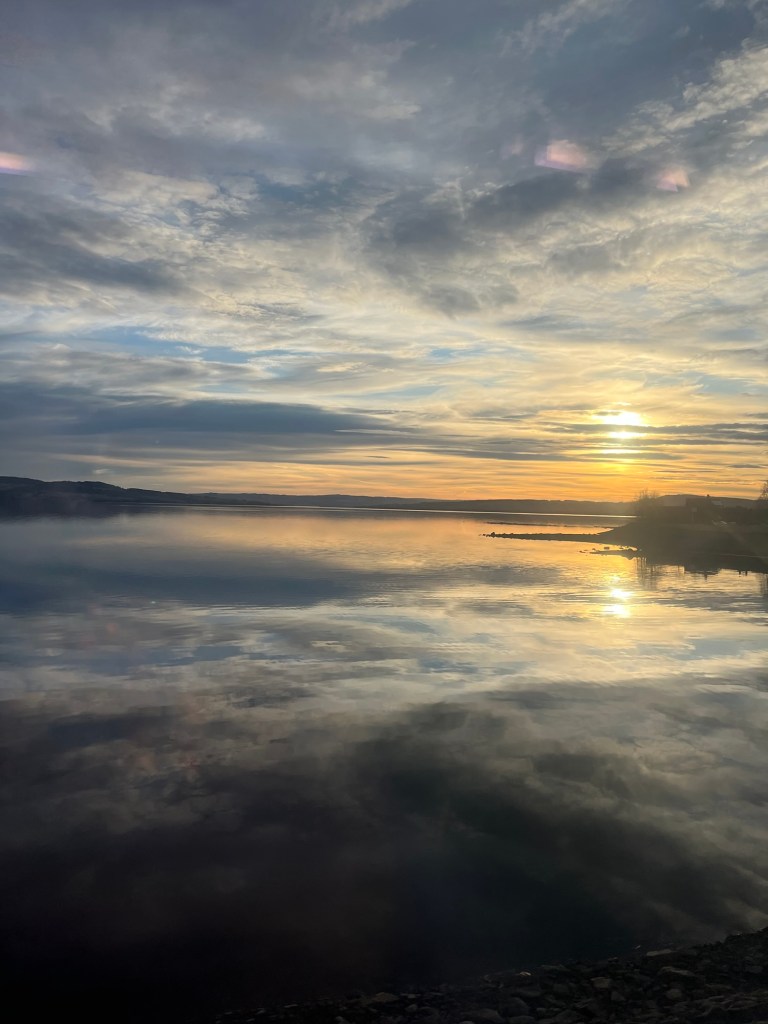
And so we return along the lake as the sun is setting and the world is returning to magical light and sky. I settle into my seat and review a lovely day in Lillehammer as the world rushes by.
-
Olympic Spirit: Travel Goals
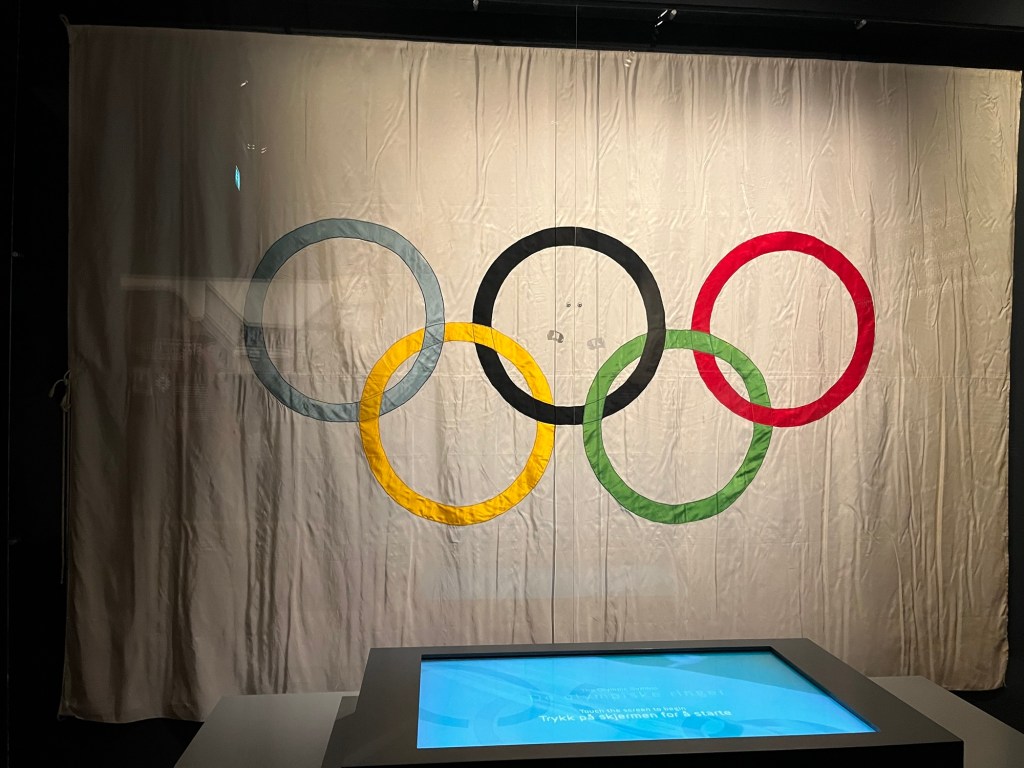
Daa. Daa. Da dah da dah dah. Bum bum ba bum. bum bum ba badda bum bum bum. Sorry the Olympic fanfare horns are trumpeting in my head and I have to get it out. Excite builds as we approach the Lillehammer Olympic museum. In my head, I see Nancy Kerrigan, Tonya Harding and Oksana Baiul in an epic (post wrench to the knee) show down. Dan Jansen and Bonnie Blair also blur past in my mind on their golden skates.
I am so busy remembering Olympic glory that I fail to notice that there is no way to cross the barriers to get to the Olympic center which is now on the other side of the elevated roadway. So we backtrack.
The Olympic museum is part of a larger museum Maihaugen complex in Lillehammer. One ticket is good for the entire day. There are houses, forests, and lakes. But first, the Olympics await.

The first gallery traces the Olympics from its roots in Ancient Greece. We learn about the naked ancient Olympics. We also learn that the founder and champion of the modern Olympics was a French man, Pierre de Coubertin, a cheerleader for sports in education. He served as the first president of the International Olympic Committee.

The next galleries allow us to relive the opening ceremony including the dramatic ski jump lighting of the Olympic cauldron. A variety of Olympic torches are on display for comparison to the massive ski jump torch. Nearby is a display of weird mascots of the Winter Olympics.
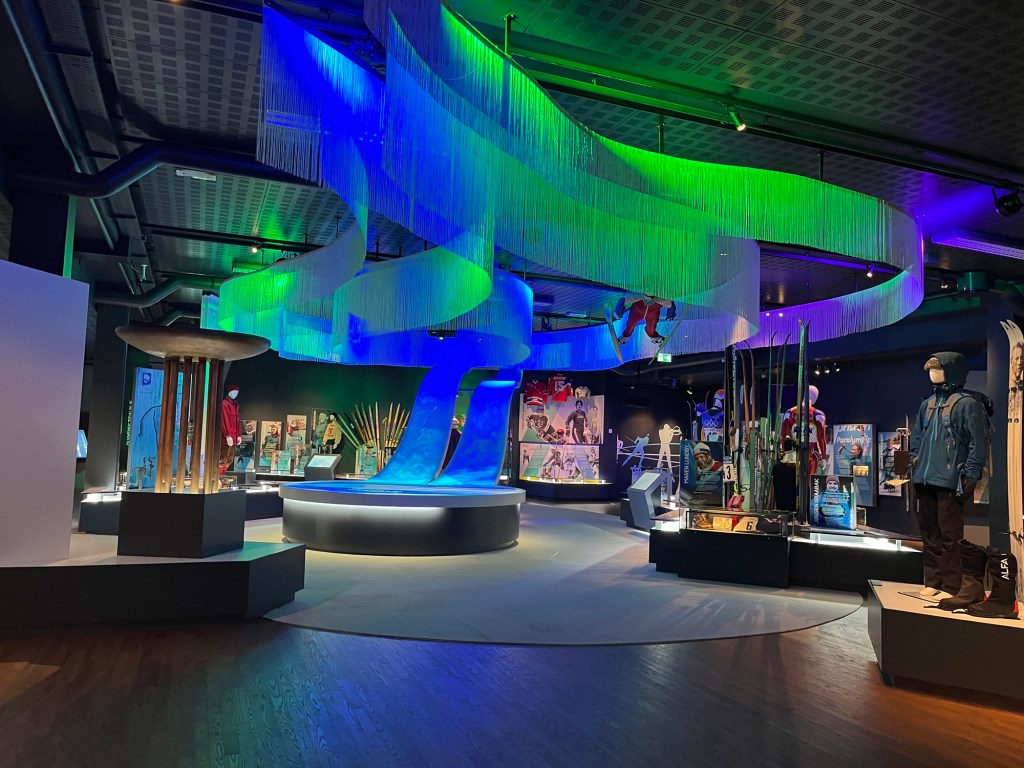
The main galleries are dedicated to the Norwegian Olympians. Not an American athlete in sight. I chuckle at my American assumptions. I learn about the Norwegian successes in sports that they literally invented, like ski jumping and biathlon. I try my hand at the biathlon simulator. Let’s just say I am not a contender.
We spend time reading about competitors and examining their equipment. Most of the athletes I have never heard of or maybe I forgot I had heard of them (as they would always be introduced as a potential foil for American athletes on U.S. Olympic coverage).
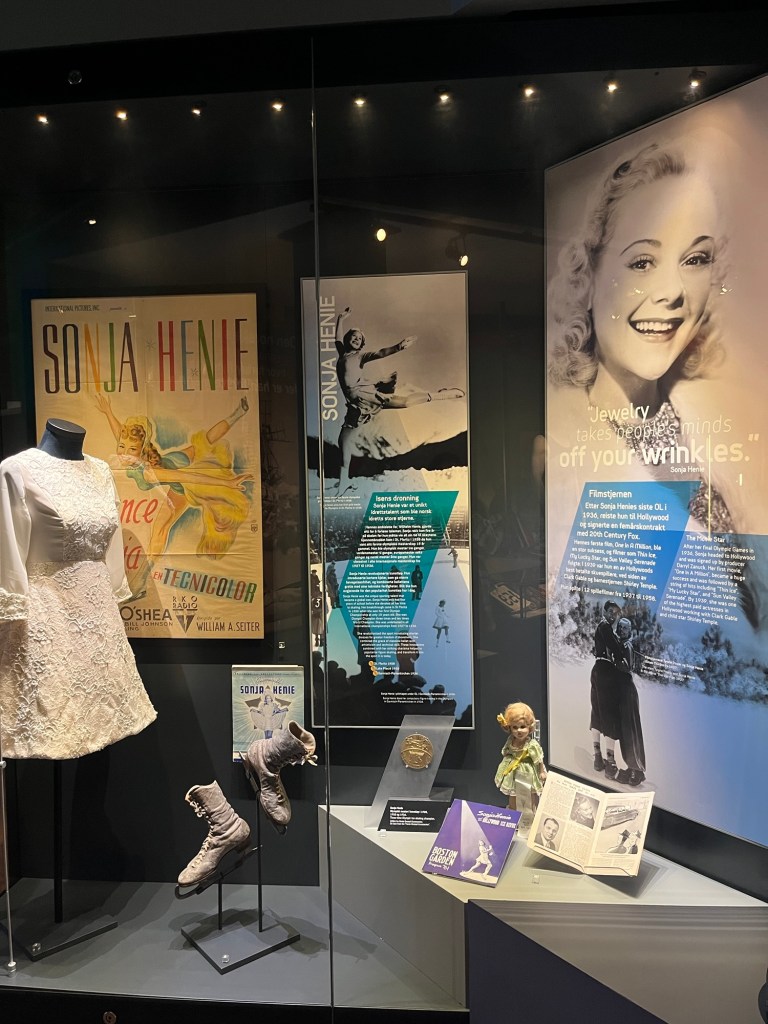
One athlete I recognize is Sonia Henie. A figure skater from a time when competition was about form and elegance and less about physical jumps and feats of strength. A celebrity at home and abroad, Henie used her fame to benefit Norway. She is beloved.
The center also has highlights from the Oslo Winter Olympics. I watch grainy film clips from the 1950’s and don’t recognize some of the earlier forms of sport. How far we have come. Looking at the equipment from earlier times, I am still mystified at how ski jumping ever became a popular pass time. Having visited the top of the Holmenkollen jump in Oslo and now walking to the Lillehammer jump, I know that this is one sport I will never attempt. It would, however, be very exciting to watch.
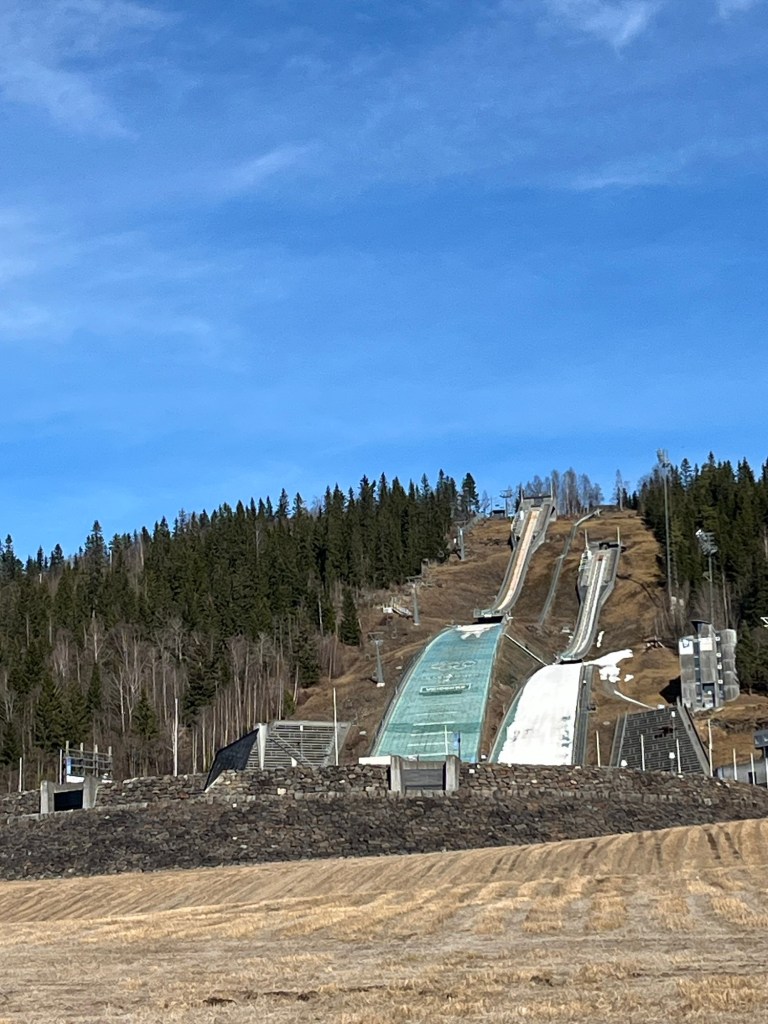
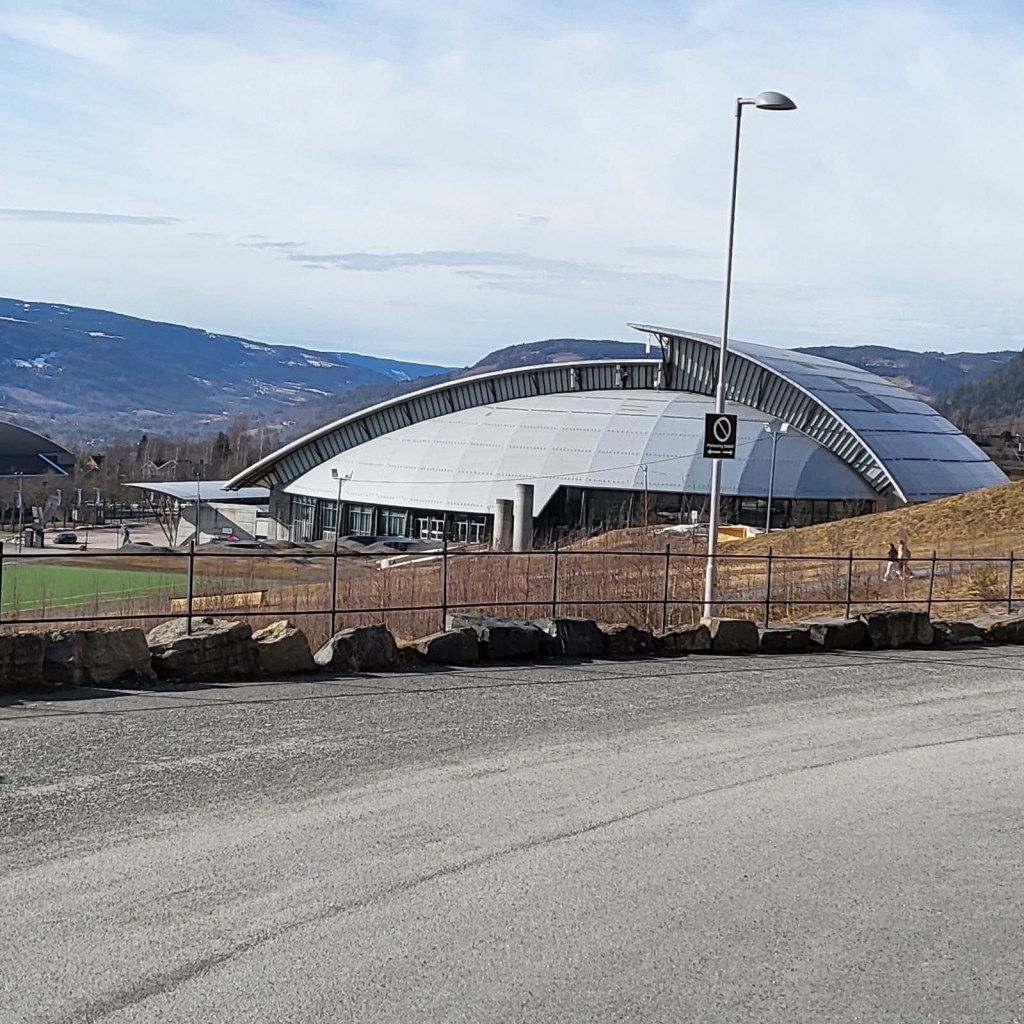
After a long walk up hill and past the remains of the Olympic Village (now a modern student housing complex), we sit on a rock in a farmer’s field at the foot of the massive jump arena and imagine what the Olympic crowd would have been like. Nearby the speed skating arena glistens in the Spring sun. Soccer parks line the lower fields and a beautiful waterfall cascades down through the park.
An idyllic setting to remember the glory of the Winter Olympics 1994 in Lillehammer Norway. I bet it was magical.
-
Remembrance: Travel Goals
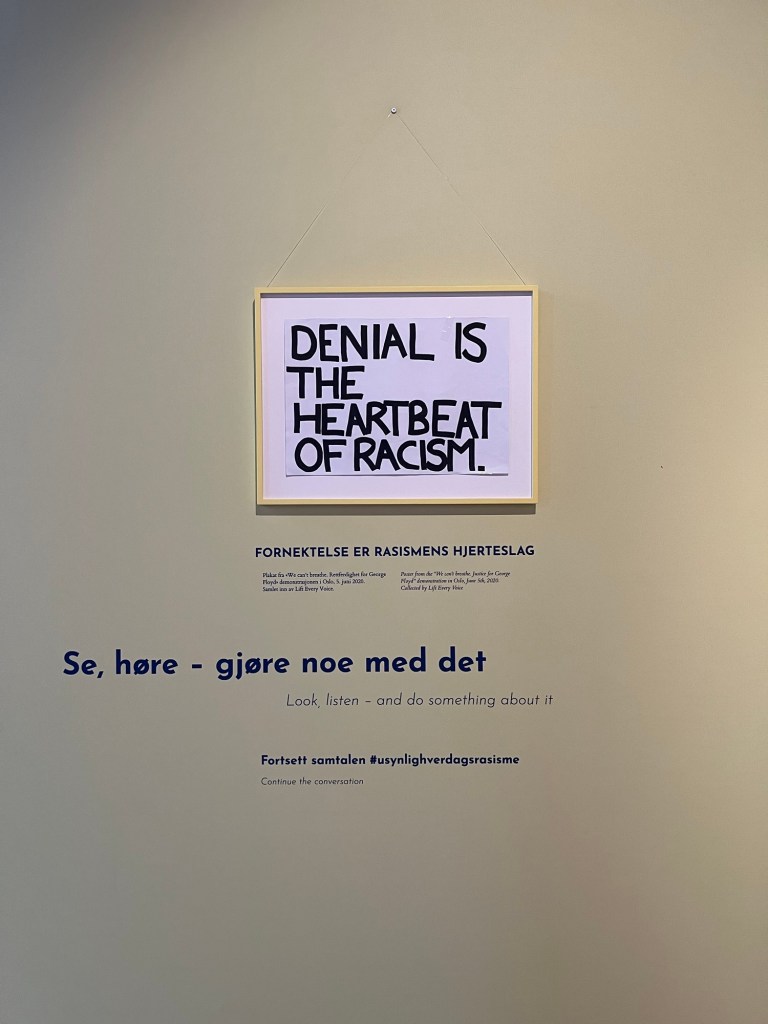
The Holocaust Center in Oslo is located in the former home of the Norwegian Nazi party leader, Vidkun Quisling. His mansion seems in gross excess compared to most Oslo city dwellings. It is now a center that commemorates the forced removal of over 700 Jewish citizens during World War II. Many of the deportees, especially women and children lost their lives at Auschwitz.
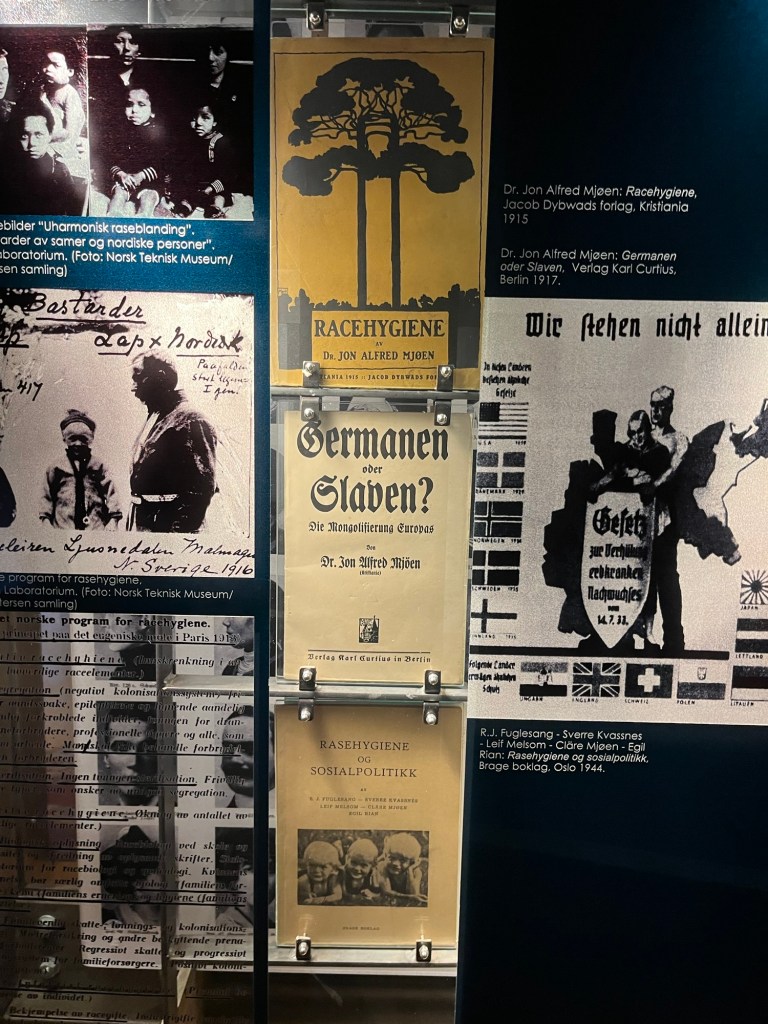
The museum begins with propaganda about the Jewish people. It is hard to think about how any party, government, or person could do this to innocent people. What causes hate? How does xenophobia and racism take root? As I read the anti-Jewish propaganda written by Nazis I am disgusted. But it is the hate filled writings of people like Henry Ford and even Martin Luther (yes….that Martin Luther) that causes the most dismay. I think “how could they” and then I juxtapose the callous propaganda video of immigrant deportations that I saw on the official White House social media page just this morning. Different times and different media, but propaganda pieces all the same.
I keep reading and walking. Each piece is more dehumanizing than the last. Portraying entire groups of people as criminal and evil without proof. Designed in a misguided racist attempt to shape society. Soulless. Unempathetic. Evil. I am plagued by historical examples whispering to me their modern parallels. I am gutted by an exhibit that outlines how Nazi ministers got their ideas from studying American slavery and Jim Crow laws….meanwhile my government on this very day is actively trying to keep Americans from having discussions about diversity, equity, and inclusion, …I fear for our national identity if we continue to avoid facing history and ourselves.

I see the disturbing images of authoritarianism and blatant racism in photographs and artifacts. A scrapbook of Hitler Youth activities looks like wholesome sports until you see the Nazi flag and read the subtext. The Nazi discredited the teachers and education system by accusing them of disloyalty to Germany and indoctrination. So that they could replace the teachers with loyalists and require all children to join Hitler Youth where could actually indoctrinate children with Nazi ideals.
I see the modern similarities but don’t want to admit them, even to myself. I will never understand racists. I certainly can’t understand a level of cruelty that allows individuals to treat people as disposable objects instead of souls created in the image of God. This happened only 80 years ago. The people in the photos could be my grandparents. It is 2025, and the organized and targeted cruelty toward immigrants and ethnic groups is still raging around the world. Even in a country that was formed by immigrants and that helped to liberate Auschwitz. God help us all.
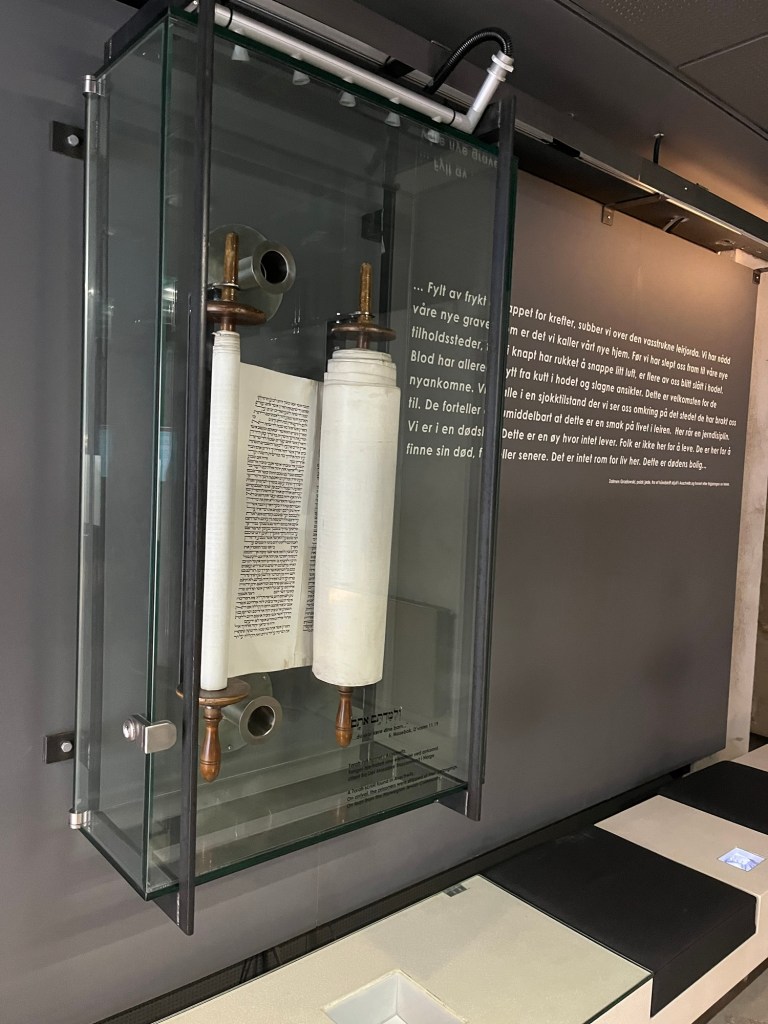
I walk and read the Nazi timeline displayed on the wall. I have to sit down as the parallels roll over me. Stigmatize the immigrant. Marginalize the transgender and homosexual. Mock and target the disabled and autistic. Find a vulnerable race to blame for crime and economic issues. Punish students. Build and reward trusted media sources and ban all the rest. Take over the churches and arrest ministers who don’t comply. Get the backing of industry leaders and the wealthy. Destroy the targeted group’s ability to work and seize their assets. Demand agreement with the state agenda and promise a new golden age. All of it here, written in black and white on a clear timeline. It is too much….it is horrifying…..
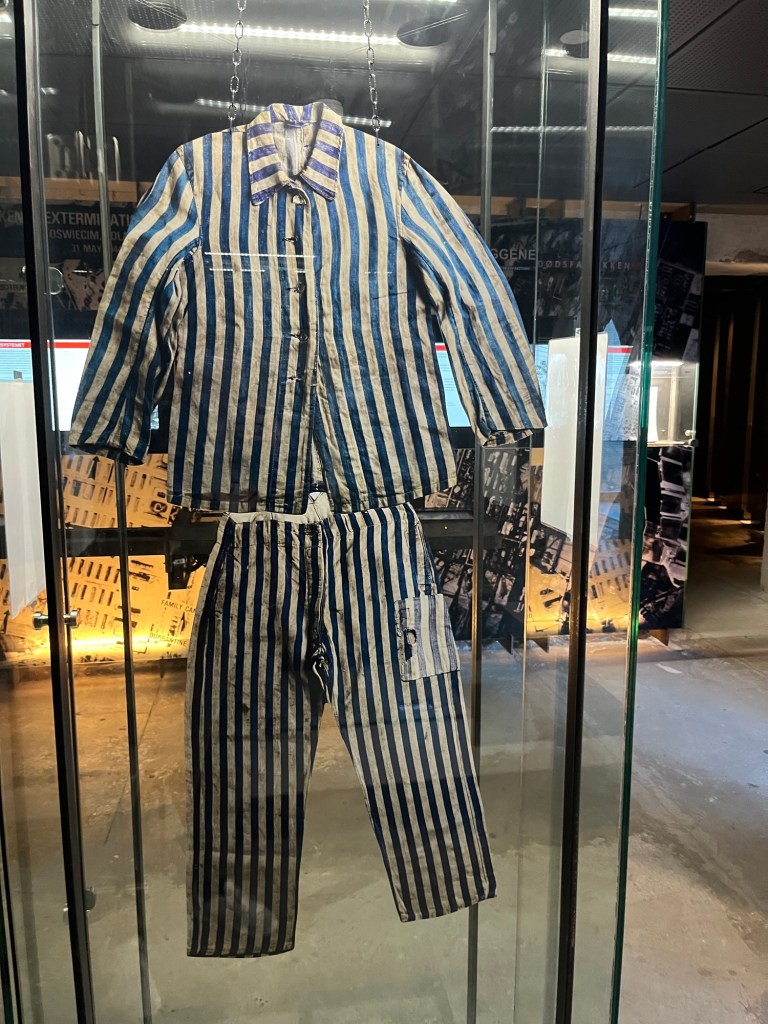
In the next room, artifacts from Auschwitz are on display. Photos of people having their heads shaved and being stacked into over crowded cells compete in my head with images ever in the news of immigrants entering an El Salvador prison. Different times, different reasons, different locations….. and yet the images are so closely the same. Human beings stripped of their humanity. Deliberately dehumanized and vilified. Taken away. Disposed of. Portrayed as less than human and deserving of their fate. No trial. No appeal. Disappeared because they are…..a group targeted.
A cyanide jar from the Auschwitz showers sits in a case directly across from the mansion’s escape tunnel….almost as if the Nazi owner (Quisling) knew the reign of terror wouldn’t end well for him. Racism and loss of human dignity never ends well. Genocide will not go unpunished. In Norway, the people resisted early and relentlessly. Quisling, after the war, is eventually executed for treason and crimes against humanity. I sit and look at the names of the Jews sent to Auschwitz and realize justice came too late to save them. Even with fierce and constant resistance, over 700 people from Oslo were deported to concentration camps and that most didn’t survive. The names of one family is engraved on the sidewalk right outside our apartment. It is overwhelming and awful.
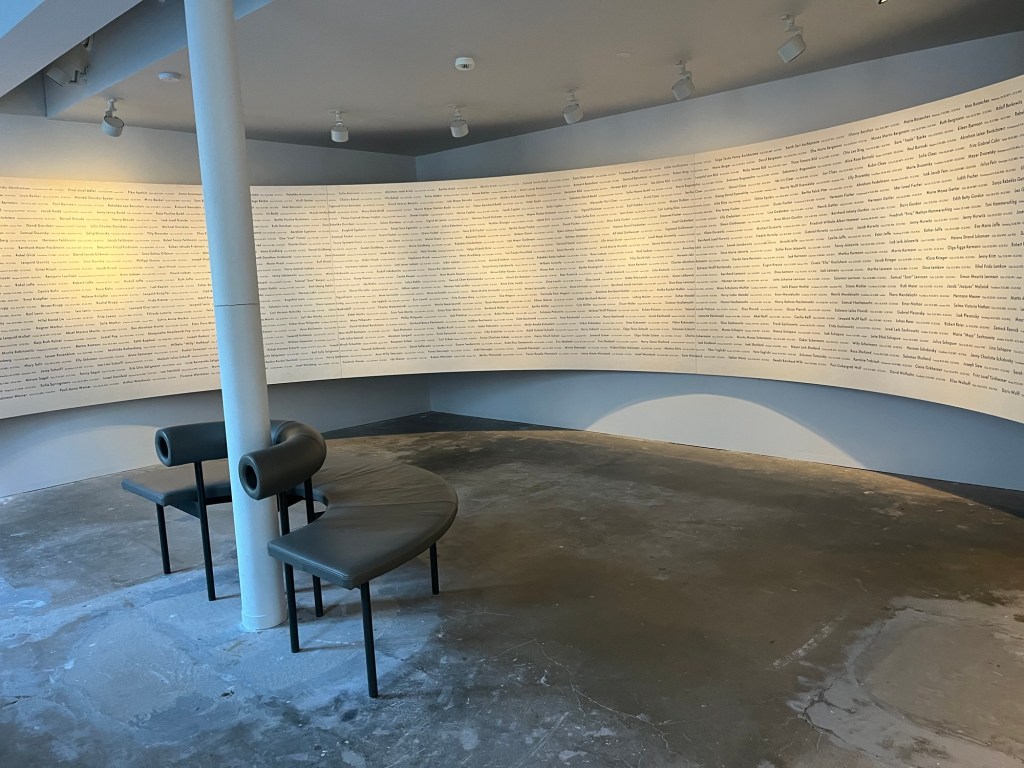
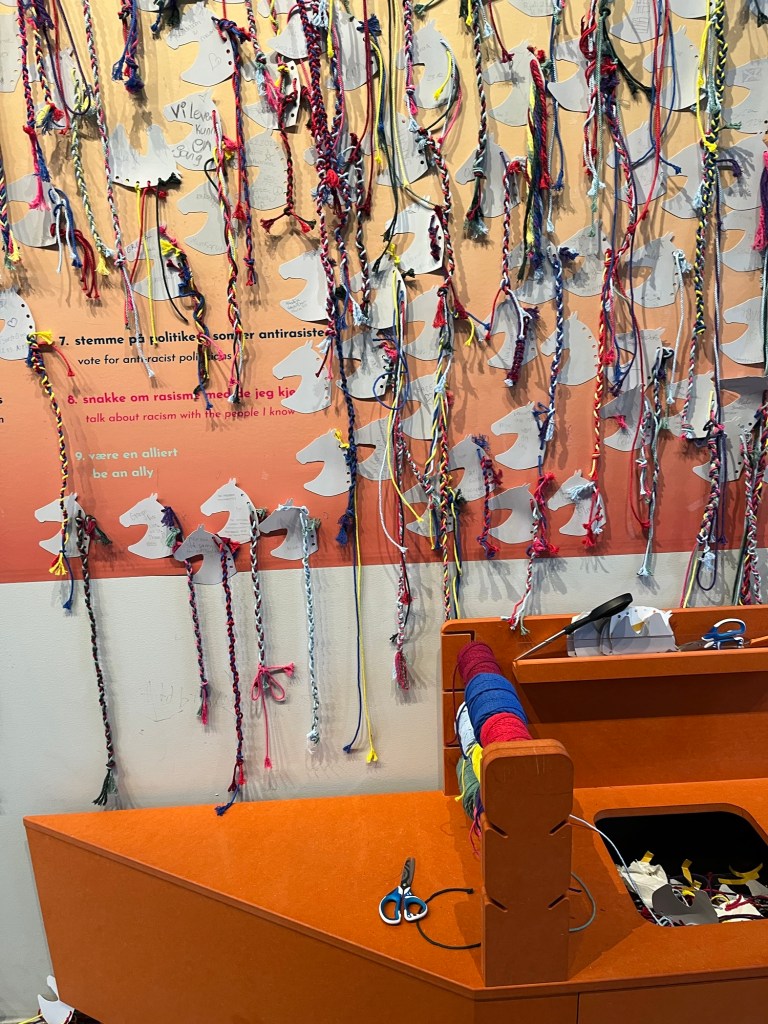
Our center visit ends in an exhibit on racism. A film shows Norwegians of all ethnicities discussing the “everyday” racism they experience. Kiosks hold artifacts and examples of racism from all over the world. There are unfortunately many American examples. Question cards encourage dialogue and understanding. It is refreshing actually. Adults and children are encouraged to choose colored string that represent actions and then to braid them as a symbol of commitment to actively work against racism. The exhibit empowers Norway’s citizenry to make “never again” more than just words. If only America had the same moral courage.
We leave the museum with heavy hearts. We walk in the sunlight and sit in the park. After a light lunch of coffee and pastry from a Narveson convenience store, we board a tram to Rose Castle. It is not a castle. It is a memorial and art installation. I am hard pressed to describe the unusual beauty of the place. An artist has painted hundreds of portraits symbolizing the Norwegian resistance to the Nazi occupation.
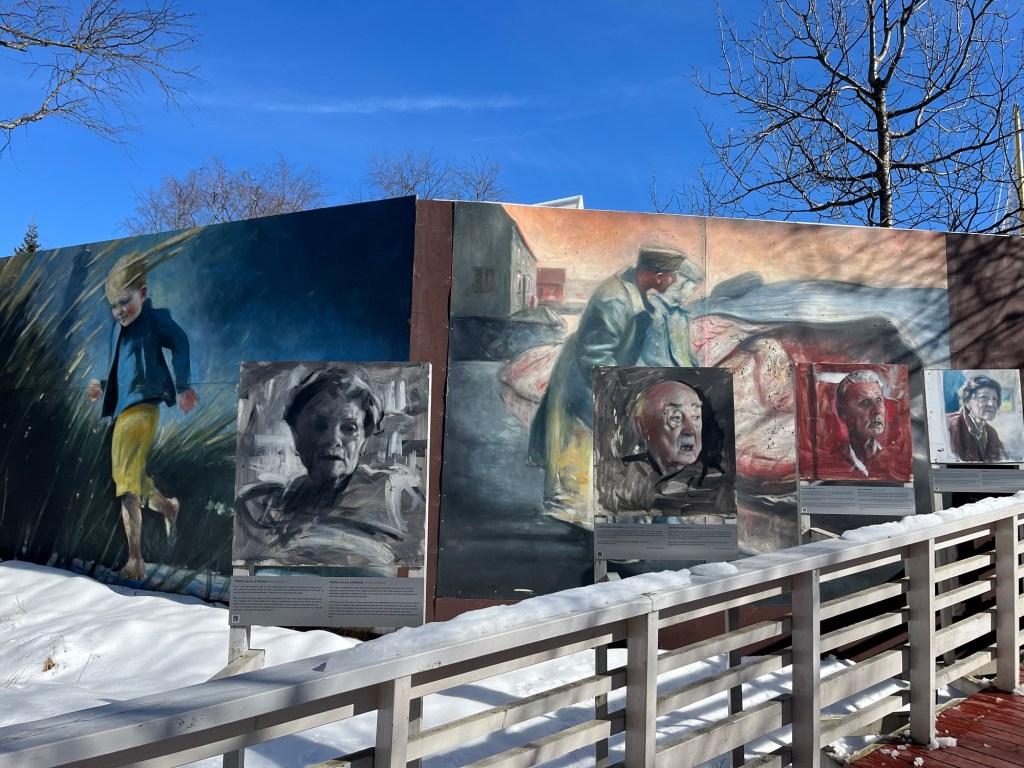
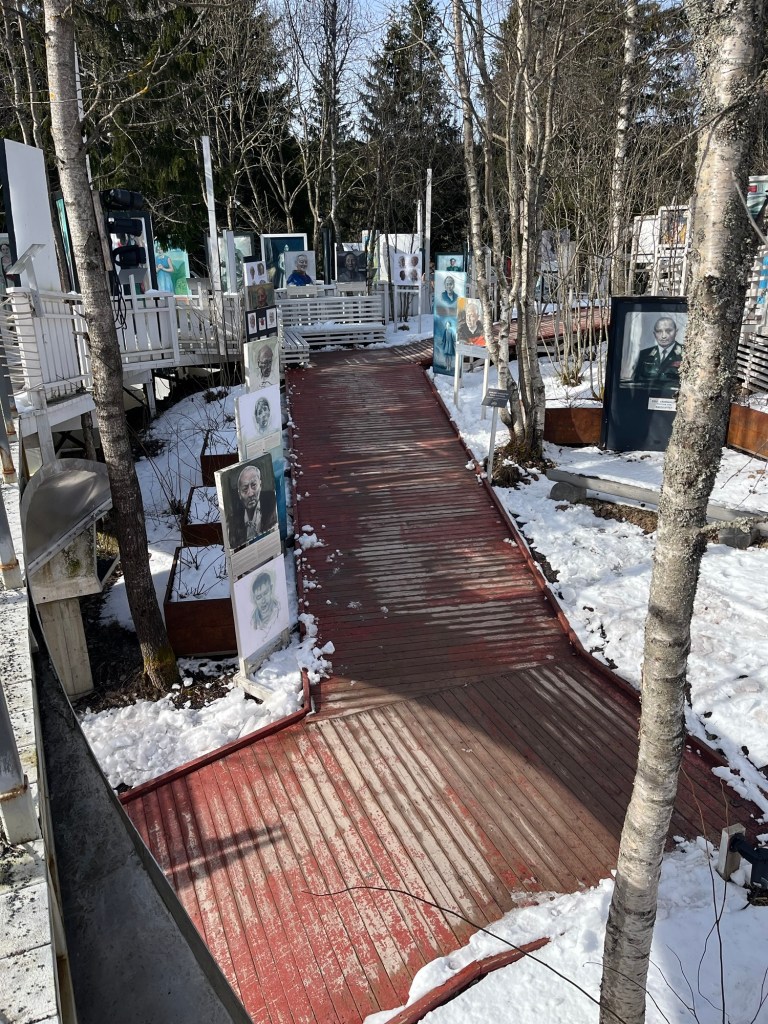
As we walk outdoors, through snow and under blue sky, we encounter hundreds of images of people who gave everything to resist oppression and forced authoritarianism. We hear stories of sacrifice and pain and triumph. The art is beautiful and haunting. The story of occupation and resistance is compelling and jarring. A white rose rises out of the snow. We learn of the secret student group, the white rose society, that resists by fighting disinformation and misinformation. Some pay with their lives. Resistance comes at a cost.

I stand in an area dedicated to Guernica, a small Spanish town that was annihilated in a single day, for no other reason than the Nazis wanted to see if their air strategy would work. If they could kill an entire town in one lightening strike…..blitzkrieg…. Homicide on unimaginable scale. In the painting, a lone nun stands and watches the plane approach. She has no time to warn anyone. Even the churches are not safe from the coming evil.

The paintings form a series of concentric circles along a path leading to a center star. The North Star structure symbolizes a beacon of hope that future generations will remember the sacrifices and protect the democracy that has been preserved.
But the most haunting monument is the small building that sits by itself to the side of the circles of paintings. It chronicles the story of a young girl who is sent on a ship with over 700 Jewish citizens to Auschwitz. Her photo shows her innocence on the day of departure as she poses with a small smile. She thinks she is going on an adventure.
In the first of a series of paintings, the artist paints her in a red coat. The next painting shows the coat in a pile of discarded clothing next to an incinerator. I am directed into the dark structure. As I enter the building, I am already trembling. Violin music plays a serene melody, a melancholy lullaby. It is pitch black and I hesitantly move forward. A portrait appears, created with paint and ashes. It symbolizes the ashes of those killed and sent to Nazi ovens, three women burning to ash. I turn to look away. In front of me, out of the darkness, a final ash painting shows the little girl rising in her ash body to join the stars.

I choke on my tears. Who does this? Who punishes children because they live in the wrong place, they have a different color skin, they speak a different language, they have unfamiliar customs, or they are an “easy” target for political gain? The bile sits in my throat as I work to tame the rage against such injustice. I am forever changed.
As we leave, I notice a portrait of a comedian who resisted by insisting “this isn’t normal”. No, sir, it is not. It should never be. If we ignore, if we look away, we are complicit.

In Norway at Rose Castle, they honor the hundreds of people standing up. . . Fighting back. . . Sacrificing all so that their country could once again be free. It is a hauntingly moving monument in the forest.
I need to sit a bit and reflect. We rest by a fire pit near the exit. Reindeer furs make the log benches extra cozy. A friendly local asks our opinion of the monument. I can’t adequately respond. He then asks what America will do in our current situation and about the motives of our President. I can’t adequately respond. I only hope the Americans are as resilient and committed to our democratic values as the Norwegians.
-
Seeking Peace: Travel Goals
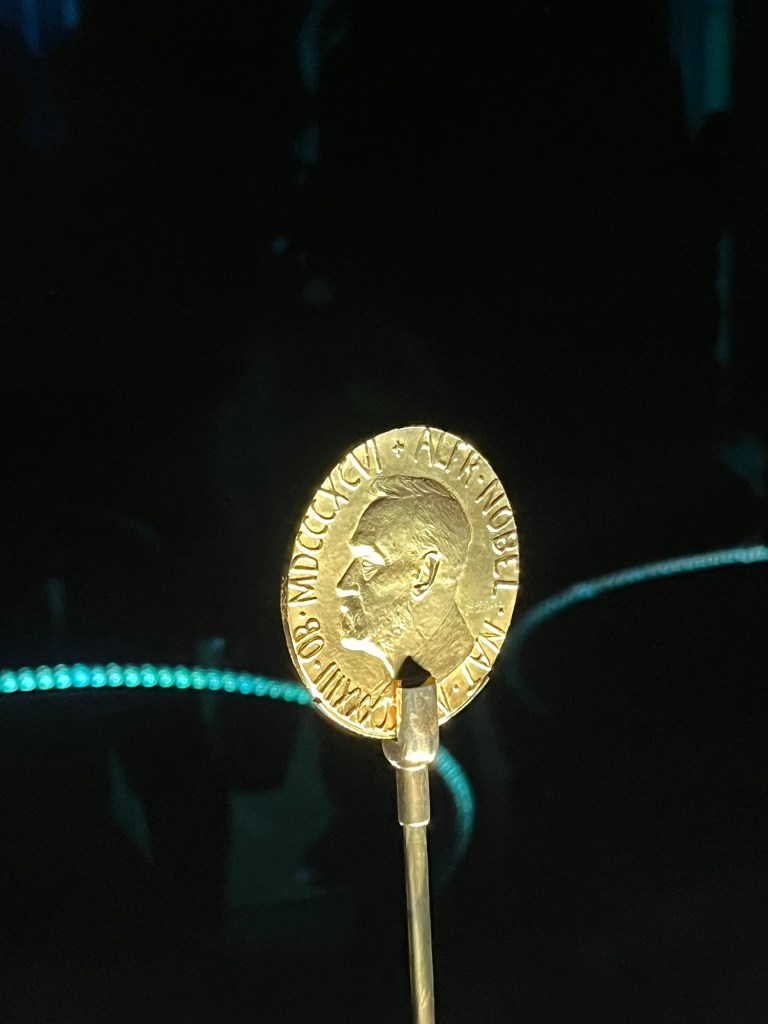
Blessed are the peacemakers for they will be called children of God. Matthew 5:9
Peace is an illusive goal. I question whether it is even possible in a broken world. Freedom from disturbance. Tranquility. A time of no war. “In this world you will have trouble, but take heart…..”
As we wander through the Nobel Peace Museum, I am overwhelmed by how many people have sacrificed so many things to bring peace. People have suffered and died to promote peace in a world all too eager to deliver destruction.
Human history is a series of struggles against tyranny and the power hungry; struggles against environmental and social destruction; struggles against vice and the money hungry; struggles against racism and misogyny; struggles against ignorance, poverty, and misplaced nationalism.
This places honors the individuals who have had the courage to stand, often alone at great personal cost, for a better way. They are builders and life givers. They are humble and deeply concerned with the human condition. Peacemakers understand that when one is diminished, so are we all. Therefore….Peacemakers do not taunt. Peacemakers do not mock. Peacemakers do not build walls.

There are many ways for evil men to disrupt peace, to divide, to dehumanize. The peace seekers attempt to educate, understand and build bridges. Sometimes reading headlines and history makes me tired. Weary to the bone. Senseless violence and destruction. Greed and avarice. Bigotry and ignorance. God help us all. Worst of all, walking these halls, I am reminded of the numerous instances of religion used as the excuse for violence, oppression, and genocide. Christ have mercy. I feel shame. My conscious is working on overdrive.

Why must we work so hard to convince people that human rights matter? Why is seeking the common good controversial and worthy of a prize? It is telling that the people honored here are seen as exceptional and the evil they have opposed is the default. I am feeling defeated that concepts I have tried to teach every day of my adult life: listening to multiple perspectives, dialogue, understanding opinion, cross checking sources, and empathy are rare skills. American social media has revealed a dark underbelly that I could not see. Now that I have seen it. I can’t look away.

But here in Norway, these ideals (that I had always believed were uniquely American ideals) are honored and talked about. In virtually every public space there are reminders and conversation starters. They have not forgotten the horrors of Nazi occupation. They understand the concept of common good. They are actively teaching their children their democratic values. I have to hope that democratic ideals are carried like a blazing torch in Europe …..and that one day they will be again practiced in America. Right now it is hard to see away out of the self imposed quagmire. Peace…..be still….
Peace keepers have to try. I have to try…..by encouraging dialogue, considering multiple perspectives, cultivating inclusion, protecting human rights, respecting the environment, promoting common good, and ….and….showing up for human decency. The same things I have tried to teach my whole life. The same things I have tried to live, albeit imperfectly. We are called to action.
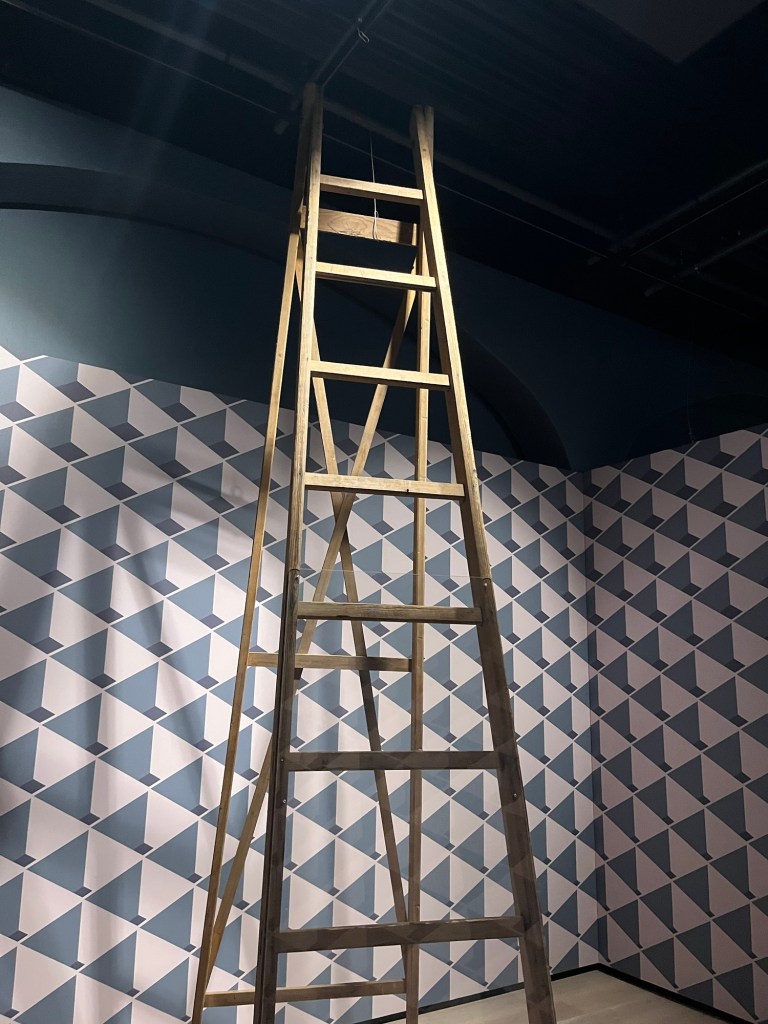
One final exhibit, reminds us of the danger of echo chambers. Just a ladder, encouraging us to see beyond the walls that divide us. A reminder that there is something of value on the other side and that peace depends on all of us. Truth. Truth. Truth. I am overwhelmed with the wisdom of this space and the enormity of obstacles in front of us. I am fearful for my nation and the world if we can’t get out of the partisan divides. It sits heavy.

After hours of emotion and cerebral thought, I need a peaceful activity for balance. So ……Norwegian mini golf to the rescue. While we don’t plan to attend the advertised naked golf or the horse meat disco, we do join several families in an afternoon of laughter and sport. They probably think we are strange, playing the holes in order and taking turns with each putt. But we are American and like our rules better. Despite our differences, a good time was had by all. Peace….
-
Ferry and Fortress: Travel Goals

It is a lazy Saturday in Norway and the sun is shining. Each morning I thank God for the health and ability to travel and experience a new life style. Our day starts slowly. I have some muesli and coffee and catch up on some reading.
Eventually we leave the house. We are in no rush. I think our weekly transport card gives us privileges on the local ferry to the nearby islands. We decide to give it a try. The first ferry we come to is the wrong dock. Thankfully I ask before we board or we would have ended up far, far away with a ticket that is insufficient for long distances. Instead, we are directed to a dock farther down the pier.

It is kind of fun to board a boat with no real idea of where you are going or what you will find. We get off at the first stop. Might as well, it is an island that looks inviting. I was expecting to find a community and instead we find a large island park. We walk trails along the fjord, enjoying the sunshine and forest. It seems a lot of locals have the same ideas.
Unexpectedly, we stumble onto the ruins of a 2nd century monastery. The ancient walls give us clues as to how the monks lived. There are a few old signs in Norwegian but I can only make out every fourth word. Perhaps I will look up more later, but for now we just enjoy the sunshine. The temperature is still cool, but after being in the arctic, it feels like a heat wave.
We ride the ferry circuit, sitting on the outside deck to take photos and admire the forest cabins and small boats of the locals who use the islands as a weekend escape. It is a lovely day in a lovely place. But I am hungry and increasingly impatient to get back to the mainland.
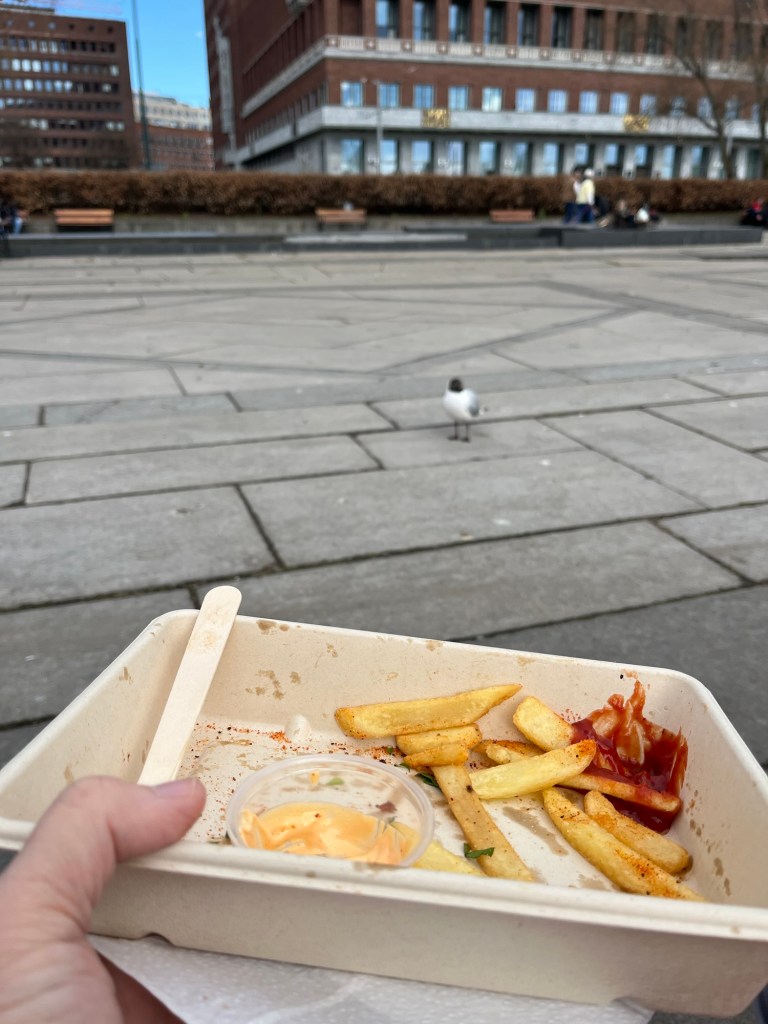
Once at the docks, I spot some food trucks. There are lots of fun options, but my guy loves fried chicken. So chicken it is. We split a large basket of chicken and fries. We decide to sit down to eat outside in the large plaza across from the city hall. The plaza is adorned by more Vigelund statues (naked people). It is also inhabited by many gulls who want our lunch. One persistent black and white demon sits and stares at my basket of fries. He chases all the other gulls away while crying “miiiiine”. The joke is on him. I don’t share food with wildlife.

Akershus Castle is only a short walk away inside the fortress. It is large and beautiful in its ramshackle way. The ticket clerk offers us senior tickets. Sometimes it pays to get a little older. In fact, most visitors in the castle appear to be retirees. The young ones are all out hiking the islands. They were arriving as we were leaving.

Some Norwegian kings are buried in the mausoleum here, just beneath the chapel and beyond the dungeons. The interior of the crypt is simple marble. The chapel is understated elegance, with carved wood altar, pulpit, and royal box. The muted colors and natural elements give a natural dignity to the spaces.

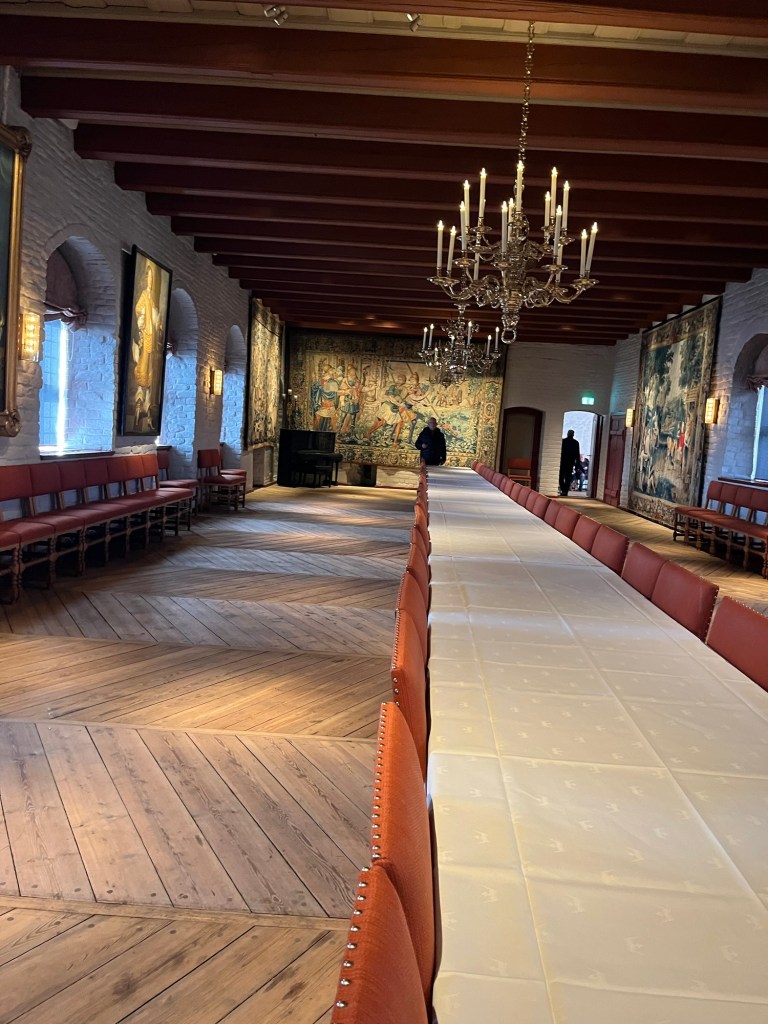
Further into the castle, the rooms are turned out in medieval finery. Ornate leather chairs and priceless tapestries fill large halls. The Danish kings once ruled Norway and decorated the rooms in splendor. But I find the the story of Queen Margaret the most compelling. She was left a widow, became regent, and ended up uniting Norway, Denmark, and Sweden in the Scandic league. Her legacy lives on in the rooms that she inhabited so long ago. They are rugged and unassuming, as she must have been.
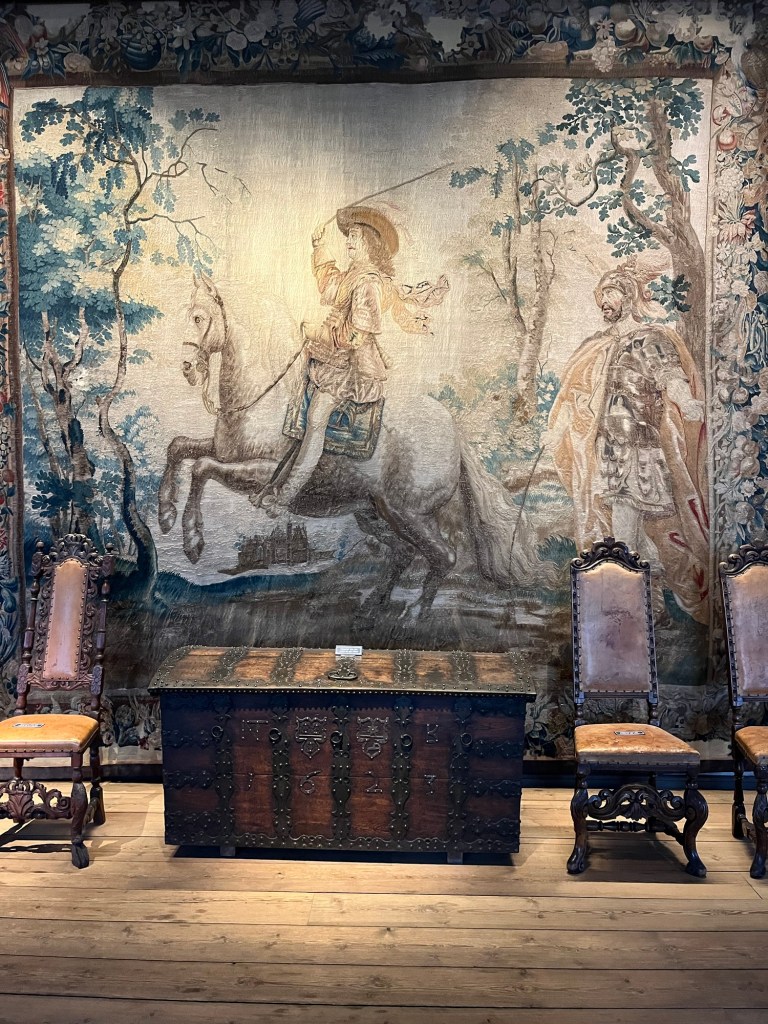
I giggle as we move throughout the castle. No matter where I turn to take a photo, there is one lone old man. It is not always the same man. Just a man, usually standing aimlessly in front of the central point in the room. Often he is looking at his phone. Oddly he usually looks like Bernie Sanders. I wait patiently for the man to move, but if he is entrenched and also oblivious, it is impossible. So I have lots of photos from Norway featuring men who look oddly like Bernie Sanders.
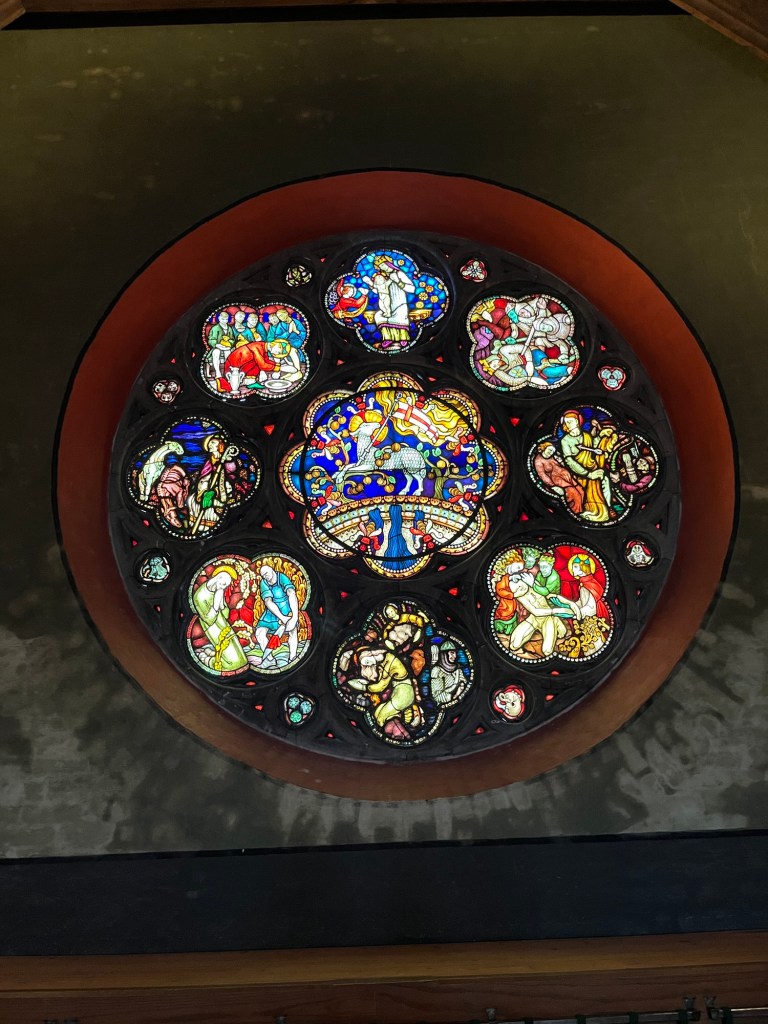
In the final room, a beautiful stained glass masterpiece dominates a wall. The colors are radiant in an otherwise dark room. Sketches on the opposite end of the room show the construction and planning of the glass work. I am surprised to see the artist is Vigeland. So far all of the many pieces we have seen have been bronze statues of naked people. This is different and wonderful. Because it is a different Vigeland. Emmanuel not Gustav.
It is a full day. A beautiful day. Sun and sea. Castles and parks. Ferries and fortress. This is the day the Lord has made and I am rejoicing and glad in it.

-
Paradoxical: Travel Goals
We are walking and looking for a small museum called The Paradox. It is cold and misty. Although the gps ultimately got us to the right place, there was no visible sign. We walk by it twice before we notice a worker in a Paradox jacket in a doorway. We have arrived, even though we still don’t see a sign. They aren’t open yet so we walk around the block.

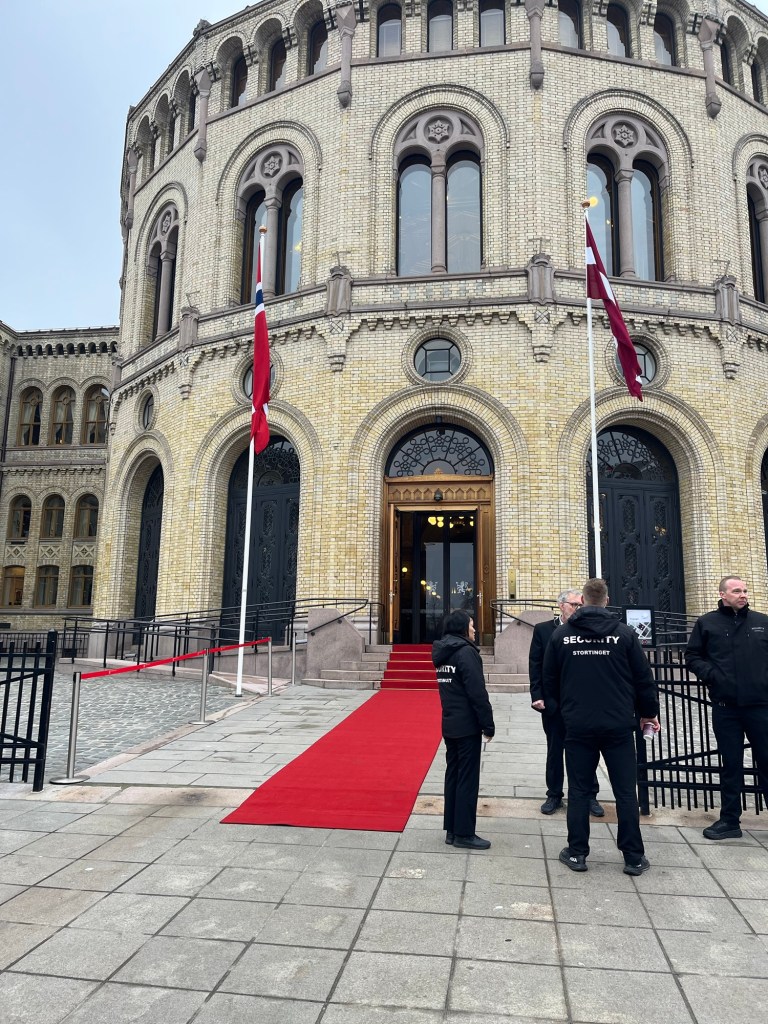
There are police cars lining the street between the Grand Hotel and the Stortering (Parliament) building. Officers line the street and politicians mill around outside . We gawk and walk among them. Oslo natives walk on by like it is a common occurrence.
We walk up to the open doors of Parliament where there is a red carpet and people taking photos. No one seems to care that we are there. We don’t know what is going on. It is a paradox to be part of something important in such an ordinary way. Two tourists walking up to the parliament without a clue… but as a historian/political scientist/sociologist, it is fascinating. Maybe later I can look up the official record of what is happening.

Curiosity keeps us longer than we intended and by the time we make it back to the museum there is a line of families. The Paradox museum is made up of seventy exhibits of optical illusions. Some are interactive, some informative, and some are just fun photo opportunities. We act like big kids playing among the exhibits (often competing with actual children for exhibit space).
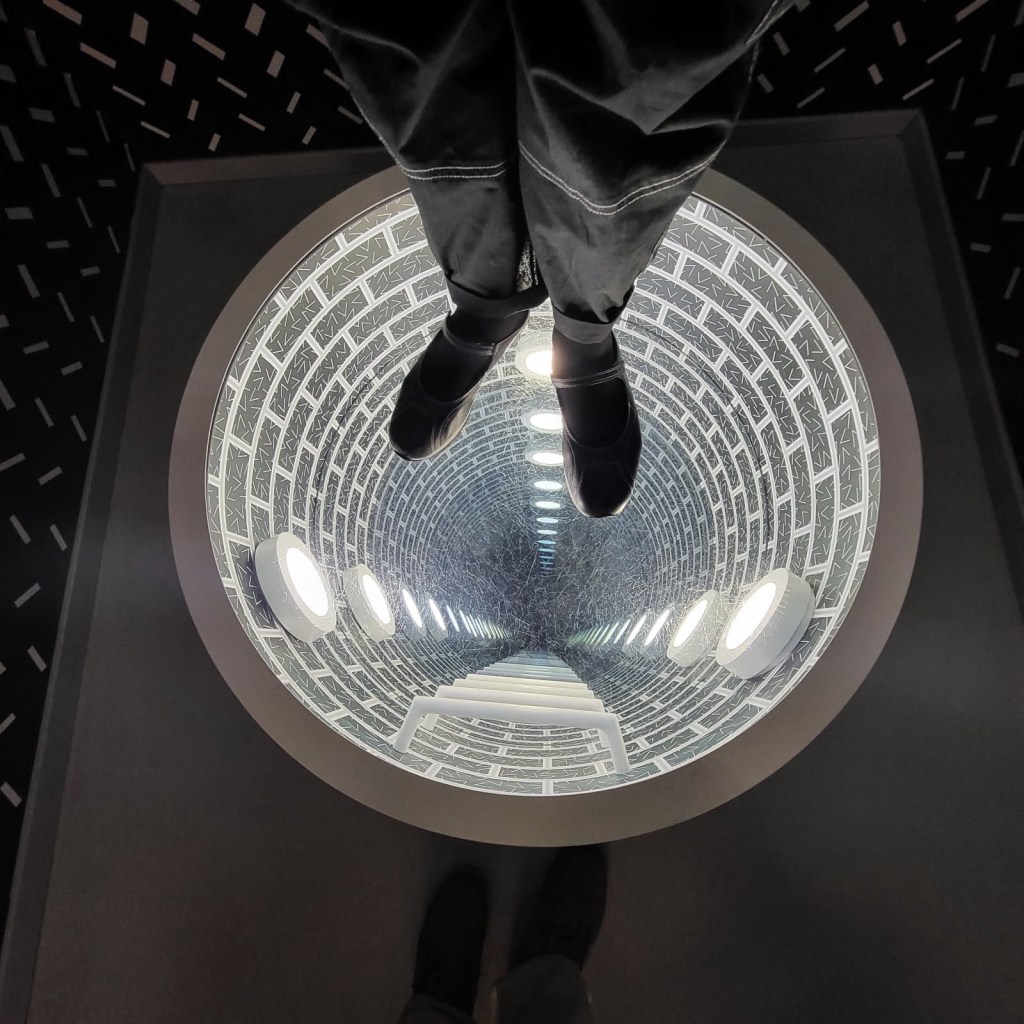
There are halls of mirrors, tables with floating heads, 3d pictures, camouflage walls, and a variety of mazes. We giggle and take a lot of pictures. I am a giant. I sit on a couch where my body looks separated from my feet. I stand on a bridge where the walls seem to spin around me. Big fun.
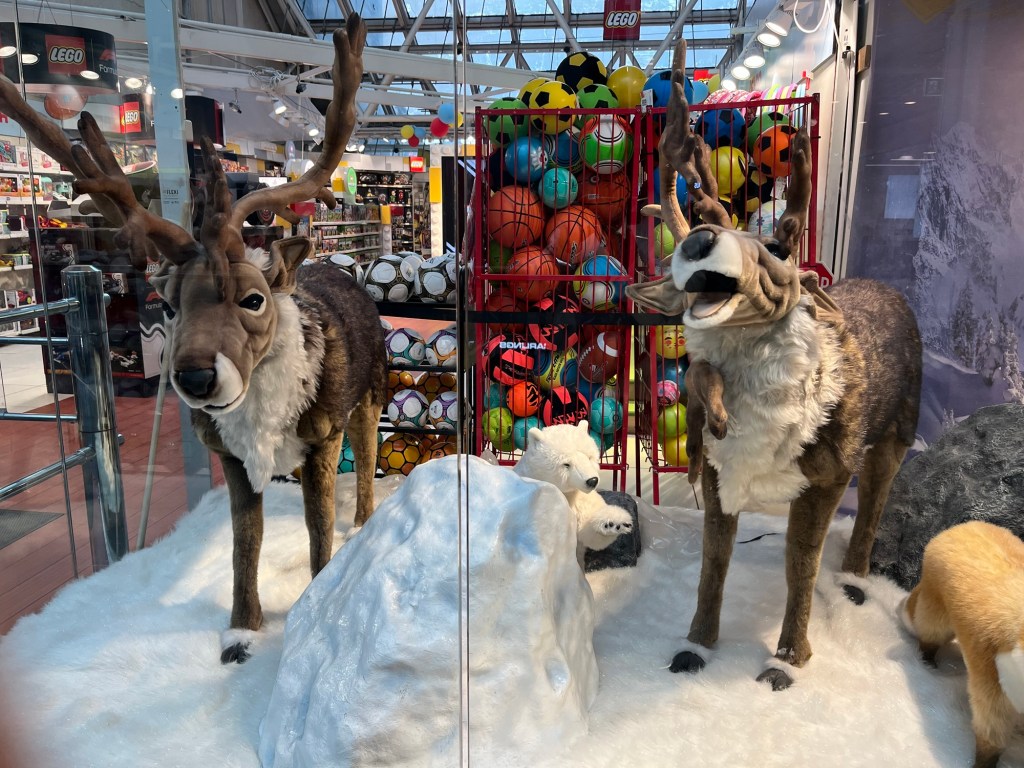
But all good things must come to an end. Hungry, we head to Pepe’s Pizza. They are everywhere in Norway and claim to have the best American style pizza. We order a large Philly cheesesteak pizza. I can’t say it is the best in Norway (because it is the only pizza I have eaten in Norway), but it is great. Two thumbs up.

The day is still young so we decided to visit a few shopping centers in the downtown area. They are arranged vertically, usually several narrow stories high. Escalators take you between levels, but the down and up escalators may or may not be near each other. This means that when I leave my husband near where I head up a floor, I may have to find him again when I come down (it will help if I can remember the name of the store where I left him).
Items are expensive in Norway. It doesn’t seem to matter what I am buying, prices are roughly three times higher than I normally see at home. The only notable exceptions are batteries and backpacks ( roughly two to three times lower). Needless to say, I do a lot of window shopping.
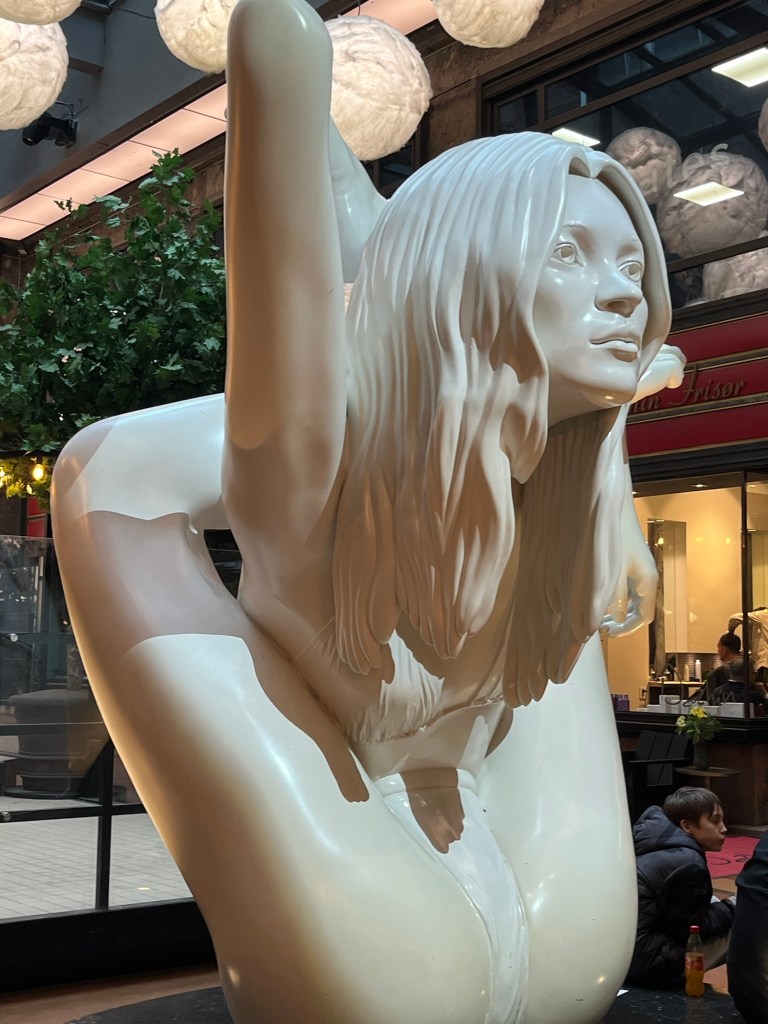
Even so, people watching is fun. So is taking in the public art and architecture nestled among the shops. I could wander in a city for hours doing nothing but soaking in the cultural differences. What might be mundane at home is suddenly exciting in a new context. That is not a paradox.
-
Parkering: Travel Goals

Norway is full of surprises. Everyday we find something strange (to us) yet wonderful. Brown cheese is the best! Skiing to town! And amazing public transport….America has a lot to learn.
On almost every corner we find a sign that reads “parkering forbudt” which means parking is forbidden. Because public transportation is so wonderful, parking is largely unnecessary. Car traffic is minimal. We hop a bus or maybe a tram (both are viable options) to Frogner Park.
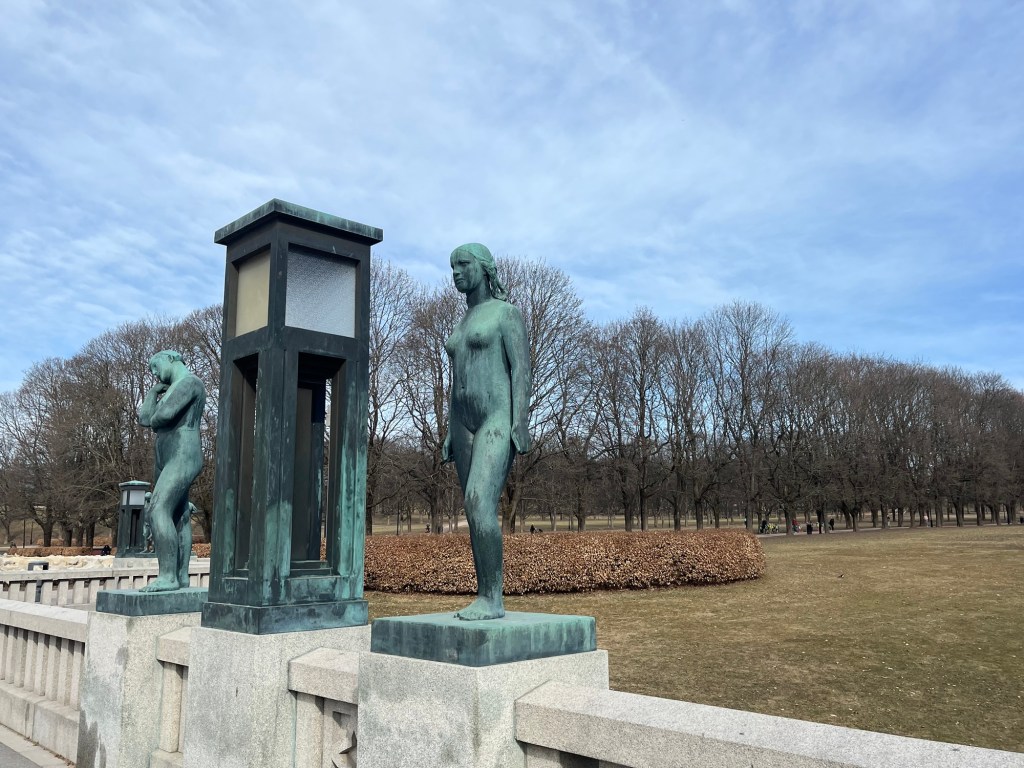
Because today, we are parkering ourselves (see what I did there) in Frogner Park. It is a very large urban park and also home to hundreds of statues by the artist, Gustavo Vigeland. Born Adolf Thorsen, he changed his last name to honor the area where he grew up. Vigeland worked as a sculptor at Nidaros cathedral, studied with Rodin in Paris and is considered the most prolific Norwegian sculptor.
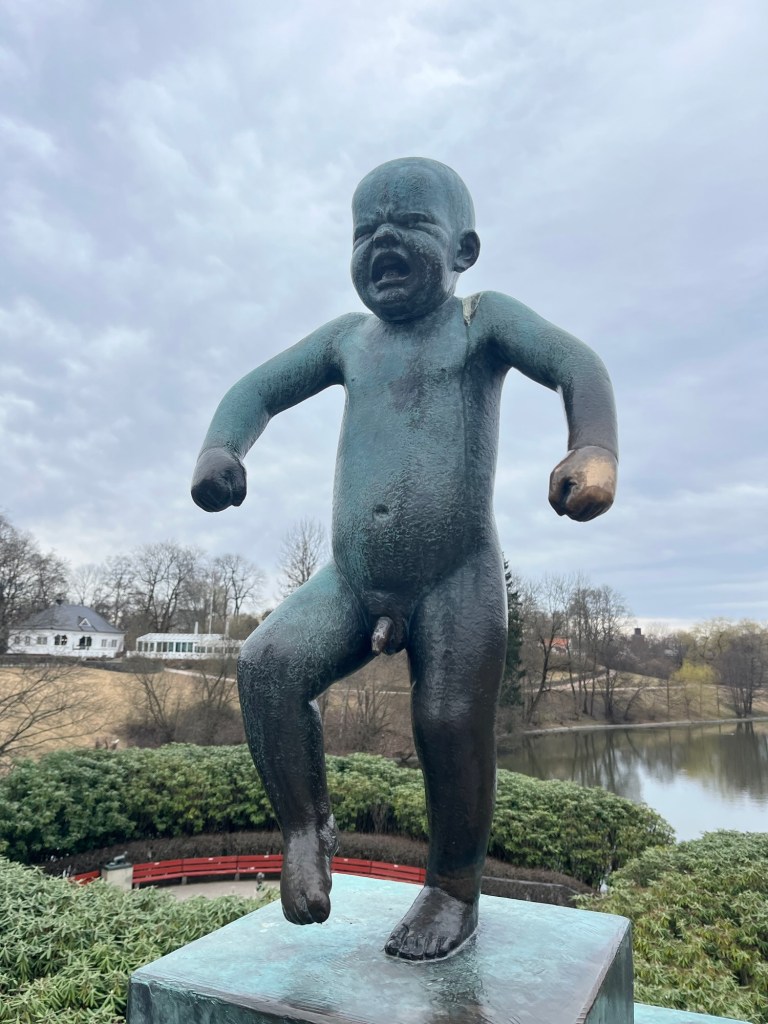
He is best known for the 212 pieces installed in Frogner Park. Large naked figures convey humanity in all of its moods. My favorite in his collection are the children, looking sassy and moody. I recognize the expressions. A perennial favorite is the iconic angry baby. I am especially drawn to a sculpture of a small girl looking angrily at an older brother who is looking back with a “what did I do?” expression. Art imitating my life.
At the end of the park we find a lovely cemetery and decided to take a walk through. People are strolling in the park like setting. I stop to photograph the military monuments honoring those who died in World War II. Directly across the lane, we find a small, seemingly unmarked grave with American flags.
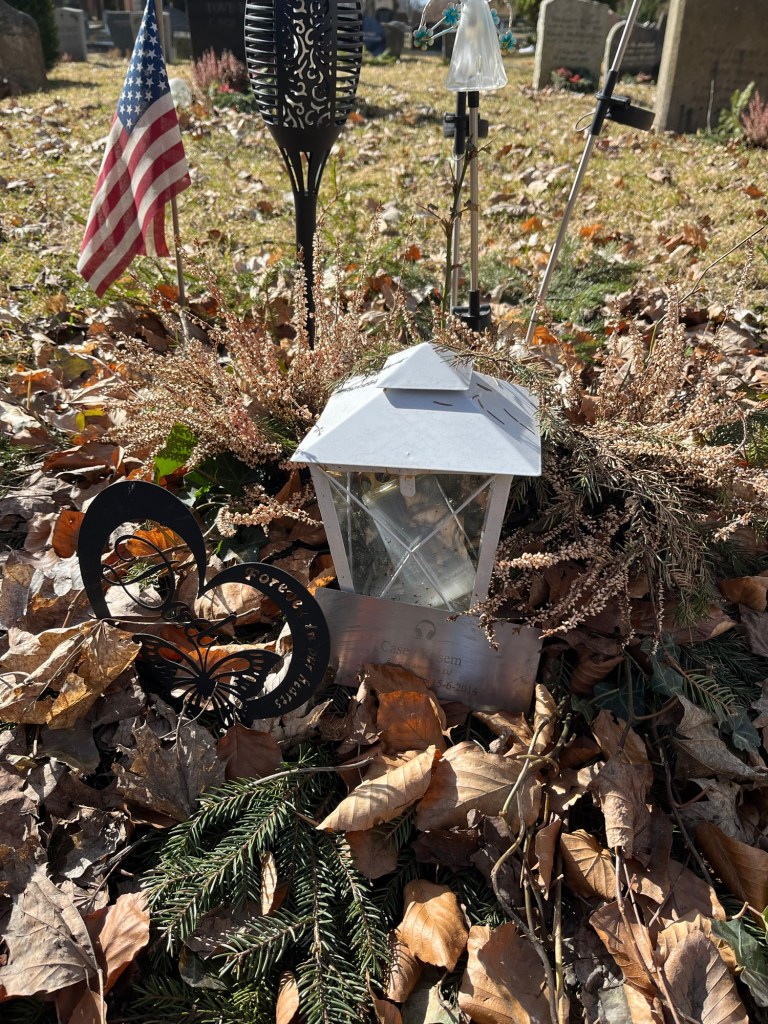
Curious, I walk over to see why a grave without a headstone is adorned with Old Glory. Upon closer look, we see that the grave belongs to America’s Top 40 DJ, Casey Kasey.
This seems strange. Via the magic of the internet, we discover that he wanted to be buried in the U.S.. But there was a family fight, and his wife had him buried here in Oslo. It apparently was quite ugly and fraught with the controversy. It is sad. I am saddened that he doesn’t even have a grave marker. This man was an important part of my youth as I tuned in each week for the countdown. We pay our respects.

There is something peaceful about older cemeteries. The birds sing. Graves from WWI and WWII in military rows convey a sense of order and gravitas. Monuments to British soldiers who gave their lives defeating the Nazis are covered in blankets of fresh greenery. The breeze whispers through the trees.

Eventually, we cross back to Frogner park where preschoolers in their yellow safety vests run and play. Mothers pushing large prams stroll leisurely through the park. Dogs and their owners frolic on the lawn. Endless busloads of tourists make a mad dash to take photos of the sculptures. Meanwhile we are parkering on benches and the cafe.

I sip coffee and eat a surprisingly good slice of key lime pie. We people watch and enjoy the bright sun. Walking the street to the tram, we find interesting art installations, coffee shops, and a public library. The buildings in Frogner are a mix of apartments, businesses and small shops. It is a vibrant and welcoming neighborhood. But all good things must come to an end.

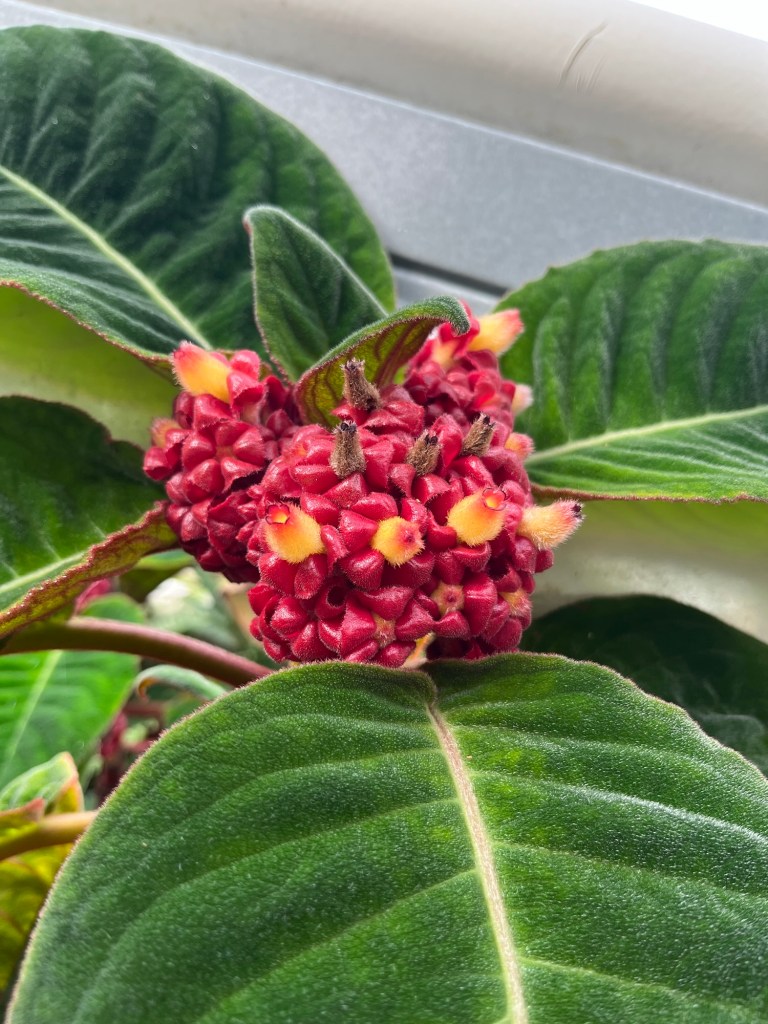
Back in our neighborhood, I talk my husband into visiting the park across the street. It is a lovely botanical garden and the greenhouses are open. It is very hot inside compared to the cooler outside weather. But there are lily pads and Venus fly traps. Summer blooms and tropical vibes…. I think I will also be parkering in this park … at least for awhile.
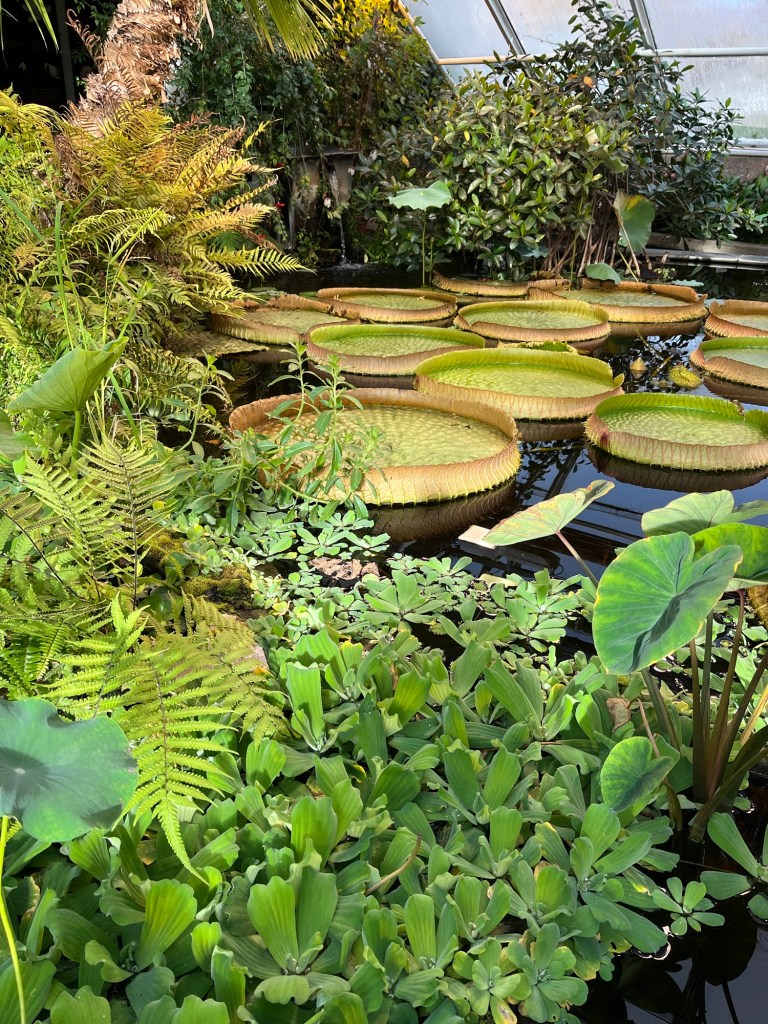
Parkering in the park. We sit down for yet another cup of coffee in a lovely courtyard and catch the lingering sunshine.
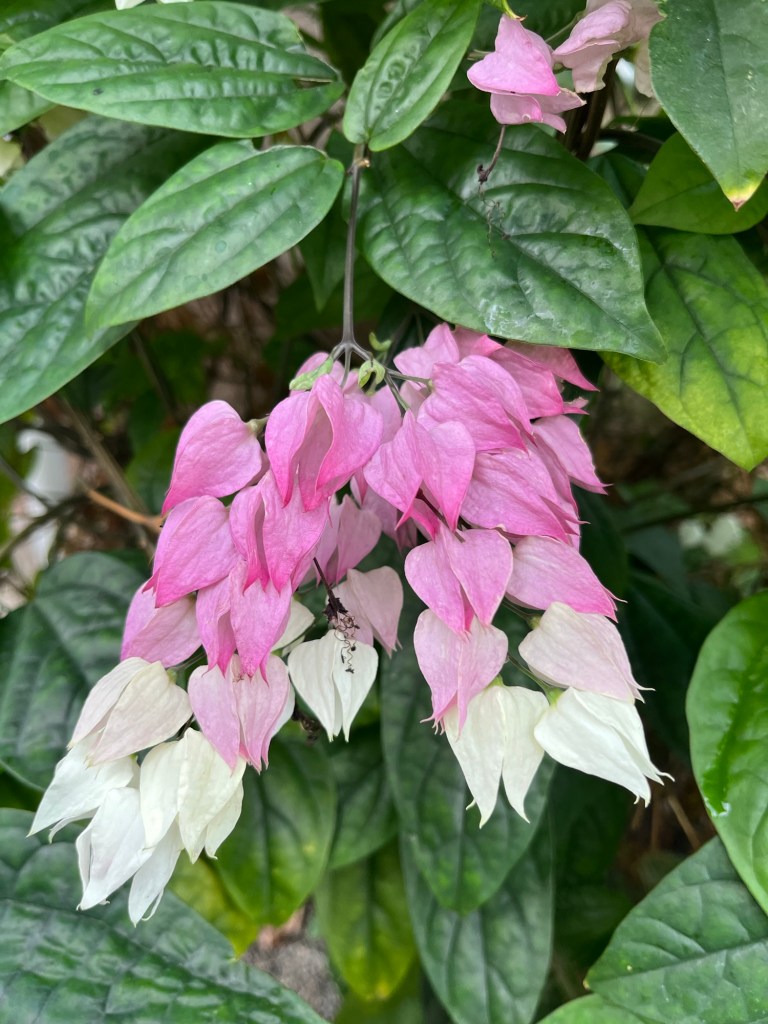
Parkering in the park…. I like it……
-
Time Traveling in Oslo: Travel Goals

I love outdoor history museums. The Norsk folk center in Bygdoy did not disappoint. The Norwegian King had entire neighborhoods and farms and other random buildings moved to this park so that visitors can experience life across Norway. We get there early.
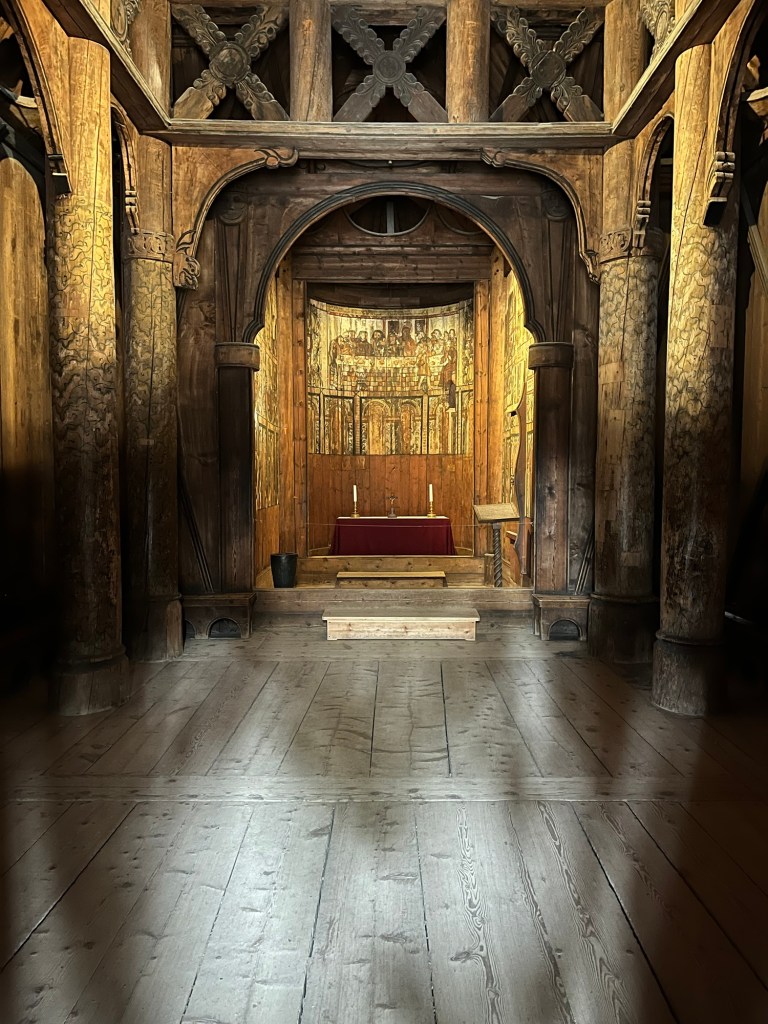
I am excited to arrive at the Stave church before any other visitors. We are able to admire the dragon carvings and dark church interior undisturbed. Inside, a unique last supper scene carved in wood is the only adornment. Pillars and beams take up most of the space. Despite the exterior size, an interior gathering in this structure would need to be small and intimate. It is rustic and wonderful.
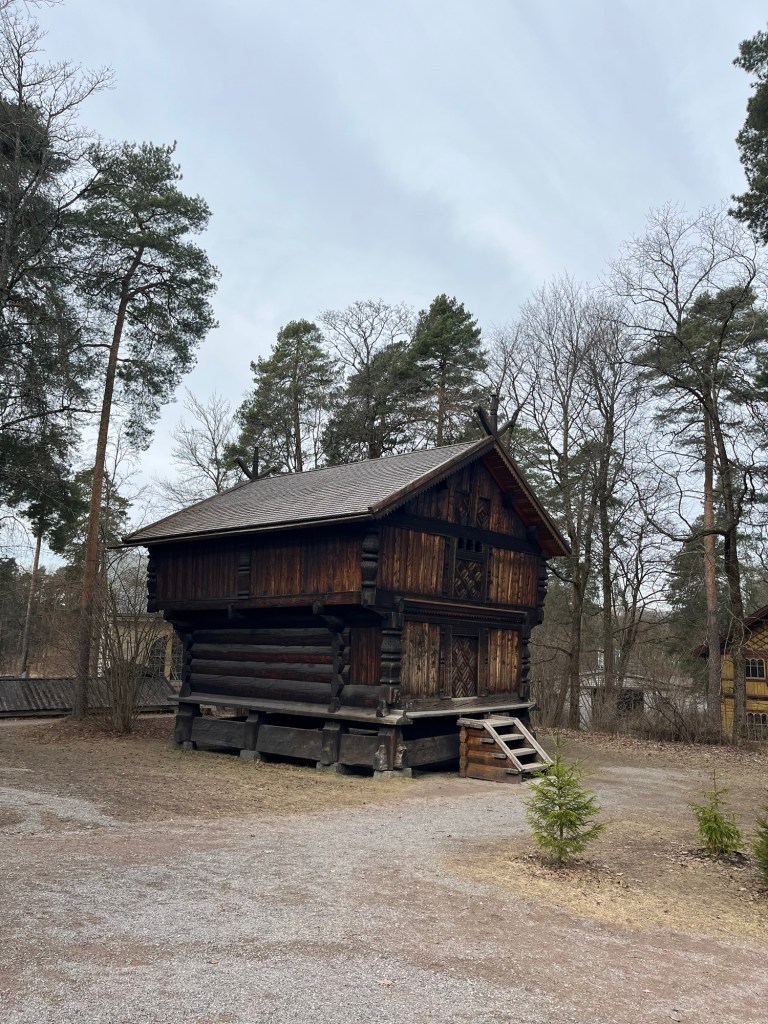
Even the storage house nearby, is a great example of the craftsmanship of expert wood carvers. There are dozens of these multistory sheds or barns on the property. Farmer’s storehouses expertly carved in wood with slate or earthen roofs are literally everywhere.
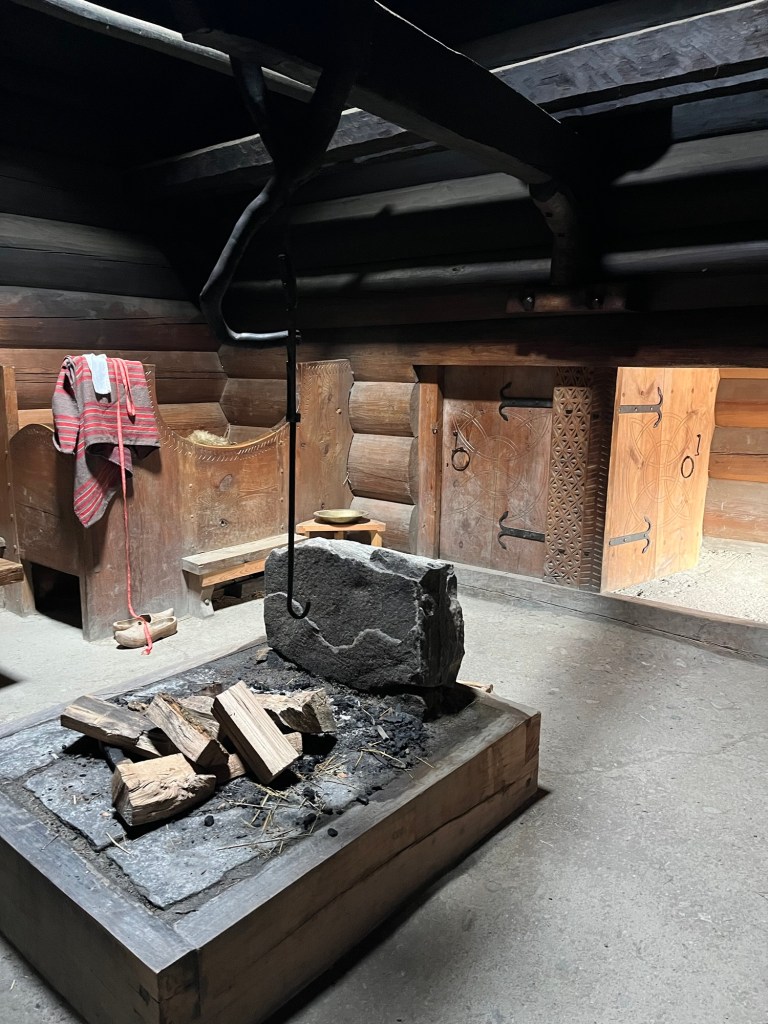
There are dozens of houses and farm buildings representing each region in Norway. While some are closed, most are open for exploration. This allows us to experience what a Viking cabin might feel like, complete with an open fire and beds in wooden stalls. We tour school houses, farm houses, coastal cabins, and apartment blocks. Ancient to modern Norway, traversed all in an afternoon.
In a gathering of Norwegian architecture like this, it is easy to see the evolution of carving and painted interiors. The farmhouse furniture is predominantly long benches and tables in open rooms. The city houses favor small rooms with small chairs tucked into snug corners.

After several hours of touring the houses and farmsteads, we walk through wonderful museum spaces filled with decorative arts. Ornate weapons, sleds, tapestries, chests, bowls, and other precious artifacts are span across time. Spaces hold interactive timelines and information about each preservation artifact.

Exhausted after several hours of immersive history, we stop to have a sandwich in the cafe. Of course I want a peak in the shops, but as I was doing so I notice one final exhibit. The recreation of Norways first parliament. If there is a building they left out, I don’t know what it could be. Today I walked farms, barns, schools, manors, cabins, prefab houses, apartment blocks, churches, shops, and more. Truly a wonderful museum in Oslo. There is no better place to time travel through Norwegian life.

-
Jump: Travel Goals
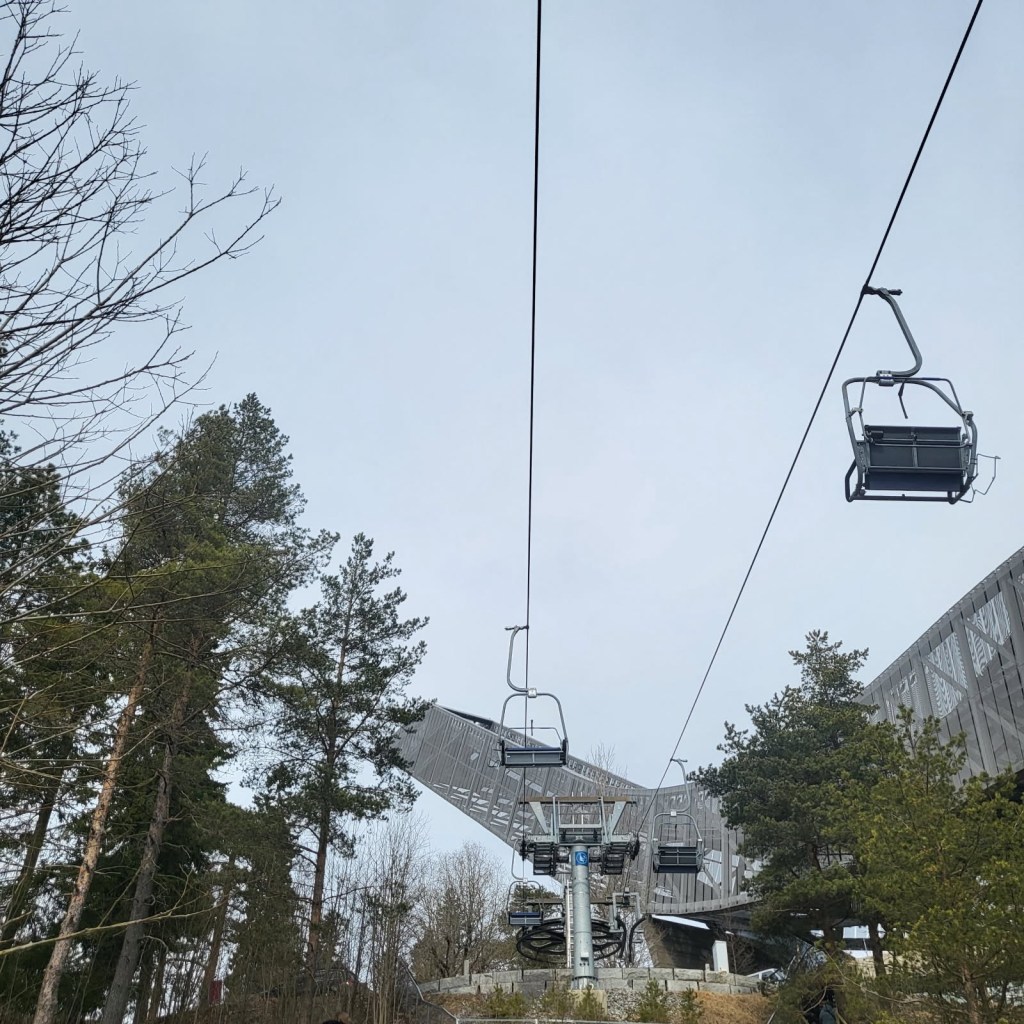
Norwegians love skiing. In Tromso, they ski to work. In Oslo it is warmer, so they have indoor skiing and they have snow machines to maintain cross country trails. But the king of the mountain is the Holmenkollen ski jump.
We take the tram up the mountain to Holmenkollen and then walk uphill to the massive, world class ski jump. The top of the jump is accessible through the Norwegian ski museum.

I find the Museum delightful. In case you wonder if Norwegians were born in skis, yes they are. The museum has video footage of six month olds happily skiing and the tiny skis to prove it. It truly is the national pastime.
The museum also has exhibits on polar expeditions, prehistoric skis, and Olympic athletes.We try a ski simulator that lets us know what it feels like to ski jump and also to complete a downhill race. It isn’t real yet. I am not even on skis yet I am sure the bunny slopes are for me. We try a ski race and pack pulling machines. My husband is stronger and was a little faster….at least this time.
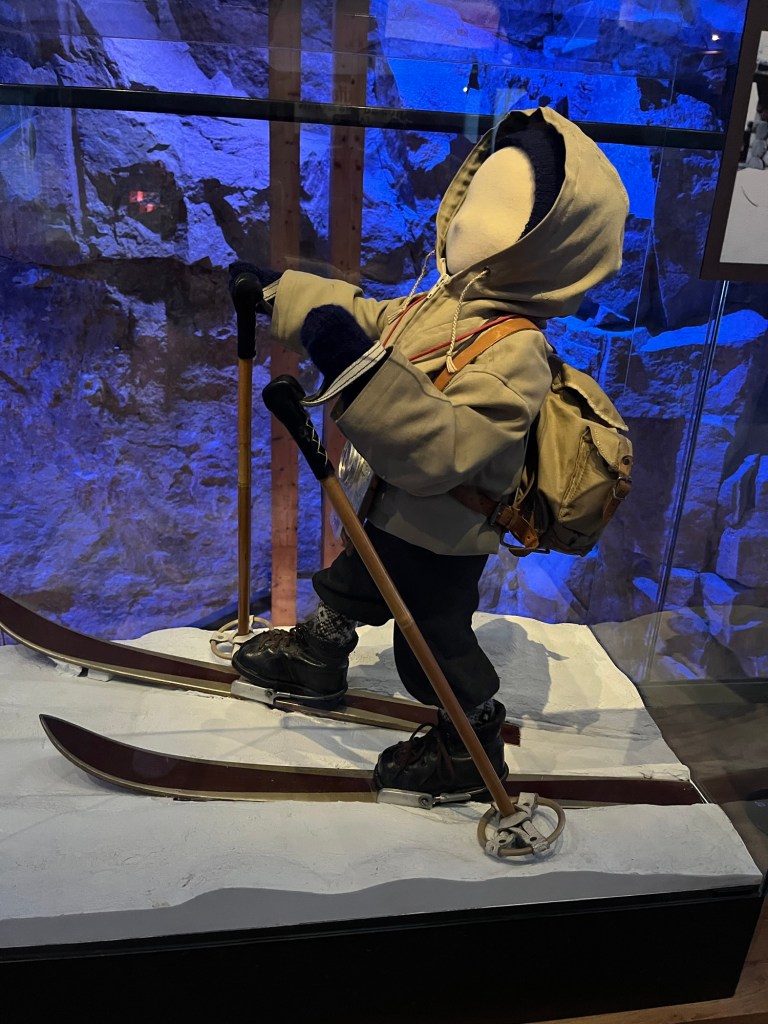
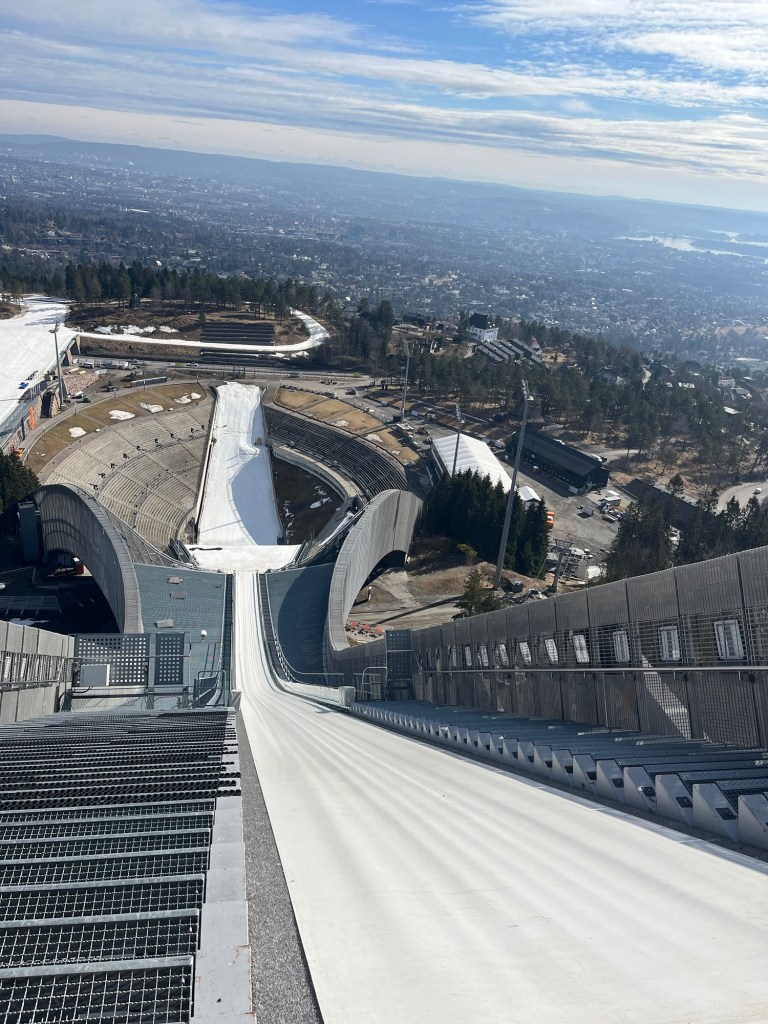
After goofing around the interactive museum, we take the elevator to the top of the Holmenkollen ski jump. The view is magnificent, beautiful, and vast. Mountains, city, and fjords. But the the big draw, the view off the starting gate onto the jump is terrifying. Who would do that? No. No way. Nope.

I can’t imagine the adrenaline athletes experience as they take a ski lift to the elevator and emerge on the platform. Thirty thousand people cheering. Medics standing by. They hurl themselves down the slope to hit the curved jump. They fly hundreds of feet in the air only to land on an even steeper slope. They then must turn and slow before reaching the end of the track. I would love to witness the sport live, but my advice to anyone I knew and loved would have to be …. Please! Don’t jump!
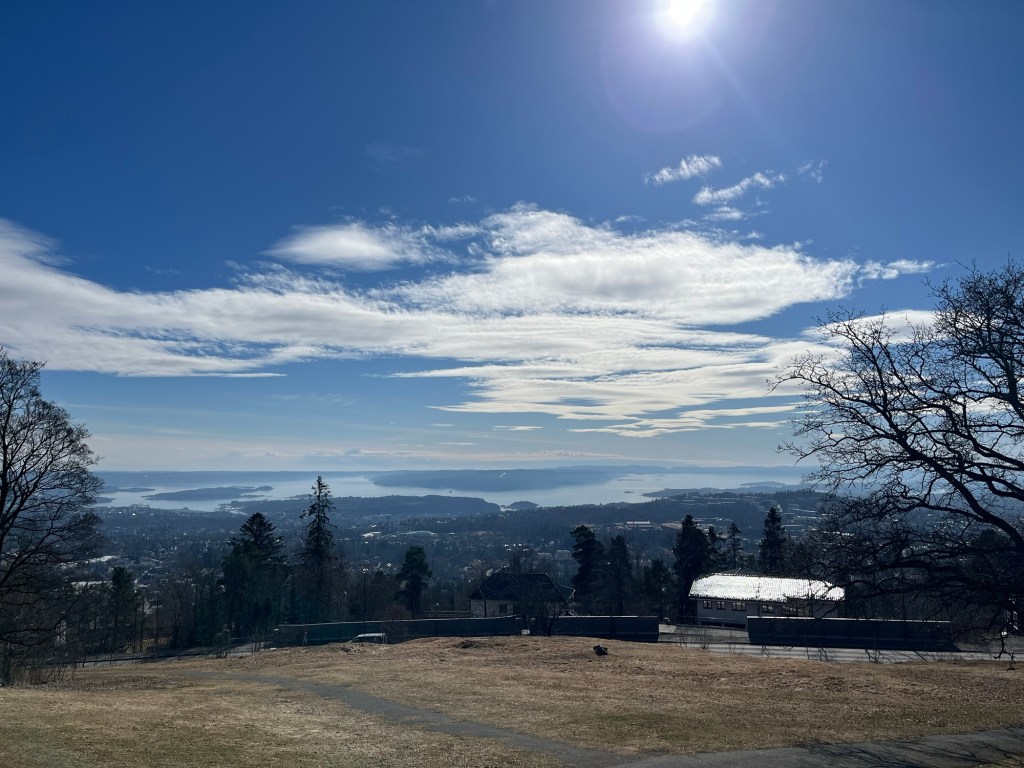
We talk about the craziness of it all as we walk back toward the train. We find the lovely Holmenkollen restaurant on a hill with an awesome view of the Oslofjord. The vibe is mountain cabin retreat complete with woodsmoke and antler motif. Throw in a little jazz music and sunlight on the fjord below…Heaven.
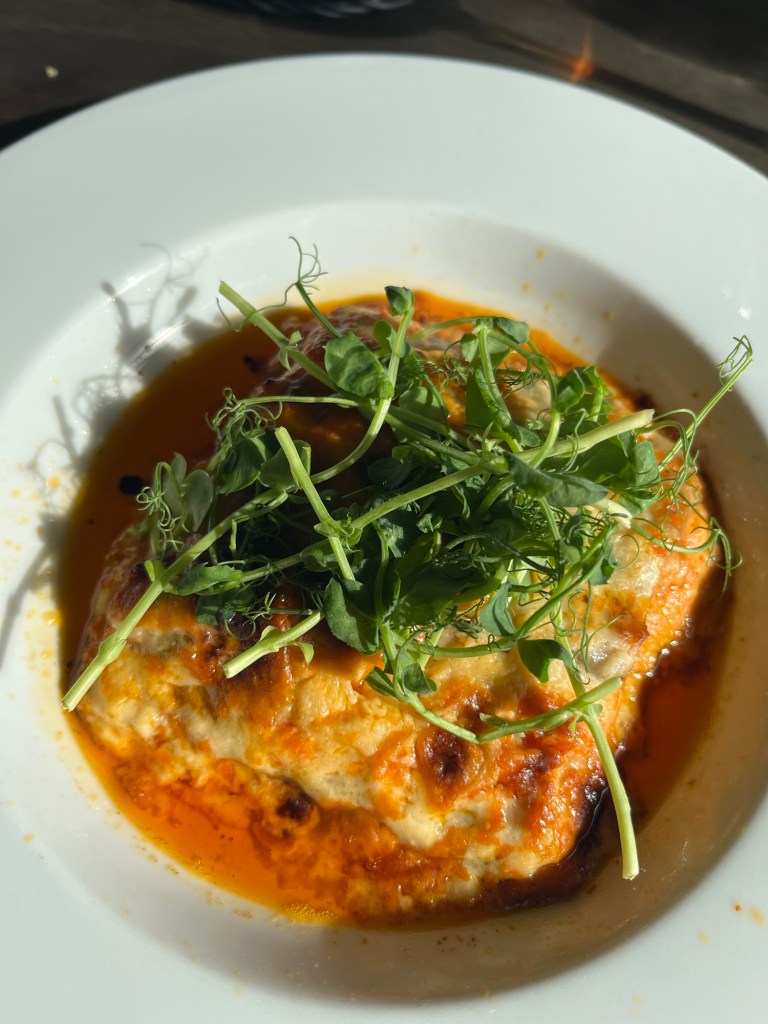
I have eggplant. It is delicious, but even if it was not. Just come for the view. I am lost in the moment. A good meal with great ambience. I almost don’t mind the sky high Norwegian food prices. Almost.
We wander down the hill. I am amazed we are so close to the massive ski lift that be seen from almost anywhere in Oslo… and we can’t see it. We are literally underneath it and it has completely disappeared from view. Perspective. Angles. How strange to know it is there and not be able to find it.
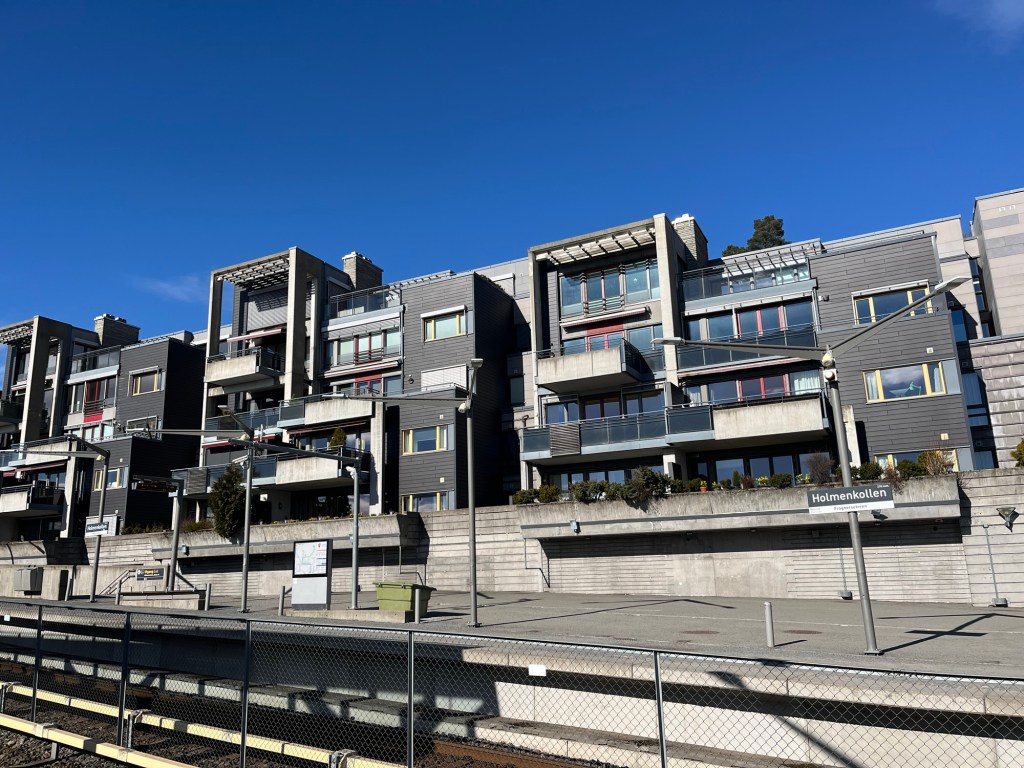

Partway down the mountain I cajole my husband into getting off at a stop with hiking trails. I want to see where they go. Just a short way into the forest, I see more ski jumps in various sizes. Baby jumps that would still scare me to death. We hike to the complex. These Norwegians are crazy….about skis.

Back at home (our Oslo apartment), I take a walk in the garden across the street. I find bees and Spring flowers. I soak up sun and stop to smell the aroma of tees and mulch.

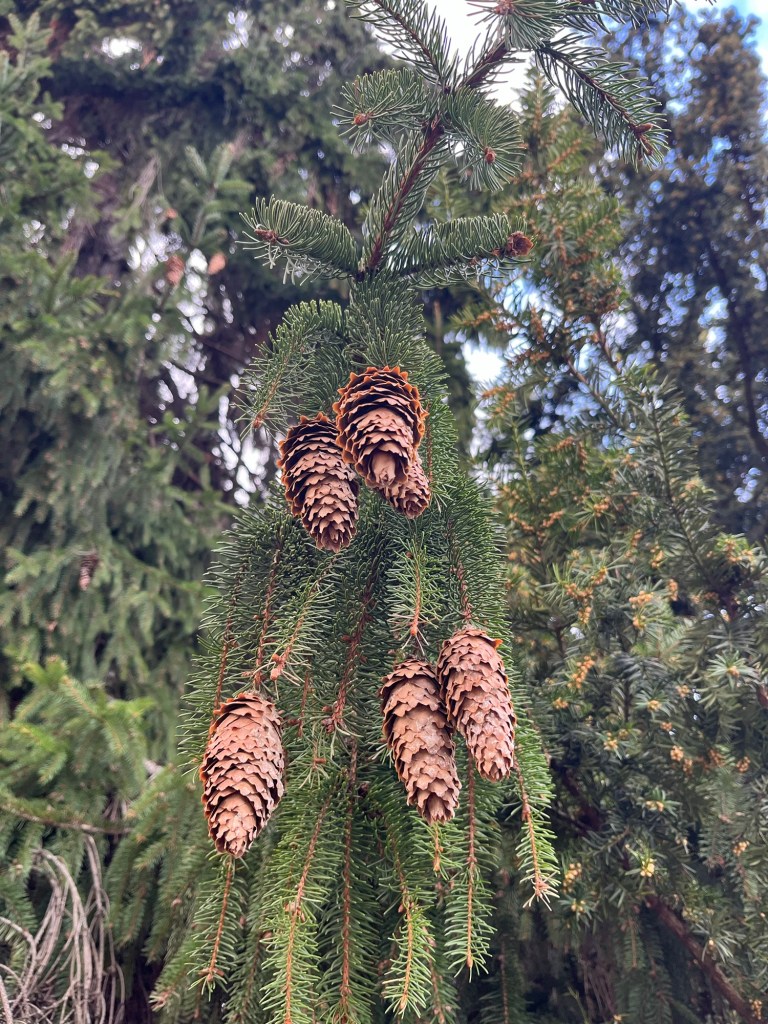
I linger among the pine trees and touch the cool bark. I tell myself I am made for this, to be grounded to the earth. I belong on land. Others can jump and fly through air. I am made to hike and walk amongst the trees.
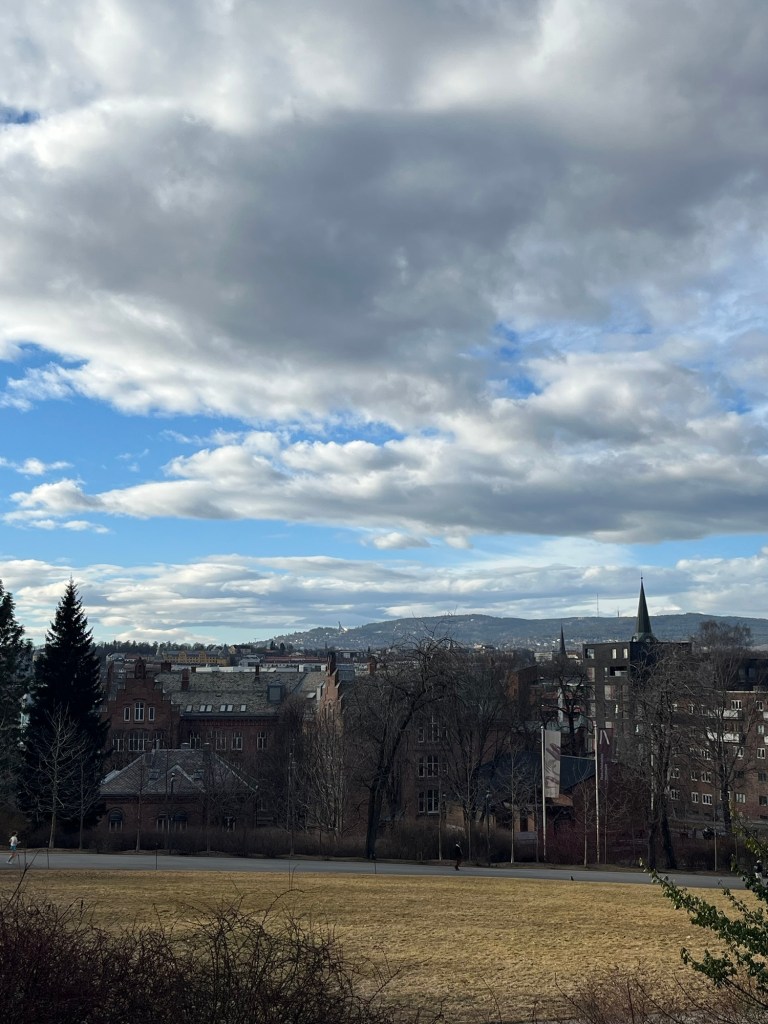
As I round the corner and top the garden path. I look up and see Holmenkollen high on the mountain. Jump….it taunts. I wisely remain grounded…. And always will.
-
Military History: Travel Goals
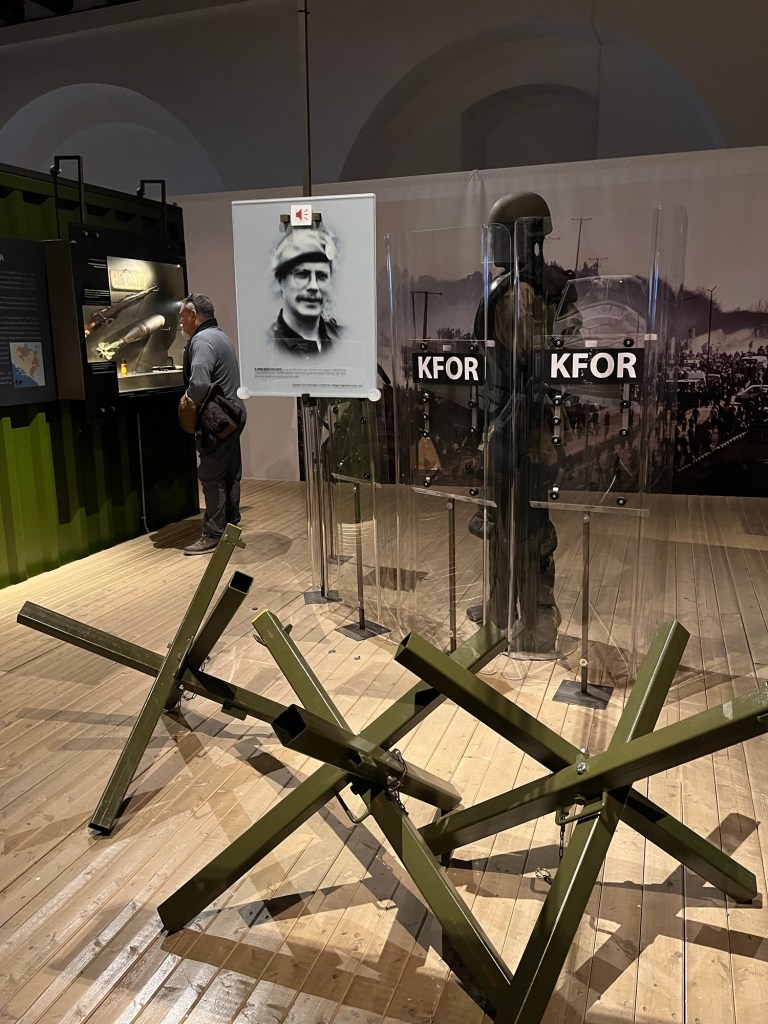
We aren’t sure what to expect at the Akershus Festning (Fortress). We walked by the large park/military complex when we first arrived in Oslo (two weeks ago). But it is much bigger than it appeared from our walk along the harbor. The walled fortress houses a castle, a resistance museum, a military museum, outdoor amphitheaters, military offices, horse paddocks, and barracks. Just walking the grounds will take some time.
We start at the welcome center. It is small, and has a few artifacts and a vr game. The attendant tells us the castle is closed. But, we can buy tickets directly at the military museums. Not off to a great start, we wander down the hill and over a bridge to the military museum. Along the way, I am fascinated by the statues and public art. We are not sure where the park ends and the military base begins. It is a strange mix of people out for a stroll and uniformed servicemen with guns. I figure we will eventually be confronted if we are not in the right area as we follow the gps across the festning.
When we reach a large building with cannons and military vehicles on display, we assume we have arrived. Past the few tanks outside, we entered the museum complex. The soldiers checking us in are friendly and warn that much of the museum will not have English. We have google translate at the ready.
The first gallery is about NATO actions since WWII. It was a great reminder of the many times our Allies have supported U.S actions in Africa, Kuwait, Afghanistan, etc. Americans tend to dismiss or downplay allied contributions. It is useful to see the world through many perspectives. Having been in military museums in England, Portugal, and Australia, I have a different appreciation for NATO. I love museums that challenge my thinking, especially about topics I assume I know very well from an American perspective.
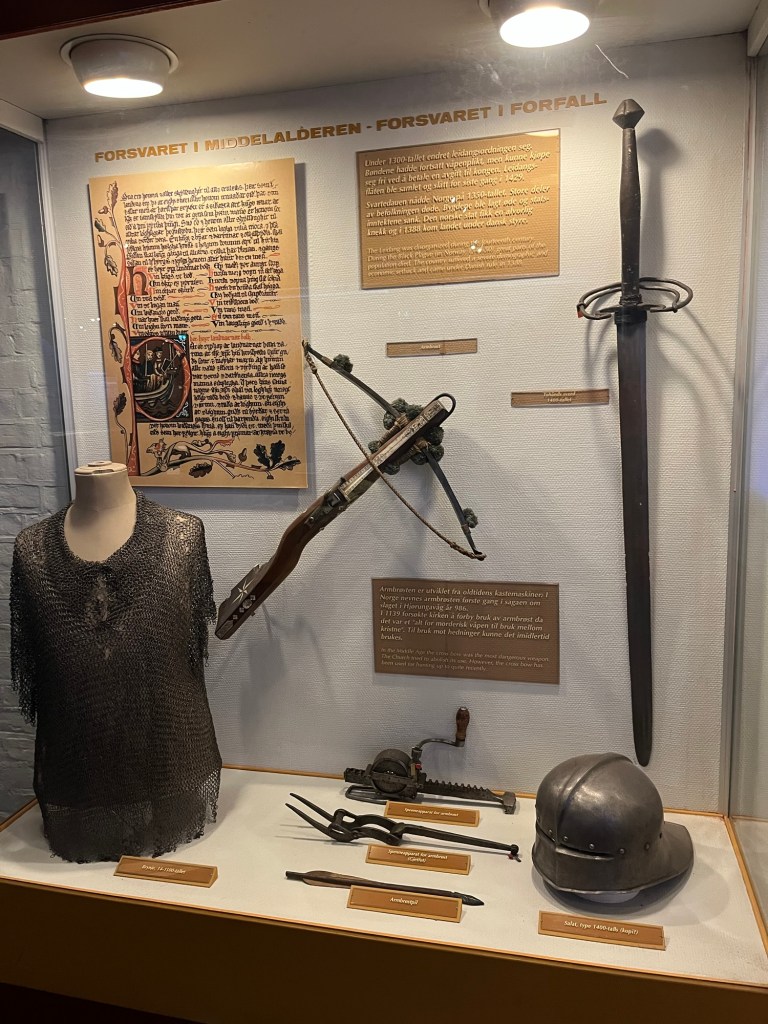
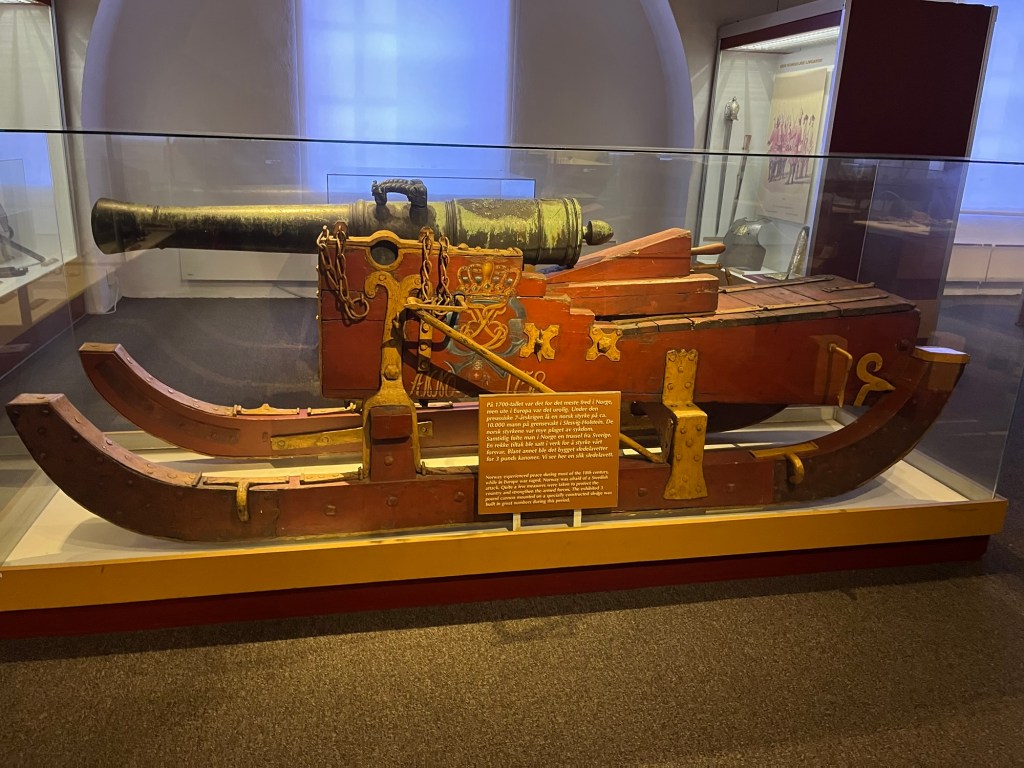
The museum is surprisingly large. The galleries follow a chronological timeline starting with Viking artifacts. Who doesn’t love a Viking sword? Medieval exhibits contain the usual swords, crossbows and simple cannons you find in other European museums, but they also include weapons from the armed ski patrols. There are sleds that pull military supplies and even a sled with mounted cannon. All necessary in snowy Norwegian mountain territory.
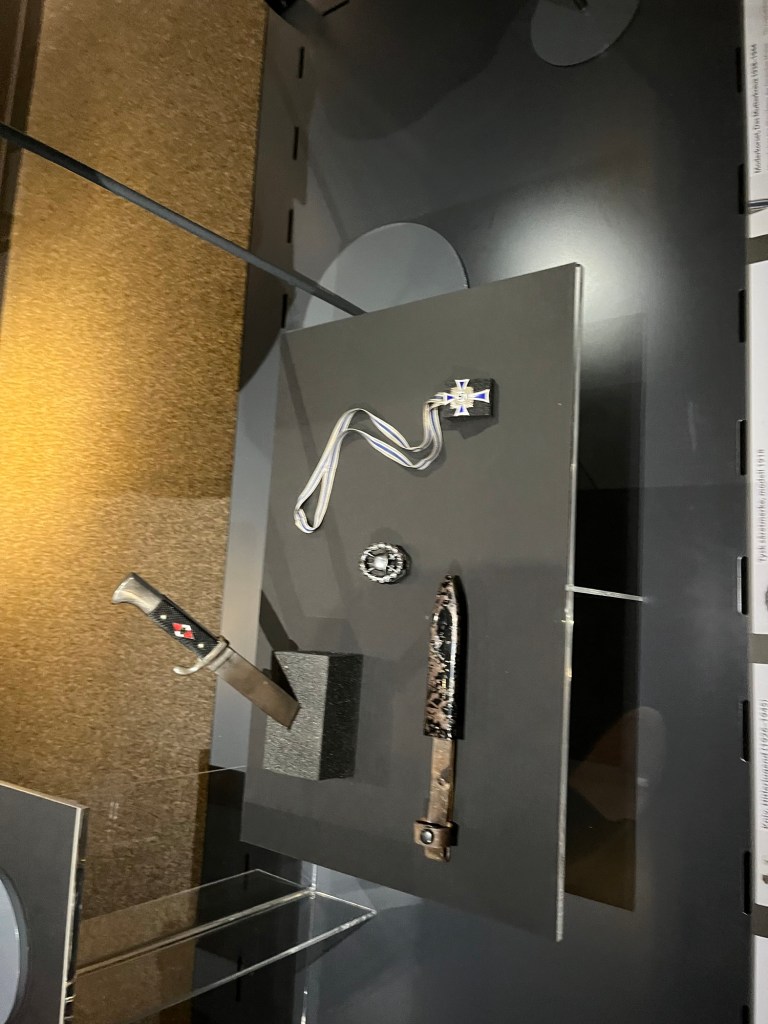
Because Norway was a Nazi occupied territory during WWII, there are multiple exhibits with artifacts from the occupation. I find myself both fascinated and horrified at the Norwegian lived experience during WWII. I realize that despite teaching history for many years, I was largely ignorant of events in Norway as the American narrative is almost exclusively from an American and British point of view.
I recoil viscerally as I encounter Nazi artifacts. Today, they don’t seem part of a distant past. They seem all to real and all to close. The photographs of children could be my parents. The young adults so horribly affected could be my grandparents. WWII had been a distant event to be taught. Today it seems recent and real. The faces looking back at me, look hauntingly contemporary. They insist I bear witness.
The museum takes several hours to complete. We find exhibits and artifacts from the Cold War era and an exhibit in recognition of the ongoing hostilities in Ukraine. The interpretive space uses video documentaries to illustrate the Russian aggression against civilians and war crimes violations. It was a moving reminder of the effort and sacrifices required to defend democracy in the face of autocratic aggression.
By the end of the museum, I am somber, tired, and hungry. In need of a break, we walk out of the park to a bakery for sandwiches and cake. I laugh as a picky American tourist grilled the counter attendant about what kind of cheese was on the sandwich. Without blinking, she replies , “yellow”. Amused and refreshed, we walk back up the hill into the fortress and make our way to the resistance museum.
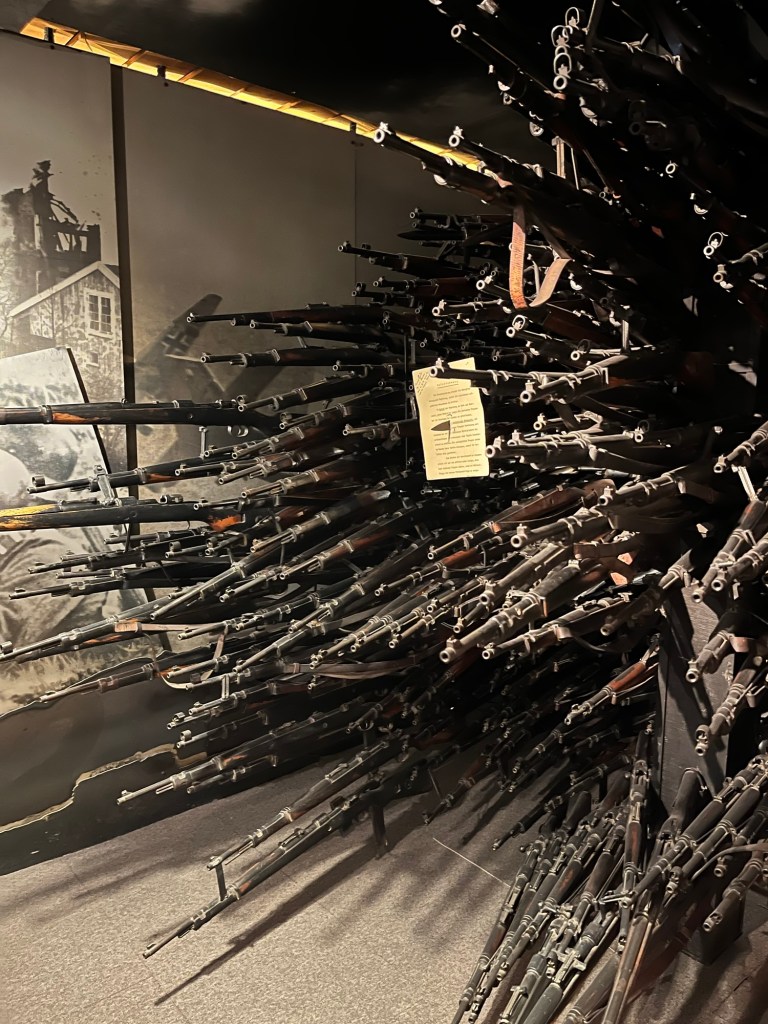
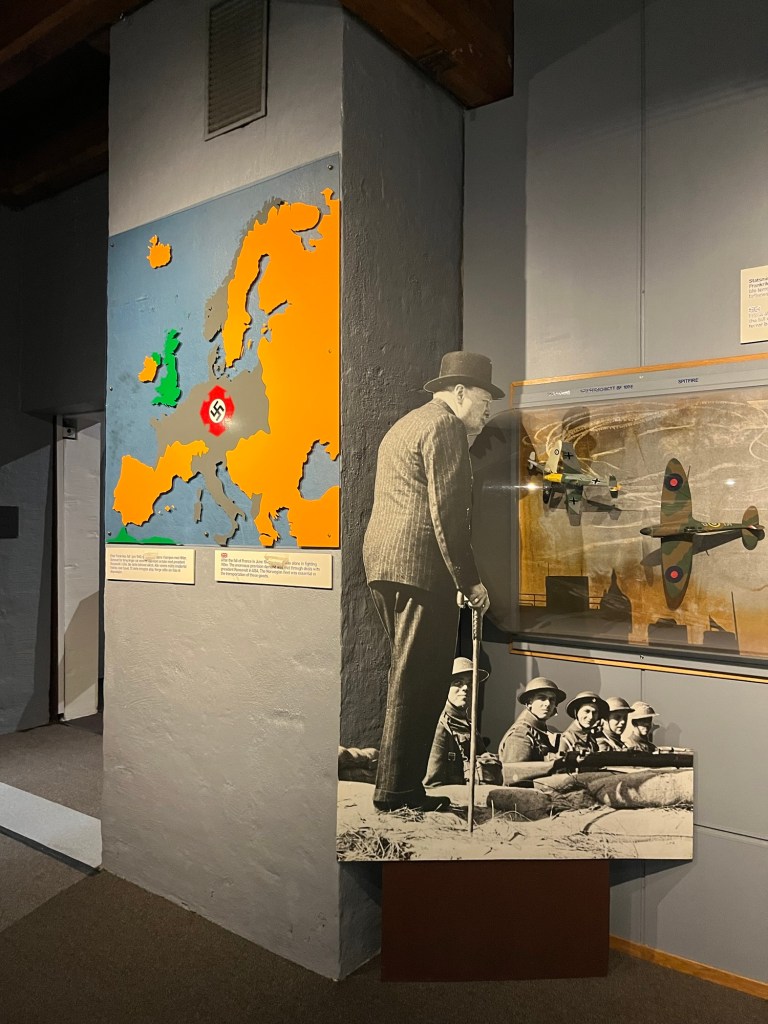
The first museum of the day was about the military and armed conflict. The resistance museum is dedicated to the personal resistance to facism and Nazism leading up to, during, and after WWII. The museum experience is emotional and evocative. As you enter the museum you are confronted with a barricade of dozens of rifles with the German ultimatum for surrender affixed to bayonets. The Nazi invaders made 14 demands which were all rejected by Norway. The Norwegian King was smuggled out of the country by boat to England to evade capture. The museum tells the story of the Norwegian people who remained and who resisted the occupation. They believed democracy was worth preserving and many paid with their lives.
The museum defines Naziism as a political ideology that embraced nationalism, militarism, and racism. Panels describe how it spread with fake news and fake science…how messages were targeted to the unemployed and hungry. It showed many attempts to start a Nazi party in Norway and how the people resisted.
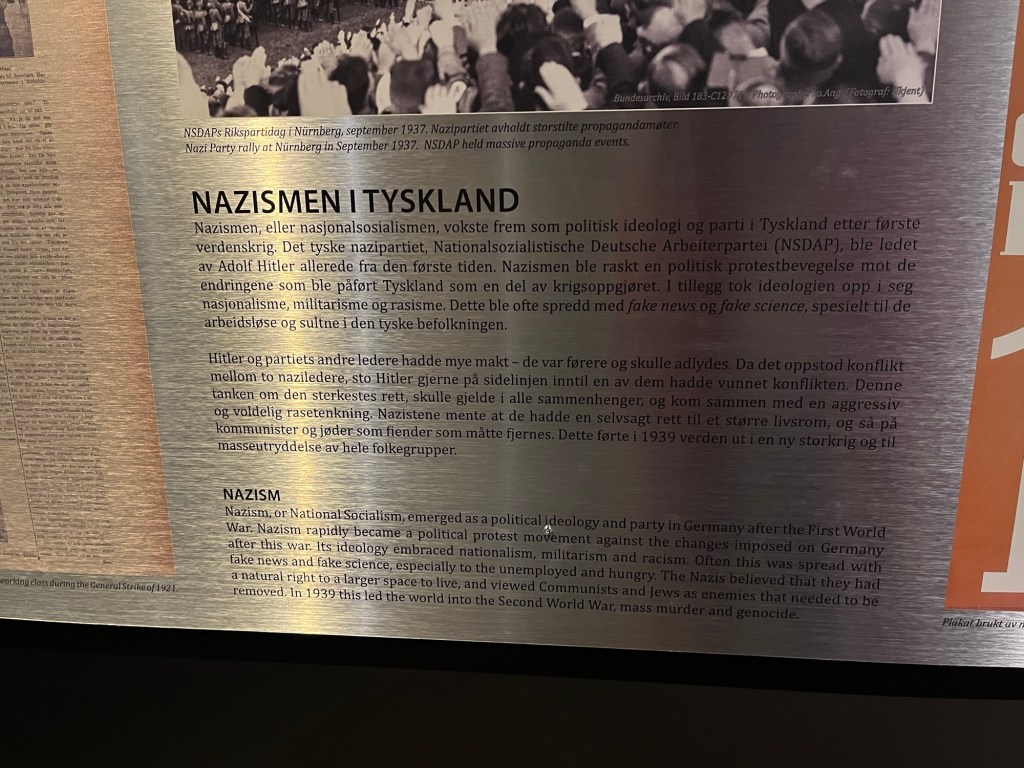
The citizens resisted. The teachers refused to teach Nazi sponsored curriculum that subverted history. They went to forced labor camps rather than teaching lies. Nazis created mandatory youth organizations (Hitler Youth) and weakened education requirements, in response.
When the Nazis took over the Lutheran Nidaros Cathedral and began giving directives to the local parishes, the clergy resigned. Many continued to serve their communities in parks and squares outside the official church. Sabotage was carried out in inventive ways. Underground newspapers sprang up. People died for their acts of resistance, but the others carried on.

A few rooms commemorate the abysmal treatment of the Norwegian Jews. I physically recoil at the accounts of imprisonment and almost wretch when I get to the display of cyanide canisters that were used to poison people in the showers. They just sit there, looking like an ordinary household cleaning product. A small round box of death. Small and unobtrusive in shades of red and blue. Evil in the prettiest packaging. What is wrong with people that this could ever be a product manufactured and sold?
Photos of shaves heads (meant to dehumanize) and striped prison uniforms hanging in the exhibit made me sad at the inhumanity and lack of empathy. Never again, they said after the liberation of the camps. Never again should be foremost for all of us. In my head I can’t stop comparing images of men with shaved heads sitting in cramped rows or in cramped cages in modern El Salvador. Different time. Different circumstances. But the similarities haunt me just the same. Who are we? What will we become? This museum asks us to decide if we will resist or collaborate with oppression…….

We end the exhibit once again learning about the importance of allies. The British, the Australians, the Americans and others who banded together are honored for their contributions. They were critical in the fight to overcome invasion. There are lessons here for all of us.
Outside the museum are the graves of three people executed by the Nazis. They were hung on this spot. Students, members of the White Rose, defenders of free speech, defenders of democracy. There are fresh flowers. The people remember. I bear witness. Never again.
-
Subscribe
Subscribed
Already have a WordPress.com account? Log in now.
 Prisoner of Hopes