-
Birthday Journey To Locarno: Travel Goals
Today I turn 58 years old. To celebrate, I am traveling to Locarno Switzerland. It sounded like a great idea, yesterday, when after an “uphill day”, the travel office in Stresa was finally able to book it. After two unsuccessful attempts to purchase seats had failed, finally getting tickets for the rail and ferry Swiss adventure felt like a triumph.
But this morning, as I am standing at the train station and looking at the information board that says train delayed…. I realize it is the kind of day that stresses me out. I need to make five different transportation connections. I don’t like connections, especially when there are transportation delays. My anxiety grows incrementally.
My husband tells me to chill out. We have an espresso and a cappuccino while we wait. It helps. Exactly six minutes late, our first regional train arrives. It is a double decker. Clean. Bright. The kind of train I would really enjoy riding if I wasn’t on a strict timetable. Once the train takes off with me in it, I relax a bit. There are large screens that signal each upcoming stop. I appreciate not having to count stops.
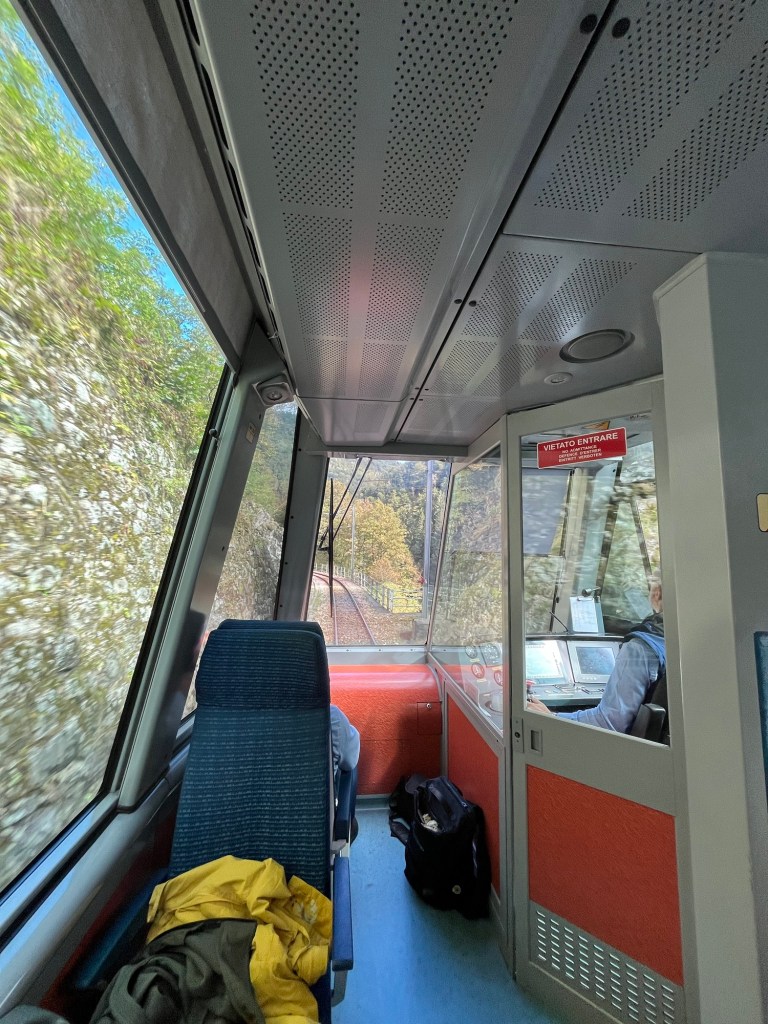
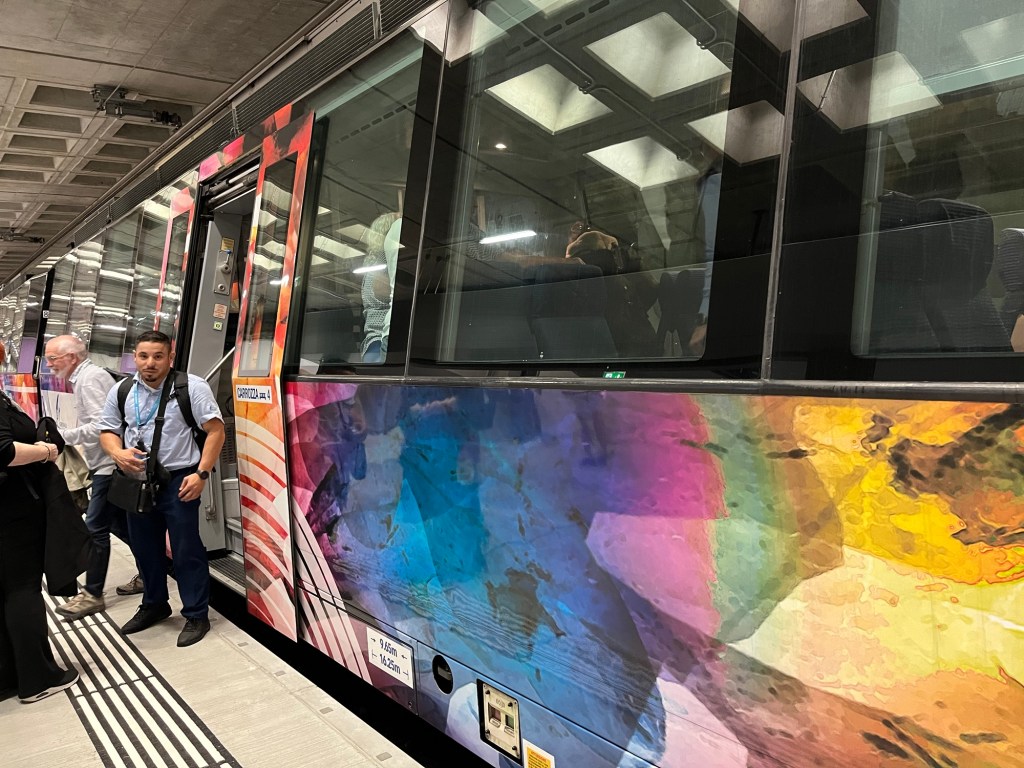
We arrive in Domodossola with 15 minutes to spare. My worry was for nothing as we simply walk down a flight of stairs to the next platform. The station is very old. The small gauge, scenic train is in an underground tunnel. We find our car and our reserved seats, conveniently labeled with stickers of our seat numbers. It is a panoramic car with wrap around windows to allow views of the stunning scenery. Four seats face each other. Our seat mates, whose legs intertwine with ours (the seating is very, very tight) are from Romania. The giant of a man moves to allow his wife (and us more room). He sits across the aisle with two women from Asheville, North Carolina. They tell us about the devastating effects of hurricane Helene, and how they were told not to come home just yet as the roads to their houses were not passable. We hear stories of the son in charge of rescue and the husband securing property and working to restore power. They share fears about politics and are resigned to a long recovery.
We hear about Romania and Dracula’s castle. There are references to American movies. At one point, I am the demanding tourist. The women pull down the shades when the sun comes out. But I am on a sightseeing train with panoramic windows. I appreciate their minds are elsewhere…but it is my birthday and I came to see the Alps. I politely ask them if they minded raising the shade. They say of course.
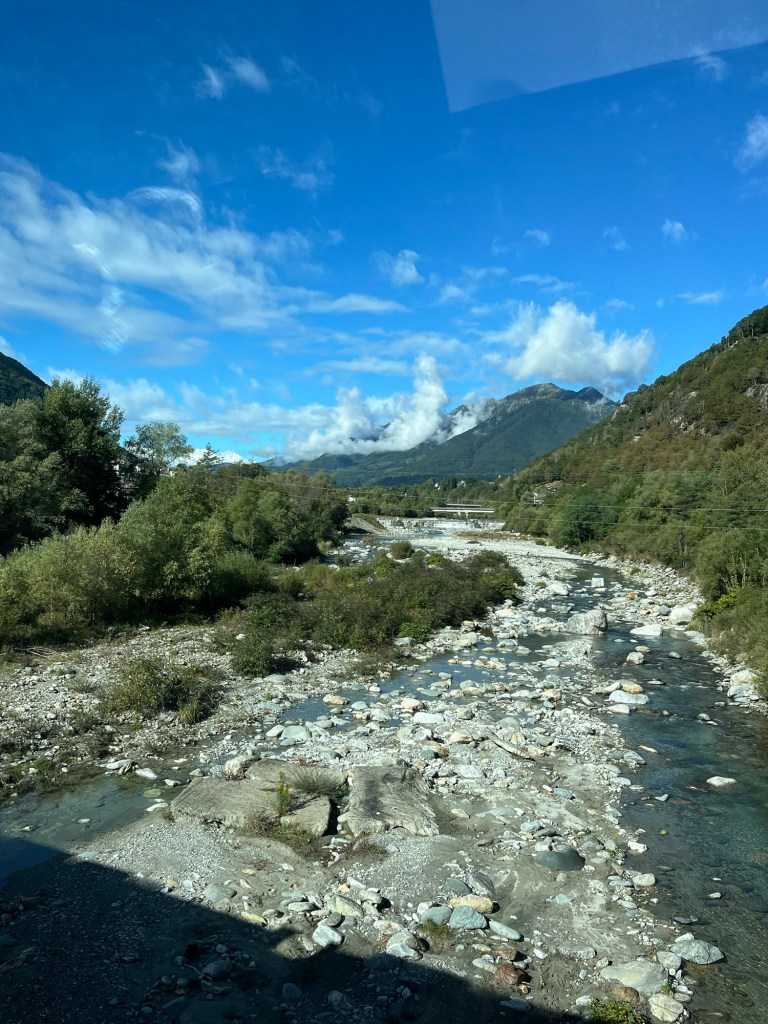
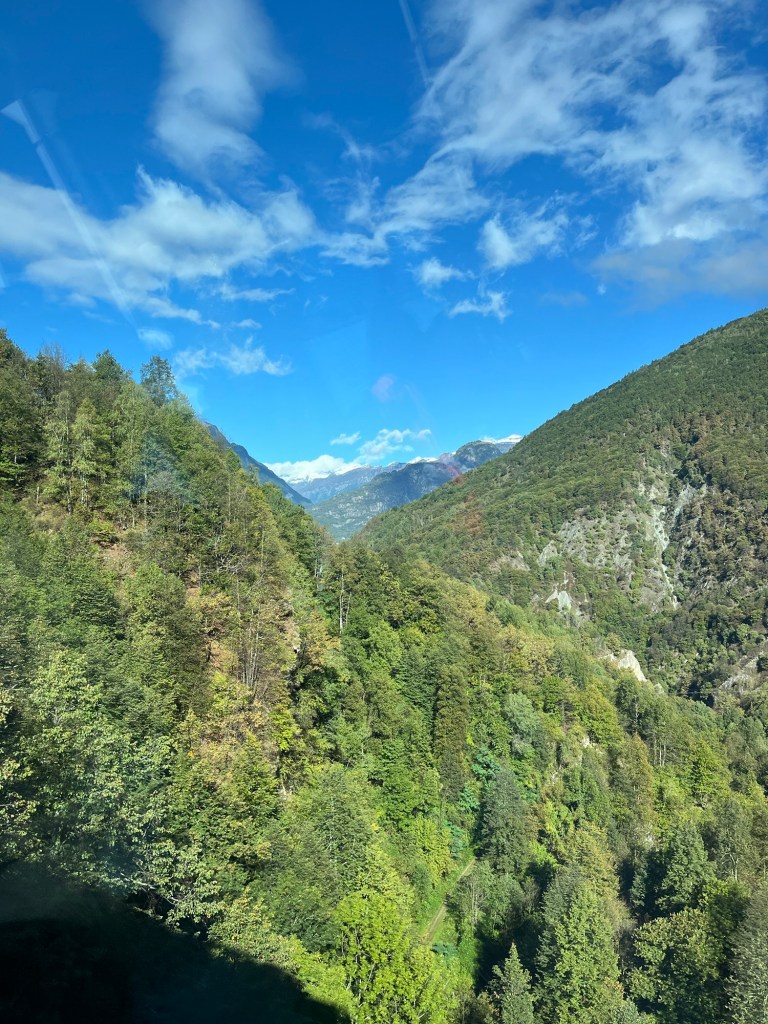
Continuous conversation and beautiful scenery help pass the two hour journey up the central valley to Locarno. Trees and mountains, rivers and waterfalls, tales of Transylvania and hurricanes run together in pleasant fashion. Small village train stations mark our passage as we pass through each in short time segments.

We arrive in Locarno with no fanfare. It is the end of the line. Everyone must get off. We stop to find a restroom, but the entry to the toilette is $1.50, only payable by swiss coin. We have none. We go across the street to the tourist office and are directed to a toilette in the adjoining hall. This time a machine lock charges $1.50 only payable by credit card. A rude welcome to Switzerland. A Swiss man holds the door for a group of tourists and shakes his head like he sees the confusion and disbelief daily.
I want to visit the Convent Sanctuario Della Madonna Del Sasso. It is on the top of a mountain. We hope to take a funicular to the entrance. It is also lunch time, but it makes the most sense to me to get up the mountain (if it is like Italy, things tend to shut down mid day). I promise my husband we can eat in the upper town. We walk down a street lined with shops and a McDonald’s. I notice that things in Switzerland are very expensive. We pass a busy McDonald’s and next door we find the funicular. There is no one to sell tickets. The driver of the train is also the ticket master. We queue up with the locals and do what they do. We don’t have any Swiss money and the driver is annoyed to deal with a card.

The ride, however, is lovely and short. My husband is thankful for the ride up the mountain until he realizes that the station is not at the convent. We passed it on the way up. We have several stairs to go to get to the convent. We walk back down the mountain. It looks like there used to be a stop near the church that is now closed.
The Madonna del Sasso is a quirky place. The views from this convent, perched against the mountain, are breathtaking. Paper mache scenes from the life of Christ take up most every nook and cranny. The last supper, the nativity, and other scenes are lovingly displayed in off-puttingly distorted diorama.
In the chapel itself, I find a sense of calm. I need this respite from my morning of travel connections. I give thanks for the many blessings of my life so far and ask God to bless my 58th year. The colors from the stained glass cast a pleasant glow of peacefulness. I reflect on God’s faithfulness and the words “Be Still and Know That I Am God” take on a deeper meaning.
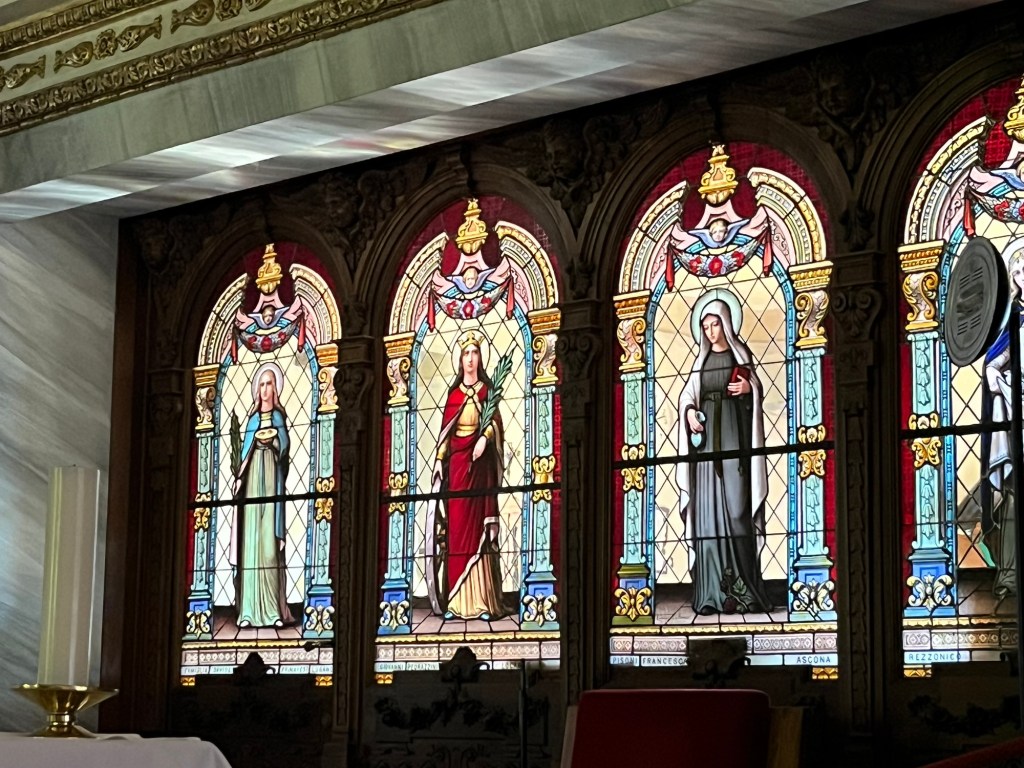
Outside, Lake Maggiore commands attention. The brilliant blue water reminds me that we have a ferry boat connection in just a few short hours and I have much to see in the meantime. I force march us up the stairs. Lots of stairs. We just miss the funicular leaving down the mountain and have to wait for the next. We decide not to eat at the lone restaurant nearby. One hundred dollars for a mediocre lunch is not my idea of a birthday present.

Once down into the central district, we move quickly to the next door McDonald’s. It is quick and easy. No matter, where we are in the world, McDonald’s fries smell good. Prices vary. Last year in Brisbane we got two burgers, fries, drink and icecream for five dollars. Here….Twenty five dollars for two basic cheeseburger meals….Fifty cents per small package of catsup. Switzerland is expensive. But we need to eat and the outdoor seating area is lovely.
All afternoon we wander the streets of Locarno, taking in the grand plaza and the Castello. I am charmed by the grand old buildings, the outdoor cafes, and the market stalls. I don’t know what I expected. I think of Switzerland as modern. I forget that this city sits on the same lake, beneath the same Alps as northern Italy. Of course it has a Castello Visconti, centuries old. Of course there are ruins of ancient buildings in the car park. Of course the central square is made of cobblestone.
On the way to the harbor we pass a casino. The pathway celebrates the Locarno music festival and the artists who have performed there. I take a few minutes to find the handprints of Sting on the walk of fame. Today is also his birthday. He doesn’t know that we shared a moment when I put my hand in his handprints in an act of birthday solidarity.
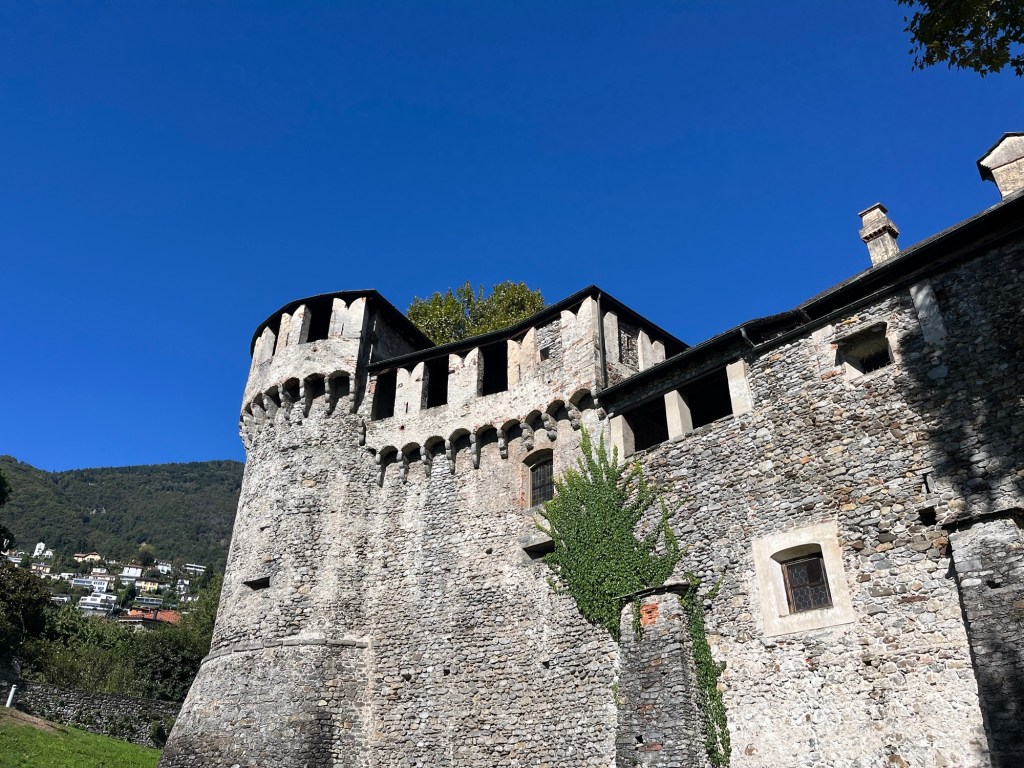
Eventually. we find our way to the ferry dock. We stroll the Lungo Lago and smile at families who also stroll the long promenade at the lakefront. Gelato is essential in these moments and so we indulge. The sun is shining. The air is cool. A perfect day. If only, we didn’t have to keep an eye on the clock.
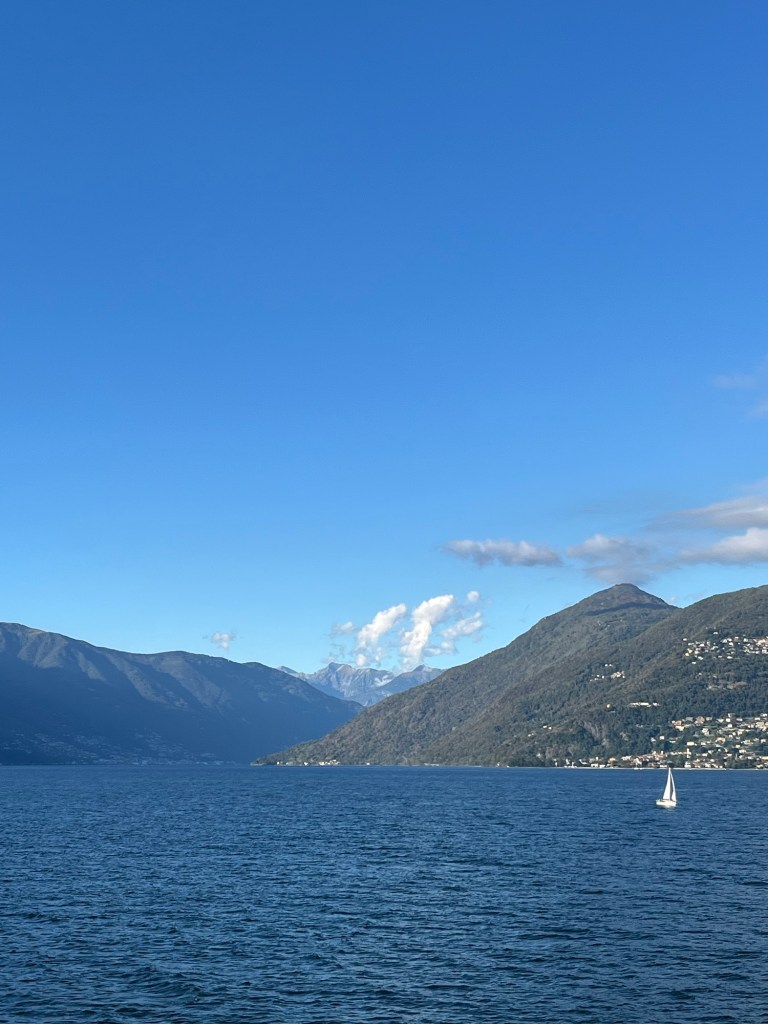
At exactly four pm, we make our last connection, a ferry. We embark and take our places on the top deck. I find my perfect spot and am asked to move to accommodate two couples who want to sit together. I grudgingly comply. Don’t they know it is my birthday?
I finally relax as the sun warms my face and the gentle waves rock the boat. The couples turn out to be good company. The beautiful world rolls by. Small towns line the lake. Mountains and clouds create fantastic shows of color and shadow in every direction. Sailboats move silently through the water. Hearty souls paddle board the deep water. I am at rest. 58 feels good (even though in my mind I am still a child). How did my body become so mature?
We dock in Stresa at six thirty, almost 11 hours after our tour began. The sun is setting behind the Alps. We disembark and walk a short distance into town. It is my birthday and I feel accomplished. I made the circuit of connections onto four trains. I traveled across the Italian Alps to Switzerland. I came home by boat.

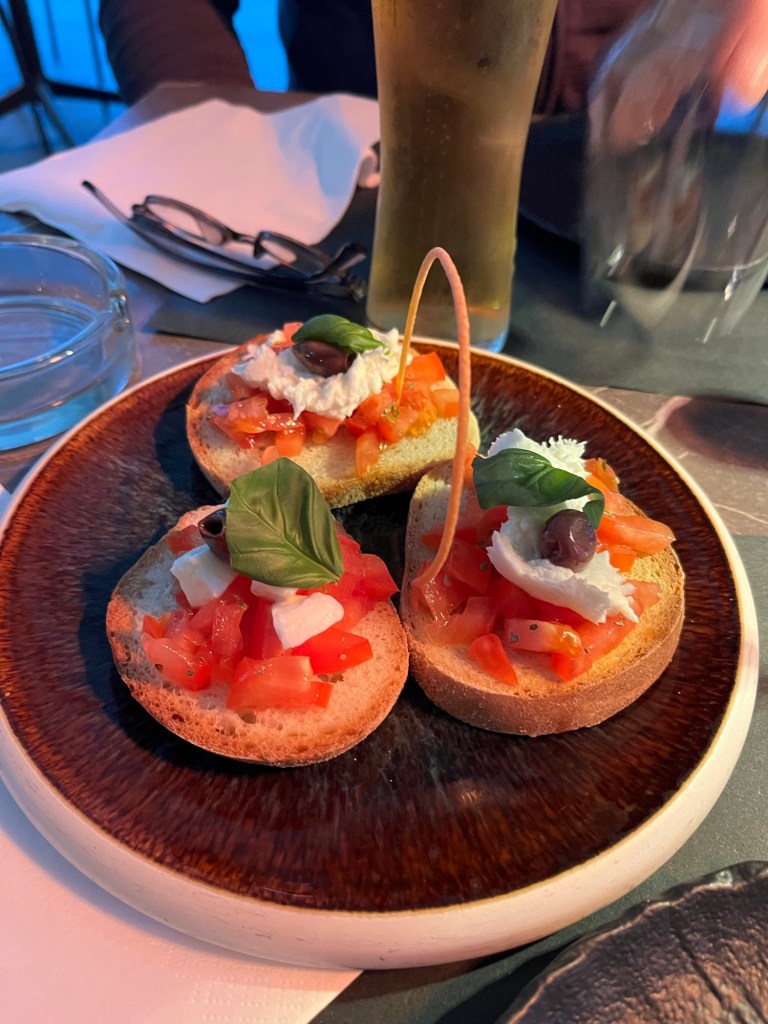
But just now, I settle in an outdoor piazza under a heat lamp. I order bruschetta and pasta with swordfish and eggplant. I sip Prosecco and laugh with my husband about our day. I meet new friends from Sweden and hear about their drive. Italy is a road trip for them, much like we might drive to Texas. New perspectives, new adventures, new food, new horizons. Fifty-eight is off to a great start.
-
Lost in Time: Travel Goals

Isola Pescatori, the island of the fishermen, was meant to be a brief stop. We sought out a quiet restaurant on a remote alley, away from the tourist boat crowds. The waiter took us up flights of chairs and seated us in a window overlooking the rooftops.
The pasta was fresh and regional, accompanied by homemade bread and local wine. Afterwards, the creamiest tiramisu with hints of coffee and freshly made mascarpone ended the meal on a high note. We lingered. We admired. We left with new friends. The cook waved and the waiter smiled.

Down a side street, I happened upon the fishermen’s chapel. The frescoes, weathered and aging, were somehow more beautiful in their decay. Soft music played amidst the glow of candles. I paused to give thanks to God and felt humbled to be in this ancient sanctuary, offering my prayers as had been done for countless generations.
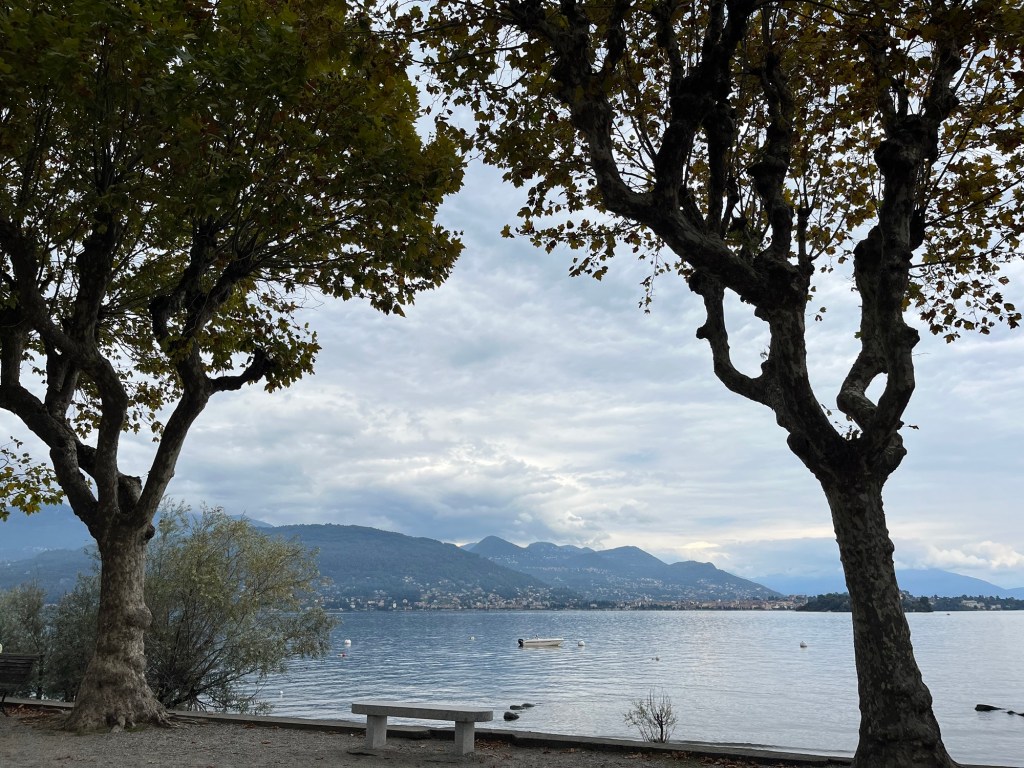
A short walk down a narrow street and we found ourselves on the shore. We sat on a bench and watched the school children play tag. The boats wandered by. People held hands and took photos, but mostly we all sat and silently listened to the lullaby of lapping water against the pier.
Eventually, we had to leave. A boat carried us back to the mainland. But in my memories, I will remember this place…Isola Pescatori….where time, just for a moment, stood still.

Late in the afternoon, we got a text from the travel office. The agent was able to get us reservations on the scenic train. An uphill day took a turn…I am going to Switzerland for my birthday. The islands have worked their magic and now we are looking toward the mountains.
-
Isola Bella- The Beautiful Island: Travel Goals
The day started slowly. We changed plans again and again. Finally we decided to go to Stresa to see if we could find spots on the Centovalli rail and boat excursion to Switzerland. The people at the travel agency were great and so helpful. We laughed and chatted, only to find out that the tracks had been damaged and ticket sales had been halted. The agent promised to keep trying throughout the day. The Italians have a saying, “it’s an uphill day”. It certainly seemed uphill.
While we waited, we decided to take a ferry to Isola Bella…the beautiful island. It wasn’t on the plan for the day, but nothing was working out. The short ferry ride transported us to another world., a world of Borromean excess.
It is easy to forget everything in the midst of splendor. The ferry dropped us off on an island with the Borromeo palace and gardens. Despite the long line, we were able to enter immediately because we had purchased our ticket at Angera the day before. The first rooms felt like playing leap frog as we squeezed between massive tour groups crowded around their leader.
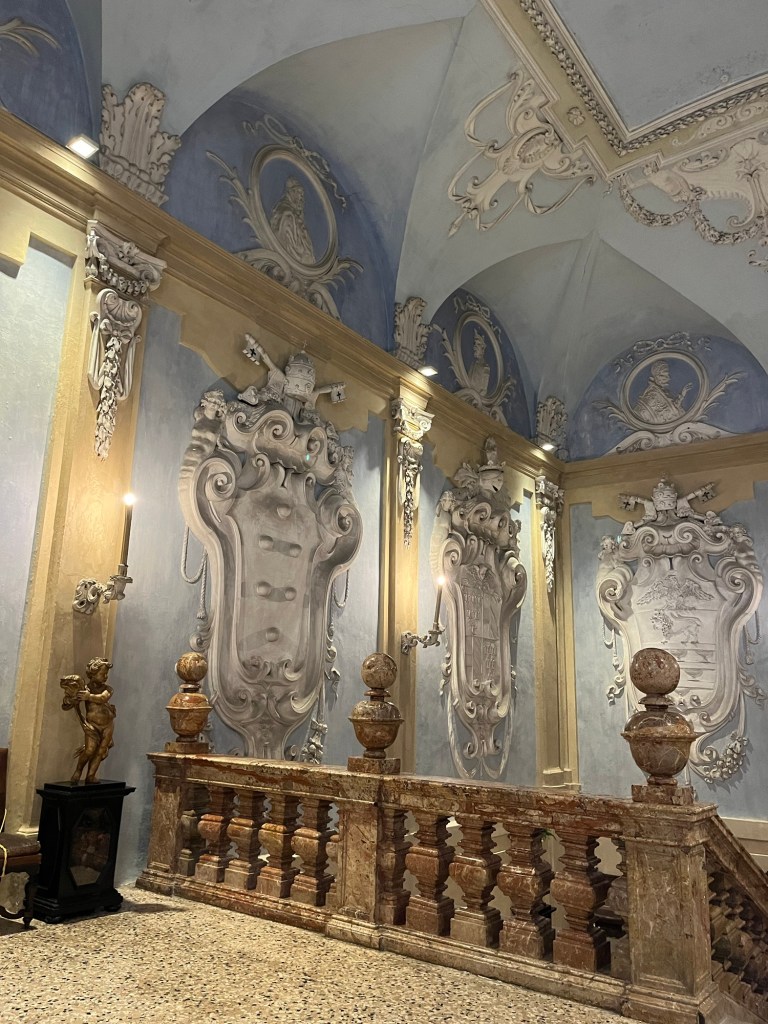
The Borromeo family owned everything surrounding Lake Maggiore. The castle was a way to show off their wealth. Their ostentatious displays of wealth even lured Napoleon to visit. He eventually come back and took everything in sight. Beware house guests!
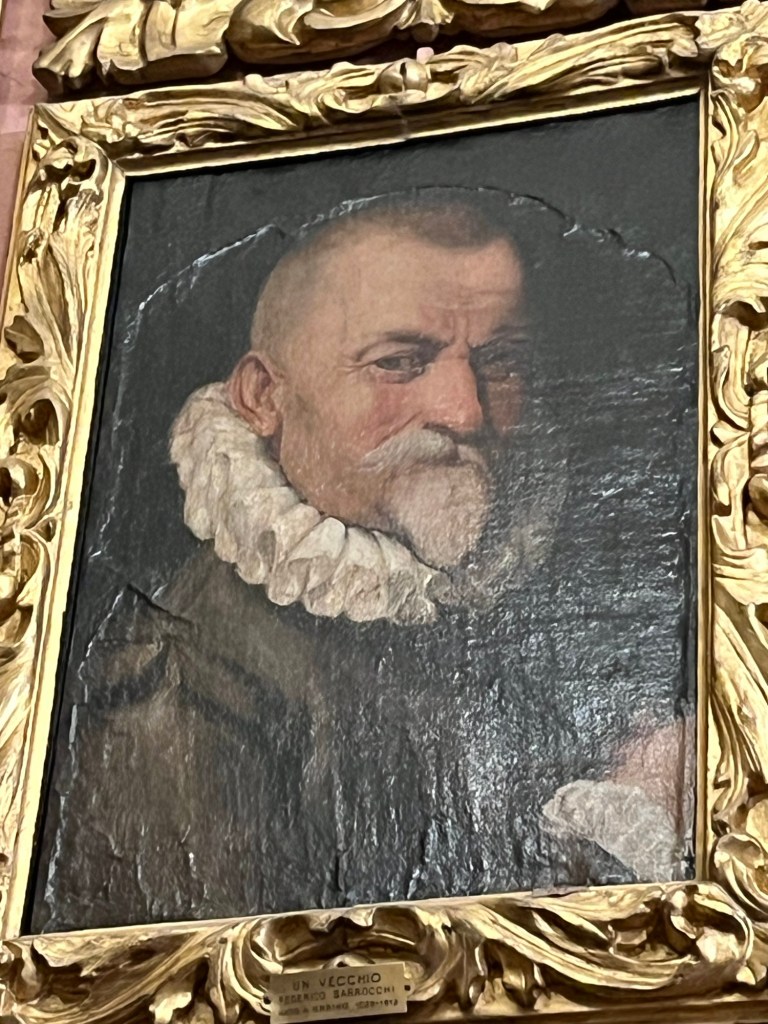
As we gawked and talked our way through the rooms, we stumbled onto a portrait that is the medieval twin of my husband. He now thinks he would like to grow a van dyke beard. It is okay by me, but the ruffles are a step too far.
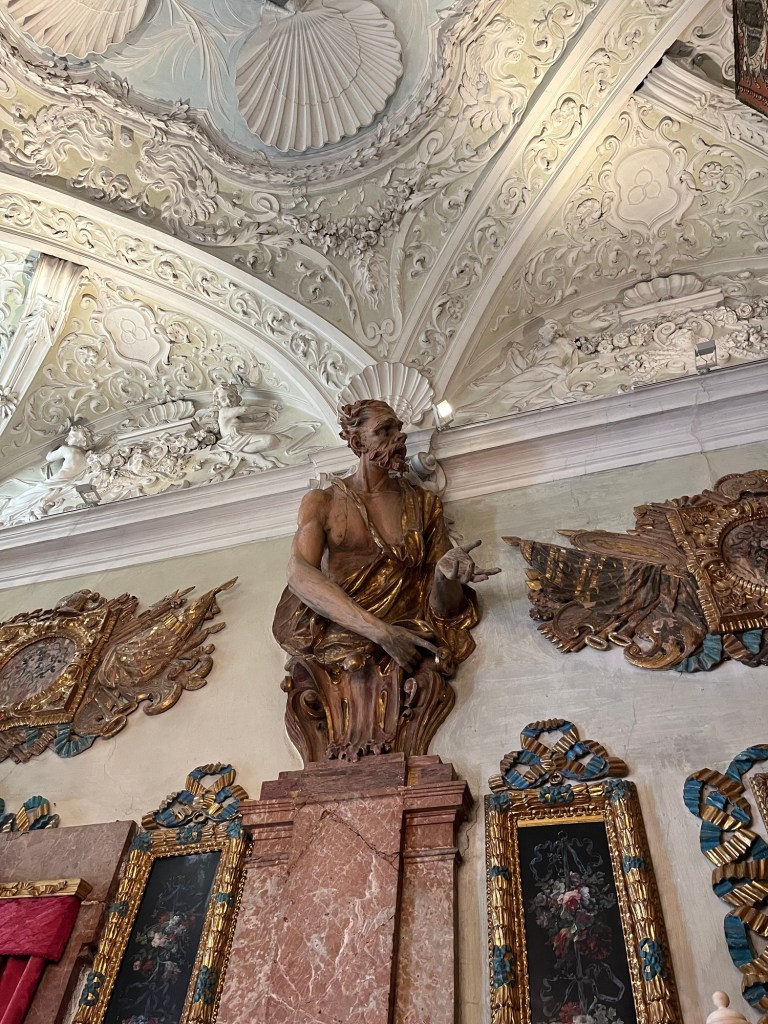
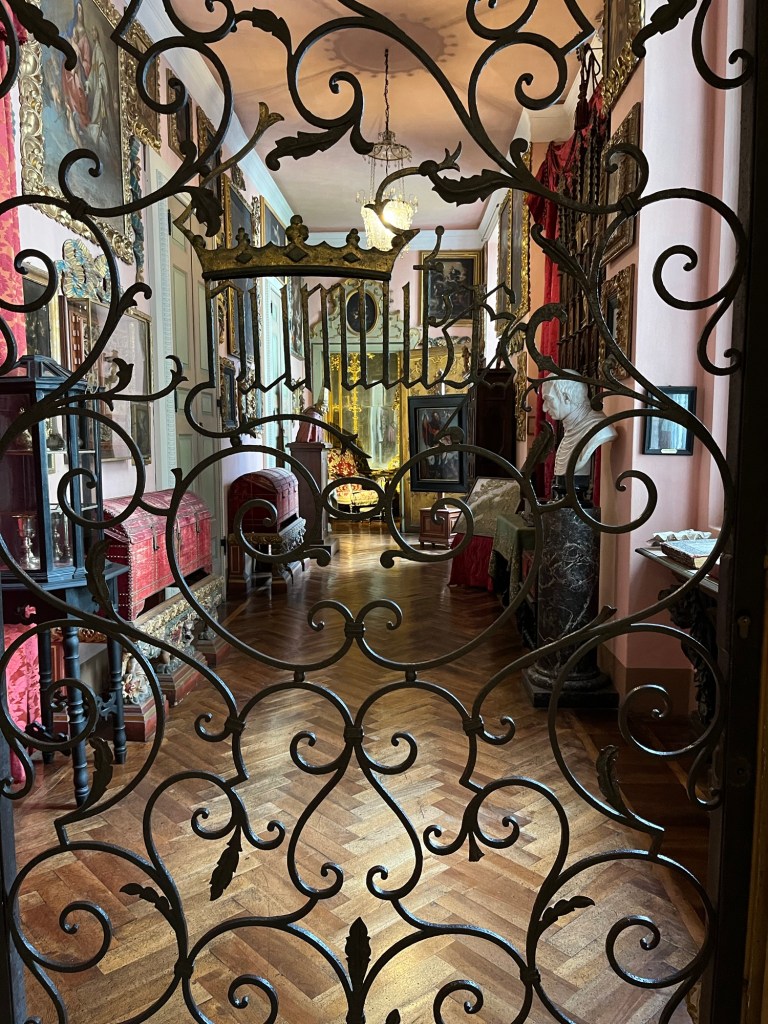
Each room was an explosion of colorful marble, Italian art, and priceless furniture. Tapestries of hunting lions competed with graceful unicorns. Plaster figures decorated ceilings. As the crowds thinned, it was easy to imagine a different time and style of life.

Every window had its own breathtaking view. Isola Pescatori (the fisherman island/isola superiore) beckoned on the horizon. The clouds hovered over the lake, framing the mountains in magical mists. What must it have been like to call this massive monument a home? I imagine how it must feel to know this castle is just one of many “homes” in your collection.

The salons had musical instruments, armor, saddles, books, vases, and paintings. One room’s red chests held the vestments of St. Charles Borromeo. Entry halls the size of small hotels greeted visitors. Underground grottoes made of shell held archeological relics. Every corner had its own fascination.
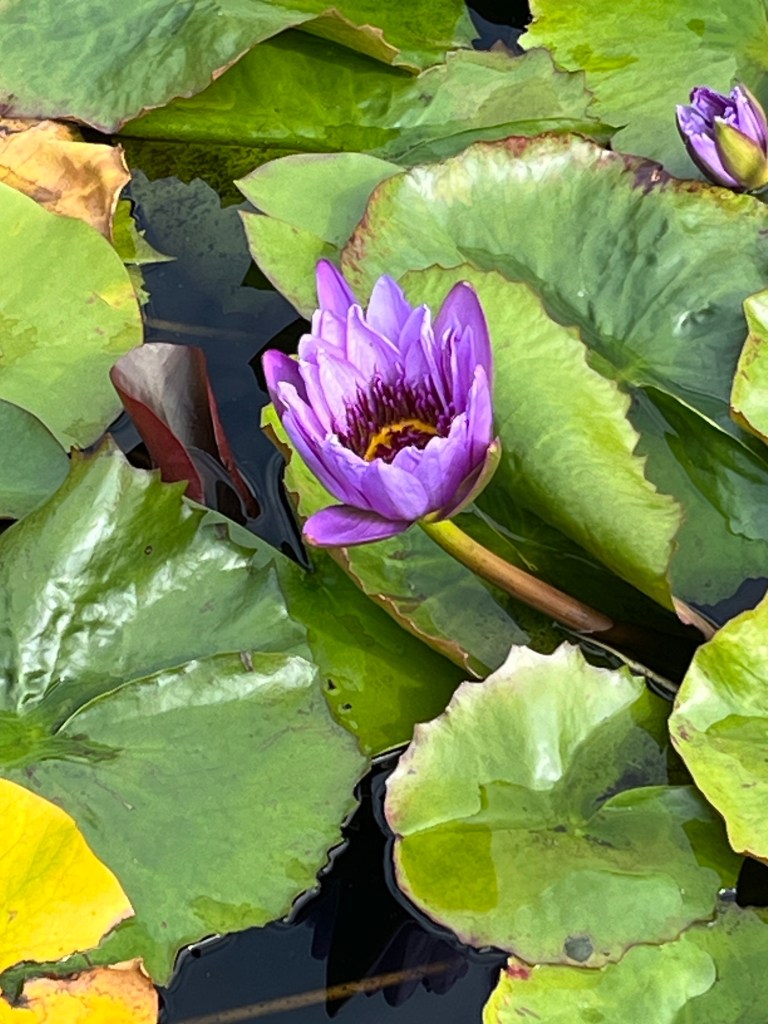
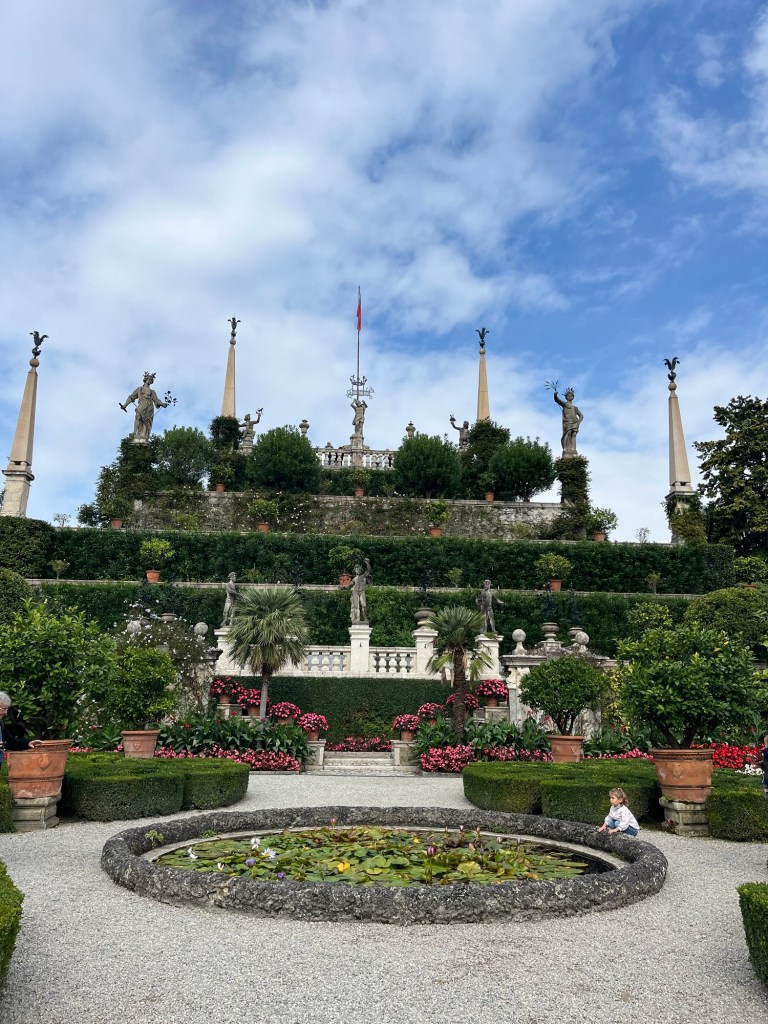
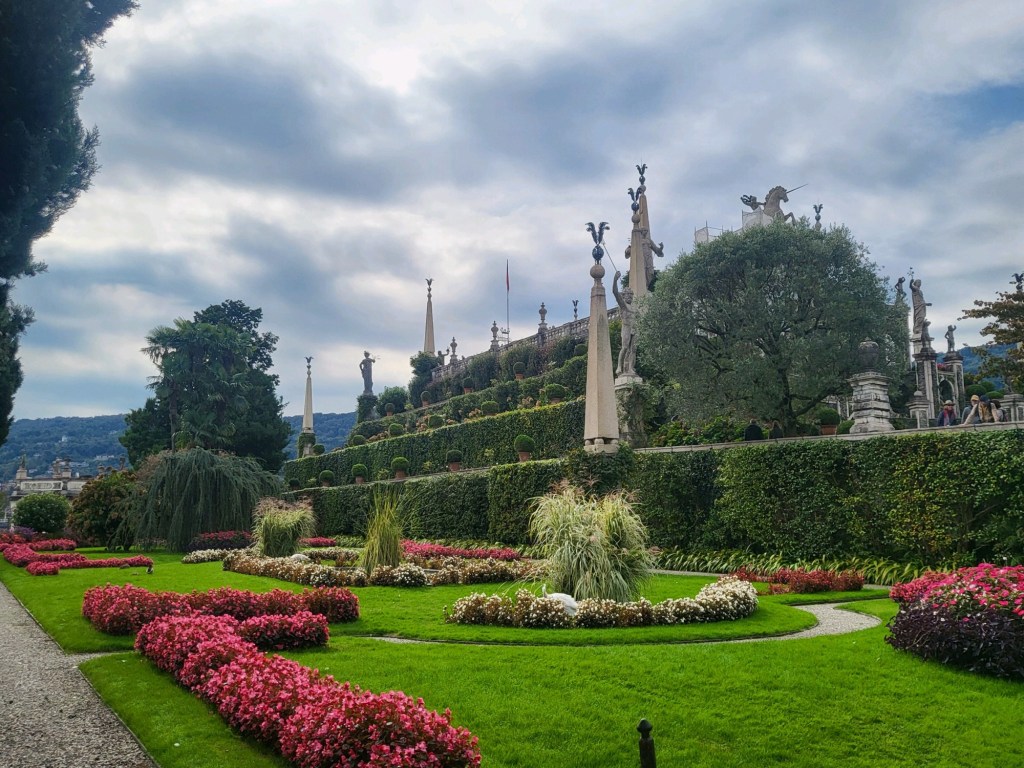
But for me, the real magic happened outside. Isola Bella…a beautiful garden oasis. Terraced like a ziggurat, each level had plantings and sculptural markers. The smells of oranges, limes, and lemons tickled our noses. Color bursts of begonia, waterlily, and verbena teased our eyes. Carefully manicured, the grounds were beyond impressive.
I lingered at the aviary of lovebirds. They chirped and cuddled in adorable poses. I climbed up and down terraces and plazas. I puzzled at the trees shaped in fantastic geometric designs.
Finally after all the fantastic sights , we just stood and held hands and listened to the lapping of the water. I let it wash away lingering thoughts. The colors brightened my mood, the trees whispered an ancient truth that all is well and exactly as it should be. Isola Bella…the beautiful island…. is beautiful indeed.
-
Stress free Stresa: Travel Goals
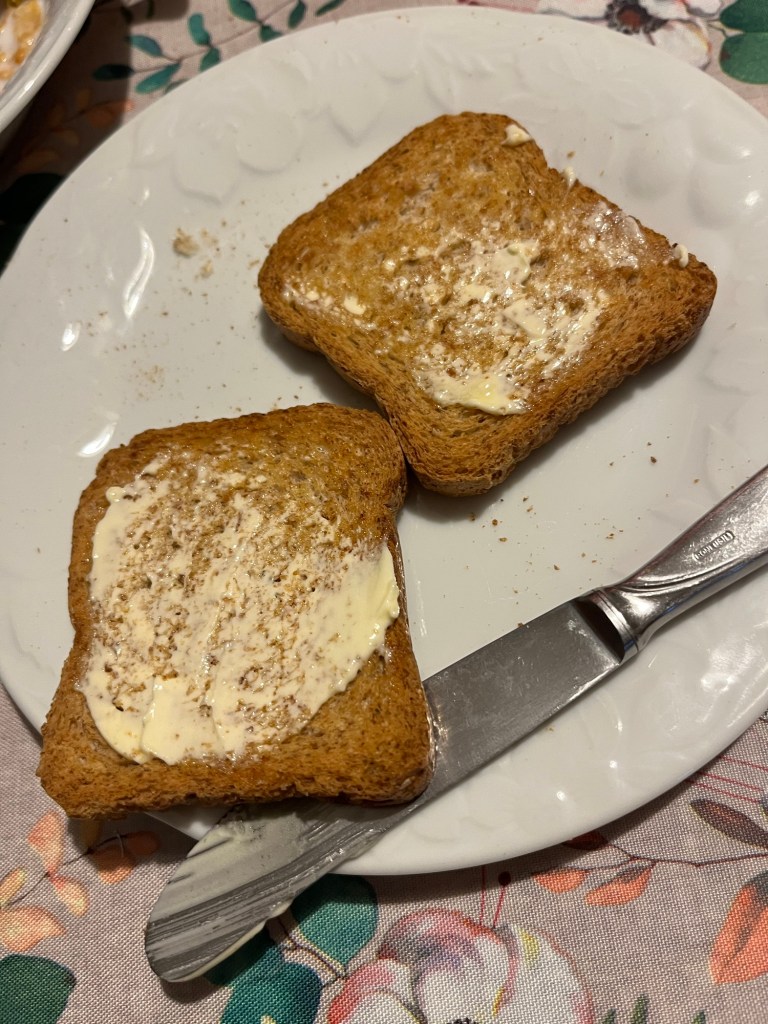
It is a rare day that we both awaken at about the same time. In sync, we enjoy coffee. My husband decided to try Italian toasted bread. You buy it prepackaged and already toasted. It is hard as a rock. I took a hard pass. He is desperate because there is no toaster in the house. Tomorrow we will try toast via panini maker. I like to improvise.
We decide to visit Parco Pallovicino, which is about ten minutes from the house. We have no idea what to expect, but the commute seems simple enough.
The car park is free and the tickets collected in no time at all. The entry walkway takes us past manicured shrubbery that frame views of Lake Maggiore. We wind past waterfalls and old growth forest until we find ourselves on a farm. There are donkeys and chickens and llamas and goats and a number of other animals to enjoy up close.
Last Spring we wandered through Patagonia and didn’t see a single cavy. Apparently they were all vacationing in Italy, as evidenced by the video above. While we are watching the cavies and the Swiss goats a free for all breaks out in the farm yard. Animals are screaming, bleating, running and ramming to get to the breakfast line. Dozens line up for chow, making the worst racket imaginable. For some reason, the louder they get, the harder I laugh. It is a sight to see. Afterwords, the goats trot onto the bridge. With much reluctance, the billy goats gruff let us pass.
A peaceful stroll on woodland paths are good for my soul. Sometimes you encounter places that speak deeply to you, this is my place. Deer, gracefully walk along side us. Mules stand at the fence with lazy eyes. Wallaby babies happily hop in carefully manicured pens. Colorful birds in tall cages call for attention while prairie dogs dine on hay.
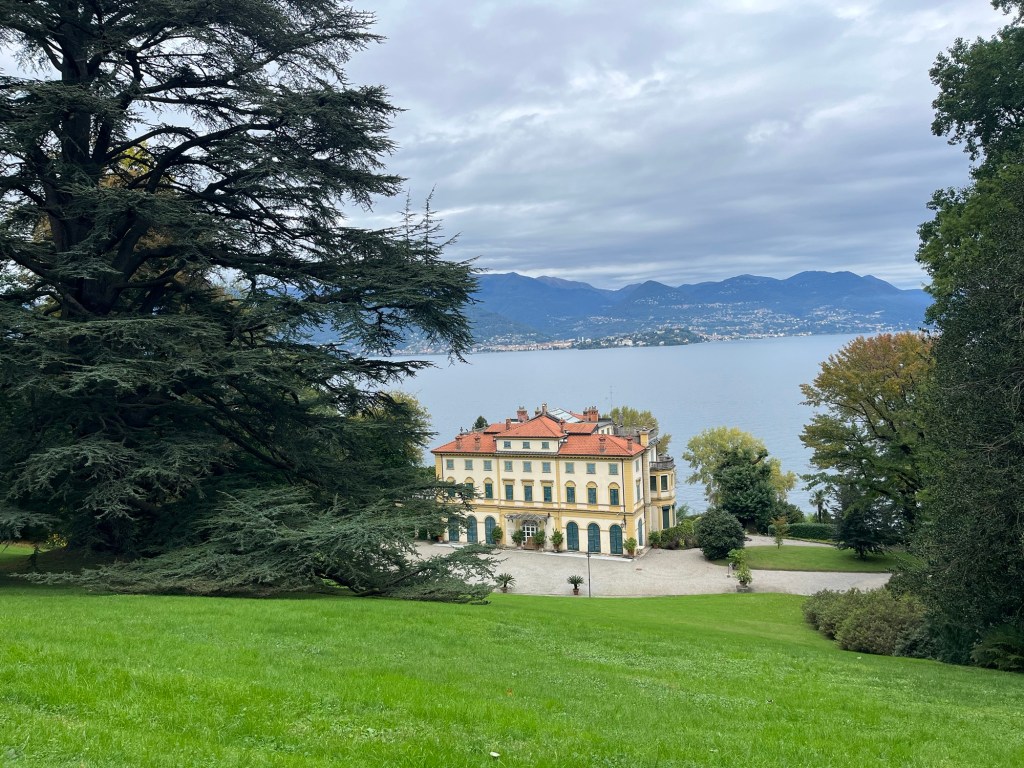
A stress free morning walk in the cool air is just what I need. Except, the park bench at the top of the hill with the perfect view may be just what I need. Or maybe the tall trees with the trunks that are cool to the touch is just what I need. I am at peace in this place. I need it all.
As if we aren’t relaxed enough, we stop by a pleasant pond of ducks to sip cappuccinos and eat flaky croissants dusted with powdered sugar. Life is slow and joyful….the way it is meant to be lived.
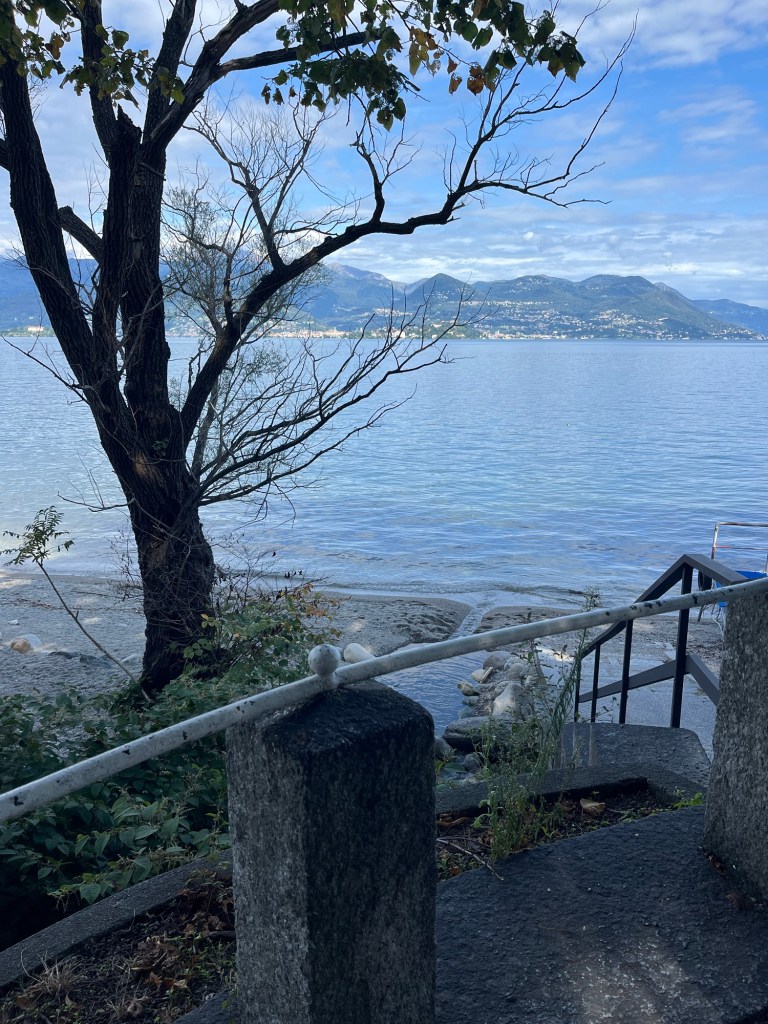
We lunch in nearby Stresa. Meats and cheese and pasta in an outdoor piazza. Lingering, we watch the people converge at the lakeside village after departing one of the many ferries landing in Stresa. We laugh with the ladies in the tourism office who tell us everything we wanted to buy was not available and I lament that I want to spend money on trips they can not sell. But we have a car and can navigate the way ourselves….or we can just walk the shores of this beautiful lake. Either way, we are definitely in the right place.
-
Angera Unplanned: Travel Goals
I am up with the dawn no matter where in the world I find myself. My husband is up with the owls and does not like mornings. This makes for some interesting travel logistics. Multi-room lodging is usually best, so I can get up and move about without waking him. But after three hours, if he isn’t up, I am pacing. It will take at least an hour after that before we are out the door. On good days we go with the flow, on others one or both of us are out of sorts because I wanted an early start/he wanted a late one.
Today was no problem as we just headed to the small village of Angeri. Our destination was Rocca di Angeri, an ancient fortress of the Boromeo family. The castle sits prominently on a rock cliff face and looms over the town. It can be easily seen from across the lake.
Despite the prominent location on the lake, it is harder to find by land. We drove up the small one lane road with two way traffic entryway and parked. The ticket taker was super friendly and welcomed us inside. She came out of the booth to talk with us and make sure we understood how the multi site tickets worked.
The views as we walked up the entry road and onto the lower court were stunning. After oohing and ahhing over the view, we tried to find the entrance. The signage was misleading and we found ourselves in an empty stairwell that was blocked. The false start required us to turn around and find the actual entrance.
The castle also houses a doll museum which was the designated starting place. The strange and creepy dolls were hundreds of years old. Made of wax, wood, and every other conceivable material, they spanned the centuries.


Japanese dolls from the 1700’s. Nuns. Animals with children’s faces. And craziest of all, animatronic dolls. There were tightrope walkers, acrobats, musicians, and various other indescribable dolls in motion. But the most unexpected was simply labeled, old lady weeing. And yes, in fact she shifted on her stool, smiling, and peeing. Yikes! What manner of Italian weirdness have we gotten ourselves into? That was definitely unexpected. Not what I thought we were visiting when we set out to see a castle.

Things normalized as we traveled into the main areas of the castle. Frescos from the 1000’s lined the walls. Beautiful and fragile, the paintings evoked the splendor of an earlier time. Especially since this was just one of many castles owned by the Borromeo family. Their fortresses circled the lake at one time and also filled the islands.
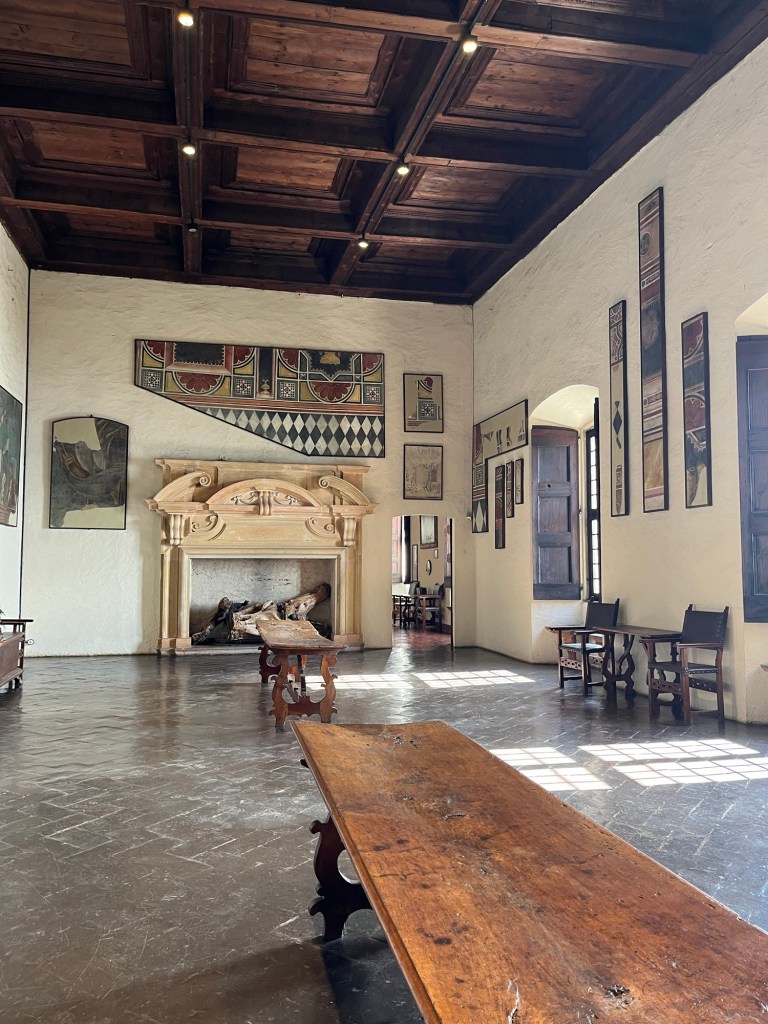
The echoing tiles and muted colors mesmerized me as we wandered the rooms. And the views from the windows! Looking over clay rooftops, boats on Lake Maggiore, …. I could never tire of the view! I tried to imagine living in such luxury in the 1400’s.
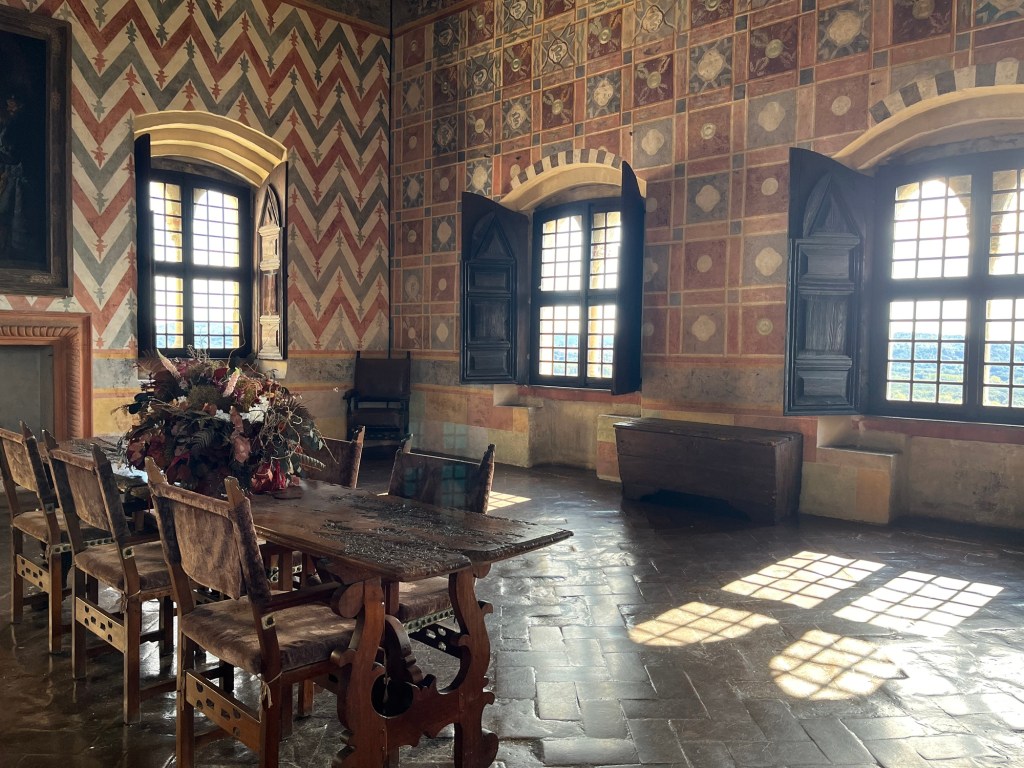
We climbed step after step, each worn by a 1,000 years of climbers. Upward to the lookout tower and parapets. Up and up until we seemed to touch the sky. The Alps in the background and the beautiful lake in the foreground. No invaders for us to worry about, just sailboats and water taxis. The defensive tower is now a sightseeing viewpoint.
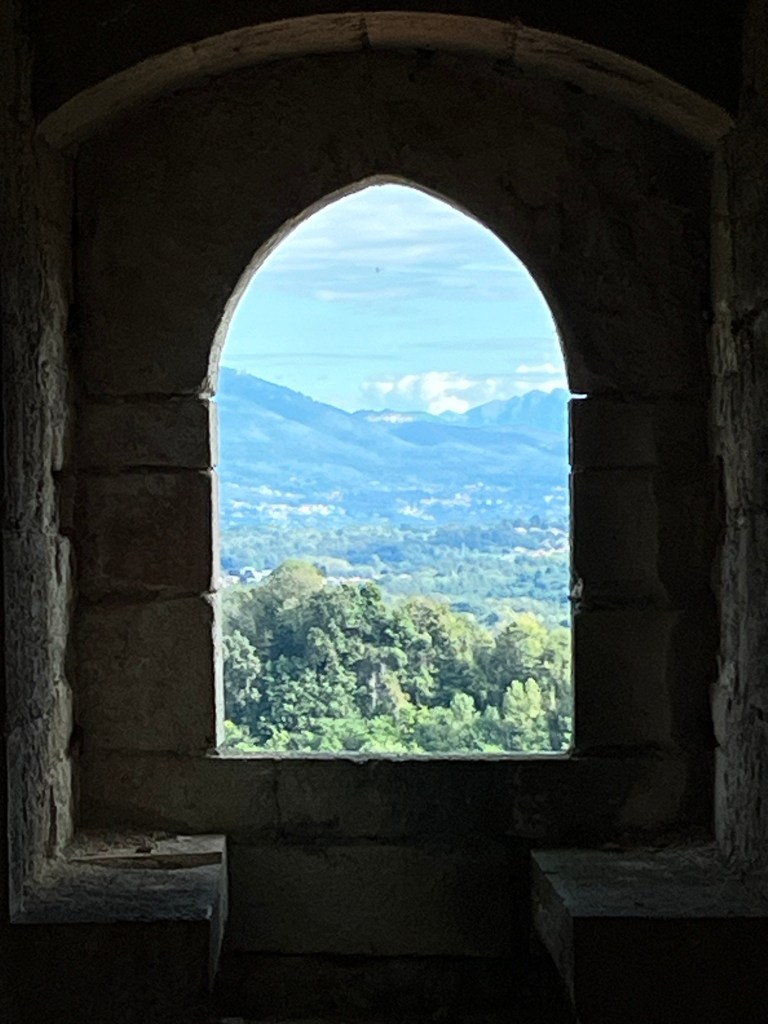
It was hard to remember I was in the 21st century while exploring empty rooms with murder holes and garderobe. Sometimes when confronted with history, I am overwhelmed. I wish I had all these experiences during the many years I taught. My descriptions and explanations to world history students would be so much more informed and colorful.
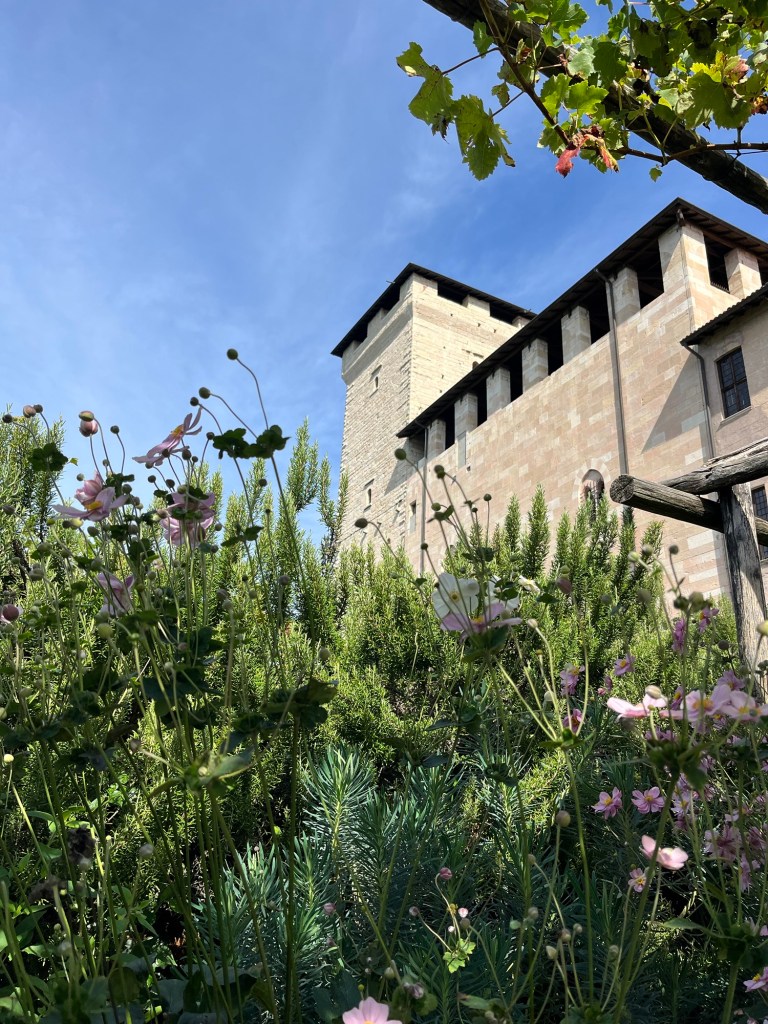
The castle tour completed, we wandered the medieval garden. Herbs to cure fever, upset tummy, rheumatism….your pharmacy was what you could grow. Artfully arranged to encourage contemplation and prayer, the gardens were peaceful and colorful. You almost feel like you could live there…if of course, you had someone to draw you water and cut your wood and carry it up all those stairs.
We tried to visit the market along the waterfront, but there were no parking spaces. The police had blocked off most of the spaces downtown. It seemed strange that you would have a lovely park full of shops and you wouldn’t allow anyone to park. We drove out of town looking for anywhere to wedge our small car. Nothing! So I routed the gps back to the main road. Note to self, goat paths count as viable options in Italy. One way, two way traffic…..meaning open for two cars but only big enough for one…. Makes for unplanned adventure. Major relief when we hit the main road.
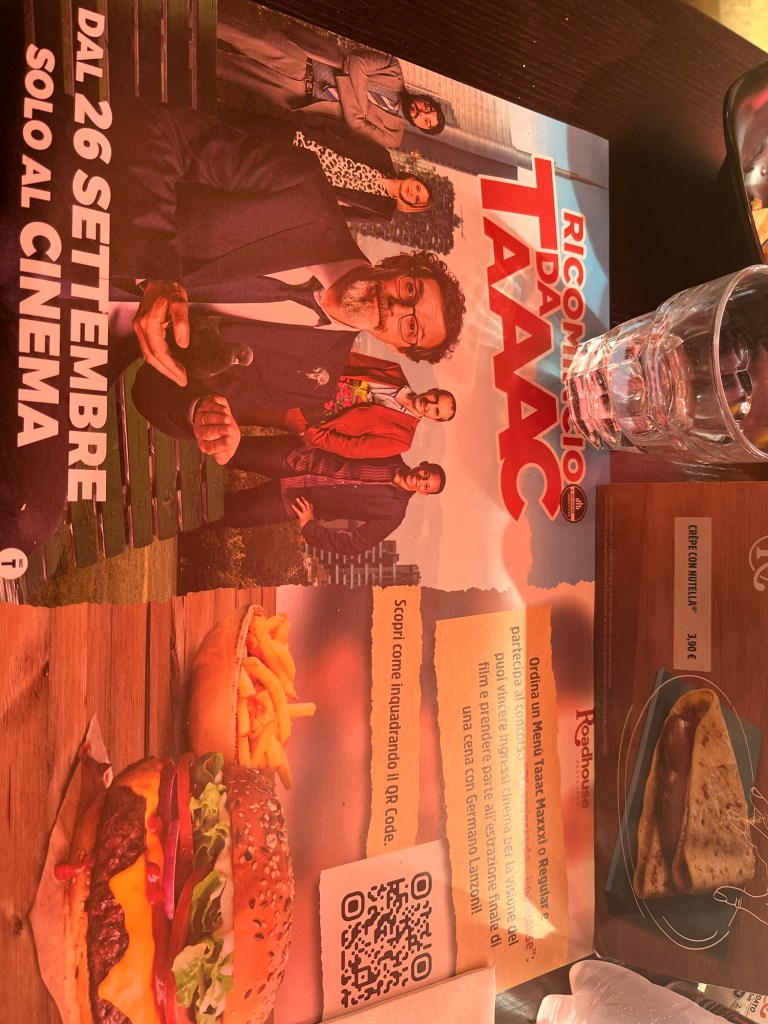
By now we are hungry and our plans for a small lakeside cafe are dashed. Instead we find Roadhouse, an Italian Western Sizzler knock off. Meat, meat, and more meat. My husband is in heaven. I am not thrilled about the food, but loved the local atmosphere. This unplanned stop gives me an understanding of what an Italian must feel like in an Olive Garden. It was a caricature of American steakhouses.
They had burgers with a layer of mashed potatoes, double patty, and topped with onion rings. Fries were covered in nacho cheese and ham. My burrito had nicely flavored steak, beans, rice….but also Cole slaw, Italian cheese, and corn. Strange combinations, not quite right, not quite wrong. What was wrong….incredibly wrong….my place mat had an advertisement for an upcoming movie featuring a man holding a pigeon. The man was also covered in pigeon poop. Not what you want to look at when you are eating a burrito with unknown ingredients.
Since our afternoon plans were scrapped, we stayed at the strip mall and joined hundreds of other Italians in the shopping experience. We needed to purchase an electric adapter as the two we brought were not sufficient for our electronic needs (we had no English stations and had to use the computer or iPad for programming). Add in phones that needed charging and the two plugs we brought required a dance of coordination that fast became a headache.
The electronics store was set up like Best Buy, but we could not read the signs and had to walk aisle by aisle to look for plugs. We found phone cords and extension cords and three way adapters, but none with an American plug. Finally after showing a photo to an employee, we walked to the check out line where we found exactly what we were looking for.
After a chaotic drive in which hundreds of bicycles took up the right side of our lane and hundreds of motorcycles passed us on the left despite oncoming traffic (and sometimes motorcycles approaching from the other direction as well). Think Bicycle➡️ car➡️ motorcycle➡️ motorcycle ➡️ car➡️ bicycle. That is a lot of traffic for a narrow road with rock walls and sharp curves. Add to the chaos, the Italian need for speed and……whew!
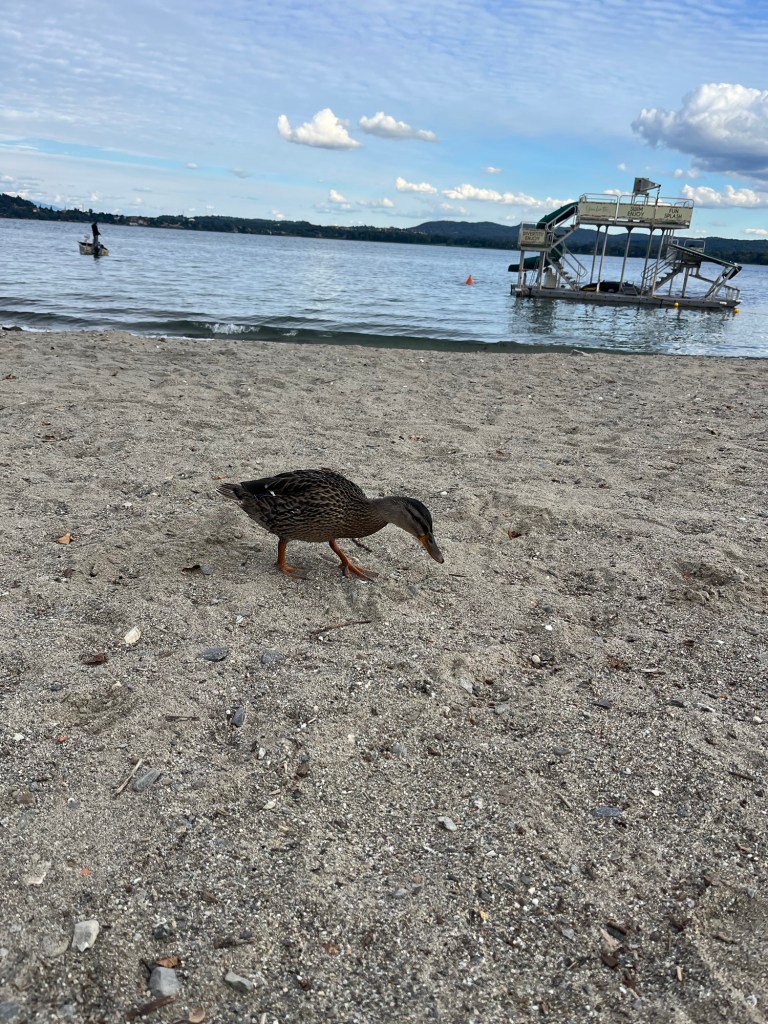
Once home, I needed to chill out. Grabbing my trusty lawn chair, I headed for Herno beach. I had the entire beach to myself, unless you count the ducks, who wandered right up to my chair. I got an earful about not bringing a handout, but they eventually calmed down. Just listening to the lapping of the lake was relaxing…. Until across the river a motley crew began ringing bells, waving sage, chanting, and banging drums. Unplanned drum circle…. But I decided that was one adventure I would ignore. Instead I settled in with a good book. Besides, the ducks seemed to be enjoying story time.
-
First impressions of Northern Italy in Arona and Lesa: Travel Goals
Waking up in a new space can be disorienting. Waking up in a traditional Italian house? A whole other level of level of confusion. Stumbling into the bathroom, I forgot the light switch was actually in the hall. In my sleep addled haze, I tried to recognize the toilet from the bidet in the dark. So far so good. No major calamities.
Next up, how to make coffee? N’espresso machine? Espresso stovetop pots? Electric kettle with percolator? Even though my Italian hosts would be appalled…. I stuck with the percolator method that I am familiar with. No need for learning new tricks before I have had my coffee.

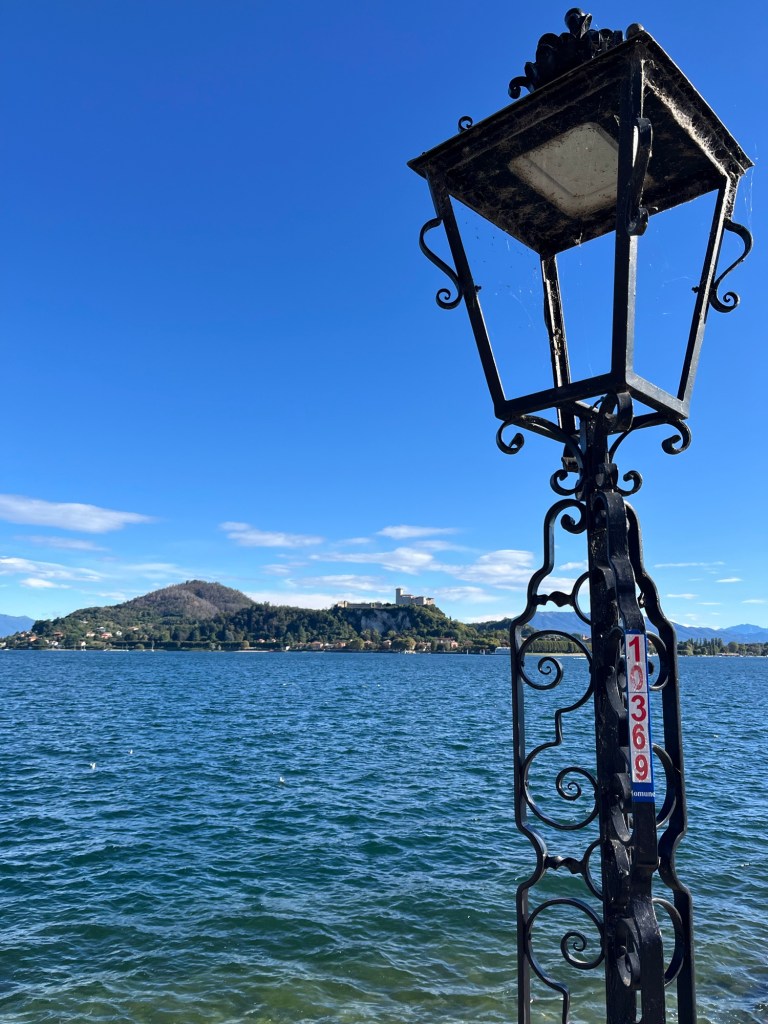
A very short drive from the house lands us in Arona. After circling narrow streets and endless round abouts, we finally find a parking spot just outside the restricted traffic zone. Parts of town are very narrow pedestrian only streets. Almost immediately, I was taken in by the charm of the city. A peaceful promenade lined the lake. Swans greeted us along the shore.
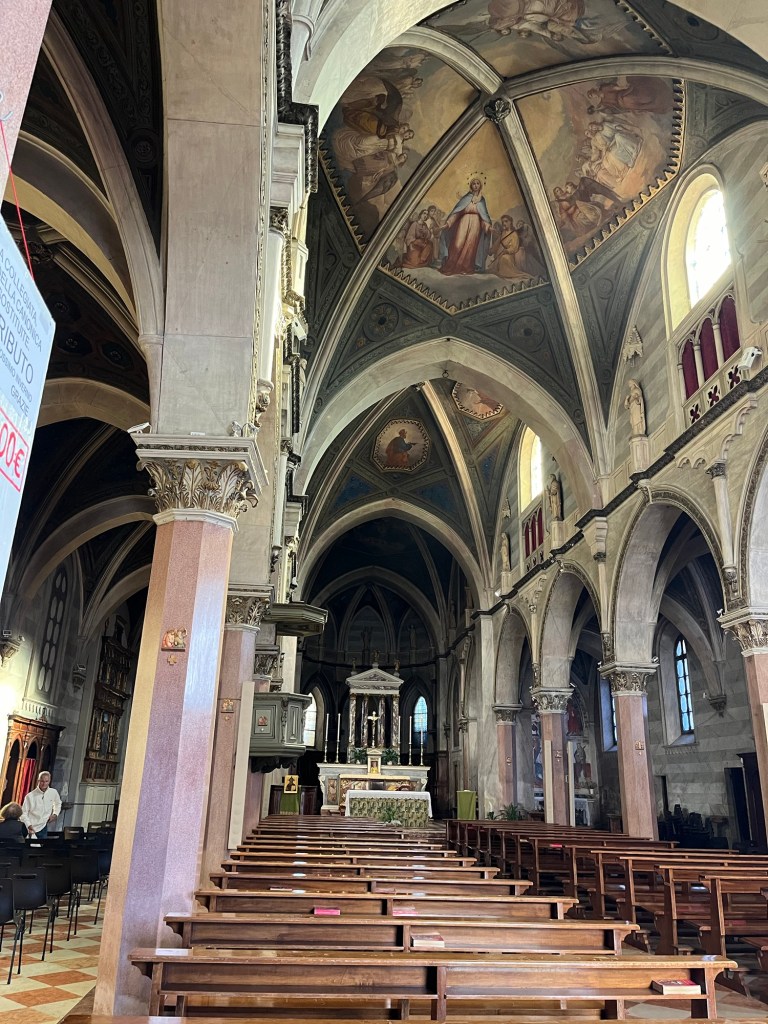
Endless restaurants offered culinary delights. Cobblestones under foot and villas lining the streets reminded us that we were newcomers to these ancient alleys. A cluster of churches reminded us of the circle of life. The Church of the Nativity sitting next to the Chapel for Souls in Purgatory reminded us that life and death are connected. What has been and what will be pulsating together in the autumn air.
Finally, we rest and lunch along the banks of Lake Maggiore. Italian style, there is no rush. A blanket on the chair is provided to ward off a chill. Although many Italians are wearing coats, it seems to me like a warm autumn day.
Our two personal pizzas provide more food than we can possibly eat. Entertainment consists of watching two teenagers strip to their underwear and plunge into the frigid lake.
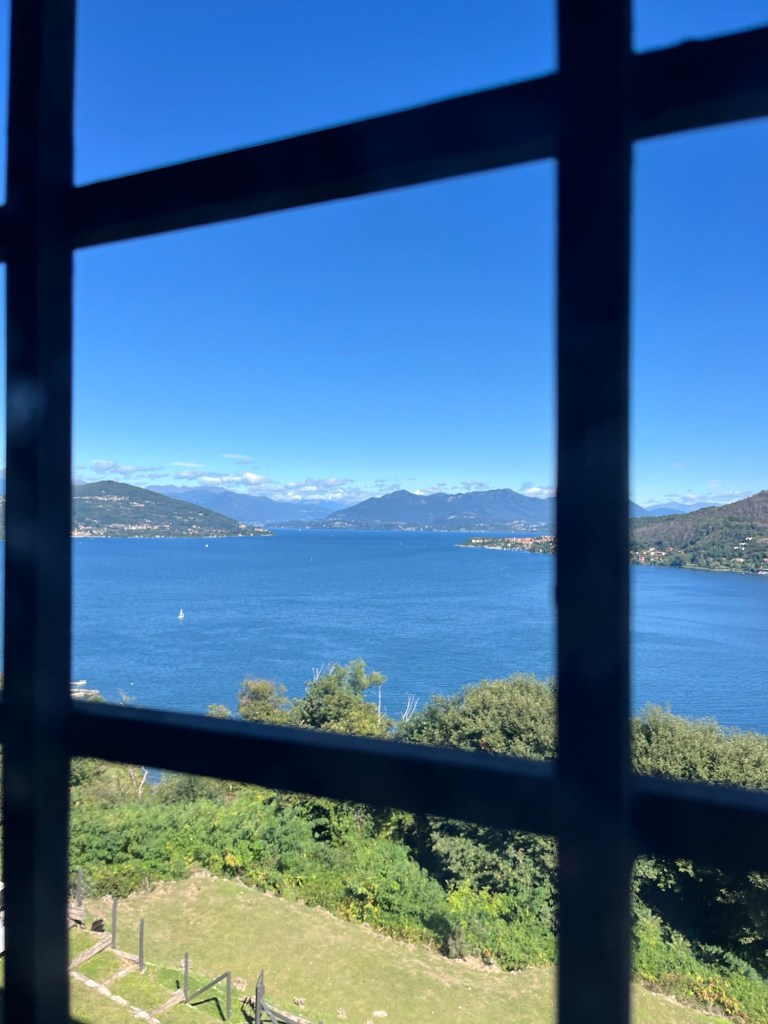
The next stop is the Parco Della Rocha. This large public park is situated amidst the ruins of a vast castle and the birthplace of St. Charles. The park towers over the city. The view of the lake against peaceful ruins made it the perfect place for an Italian wedding. Even though I had on a nice casual dress, I felt under dressed next to dazzling floor length formal wear if the wedding attendees milling about the park. Americans could use some fashion advice. We saw at least three weddings throughout the day and each was a runway worthy spectacle.
Leaving Arona, we stopped at colosso di San Carlo or the giant St. Charles statue. While the statue wasn’t particularly interesting, the nearby Chiesa di San Carlo contained chapels filled with art and artifacts of St. Charles. I felt warmth in the sanctuary and shared a smile with a woman who had come to pray.
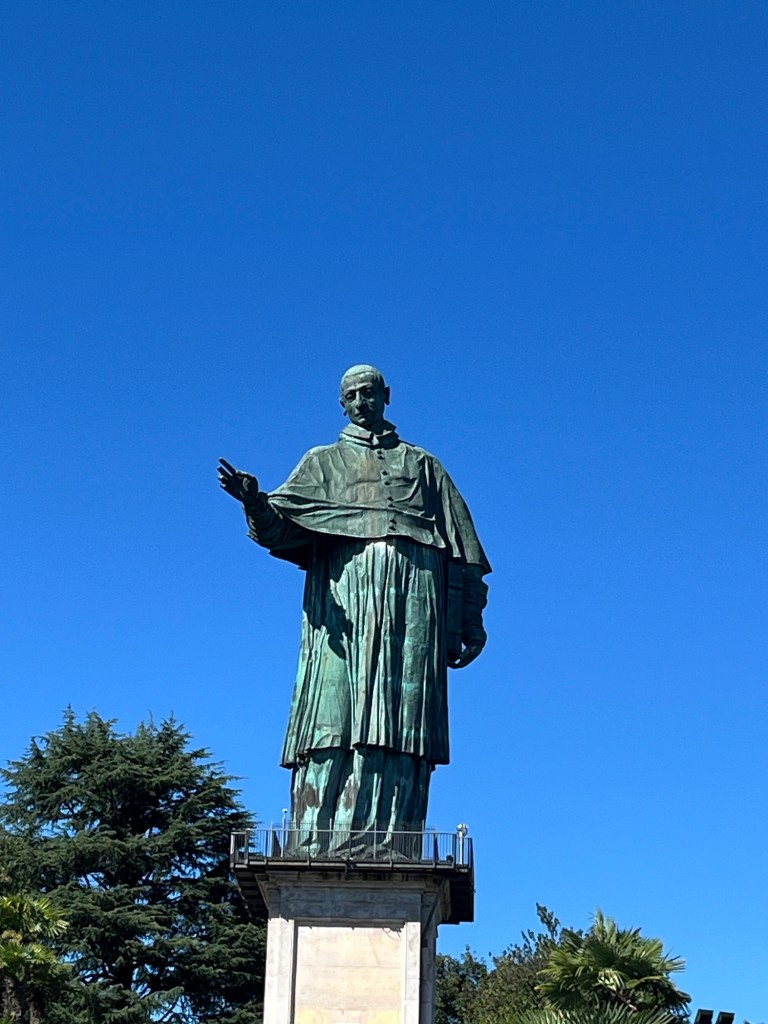
At end of day, we explored Lesa, the little town we call home for the next several weeks. The town is small, only a few streets wide. The structures are ancient and I could easily be strolling 1000’s era Italy. If it weren’t for an occasional electric line, I would never know I was in the 20th century. Main Street along the lake is more modern and is a restaurant row. Having just had lunch, we opt for gelato. Peach for me, made from fresh puréed peach. My husband gets some unholy combinations of chocolate, stracciatella, and strawberry. And we sit with our gelato treasure and watch the boats in the little harbor.

Driving back to the house, we conduct a futile search for ice. My husband is in withdrawal mode and may not survive the evening if we can’t produce ice for his soda. No bueno. Ice is not Italian. Dejected we head home, dodging bicycles and motorcycles and cars passing in no passing lanes.
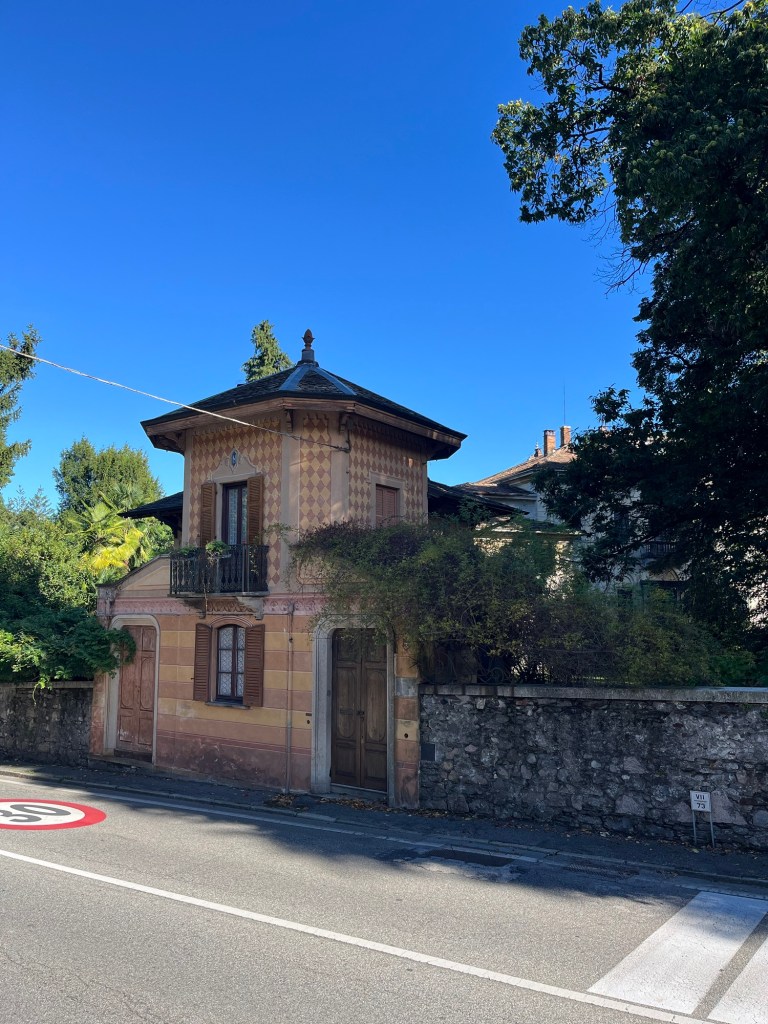
At end of day we follow the Erno River just past our villa to where it meets the sea. The water gently laps to shore and peace descends on a most satisfying first day in Italy. Ciao Bella.
-
Arrivals: Travel Goals
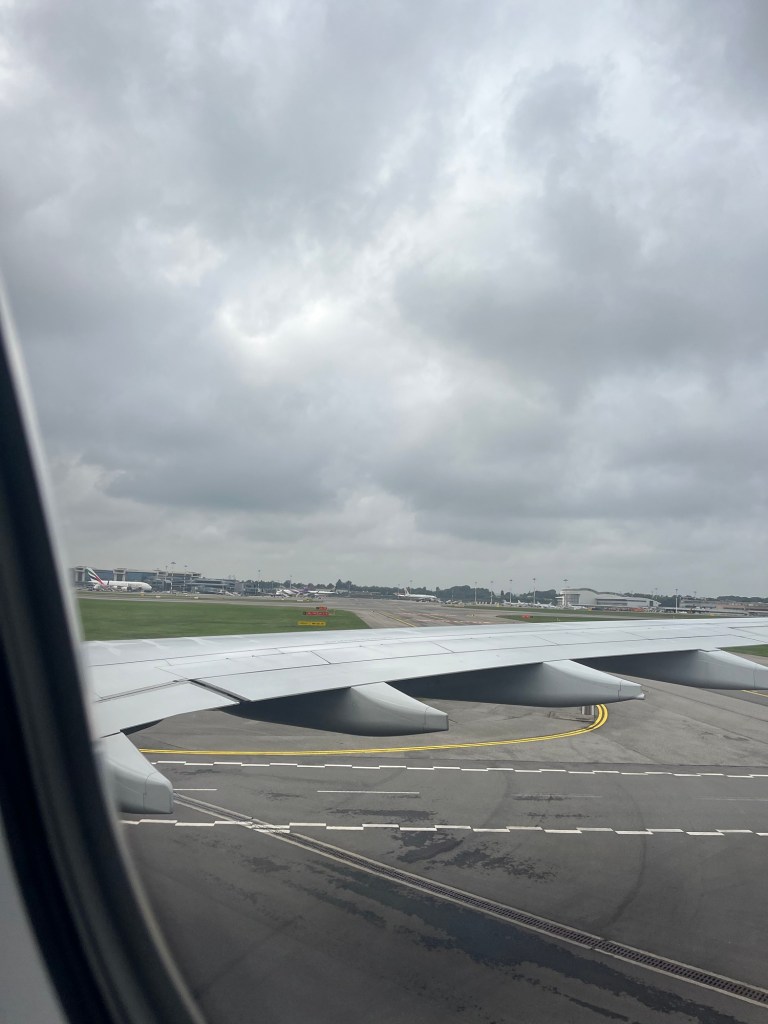
When the plane takes off from American soil, I always release a big sigh. It finally sinks in that I am going on an adventure. This trip I was especially ready to release pre-trip tension. We flew through Atlanta on the day hurricane Helene hit Florida. The airport was pounded with steady rain and high winds in the surrounding airspace. Our flight was delayed by over three hours and I was pretty certain we would be stuck in a flooded city.
Equally appealing was flying out of an incoming hurricane zone. Hard to know what outcome to wish for in this scenario, but the flight was not cancelled. When we finally were allowed to board something was wrong with an aircraft door and we waited another 30 minutes for it to be fixed. All the while, the hurricane was inching closer and the rain was picking up. (Just in case you are wondering, these are perfect conditions for a person with travel anxiety to spiral. Luckily, I know a lot of self-regulation techniques so on the outside I look calms and collected.) I was sure we would never leave, but eventually 3.5 hours after our expected departure (around midnight), wheels left the tarmac. We ascended through really bumpy air. Everyone including flight attendants were required to remain seated until we were almost to Nova Scotia.
9 hours, a few movies, a nap, and two icky airplane meals later…we touched down in Milan. A quick walk across the airport through a fast moving customs line and we were in baggage claim. My suitcase was sopping wet! Perhaps they left it out in the rain on the tarmac for the three hours we waited for the plane. Hurricane Helene had far reaching effects.
Next, a walk back across the entire airport to the rental car office. It was really hot in the tiny office. The sales attendant moved at a snail’s pace. Since we had pre-reserved and pre-paid, we aren’t sure what took so long, nor are we sure why they wanted to double the cost for two drivers since we had requested two at booking. Not wanting to double our cost, my husband won designated driver status for the month. I was Italy with a handsome chauffeur, every girl’s dream!
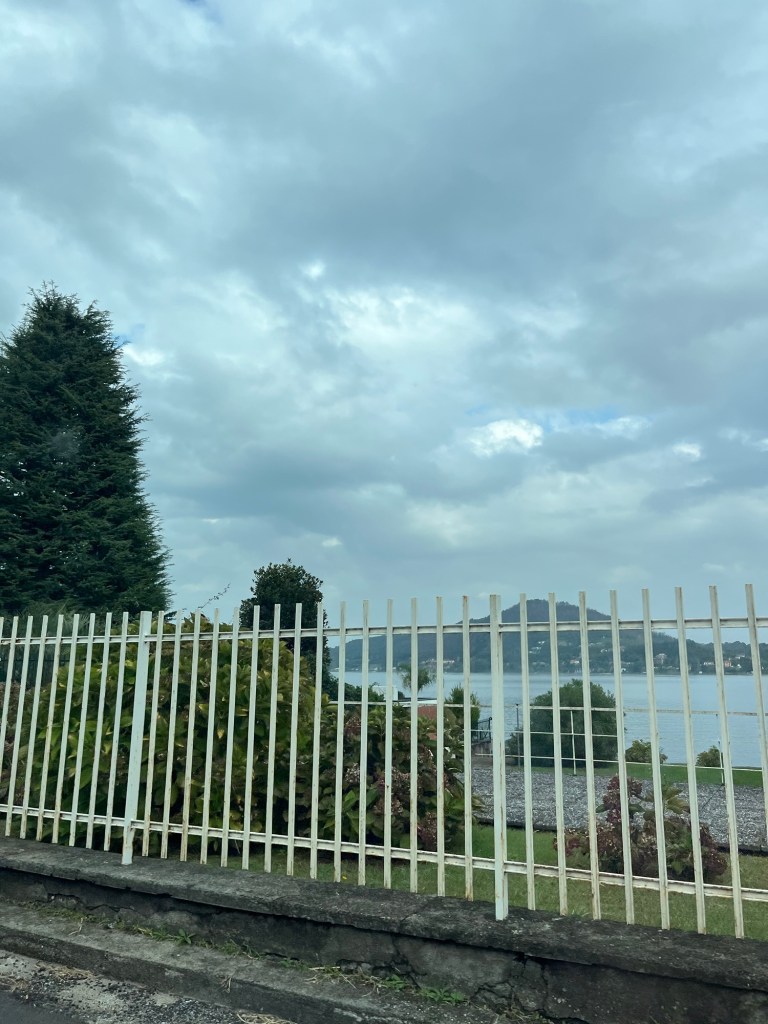
The drive from Milan Malpensa airport to the town of Lesa took about an hour. We skirted the Ticino River until we reached the shores of Lake Maggiore. I was tired and just looked at the passing scenery. The road most of way was lined with houses and strip malls. As designated navigator, I had to anticipate the twists and turns that navigated us onto a new road. Meanwhile my husband was learning how to drive a stick shift (toy sized) car through round abouts, over speed bumps, and through traffic. Italian drivers are aggressive, love to speed, and have no problem creating their own lanes. Motorcycles pass all cars in the middle of the road. Gangs of bicyclists take over the right hand side of roads and frequently spread across the entire lane. Nevertheless, we arrived in one piece to be greeted by our host.

Our Italian house was quaint and already felt like home. With three bedrooms, a kitchen, living room, two baths, and a patio; we are living in Italian style. We got a quick tour and lessons on how to use the heating/cooling and how to separate trash. There are five different bins and a lot of local rules.
We deliberately chose a typical local house in a non-tourist neighborhood. While it will only be a month, we want to experience Italian living. Our host returns, quite concerned that we may have five people in the house at some point. He has only laid out towels for four. I think to myself that four towels will need to washed several times before our guests even arrive at the end of the month. I don’t understand the concern, but he fusses about having to provide another set of towels. In the guest room, one cabinet is secured with a bicycle style locking bolt around the closet handles. He used a key to unlock the closet and reluctantly handed a thin stack of bath towel, hand towel, and bidet (or what my sister in law calls the “booty”) towel to me for inspection. They are old and stiff. He indicated that we may have to pay extra for the use of the towels. I said okay and wished him a good day. There was no need for stress over a towel, and I was really wanting him to leave so I could unpack.
After he left, we did a quick inspection of our house. We each claimed closets and bathrooms, and everything was settled in short order. We needed to stay awake to fight jet lag. We also needed to get groceries. So we braved the Italian Supermercado. Pastry, Pasta, Wine…oh my. Cheese, pork, fresh veggies…all at prices that make me wonder what is wrong with America.
We had now been awake for much of the last 38 hours, and I was running out of steam. We make dinner (fresh pasta and bakery shop cannolis). I took a hot bath and put on my very damp sleep shirt (thanks to the hurricane soaked suitcase). We sat down to watch a movie and I promptly fell asleep on the couch. It was clearly time to call arrival day a success and finally go to bed.
Buona Sera!
-
And So It Begins: Travel Goals
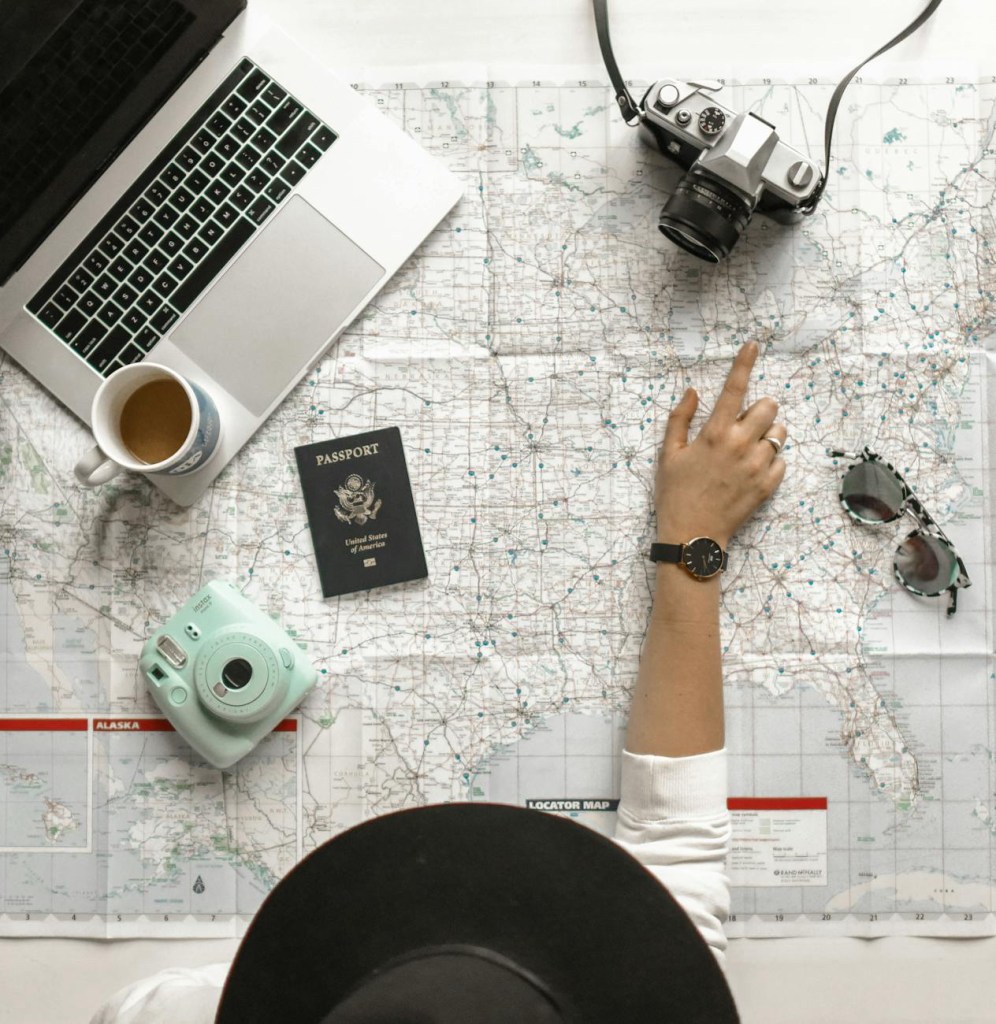
Travel is an intentional act to get out of your comfort zone and encounter new experiences. What makes it thrilling and satisfying is also what can make it stressful. While planning our latest adventure, I discovered the video feature of this platform. I have no desire to be an “influencer”, if I’m honest I don’t even understand the concept. But I do like to watch travel posts and I will happily look at anyone’s vacation photos. So for this trip, I will be posting a few videos and writing about our experiences.
To break the ice, let me introduce travel mode me…..at 6:00 am …..doing what I always do. I can’t sleep. I check and recheck our travel route, connecting flights, and airport maps. I can’t control the weather or airlines operations, but having a little knowledge of options if I need a plan a, b, or c is how my extreme type a personality copes with the total lack of control that comes with air travel. I have also decided just to share my travel day anxiety. It makes no sense and I can’t control it, but it doesn’t stop me.
When I get a text it is time to check in online, I still get a knot in my stomach. The process has gotten so much easier over the years, since the days of hand entering passport information only to be told there was a problem and check in couldn’t be completed online (that used to ensure no sleep). I had already uploaded my passport shortly after we purchased tickets, so with my trusty iPhone, I got us all checked in on the airline app within minutes. A few clicks while sitting in my car between meetings and we are good to go. Now I only have to worry about hurricane Helene staying away from our connecting airport (Atlanta), we should be on track for a good flight. Leave it to us to pick a route flying into a hurricane the day it makes landfall.
Throughout the night, we got weather alerts about the hurricane’s potential effects. Oddly the Atlanta airport does not have alerts for our travel date…only the day after. So we will not be changing our flights and hoping for the best. Yikes!
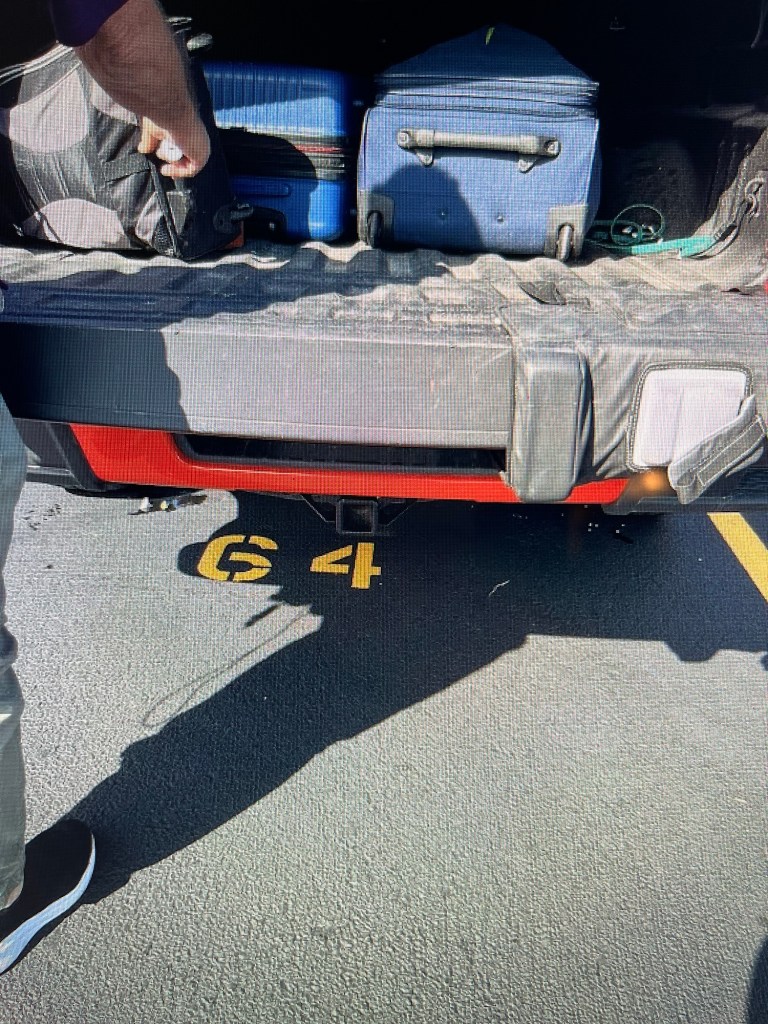
After a brief bit of confusion where my husband thought our flight was at 2:00 pm based on the original ticket and I knew it was at 1:00 because I obsessively check the updates, we made it to the airport without incident. Other than me assuming he was procrastinating on purpose to make a point, and he assuming that I wanted to leave an hour early, which we cleared up on the drive, we had no issues getting to the airport. The late start (for me), made me anxious, but we arrived with plenty of time to spare.
The big excitement occurred on the shuttle from the parking lot to the terminal. Our driver stopped to see if a man parked next to the fence needed help or to be picked up. He was parked sideways where there was clearly no spot. When the driver stopped to see if he needed help, the man came to the door of the shuttle and said, “I need to use the bathroom”. The shuttle driver politely told him there was not a bathroom in that area. The man replied, “I know, I am making one.” He then proceeded to pee on the fence. Who does that in a busy airport lot? Crazy times in America. It might be good that we are leaving the country.
-
Skunked
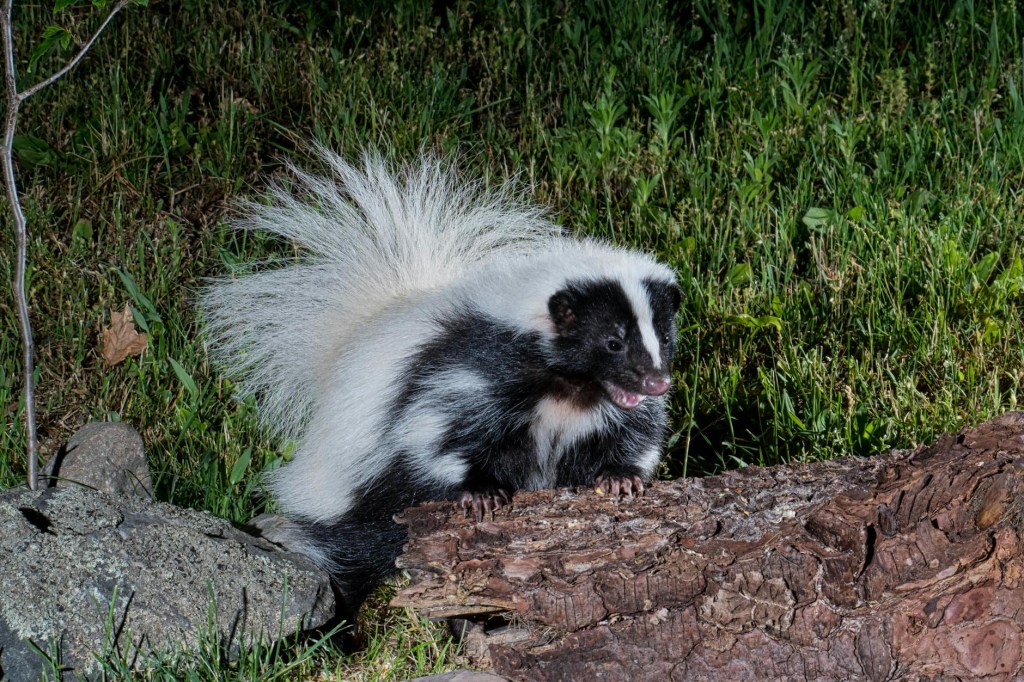
Friday started out normally. I had laundry running and was packing for an upcoming trip. As I moved from room to room, I caught whiffs of an unusual odor. I kept working.
There was a heat wave, with temperatures reaching 100 and I wasn’t too keen on working outside in between my zoom calls and usual paperwork. Yard work was calling but I wasn’t answering . So instead, I decided to pack for a trip weeks away. Some call it avoidance…. I call it preparation.
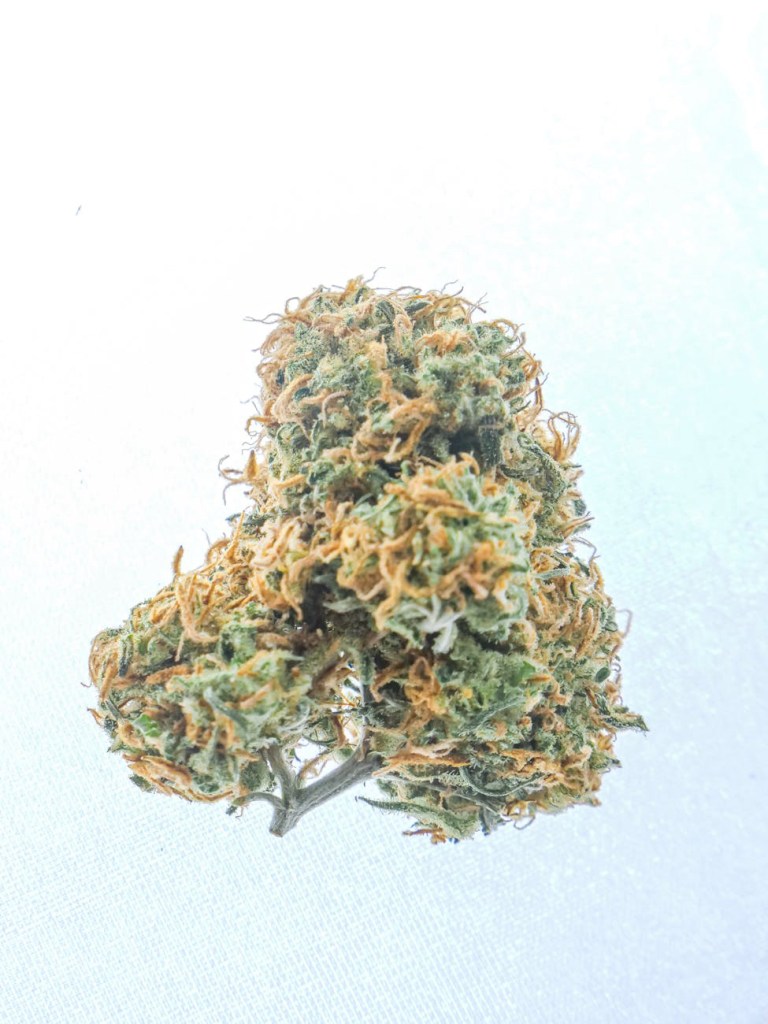
With each trip to the closet the smell grew more pronounced. Finally, I realized that it smelled like marijuana of the variety that you encounter drifting out of cars or rolling off of jackets of people you pass on the street. Confused I walked to the opposite end of the house where my husband was dealing with household paperwork.
“Our bedroom smells like weed.” I announced. He looked up and said “well what have you been doing back there”. Very funny. After I finally convince him there is an issue he comes back to my closet and concludes, “yep, it smells like weed”.
Puzzled, we both search for the cause and come up empty. A little later, taking out the trash through the laundry room, we open the door to our garage and are knocked over by SKUNK. Not a little skunk, but full bore, eye watering, gagging SKUNK!

Not knowing where the skunk is and not being able to see under cars or behind the freezer, we quickly opened the garage door and went back inside. At least we knew where the smell was coming from. The garage shares an interior wall with our bedroom.
Later in the day my husband searched the garage and came up empty, thankfully. We hoped the skunk had wandered away, but the smell did not abate as it should. A few hours later he came in from the garage and announced that he had found the skunk. Pepe Le Pew appeared to be sleeping on the floor of our tool room which is attached to our garage. I imagine that the dark tool room with its cool concrete floor was appealing in the heat. Why the door was open is still a mystery, but there it was. A black and white stink bomb sprawled in my house.
We decided to leave the door open and hope he went away on his own instead of telling his friends and bringing them in for a house party. But, in the morning he hadn’t moved. He was poked and prodded (with a very long pole) but no movement. We had a dead skunk in our house.
My husband had to leave to work at a football game that had conveniently been rescheduled for that morning due to storms. It was just me and the skunk. (In fairness, he planned to deal with it when he returned). I couldn’t deal with the smell another minute. At least the storm ended the heat wave, because I suited up like I was the commander of a hazmat strike force. Long sleeves. Check. Long pants. Check. Hair and face covering. Check. Gloves. Check. Boots. Check.
I gathered triple layers of garbage bags and proceeded with caution to the tool room. The smell. The SMELL! I had to walk up and stand over the skunk to get to the shovels. I wasn’t convinced that it wasn’t going to spring up and run up my leg. Irrational fear, it was well and truly dead. I began to arrange the trash bags so that I could lift the skunk with two shovels into the bag.
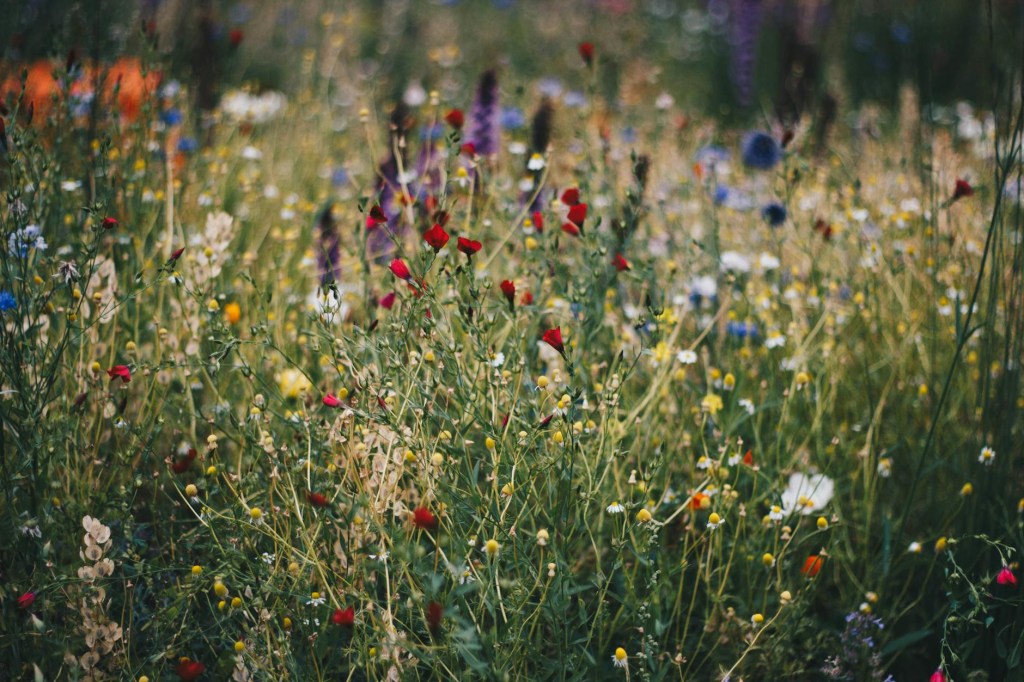
It weighed so little, I was surprised. Into the bag it went with no issues. Triple knotted and secured in seconds. I walked down into our back yard to the middle of the wild flower garden carrying the bag and shovel and began to dig. I hoped the smell of lavender would help to counter skunk. Digging was harder work than I imagined because wildflowers have long, deep roots. Eventually he was in the ground. I did not stay to give a eulogy.
Next, the shovels and the tool room had to be dealt with. Even more unfortunate, the skunk had been ill before he died, whether from poison or heat. There were presents all over the concrete floor. Armed with the trusty shovel, I cleaned up the mess and then bleached the floor. Just straight bleach and a mop. Desperate times call for desperate measures. I left it to my husband to finish up with soap and water later.

After discarding my gloves and clothes in the trash and taking a long hot bath, I felt weirdly accomplished. I was triumphant over the terrible. I had faced the unknown with action. I had the agency of self determination. I realized that when faced with something unexpected and unpleasant, the worst part of the ordeal is the wringing of hands and the wondering of why this happened. There is a calmness in action and a peace in knowing you are doing the best thing you know how. I will remember that the next time I am skunked (hopefully only metaphorically).
-
Stillness, Surgery, and Serenity
If you know me, you know I rarely sit still. Even when I am “watching” television, I am usually doing a word puzzle or craft project. When I am driving, I ponder and grapple with ideas. I like to be on the move mentally and physically.
So when my husband finally decides (after 10 years of avoidance) he needs full replacement hip surgery, I have mixed emotions. A new hip will hopefully mean less pain for him. I selfishly hope it will also mean greater willingness to accompany me on walking adventures. I am worried that something might go wrong and definitely didn’t want to see him in pain. I am excited that he will get to be more active. I dread the weeks of recovery. He says I am more anxious than he is.
As it turns out, for us at least, the process is relatively uneventful. The surgery center is amazing. He checked in and less than three hours later, the doctor is showing me a model of the new hip and explaining the procedure that has gone well. Three hours after the surgery he is up, walking up stairs, and headed home. A body part is fully replaced and we have him home in his own bed by sunset. It seems miraculous to watch him climb the stairs into the house without struggle.

The next few days are a blur of medication schedules. He has to get up and walk for 10 minutes every hour and do daily exercises. He has to be reminded not to cross his legs and to kick out his leg when he wants to sit or stand. Unlearning a lifetime of habits is hard work. So is caring for a person unlearning a lifetime of habits. Of course my discomfort is only empathetic, his is real.
Thank God our daughter is home to help look after her Dad. I originally told her she didn’t need to come. I am glad that she emptied the wound drain and removed the tubing from the incision the day after surgery. I apparently am not nurse material.
The only really tense moment come in the middle of the night two nights after surgery . His surgical spinal pain block finally wears off. He goes from no pain to substantial discomfort just like that. I couldn’t help but think of the birth of our first child. I was feeling no pain until my water broke. I went from zero to 10 just like that. He says I squeezed his face until he thought his jaw might break. As I am clutching his grasping hand while he comes to terms with the new level of pain, I can relate. Life’s patterns of pain and renewal are familiar.
One week in and we are both stir crazy. He has to get out of the house. I agree to a drive through restaurant for lunch and to park the car near the river. A low risk outing will do us both good. As luck would have it, there is a suitable bench a few steps from the car. Seeing my strong husband navigate a walker to a park bench is a little disconcerting, but life is full of challenges. The sun is shining and we are smiling.

Two weeks in and we drive a few hours to his brothers ‘getaway’ property. I fuss over using a walker in unfamiliar and uneven terrain. He fusses that a cane is sufficient. I am fearful that their lovely yet boisterous dog might accidentally cause injury. He dismisses my concerns. He is with his family and clearly enjoying the lack of routine…until I impose meds and exercise in his otherwise lovely day. He calls me the “general” (I demanded a promotion from drill sergeant) but he is clearly relieved when I insist we go. His first full day adventure fed the soul but taxed the body.
Three weeks in and he is cleared to drive. We slowly reintroduce normal things like visits to church and the grocery store. I return to work obligations outside the house (thankfully I can usually accomplish much of my to list from home). He makes his first post-op doctor visit and gets a good report. He can stop using the cane unless he is tired or feels unstable (at least that is what he tells me). We go out for dinner and live music at a local winery to celebrate. In what may be a first, I am the one dropping him off at the door. Usually it is the other way around (at least when I wear high heels that make the climb up the rocky hill difficult).
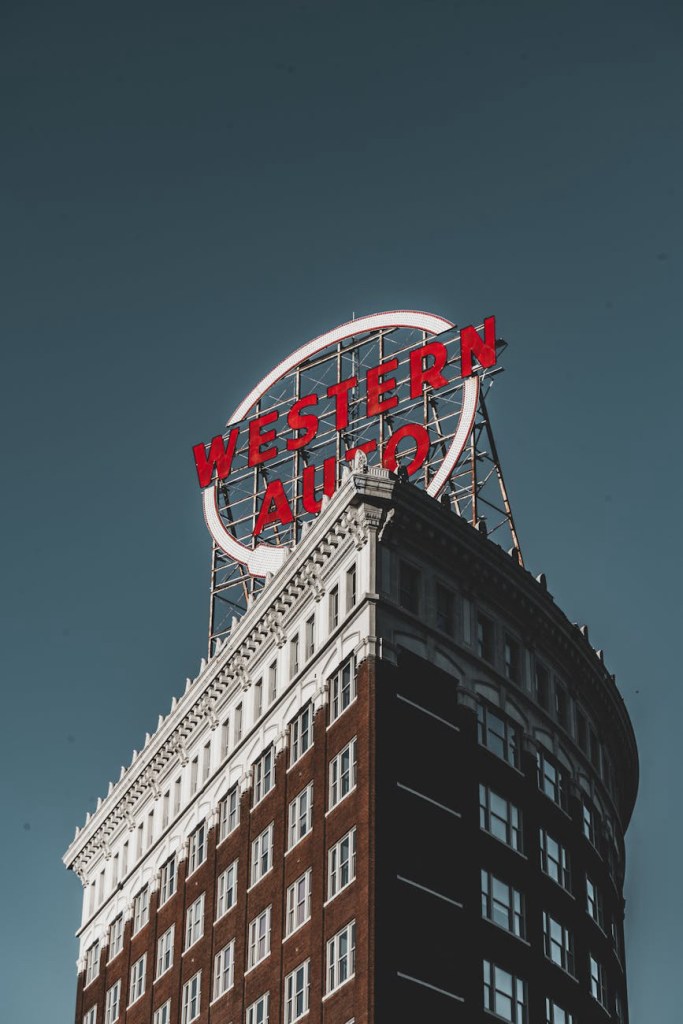
Four weeks in and we visit with our children in Kansas City. We kill time in Parkville and walk the shops and restaurants. When he gets tired he sits and waits for me (he has long perfected this strategy). I smile at the familiarity. He even attempts a round of mini golf. I exult in my victory. He scoffs at my glee in beating “a crippled old man” (his words).
Five weeks in we go camping. I try to do the heavy lifting, but he is impatient and no longer quite as willing to follow chain of command. It is a different experience as I must hike and bike alone (he is doing great, but there is no need to push the envelope). He feels up to the cave tour. (We knew the walkways were paved and the spaces large as we have toured the cave before, but had forgotten how steep the inclines were in places. It is amazing what you don’t notice when you are able bodied.) He does great, but the walk is perhaps a little too long. So he finds a bench with another woman also rocking a cane, while their spouses make a longer climb into the last area of the cave. I take a picture of him sitting far below and feel love. Five weeks after surgery and he has conquered a cave.

I might have mentioned that I don’t much like sitting still. This summer has been slower. There have been no grand adventures, but lots of little ones. He will tell you he spent about as much time with books, tv, and puzzles as he cares to. I have mowed the lawn, washed dishes, sorted laundry, swept floors, developed training materials, taken zoom meetings and a thousand other tasks to occupy my time at home. The summer has been slow, but it has also been happy.
It is nice to know that when we are forced to slow down, that we can do so with humor, patience, and love. The surgery is symbolic. We age. We slow down. While we will not go quietly into that good night….we will go. All of us must. But in the pain, there was joy. In the uncertainty, there was prayer. There was family support. There was boredom and “we can make the best of it”entertainment. We found ways to create playful adventure in the midst of restrictive movement. They say aging is not for sissies. But then, this is one “Sissy” that aging hasn’t met yet. I don’t stay dormant long, and neither does he. We continue to do what we can, when we can, for as long as we can….prisoners of hope.
-
Subscribe
Subscribed
Already have a WordPress.com account? Log in now.
 Prisoner of Hopes