-
Don’t Overstay Your Welcome: Travel Goals
I was always taught not to overstay your welcome. This colloquial saying communicates that you should always leave before your host tires of your presence. I generally like having company, but it is hard for people with different schedules and routines to coexist. In a campground, a diverse group of people are living in a small area. In a Missouri state park, you are allowed to stay fifteen days. For most guests that is a fine stay. Others join us only for a few days and we are sorry to see them go so soon. Other guests wear out their welcome long before they leave the park.
In my last post, “Give a Hoot”, I explained the challenges and perils of guests who litter and otherwise destroy the park environment. In this post, let’s discuss the top ten things that cause the park hosts to count the days until your departure.
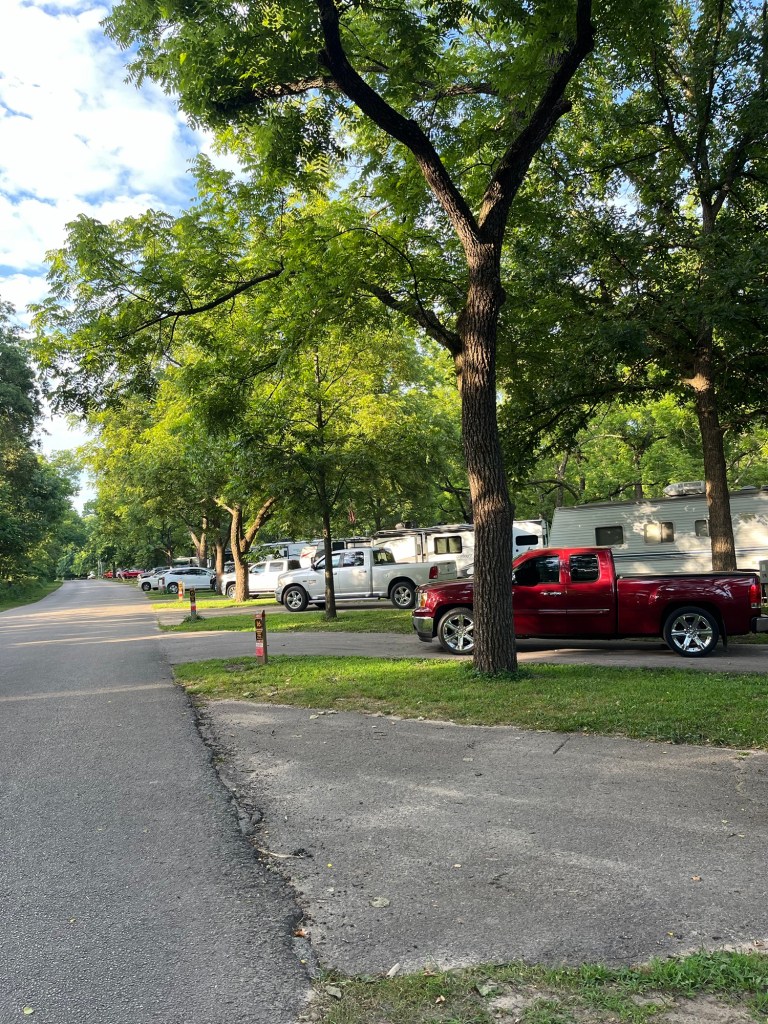
1. Imagine that your idea of a good time is something everyone wants to share. Picture yourself on a sandbar along a river on a hot summer day. You have just settled into your lounge chair. Your feet dangle into the cool water while you enjoy a cold drink. A hawk circles in the sky. You breathe a relaxing sigh. At that exact moment, music erupts from behind you….so loud that it causes you to turn over your lawn chair. The music is a genre you dislike, full of obscenities and misogynistic comments. As you are picking yourself up out of the water and scraping off the sand, a large dog races by to catch a ball thrown into the water by its owner. You feel a tail in your face. You turn to try to figure out how to get away from the ear splitting noise. Meanwhile, the dog, now exiting the water, shakes off all over you and your snacks. At this point, you are trying to salvage your dignity and control your temper. You craft what you hope will be a gracious request that recognizes your new neighbor’s right to enjoy the outdoors while you assert your right to do the same. As you approach to make your case, your new sandbar co-occupant puffs his marijuana (now legal in Missouri) in your face and gives a friendly wave. He is here to enjoy the day and is oblivious to the chaos he has created for you. Odds are good you will be leaving the sandbar before he does, because you are now an unwilling participant in the new arrival’s beach party.
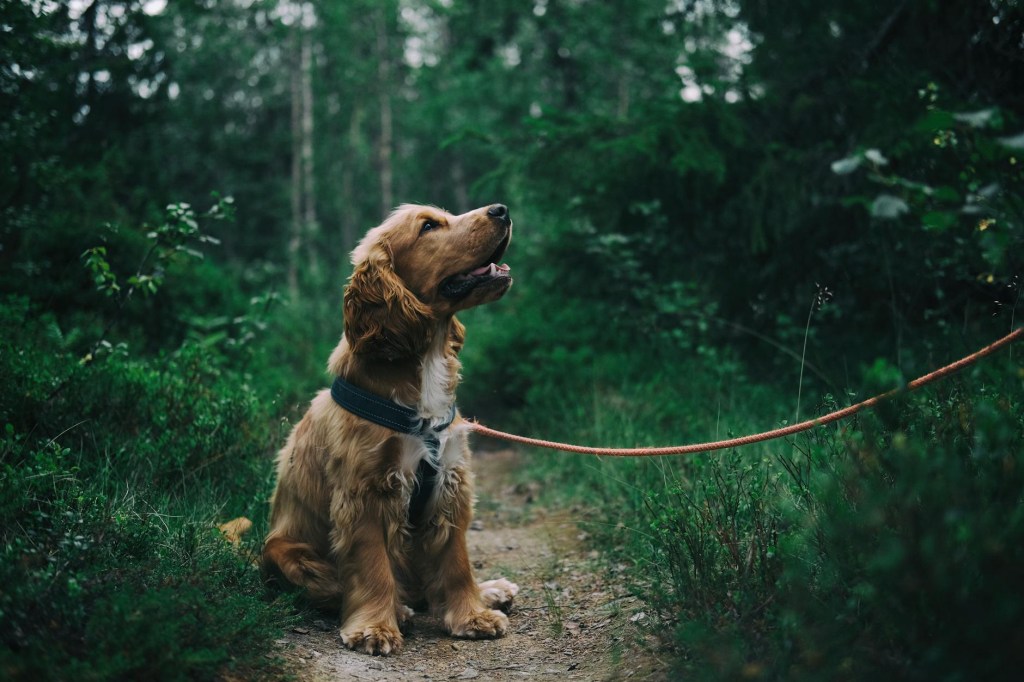
2. Assume that your dog is unlike all other dogs and therefore exempt from all rules. If you hear it once, you hear it again hundreds of times. “My dog is friendly. He won’t hurt anyone.” This usually comes after the off leash dog comes running at you while barking aggressively and exhibiting signs of stress. Owners roll their eyes when told that the dog must be on a leash…even if they have a cute little fence on their campsite. They don’t believe that when you put your dog on a 20 foot lead, it could run into the road and bite the unsuspecting person walking to the bathroom in the early morning (me, it bit me). They don’t know that when you zip your pit bulls into your tent and leave them alone, they could burst through the flimsy zipper to attack someone walking their dog (and then someone…me….has to sort out the mess). They don’t think that if you leave your dog outside the camper while you are at the river, they could chase an animal across the park and kill it in front of children playing in the playground. They don’t care that if you leave a dog alone in your camper, it may bark for 12 hours straight. Parks are crowded with people and animals. No matter what you think you know about your pet…please don’t put them in a stressful unfamiliar environment and expect that they will behave as they do at home. Don’t be upset at park hosts for reminding you of rules designed to keep you and your pets safe. And if the “could happen” turns into a “did happen”, please help the person (again …me) who was knocked down and bit by your dog instead of retreating into your camper to pretend that nothing happened.

3. Not observing quiet hours. At ten pm, the campground is officially in quiet hours. This ensures that individuals can go to sleep in peace. Fireside chats and quiet card games can still happen. Making s’mores and reading by lantern light is totally ok. However, eleven pm is not the time to start up your very loud motorcycle engine and drive through the campground. Midnight is not the time for a teenage birthday scavenger hunt. One am is not the best time for a dance party. Basically if you are looking to party all night, a state park campground is not for you. When the park host (who was probably awakened by your neighbor who had already unsuccessfully asked you to be quieter) has to come and remind you to be quiet, don’t be a jerk. That makes it worse. Also don’t offer them alcohol to look the other way. You have misread the situation.

4. Run through check points and ignore hosts. Online check in is an option and can speed up registration and check in. However, when you approach a park, if the booth is open you should stop. Hosts can save a lot of confusion at check in and offer friendly service including helping you quickly find your site, preventing you from setting up on the wrong site or on the wrong day, and making sure you are in the right park. You may know what you are doing, but the hosts don’t know your plans. When you run through a check point at full speed without acknowledging the host who is trying to get your attention you are certain to get a visit. The host needs to know your details to help the camp run smoothly. If you pretend to adjust your cap as the host is waving for you to stop, they are not fooled. We know you can still see us, and we assume you have no manners. Remember, overstaying your welcome upon arrival is not ideal.

5. Running your motorized boats at full speed through family swimming and floating areas. Yes, we know you have a new toy and want to show it off. It is probable that you are racing upstream to increase the trim and get your engine higher off the gravel riverbed. This however, does not change the fact that small children are playing in the narrow channel that you are racing through. Floaters are caught in the narrows at the mercy of the current. You could kill someone with your need to speed. Do us a favor and find a lake or a more remote location. Better yet, buy an echo friendly kayak. Because when you ground your brand new million horsepower boy toy in the mud because you were doing water donuts trying to spray kayakers (who are hugging the far bank to avoid you); I am not coming to your rescue. And you probably won’t want to talk to the ranger either. He has tickets and the number for the water patrol.
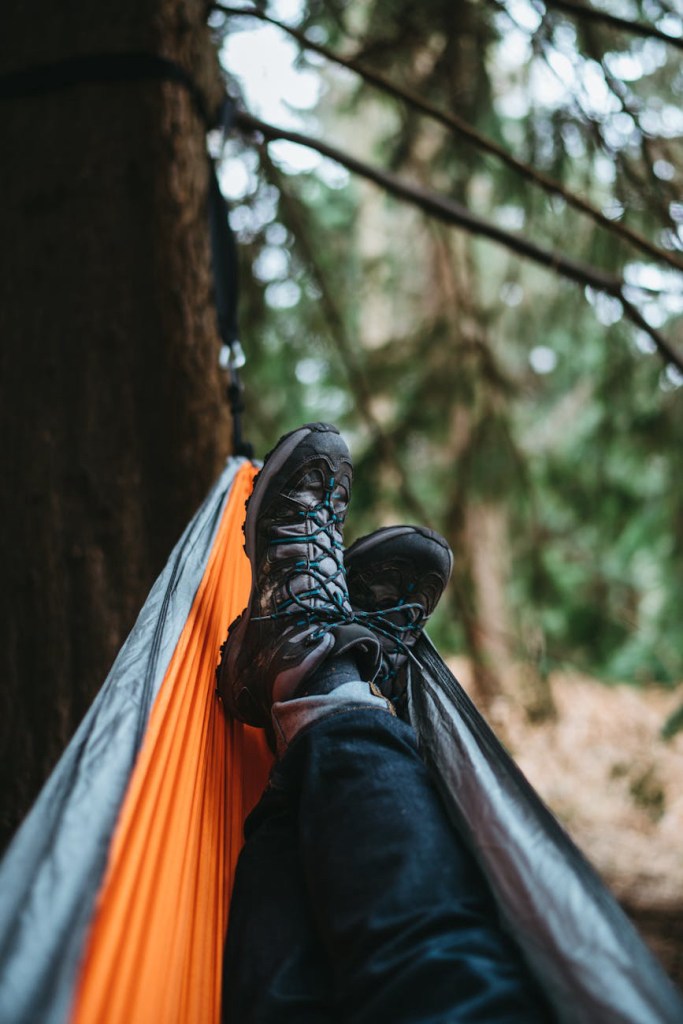
6. Tying everything imaginable to the trees. I love, love, love my hammock. I have a double wide that was an awesome retirement gift. I also have tree protecting hammock straps that are extra wide. Please remember the trees when you camp. Small rope cuts into the bark and repeated use eventually will leave the tree vulnerable to disease. So if you want to bring your hammock or your portable Olympic ninja warrior course (yes, it is a thing)… make sure you have wide tree friendly straps. If you need to dry your tent and you only have a nylon rope, tie off to the lantern pole and the picnic table. And for those of you that need to hear this….if a sapling has a protective plastic sleeve and bends down to the ground with the weight of your wet swim clothes…it is not a suitable anchor for your clothesline (which is generally not allowed anyway).

7. Flip signs to confuse the staff and to assure empty spots. It is hard to imagine the hubris of an individual who pulls into a spot and thinks “the first thing we should do is flip the signs on either side of our campsite to occupied. That way people won’t know the sites are available and we won’t have neighbors.” And yet, it happens…a lot. It is easier to understand 11 year olds on bikes who are flipping signs with abandon, thinking they are pulling the greatest heist in park history. The truth of both scenarios is that they increase the work of park staff and cause general confusion for walk in campers. It takes about an hour each morning to change all the campsite signs (vacant or occupied) to reflect the days arrivals and departures. The signs help hosts and guests visually verify who is coming and going as well as which sites need to be cleaned. Don’t be a jerk. Leave the sign flipping to the professionals.

8. Lighting up the site like Las Vegas. Ok, I have to confess this is a personal pet peeve. If your campground looks like the Las Vegas strip, you may need to do some self reflection. Do you need palm trees, American flag cut outs, bucket lights, rope lights, and string lights on all night long? Of course small lights can and should be used if you are outside and need to see in order to socialize. But if the glow from your campsite can be seen from outer space, perhaps you are pushing the limits of energy use and good neighbor etiquette. Newer rvs also have a host of lights outside, inside, and even under the camper. It seems to be a weird inverse relationship between the people who do not venture outside at night and their need for bright outdoor lights. Pro tip number one- if you are not coming outside …..do not turn on your outdoor lights. Your neighbor is likely trying to enjoy a campfire and your blue under rv lights that are making your patio glow is also blinding her. Pro tip number two- your bucket light with your name on it might as well be a spotlight shining into your neighbors tent. (At least they will be easily able to identify who to complain to the camp host about as they lay awake under the bright light.) Pro tip number three- your outdoor lights will not deter the raccoons or a bear. They could care less about a porch light if you have food. However the birds and nocturnal small animals will have a much harder time navigating and finding food. If you are inside or asleep, do everyone a favor and turn out your lights. If we wanted to vacation on the Vegas strip, we would have booked a ticket.

9. Engage in prohibited Motorsports. Unless you are at a park specifically designated for atvs, leave them at home. Side by sides, golf carts, homemade go carts…all can be great fun. None are allowed in state parks. Even if it is street legal, it must be driven by someone with a driver’s license. Parks are not the place for underage drivers to practice. It isn’t that park hosts don’t like you. It is about safety for everyone. So if you wouldn’t take your baby for a ride on your motorbike at home, please don’t try it at the park. Same goes for kid’s standing in the back of moving trucks, hanging out of open van doors, riding on handlebars of electric bikes and any other potentially life threatening joy ride. If you choose to endanger life and limb do it at home, that kind of recklessness is unwelcome in the park.
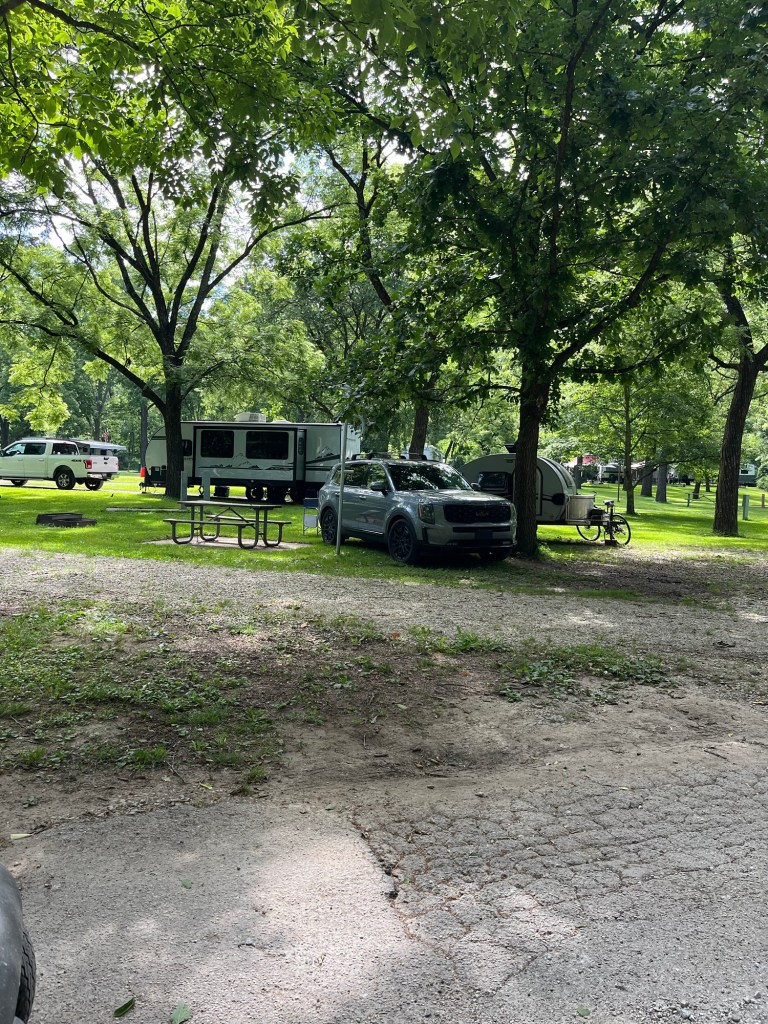
10. Repeatedly park in the grass. Nothing is a bigger headache to park hosts than trying to keep guest vehicles off of the lawns and out of the foliage. If it is muddy, it is an even bigger ordeal. I appreciate when guests have attempted vehicular jenga to get five vehicles (guests are allowed two) to have a tire on the pavement. But for all that is good, please respect the intent to keep the weight of your vehicles from making ruts and killing off any hope of grass. If you have four kids and every teenager must bring their own car, just park a few in overflow parking. If there are designated parking spots, use them instead of driving four feet forward into the meadow. If all the beach parking is full, do not pull your 4 wheel drive over the bushes to park in the woods. Do not park in the grass median or in the wildflower meadow. Do not park half in grass and half in the road in order to block traffic so you can bbq next to your car. Just don’t. There is adequate parking at shower houses, picnic, and group areas. You can walk the short distance to your destination. You won’t die. I promise.

But the surest way to outstay your welcome….so important that it is in a category of its own…is to be belligerent when you are kindly reminded of park rules. If hosts request cooperation, don’t curse, throw things or otherwise have a temper tantrum. It won’t help to engage in “whataboutism” sharing all the ways you think your neighbor breaks the rules. Hosts will also kindly deal with them if there is a rule violation. We don’t care if you got away with it before, we won’t be bothered when you demand to talk to our boss. In fact, we will gladly hand you off to a ranger. They can ask you to leave, because at that point you have definitely worn out your welcome.
-
Give a Hoot: Travel Goals
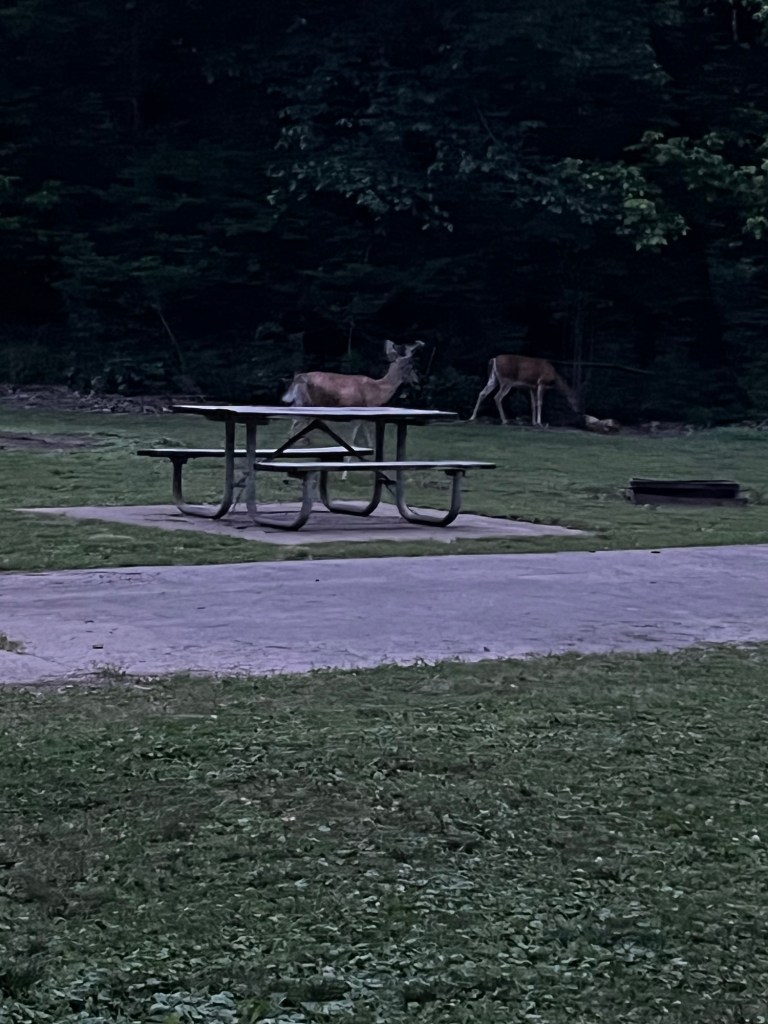
Encounters in nature are calming and peaceful. Sayings like ‘leave only footprints, take only pictures and kill nothing but time’, remind us that our wild spaces should be protected. Every outdoor enthusiast seems to understand the gift and works hard to protect and preserve natural spaces. Unfortunately, there are others that are not so in tune with the natural surroundings.
Working as a campground host has been eye opening. We have encountered individuals who revel in the outdoors and find ways to enjoy natural spaces while helping to care for the park. They keep a tidy camp and help protect the shared spaces at the playground, shower house, trails, caves, and riverside. You can easily identify former scouts by the way they clean a campsite. Many hikers respect the trail and carry out litter they find along the way. Often, guests who understand sustainable practices are helpful in cleaning up the mess left by others.
Campers come from all walks of life. They come solo and in large family groups. They bring all manner of equipment. Some have almost none, while others bring everything one would find in a large house. Plenty of guests sleep directly under the stars in make shift bedding in order to enjoy the tranquility of a night sky. However we also get campers who seemingly hate being outdoors. They pull in to their site and never come out of their rolling fortress. They light up the outside of their rig like Las Vegas, drowning out the campfire glow of their neighbors and disrupting the nocturnal patterns of the local wildlife. They play televisions and radios at top volume using both indoor and outdoor speakers ensuring that though other campers rarely see them…..we all know they are near. They run washers and dryers. They use leaf blowers. I suppose they enjoy a sterile camping environment where dirt, smoke, bugs, animals, and plants are kept to a minimum and where all the comforts of home are at their fingertips. While I don’t personally understand why you would go to the woods only to recreate the exact environment you have at home, to each their own. Other than the light and noise pollution….you hardly know they are in the park as they are rarely outdoors.
To me, the campers that cause the most concern in a campground are those that seemingly think only of themselves. Whether they are novice campers and don’t know camping etiquette or are just generally self centered, this category of campers creates 90% of campground work and 95% of environmental damage. They are why campground rules are invented. Unfortunately, this group often believes that rules don’t apply to them. Examples range from the seemingly harmless gathering of flowers and rocks, to the egregious and deliberate destruction of habitat.
Children frequently gather wildflowers and rocks. It seems like a pretty harmless encounter with nature. I myself love to gather wildflowers on our own property. As a child, I loved going on nature walks on the farm. My grandfather would take me foraging in the forest and it made me feel alive. The joy of discovery and the lure of natural beauty is intoxicating. The problem with specimen collecting in public parks is that hundreds of visitors come each day. If every visitor gathered a bouquet there would be none left to enjoy. So look, smell and admire… but don’t gather. The birds, deer and other critters depend on the vegetation.
Being close to a river, the park has lot of rocks for skipping and stacking along the gravel bars that hug the shore. The naturalists advise against stacking rocks in the river as it displaces the natural environment for crawfish and other river dwellers. But it is hard to deny a child a smooth river rock to add to their collection. It is also hard to understand the volume of rocks we find in the campground. They are left stacked on tables, in fire pits, in the showers, and in the grass at the campsites. These piles sometimes look like full scale excavations. Even small piles have to be picked up and removed back to the river so that park mowers don’t break blades and tent campers don’t end up sleeping on rocks.

Adults also can’t resist the urge to forage. Usually the prize to be found is firewood. I admit that the first thing I do in a campsite is scour the ground for sticks, which I gather in a small bucket to use for fire starter. Campers are allowed collect wood in the mowed areas of the park. Small sticks and branches can be removed from any mowed areas. Guests are prohibited from going into the wooded areas and gathering logs and felled trees. Naturalists tell us that these rotting logs are very important to the ecosystem as they shelter a variety of woodland creatures.
Never the less, almost every morning we encounter a campsite where someone has entered the woods and drug back a log the size of a small bicycle. It probably seems like a logical idea. The tree is already dead, it is just laying there, and firewood is expensive. It doesn’t hurt anything, right? Unless of course, you count the path of destruction where the “firewood” was pushed out of the woods, killing plants, leaving ruts, and a trail of broken branches. Because the wood is not chopped and often not dry, it does not easily burn. When guests leave, the log is often left in the fire pit, charred. A 50 pound log laying half in and half out of the fire pit, covered in char ensures that whoever has to remove it will be covered in black soot. Nothing says “thank you campground volunteers” like being left with a monster piece of wood that has to be wrestled onto the golf cart and hauled down a long gravel road to the ash pit.
At least I understand the logic of foraging downed wood. What I will never understand is people that bring hatchets (and yes, we even had a guy bring a chain saw to use secretly in the middle of the night) to harvest limbs from live trees or even to fell the entire tree. This wood is too green to burn, so users cover it in lighter fluid. Because the leaves and limbs are still attached, there is often a huge blaze and a strong smell. The fire flares quickly and then goes out leaving…. you guessed it….. charred limbs and lots of smelly ash. Because the Paul Bunyan wannabes don’t take time to chop their limbs; the ash, leaves, and twigs are scattered all over the campsite. Not only have they illegally destroyed the forest, they have created a lengthy clean up at the campsite. I encountered a pile of limbs (8x8x4) covering the fire pit. It took multiple trips to the ash dump to get the site clean.
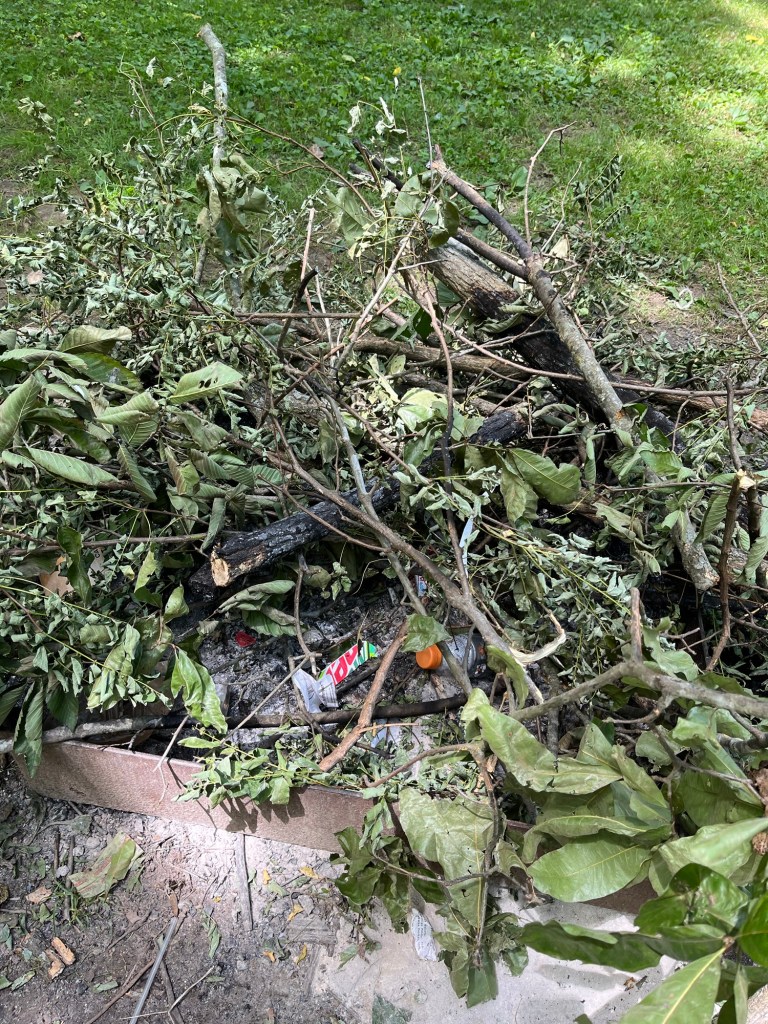
As I was spending the hour cleaning up after the great chain saw massacre, I thought of Woodsy the Owl. If you aren’t old enough to remember Woodsy, he was a giant owl mascot of the National Park Service. His catch phrase was “give a hoot…don’t pollute”. Woodsy would be appalled at the “I will harvest my own wood by chopping down anything I think will burn” people and the “it isn’t really trash if I throw it in the fire pit and cover it with ash and limbs” people. Apparently if you throw trash in the fire pit and cover it with ash, wood, and limbs it is not necessary to throw anything away. Out of sight. Out of mind.
Keep in mind that the park has over 10 large dumpsters conveniently located at the ends of each and every camping loop and at the common areas and parking lots. Never the less, each weekend, I find a few fire pits mounded with limbs and after I get done lifting, breaking, and loading the limbs into a manageable shape for transport….I find a buried treasure of trash. The trash has to be separated and lifted out of the fire pit, before the ash can be removed. This is dirty and unnecessary work.
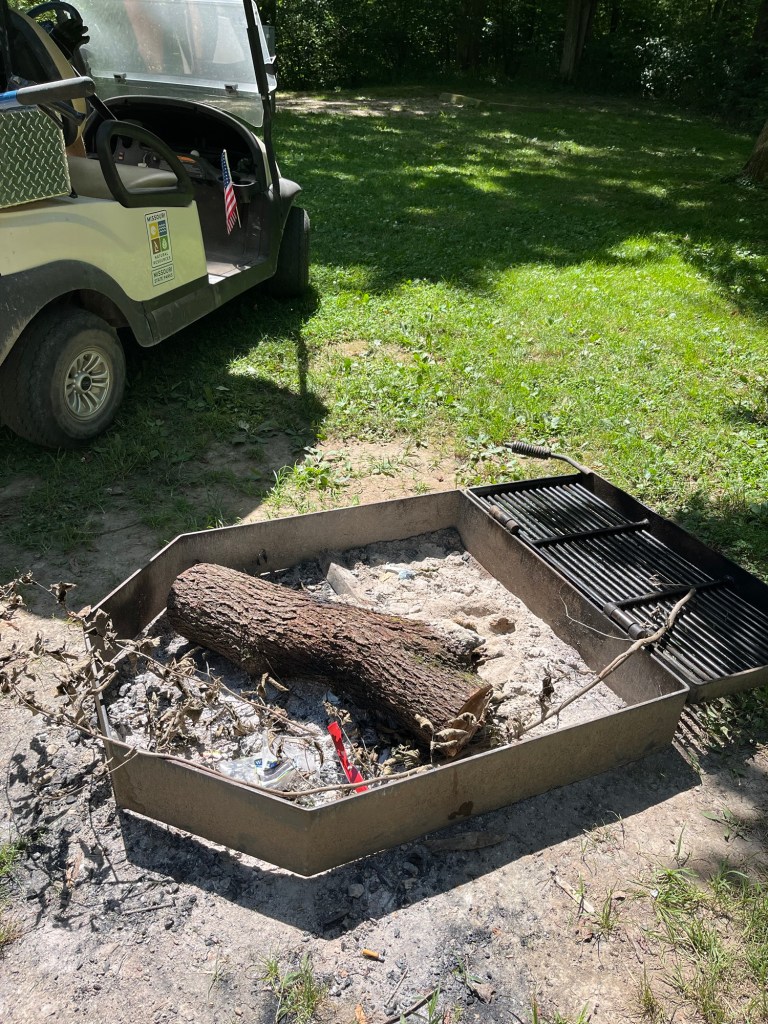
Smokers leave dozens of cigarette butts in the grass and in the pits. Where there are butts, there is always cellophane wrap lingering nearby. The party crown leaves beer cans, soda cans, jello shot containers, liquor bottles, smores sticks, bottle caps, broken glass. We find rotten vegetables, chicken parts, dog feces, underwear, and dirty socks. It is a real treat to find these items covered in ash at the bottom of a fire pit. But hey, it isn’t trash if it is covered in a pit, right? Throw up in your lawn chair? Just leave it in the fire pit with a limb on top….who will notice? Too far to walk to the bath room, just take a squat over the fire pit…. if I put a charred log that is too heavy to move over it, no one will know … right? I wish I were making up these scenarios…but alas. Sometimes people do make a partial effort. They bag their trash and leave it hanging on the utility pole instead of taking it to the dumpster. The raccoons think that is a great idea…the volunteers aren’t quite as happy, but it sure beats digging trash out of a fire pit.
Speaking of animals and the strange behavior of people hiding trash or abandoning trash instead of just putting it in the dumpster…. Perhaps the most puzzling behavior is the numerous dog owners that take the time to use a doggie bag to clean up after their little fur ball only to throw the nicely bagged doggie doo into the woods or along the side of the road. Is it better to have plastic bags of dog poop all over the riverbanks and roadsides? Does a plastic bag of poop scream please throw me in the woods or in the firepit? I don’t get it.
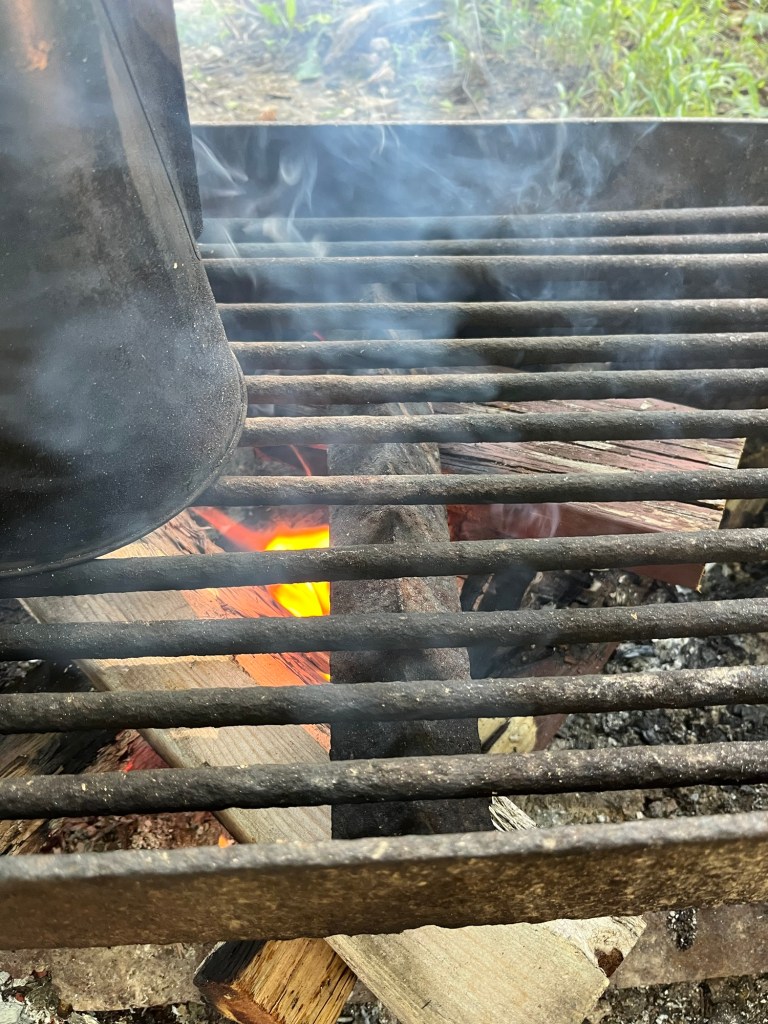
The idea of a fire must just cause a primal need, because brain cells seem to go out the window with the prospect of making fire. On one site, I noticed that the campers had dug up the lawn and created a giant hole between tents that they had filled with wood and cardboard. This, despite the fact that there were two large fire pits already on the site. As I was requesting that they refill the hole and that they use only the designated fire pits, I wondered what their reaction would be if I showed up at their house and dug a giant hole in their yard and filled it with wood and trash.
So if you find yourself in the wild or in a campground, be like Woodsy. Respect your surroundings. Respect your neighbors. Pack out your trash. Use the provided receptacles. Be mindful of the wildlife. Give a hoot….don’t pollute. Your fellow campers and the campground volunteers will be grateful.
-
Can You Help?: Travel Goals
When we signed up to be a campground host, I wasn’t fully aware that part of the job would be managing crisis. I should have expected it, but mostly I thought about cheerfully sharing camping stories and answering guest questions. I guess it is a good thing that I have decades of prior experience as a public school administrator. I am adaptable, able to interact with individuals from all walks of life, and ready to handle the unexpected. Incidents range from the mundane to critical. We evaluate each situation as it comes and determine an appropriate response. Fortunately, there are paid employees who handle anything serious. After all, we are just here for the fun of it.

If the screaming next door is because our neighbors decided to store all their food on the ground in plastic tubs and the raccoons are having a late night picnic at their campsite, we sit tight, have a chuckle and consider it a valuable lesson learned. If an early morning visit to our site is because a camper traveling cross country has a flat tire on their motor home, I immediately put down my coffee and find our compressor to help get the couple back on the road.
Sometimes the situations are humorous. I followed a man driving in circles in the campground. He just kept driving his camper in and out of loops. When I finally was able to flag him to a stop, in order to assess if he was lost, disoriented, or was searching for something; he said, “everything’s fine ma’am. I’m just no good at parking the trailer so when I mess it up, I drive a loop to get up the nerve to try it again.”
Sometimes suspicious behavior is puzzling. A camper approached me and said, “someone needs to investigate site x.” She refused to say more. I drove to the site and didn’t see anything unusual except that they had parked and not paid. I sent a ranger who told them they had to pay, but he said he didn’t see anything unusual either. The man was working in the camper at a desk and appeared to be on a conference call and alone. When he left the park, he paid my husband for the stay. The man said he didn’t know his address and that he was traveling with a child. No one had enough pieces of the puzzle to get a clear picture. Was it nothing? Something? We will never know.
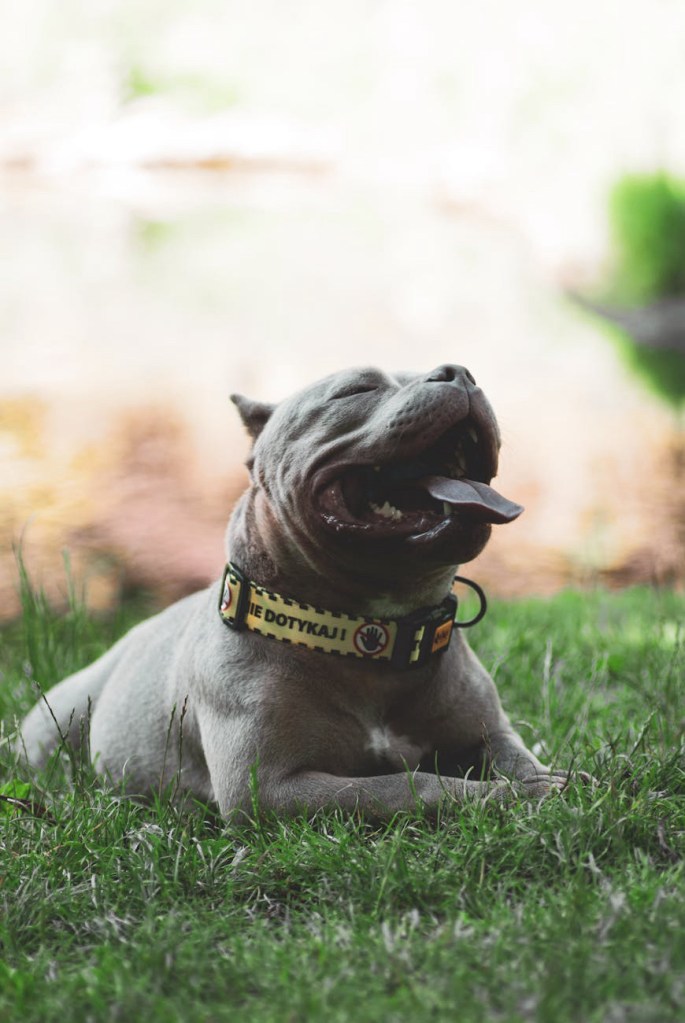
Occasionally there is actual crisis. As I was doing the morning rounds in the golf cart, a woman came running over to me and waving her arms. There had been a dog attack in the park. Even though the park has a 10 foot leash law and dogs are to be kept under physical control by owners at all times, people always assume their pet is the exception. (In fact, I was knocked down and bit by a German shepherd in this park a few years ago. The owner thought a 20 foot leash would give the dog more freedom….a story for another day.)
By the time I arrived on the scene, the man was sitting in his truck. He was bleeding from his legs and arms. His clothes were grass stained and had bloody holes. He was shaking and trying to use his phone. I did a quick assessment, asking if he was injured. He said he thought he was alright and didn’t know if he had been bitten. I asked if he would like me to check his arms for puncture wounds or provide bandages. He said he didn’t have time to worry about that. He needed to get his dog to the vet. It was then that I noticed a small dog bleeding all over the back seat of his truck.
As I helped to locate a veterinary clinic (the closest vets were not taking appointments even for emergencies) and trying to determine if he was well enough to drive, the man told me that he had been taking an early morning walk with his dog in another section of the park. Two pit bulls broke through the side of a tent and attacked his dog. The dog owner was able to get control of one dog, and the man wrestled the other to get him to let go of his small dog. The man’s injuries came from diving onto the pit bull and struggling on the ground. Thankfully he did not receive a bite. The man’s dog ended up in a pet surgery in St. Louis. The man was devastated.
The rangers checked in with the pit bull owners who were in shock. They were sure that a) their dogs wouldn’t hurt a fly and b)they were contained in the tent. All parties involved had their trip cut short. I wish dog owners understood that their pet is often stressed and confused at being in an unfamiliar environment. They will always require extra attention and restraint, especially if the park is at capacity.
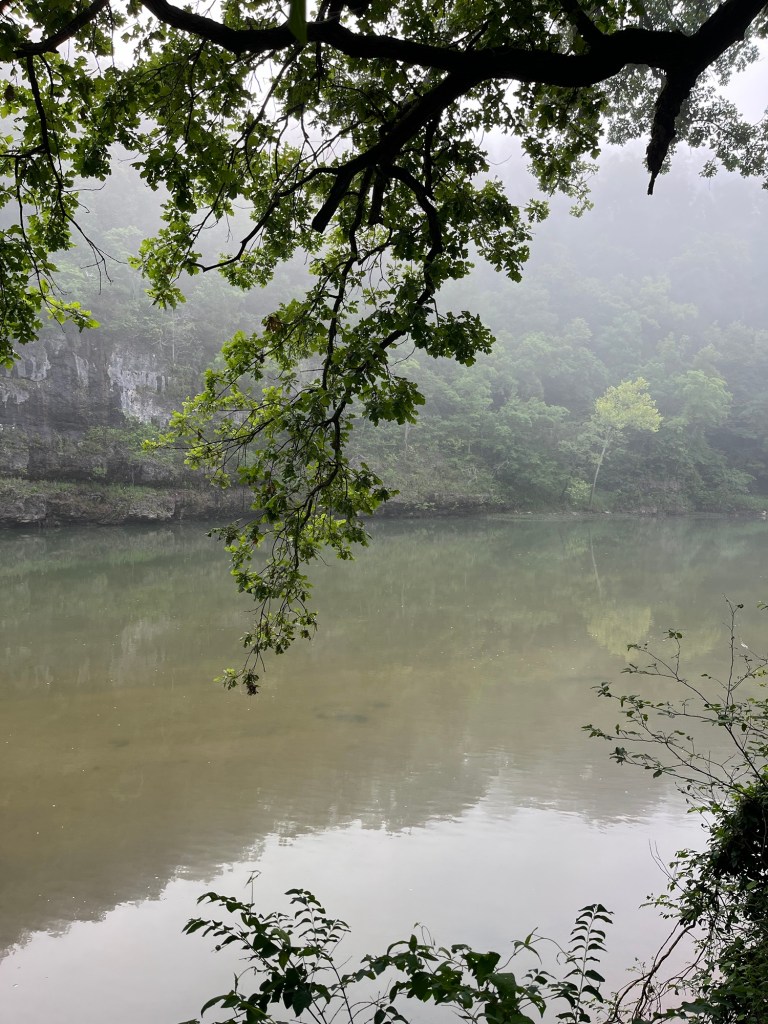
Last night, just as I was shutting down the check station, an ambulance and police vehicle pulled into the park. We followed the lights and found a man lying in the grass. His leg was being held in the air by a fellow camper. Individuals with swimsuits stood in a circle. Other campers, beer in hand came to watch. If this had been at a school, I would have immediately cleared the area, but I don’t have that kind of authority here. A golf cart and a badge only get you so far.
The man had been floating the river, and decided to jump from the bluff without checking the depth of the water. He had done the same jump numerous times in the past, but the recent flooding has changed the river course. What had been a deep pool was now shallow. He lost the skin off of his foot to the bone, and suffered serious injury. Knowing the campground was the last opportunity for help for a long while, his sister and girlfriend helped drag him up a steep riverbank into the campground. The campsite the stumbled upon just happened to belong to an off duty first responder. Providence. First aid was started, 911 activated.
The patient was transported to the hospital. His significant other rode along. This left his sister, alone in the dark, in her swimsuit. I offered to take her to the check station so she could call the rest of her group. She said she didn’t know the numbers and her phone was with them. They had continued on float , as it was dark and they had quite a way to go. She called her phone and no one answered. I offered to drive her to their pull out spot, thinking we would easily arrive before her floating buddies. So we took off through the woods, down a highway, and then a long dirt road. It was just us and dozens of deer and raccoons. We got there in good time, but there was no truck. Her friends were gone. We had not passed them in the park.
What next? She asked if I could take her to the nearest hospital where she could at least regroup with her injured brother. I was happy to help. The last I saw of her was a tired, wet, barefoot, and bikini clad body walking in the doors of the emergency room with thanks on her lips and uncertainties in her eyes.

I was, however, most affected by a much simpler call for help. All week, I had interacted with a young couple camping in a yurt. The woman was polite and called herself a hippie. She dressed in flowy dresses and carried a chubby barefoot baby on her hip. She cooked over the fire. He played with the baby. A few days in, they asked if they could move campsites to the one next to ours since it was shady and it got too hot in the tent for the baby in the full sun.
At this point, I began to wonder if they were living in the tent full time, but they seemed happy. Lots of people are full time campers. But one morning, she came sobbing into our campsite. Big ugly crocodile tears coming so hard that I could not understand her words, accompanied her shaking hands and shoulders. Her boyfriend explained that she had gone to shower and lost her engagement ring. It was a family heirloom and had belonged to his grandmother. She remembered taking it off and putting it in her shower bag before washing herself and the baby. When she got back to the campsite, it was not in the bag. Someone else was in the shower room when she went back to check.
Her fiancee was convinced that the person in the room after her had stolen the ring. I went to the shower house and asked maintenance to lift the drain covers. After a thorough check, no ring. I came back to let her know. The fiancee was driving the park in search of the last person to use the shower house.
She was still crying. Her body was hunched into a protective ball. She looked so vulnerable. I asked if she needed a hug. She clung to me like she had never been hugged; like her life depended on the hug. She cried and we hugged. She cried some more. And then a floodgate of words. She loved him. She loved her baby. She had a bad case of post partum. She had medical complications from the delivery. They were living in the tent as they were between jobs, but he had just gotten a good job and things were finally on the right track. She was afraid she had messed everything up and that he would leave her because she lost the ring. His family would hate her. She had ruined the only thing she ever wanted, a stable family.
I looked her in the eye and told her she hadn’t done anything wrong. Misplacing the ring while trying to wash a baby in a campground shower house was an accident. If her man would leave her over that, then, he was not the one. She said…. I know, but I didn’t know my dad, my mom well…I want my child to have family. I love him. We are going to do this right and now I messed it all up. The ring represented her lifelong wish….a stable family.
She hugged me some more while I tried to speak wisdom and blessings by telling her how I had observed her being a good mom all week and by reminding her of her self worth as a strong woman. She reacted like a parched plant taking in water. I noticed an ugly bruise on her arm and asked her if she was safe. She said yes, he is a good man. I believed her.
When she calmed down, I had her tell me the steps she took at the shower house and after returning to her car. I suggested that it was likely that the ring was in the backseat of the car, jostled by moving diapers and blankets and towels. I told her I had lost three different weddings rings. She smiled. She looked hopeful.
About an hour later, she returned flashing a pretty handmade ring and a glorious smile. It had been in the car all along. She thanked me and invited me to the wedding. She came back several times offering to cook us dinner or buy us groceries. I told her that was unnecessary but incredibly thoughtful to offer. Sometimes, I reminded her, we just help each other because it is the right thing to do. She came back to talk a few times before they left the camp and once at the end for one more hug. A beautiful soul trying to find the light.
Can you help? Three simple words. If it is within my power, the answer is almost always yes. We are given so many opportunities to help, to make a small difference. I didn’t expect so many needs at the campground. But anywhere people are being peoply, they will need help. Hopefully if I am in need at a campground, the person looking back at me from the check station will respond “how can I best help?”
-
Campground Host: Travel Goals
This month, instead of a grand overseas adventure, we decided to see what it would be like to serve as a campground host in a Missouri State Park. I love to camp and I love the woods, but will I still be in love at the end of the month?

My morning ritual is to make coffee over a small fire. My 30+ year old pot makes the best morning elixir. I drink it slowly and listen to the birds as the sun comes up. People generally don’t start stirring until 7:30 or 8:00, so I get plenty of time for quiet contemplation.
We work three or four days each week and the duties are generally light. We make rounds in a golf cart, gently reminding campers of campground rules and answering questions (see related post GIVE A HOOT). We provide assistance during emergencies (see related post (CAN YOU HELP?). We also facilitate guest check in and check out (see related post DON’T WEAR OUT YOUR WELCOME). This includes changing occupancy signs and making sure the site is clean and ready for the next guest. The reward for this “volunteer” position is a free full hook up site for the duration of the month.
Many of our fellow volunteers are full time RVers. They travel the U.S., going from one hosting gig to the next. One couple we serve with never comes out of their rig unless they are on duty. This seems especially strange, as I camp to be outdoors….but to each their own. Maybe if my camper was also my house, I would feel differently.
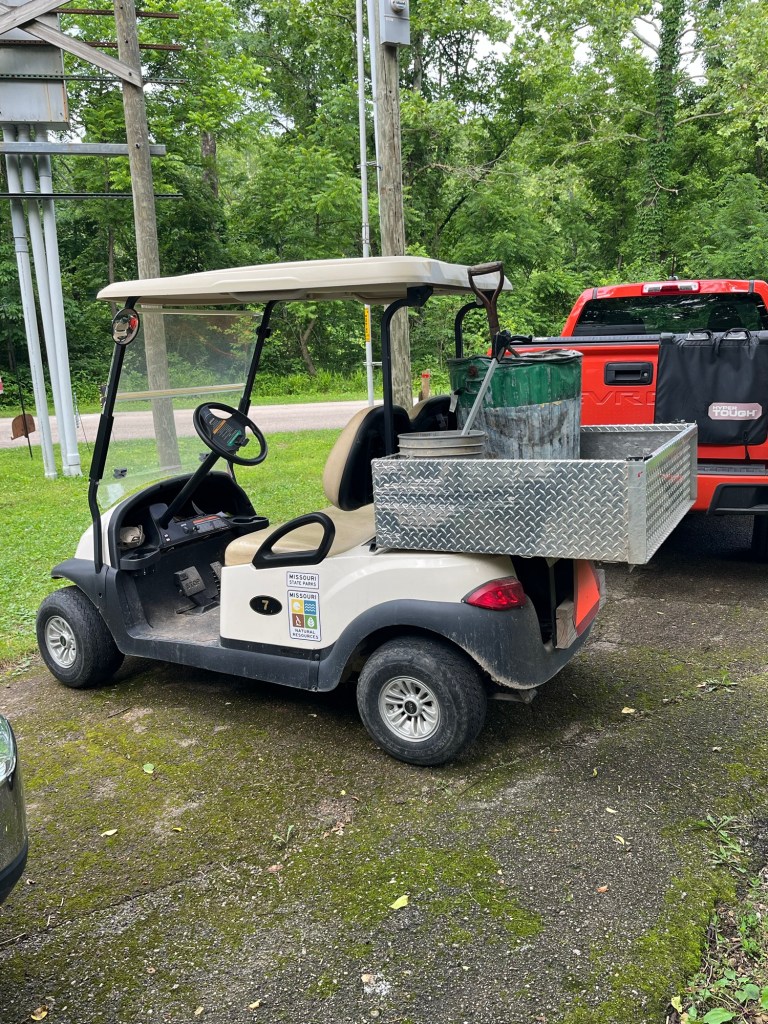
The vast majority of campers are friendly and fun. We swap stories and make suggestions for recreational activities. Children’s eyes light up when you share fun cards with an animal track scavenger hunt or information about nearby caves and swimming holes. They enter joyfully and leave silently. They leave no trace of their excursion except some ash in the fire pits.
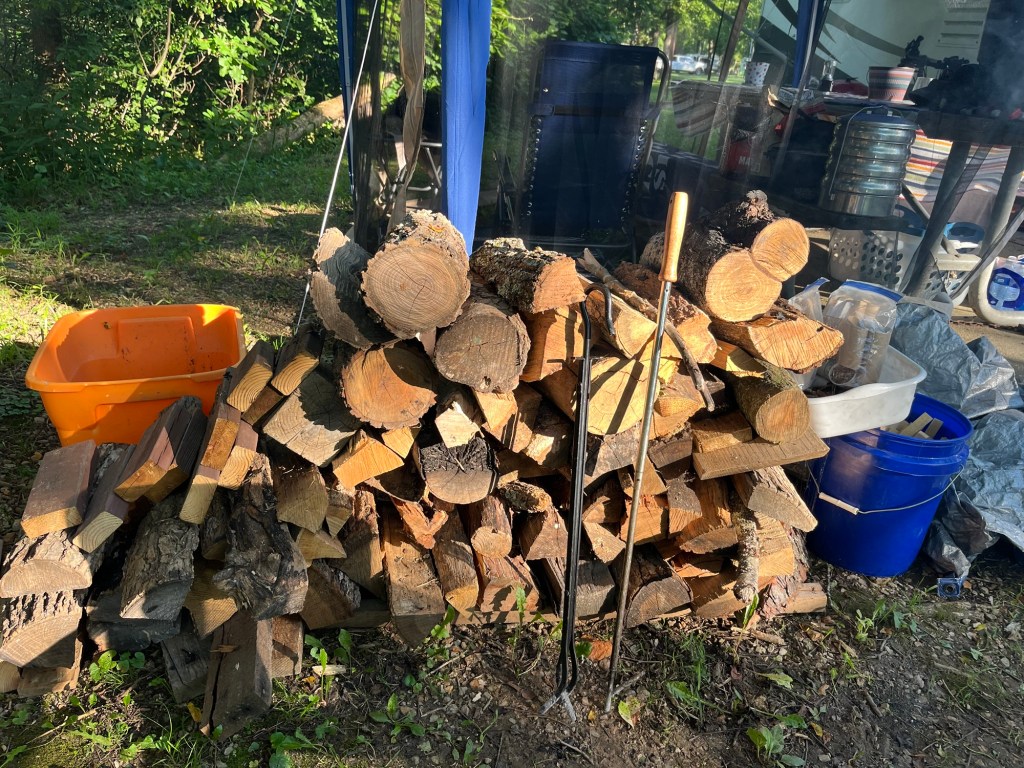
But there are notable exceptions, especially on the weekends. The group of high impact guests come in one of three categories. The most lovable, bless their hearts, are the “I have never camped before….have no idea what to do…..and am totally unaware of campground norms” guests. It is hard to get upset about cleaning out a fire pit full of brand new wood, left charred and still in its bundle; when it is clear the camper put in the whole stack, lit paper under it, and hoped for the best. When it predictably fails to light, they leave it, having spent $7.00 for nothing. The next morning as I clean out their abandoned site, I have a chuckle and help myself to a nice bundle of free wood.
The next group, the entitled hedonists, are much harder to love. These guests usually travel in a herd and only care about whether they are having a good time. They are loud and destructive. They don’t need to take out their trash, they can just fill the fire pit or leave it lay in the grass. Quiet hours don’t apply. Their tents can sprawl onto their neighbors site, their cars can be parked in someone else’s drive while they drink on a sandbar. They don’t care that someone is unable to set up because their things are scattered across multiple sites they didn’t pay for. They litter and destroy property. The peacefulness of the park is disturbed until they are gone. They don’t think rules apply to them and they never like being reminded of them. Thankfully, they usually only make an appearance on the weekend. They are here to party and the quiet weekday life in a campground has no appeal for this group.
The last group is harder to define. I call them, only the lonely. Age five to eighty five, this group just wants to talk. They ask endless questions and share too much personal information. Most days this is not a bother. Some days it is entertaining. However, when there are ten rigs lined up and the same camper is asking for information you have already shared with them numerous times, you have to take a deep breath and find a polite way to move them along.

Except for the mosquitoes and the infrequent unruly guests, I am happy with this adventure. I can live in my little corner of paradise, taking a nap in my hammock or kayaking the river. A few days a week, we do our assignments and the time passes pleasantly. The park staff is friendly, appreciative, and supportive. As a travel goal, I am glad we tried it. I would definitely consider doing it again. If you don’t mind a thin coating of ash from the fire pits, it is fun to be the old lady with the golf cart.
-
And Still The River Rolls
But let justice roll on like a river, righteousness like a never-failing stream!
Amos 5:28

Today, I am standing on a bank of a river contemplating life. The river is peaceful and in the early morning light the only thing stirring is deer. It would be easy to forget every care . I am thankful to for the tranquility.
But this morning I am contemplating the unexplainable. After a very high profile trial, the country that I love is more divided than ever. I followed the proceedings and felt assurance that the legal system works. Rule of law is more than a concept in America.
However, many others near and dear to me are talking about “sham” trials. They compare a man convicted of felonies, with numerous other charges pending, and several prior unfavorable court rulings to Jesus. They don’t refute the crimes per se, but engage in endless what aboutisms. Yes, he did it…..but what about her…..what about him. He is our leader right or wrong.
I can’t make it make sense. So, I stand by the river and I think about justice flowing like a river and a never ending stream of righteousness. To quote d’Touqueville, “America is great because America is good.” If we no longer believe in the rule of law; if party, power, or allegiance to one man is more important than our foundational civic principles….I don’t know where that leaves us.
Like many Americans, I am unsure how we got here. As a historian and social scientist, I can point to moments in time when political strategies changed. I can point to the rise of Christian Nationalism and the co-mingling of politics and religion. I can speak to the record of policy changes and economic peaks and troughs. But I can’t pinpoint the moment that party and partisan ideology became more important than country and democratic ideals.

I stand here and watch the water flow. How did who is right become more important than what is right? When did policy debate start becoming personal attacks on the very essence of identity? I have always been suspicious of identity politics. These exclusive alliances insist that individuals concur with the group stance in order to keep status within the group. To be a good (fill in the blank), you must think and vote in a certain way or you are suddenly the enemy. Policy disagreements turn quickly into personal exclusion.
The great “othering” occurs when humans decide that only their “clan” has the truth. Only they are good. Only they are smart. Only they have the answers. The “others” are evil, lazy, stupid, etc. Truth warriors pick up the mantel against the lies of the others. As a historian, I know this kind of thinking leads to discord and decline. It has long been a tactic to grab and hold power. In the short term it allows those who are willing to exploit these base tendencies immense power. In the long term, it always separates, divides, and stunts the growth of nations. In most extreme cases there is violence, bloodshed, and genocide.
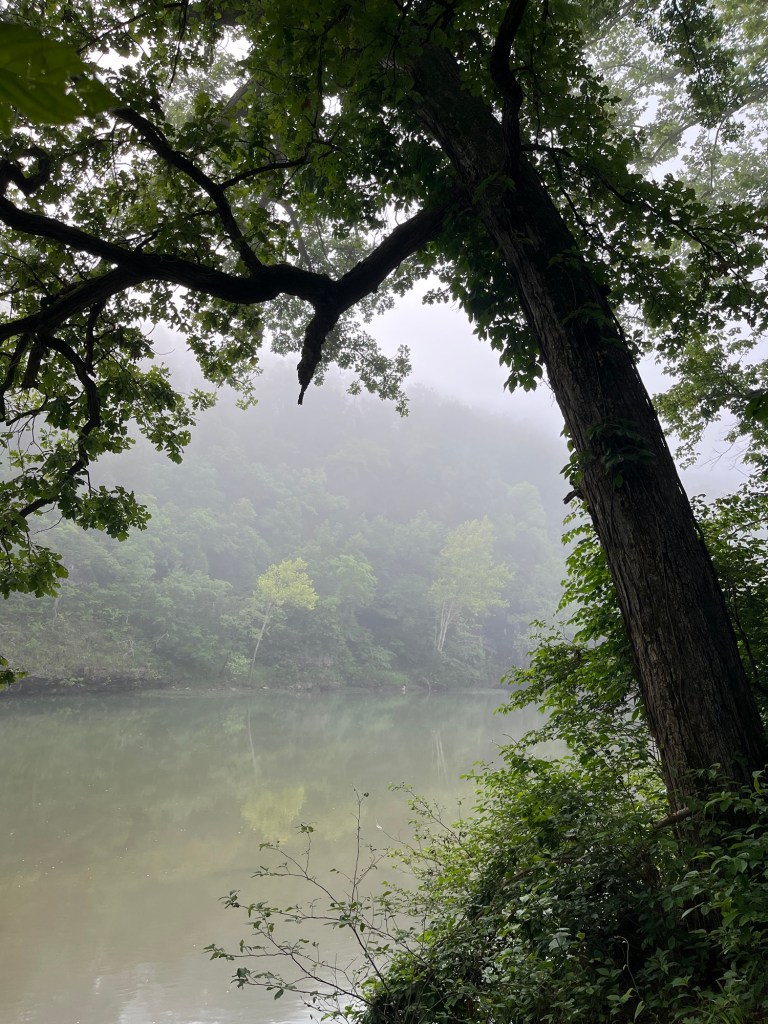
Othering stems from lack of empathy. Empathy is the ability to experience another person’s condition from their perspective. It is the desire to understand others and take an active interest in their concerns. Empathy demands that we look at multiple perspectives. Empathy induces intellectual humility, the understanding that there is always more to learn. It helps understand that there is more than one point of view, more than one solution to a problem, more than one viable policy choice. It suggests that the best approach is often complex and may be contingent on changing circumstance.
Hyper partisanship is often the opposite. It requires allegiance and conformity. It casts all other ideas as inferior or evil. It suggests that only the party faithful have valid perspective and life experience. This kind of thinking is always dangerous. It is hubris writ large, and should have no place in a democratic society.
These are heavy thoughts on a lovely day. I am only one woman, who cherishes her friends, family, and country. I am saddened by the divisions. Historical patterns tell me that we will ride this wave of partisan identity until either we reach ruin or until good people rise up to reunify and work together through differences. It will require us to value and work toward the common good. The choice is ours. Meaningful personal connections or partisan walls. So let the river roll. Let justice come. Let righteousness rain down upon us. Let me remember that issues are always more complex than a single viewpoint and people are always more important than platforms. May I understand that each person must live by their own conscience. Let me be intellectually humble and boldly empathetic. Let me live like the change I hope to see in the world. Let it begin with me.
-
Train Travel in America: Travel Goals

All over the world, we travel on trains. Generally speaking, we find trains relaxing, efficient and easy to navigate. In fact, I am an advocate for expanding train services. They provide valuable public transport and reduce car and air traffic pollution. Safe, affordable, and environmentally friendly transportation should be a national priority in my book.
Having said that, it had been years since I had actually taken a passenger train in the USA. This is partially because there aren’t many trains running where I live, and also because public transportation isn’t great in the cities I could easily get to. But recently, our youngest child moved to Chicago, giving us an accessible destination as well as a good excuse to travel. (Like we need one.)
Our trip got off to a slightly rocky start. The long term Amtrak parking had easy entry and was securely gated. As we exited to catch the train, we realized the ticket machine that dispensed cards to allow return into the lot was broken. I’m still not sure how we will get in to retrieve our car. Hopefully we can get help. We will solve that problem on the return. Travel is always an adventure.
The St.Louis station is old, small, clean, and has limited seating. Unlike every train station I have ever been in, there is no board informing passengers of train schedules and status. We encountered foreign tourists who were struggling to understand and were looking for a standard information board. They were also surprised at the lack of information. I tried to use google to track our train. My ticket had a train number, but google only listed trains by name. Turns out we were on the Lincoln Service, but that was not obvious. My husband had some luck on the Amtrak site.
To make it even more chaotic, a train scheduled ahead of hours was delayed by 7 hours and those passengers filled the small waiting area. The delayed train was also heading to Chicago. It had been in an accident and wasn’t ready to board. Our train was also delayed by one hour, due to freight train traffic; however we left the station first. It was hard to walk past people also trying to get to Chicago, knowing they had been waiting hours.
The Kansas City train arrived about the time we were ready to board. Lines were a bit chaotic. Passengers were frustrated without clear direction and no information boards. The announcements were hard to hear and workers were clearly concerned about making sure passengers arrived on the correct train. Apparently, St. Louis station is used to only one train at a time. Three in station simultaneously almost short circuited the entire operation. Our train was called by number, but we were not told a platform number. We followed the herd and hoped for the best. (Did I mention that a standard schedule board could have prevented to entire debacle?)
Although there were escalators coming up into the station, the only way down to the platform was by the stairs. I have to imagine there was an elevator somewhere, but people struggled to lug their bags downward to the train. I was glad I only carried a small backpack.
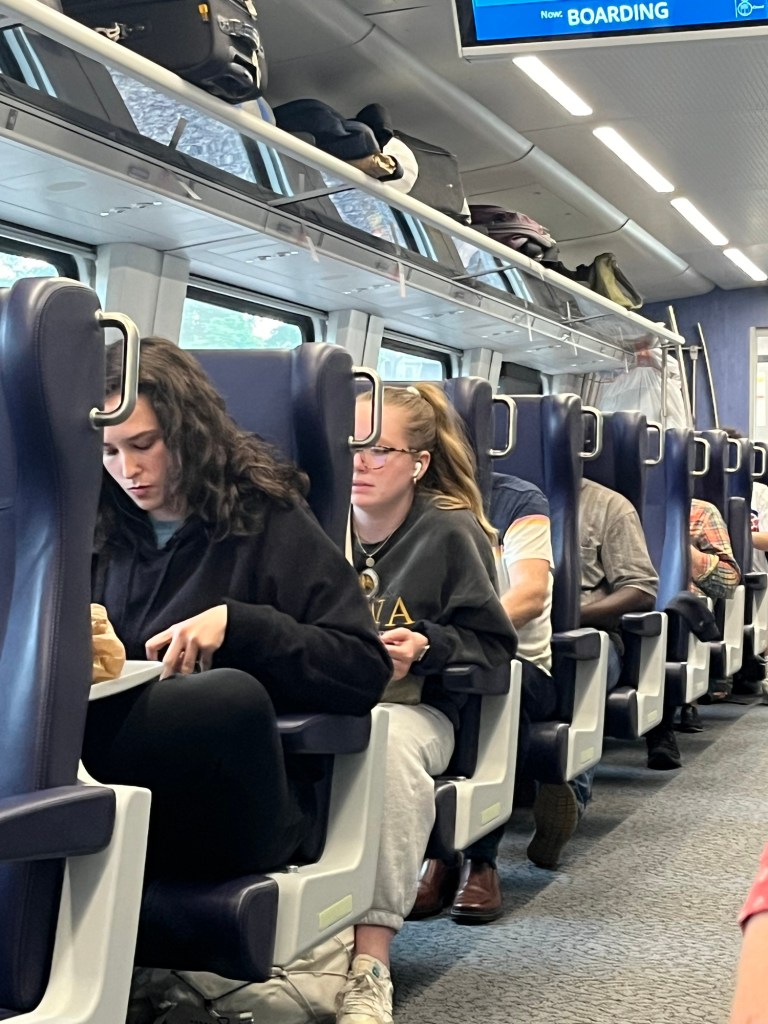
Once on the platform, the Conductors separated us into cars based on final destination. Within minutes we were pulling away from the station. Once on board, I was pleasantly surprised. The cars were clean, spacious and comfortable. The seats were very large, and we even had a good size table. Each seat had power outlets and the car had free WiFi. It was a perfect set up for commuters, with usable work space.
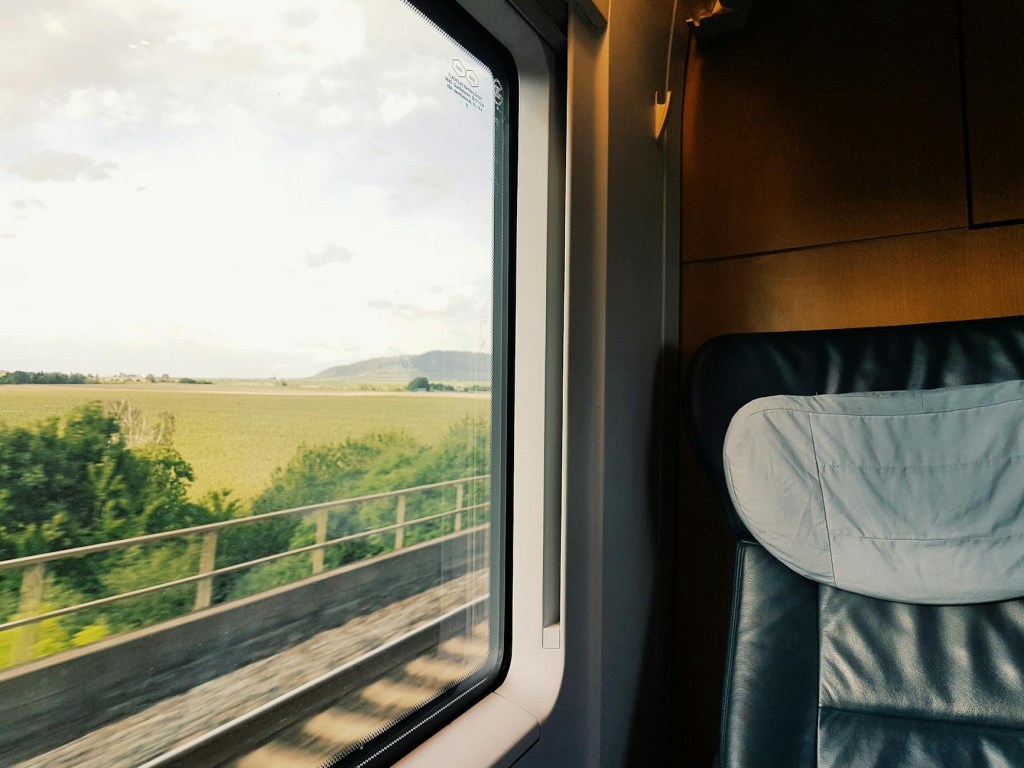
Large windows let me watch the world go by in comfort. The experience was lovely, like a fun road trip in which someone else did the driving. I could stand when I wanted, and even take a stroll. The bathrooms at the end of each car were large and clean. There was even a snack bar with drinks, candy, sandwiches, fruit, and even cheese trays.
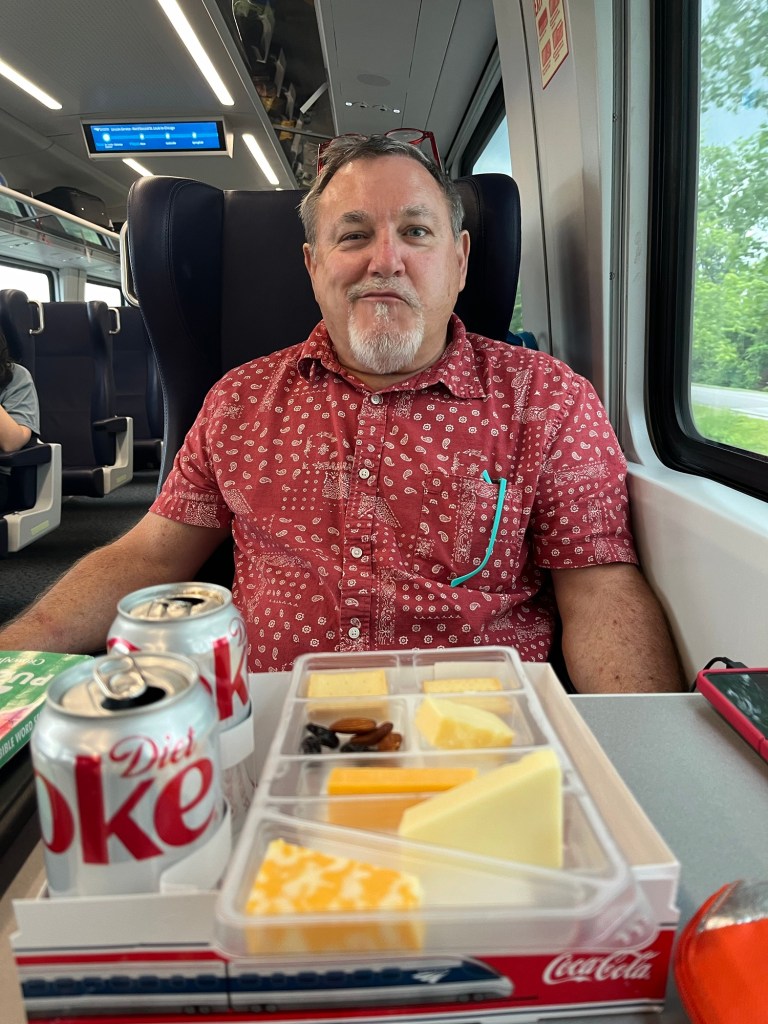
Compared the cost of airfare or even gasoline, the fare was a bargain. America trains are definitely more expensive than similar trips elsewhere in the world, but still a good value. The trains were late, which rarely happens in Europe, and unfortunately seems to be common in the USA. The significantly delayed train had hit a car that tried to beat it at a closed crossing (not Amtrak’s fault). Our train was delayed when a freight train was given track priority. American needs tracks dedicated to high speed passenger trains. As long as trains must share dual purpose tracks you should expect some delays. Our country, like other modern nations, should prioritize and invest in high quality public transport (just as they invested in interstate highways in the last century).
My verdict? Despite the challenges, I will definitely be riding again. The hassles were significantly less than navigating an airport. The lack of clear signage was annoying should have been an easy fix, however Amtrak employees did a decent job trying to compensate via general announcements. The boarding process was smooth and the conductors were friendly. The cars were immaculate. The seats were spacious (gigantic when compared to an airline seat). And ….there is something romantic about watching the world go by from a train window. Affordable, available train travel an American travel goal.
-
Rural Road Trips: Camp fire coffee

There is nothing quite like an early morning cup of coffee cooked over a camp fire. So hot it burns your tongue and full of smoky goodness, it is happiness in a cup.
I get up early (5:30). It is peaceful and still. So far it’s just me and the birds and an occasional squirrel. It has rained overnight, so this morning coffee making poses a little extra challenge. Quickly, I realize I am unprepared. As this is the first trip of the season, I forgot to get the water, mug, coffee, etc. ready the night before. I don’t want to wake my husband so I creep out as quietly as I can and “make do”.
I scrape ashes in the fire pit and lay down cardboard scraps to make a dry bed. I find a few dry logs. Next comes my homemade fire starter…. Toilet paper tubes stuffed with dried lint. I forgot to collect sticks, so I dip into my fat quarter stash for kindling.
The damp wood is stubborn. It calls for my secret weapon…an old metal lid off of a discarded citronella candle. I wave the lid to generate a strong airflow and suddenly I have a flame. So far, so good.
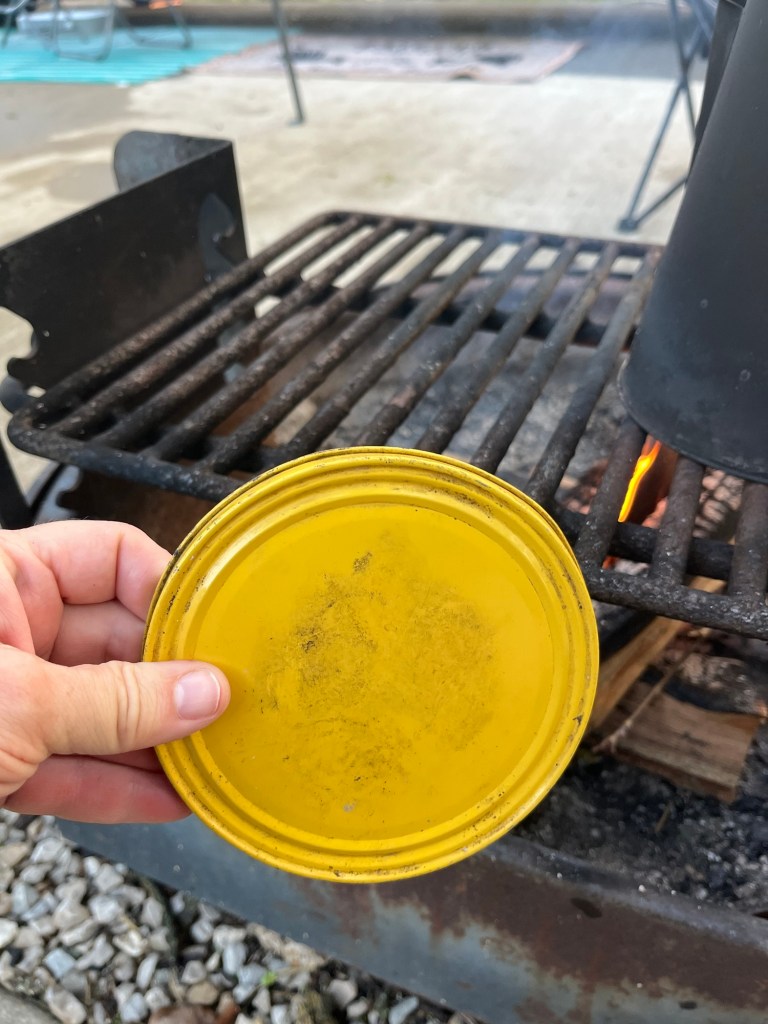
Slow, steady burning generates hot coals. I place my trusty twenty-five year old pot directly over the flames. I’m not sure how it hasn’t caved in by now, but she just keeps perking.
Hard work done, I relax. I read, pray, and enjoy nature. This is only interrupted by emergency fanning to keep the fire from dying. Occasionally I have to use my fancy fire stick to rearrange logs (fyi any long thin branch works in a pinch).
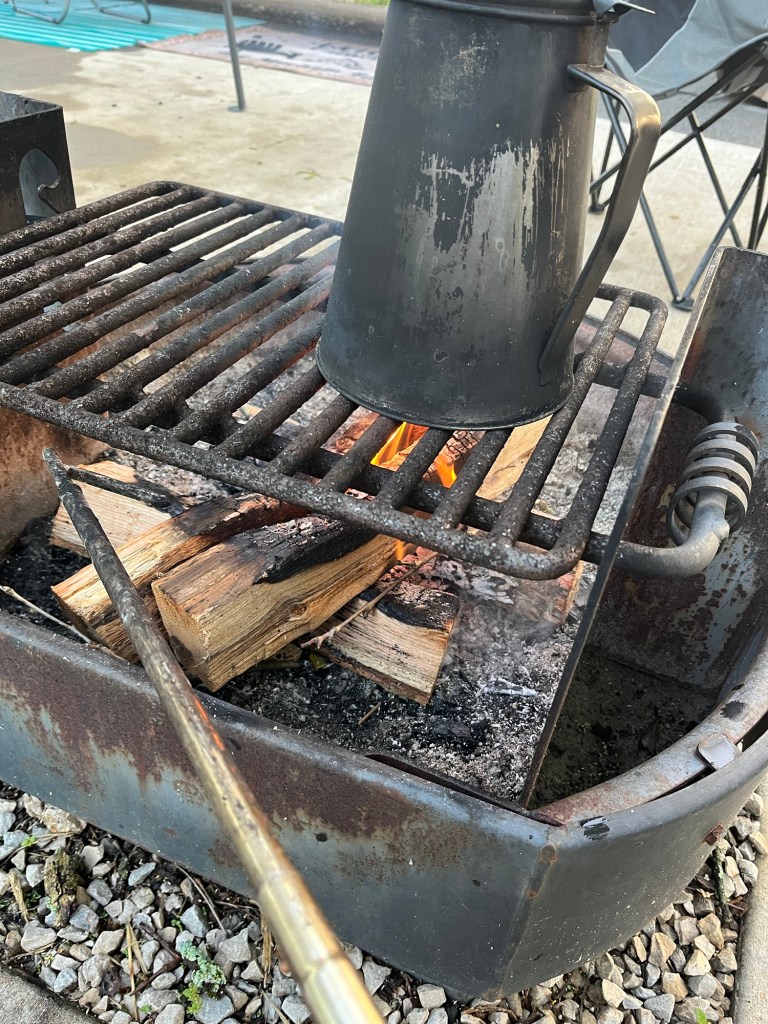
Each fire is different, some mornings the coffee perks quickly, some days it takes awhile. Today was quick. So my coffee and I will enjoy the birds and the sunrise.
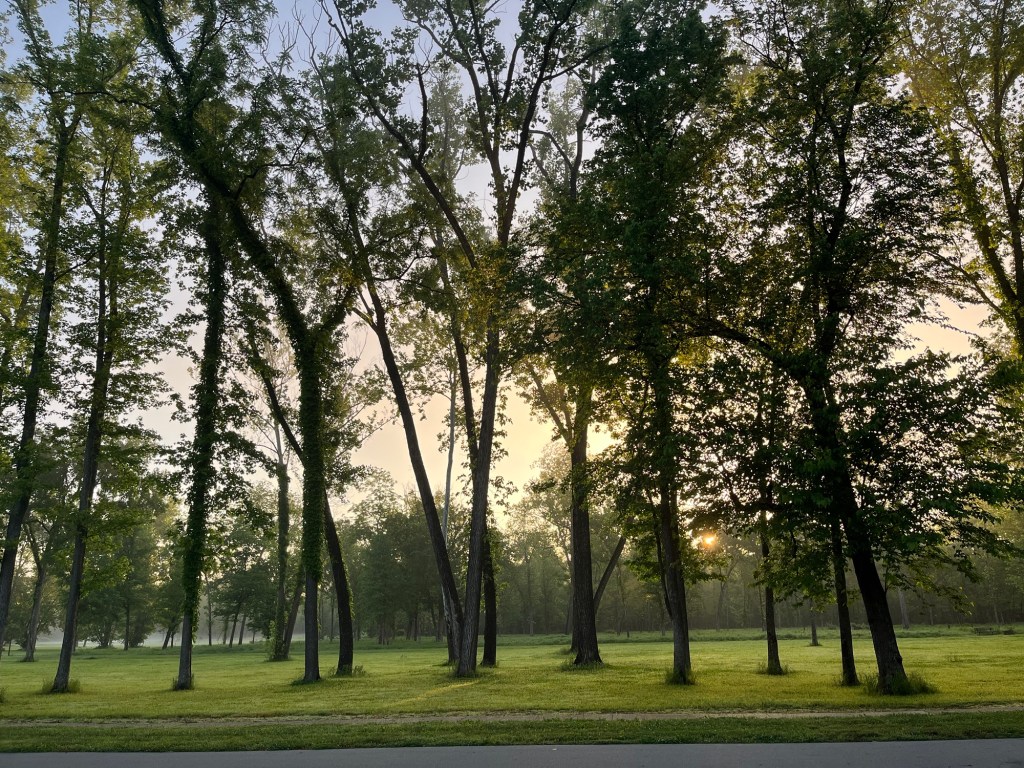
There is nothing quite like campfire coffee. I will cherish every minute until I drain the pot or other campers invade my glorious solitude, whichever comes first.

-
I don’t want to be pretty
I don’t want to be pretty, but of course I do. I don’t want to be just a winner of the genetic lottery, and ornamentally pleasing. I mean that must be nice, and I certainly don’t want people to think I am ugly. But I would rather be stylish and interesting. If you think that I am pretty, I am lucky, but if not, it is more important that my unique sense of self shines through. I want to develop personal style. I want to embrace my grey hairs, a product of years of adventures; and to love my soft belly, earned giving birth to two amazing humans. I want my clothing choices to scream that I am thoughtful, creative and comfortable in my own skin. You might find me pretty, but I hope you find me vibrant, interesting and approachable.

I don’t want to be smart, but of course I do. Being smart is a gift. I certainly do not want to be stupid. But I don’t want to be just a label given to those that know the prescribed answers or that are born with a high level of mental ability. Smart is helpful, but I want to be learned and wise. These attributes require the use of innate intelligence in pursuit of knowledge. I want knowledge turned to service. I hope that each day I seek new ideas, multiple perspectives, and understanding. I want to live outside my comfort zone and to contribute ….to participate in the dialogue of ages by reading widely and traveling often. I want to expand and grow throughout my life.
I don’t want to be nice, but of course I do. To be pleasant, agreeable, satisfactory; girls are conditioned to be nice. We are told to smile more, to not make waves. Of course nice is comfortable, and I certainly don’t want to be mean. But I want to have the type of relationships where it is ok to say the hard things. I want people to say that I am authentic, caring, and kind. I want to move beyond the superficial, to invest in others, to really connect.

I don’t want to be good, but of course I do. To be approved of is a wonderful feeling. I certainly don’t want to be bad, but I want to be gracious and generous. I want to stand up for what is right even if I must stand alone. I want to engage in what John Lewis called “good trouble”. This may be a far cry from being a “good girl” who never makes waves and never speaks her mind.
In my life, I have encountered a culture where, it was expected that I work to make myself “pretty” but not to stand out too much. The social norms demanded that I conform to certain trends in dress, hair, make up and deportment. I could be smart, but not too smart. I was called into a freshman college classroom and told by the professor that I needed to deliberately try to make lower grades or I would not catch a husband. I have been told to smile when I was upset and been expected to be “nice”. This usually was code for not standing up for myself or others in situations…. to appease, to smooth over. I have tried to be good, to do what others wanted only to question whether my compliance was morally right.
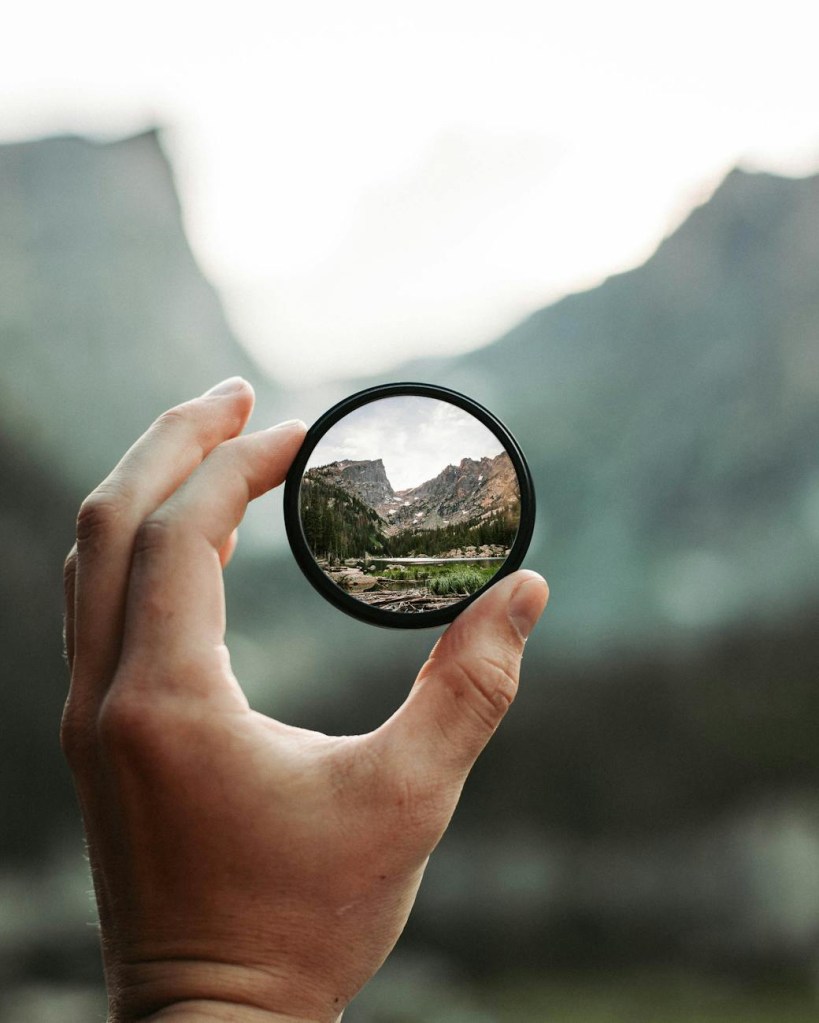
It is tough to be human. We want to fit in. We want to be our true selves. In the best version of our world, we can be fully ourselves and appreciated for it. I want to be me. I want to be loved for being me. I want to see people as they are and love and support their true selves.
We live in an imperfect world, where people sort and separate and demand conformity. My 57 years of living have taught me that I don’t want to conform. I want to be valued for the many things I am instead of being judged for all the things I am not. So in my unique, imperfect way I will continue to strive to be me. I will pursue love, joy, peace, patience, kindness, generosity, faithfulness, gentleness, self-control…and I will work really hard to see you. Because we all deserve to be seen and valued as our true selves.
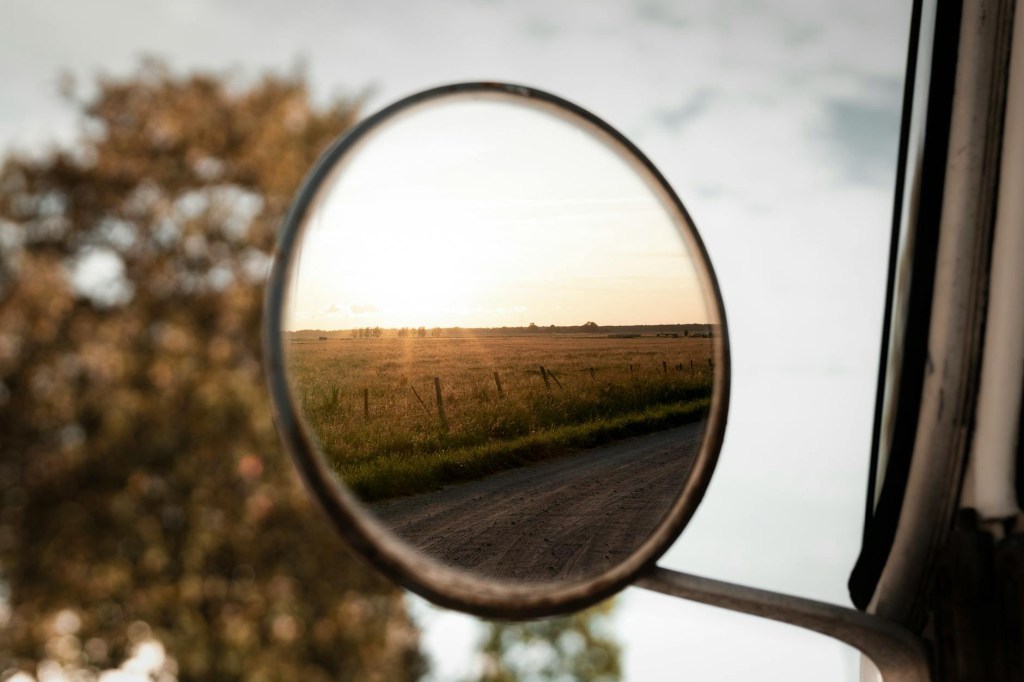
-
Stuck In The Mud
It started out innocently enough. We arrived home from a lengthy trip and realized that workers were coming the next day to start replacing our deck. Our RV usually sits on a large paved pad next to our house, but that area would be needed by the construction workers.

My husband, just as he has done on several other occasions, pulled the RV forward into the grass. This gave the workers plenty of room to tear down the old deck and stage the new construction. He is always considerate and thinking ahead.
A few days later, we had an annual service appointment to get the RV ready for camping season. It would be a bit of a challenge backing it out past the trees and the construction trailer sitting on the rv’s usual parking spot, but we knew we could do it. It can’t be any worse than backing into a campsite. Am I right?
We went out and started our 30 foot motorhome and realized …… it had sunk into the earth. The ground had swallowed the tires. While we had been traveling it had apparently rained….a lot. The topsoil was dry, but underneath was a muddy quicksand. We didn’t know that our usual place to park the rv when it needed to be in the grass was a hidden swamp.
Our powerful engine counted for nothing when the tires just spun. But we were resourceful. We dug out mud around the tires and laid down wood strips for traction and tried again. If anything, it sank lower. Not to worry, we aren’t easily daunted. We hooked our trusty chevy pickup to the rv with heavy towing cable and pulled. Nothing. We put the rv into reverse and used two engines with a lot of horsepower. Nothing.
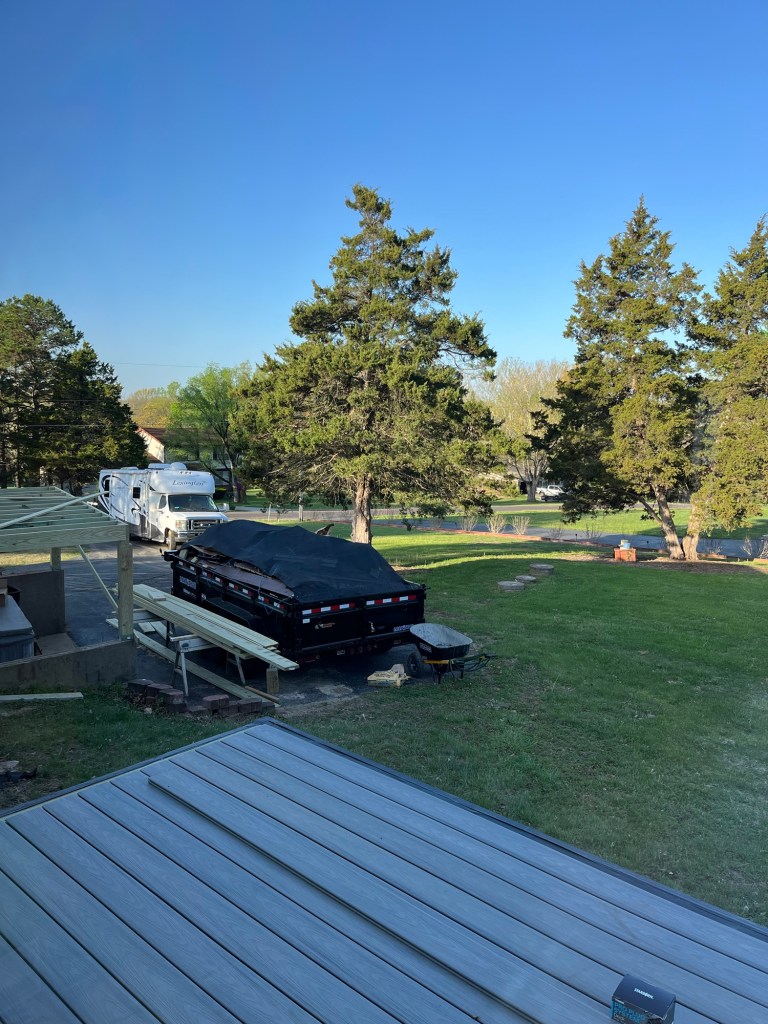
Okay….time to phone a friend. Our neighbor has a hemi…. I don’t really know what that is, but he seems to enjoy pulling people out of ditches with it. Within minutes, he showed up with a grin. “This will do it!” Except it didn’t. We tried every combination of towing tricks we could think of. Once we noticed that the step at the door into the rv was sitting in the grass, we decided it was time to stop. If we kept going it might be completely buried.
I went in the house and called our emergency roadside assistance number. It was time for professionals. I wish the call was recorded. It would have been entertaining. “Yes, I need help. I don’t know whether I need a winch or a tow. I don’t know how much the vehicle weighs. It is not stuck in snow or sand, just mud. It is currently 20 feet from my driveway. The location of the rv is at my home address. Yes, I need roadside assistance at my house. Yes, my home address is the location. No someone doesn’t need to come in the dark, tomorrow morning is fine. Why am I doing a lengthy process to allow text messaging while I’m trying to set up service is this really necessary right now? I just need someone to get the rv back on the pavement….AT MY HOME address.”
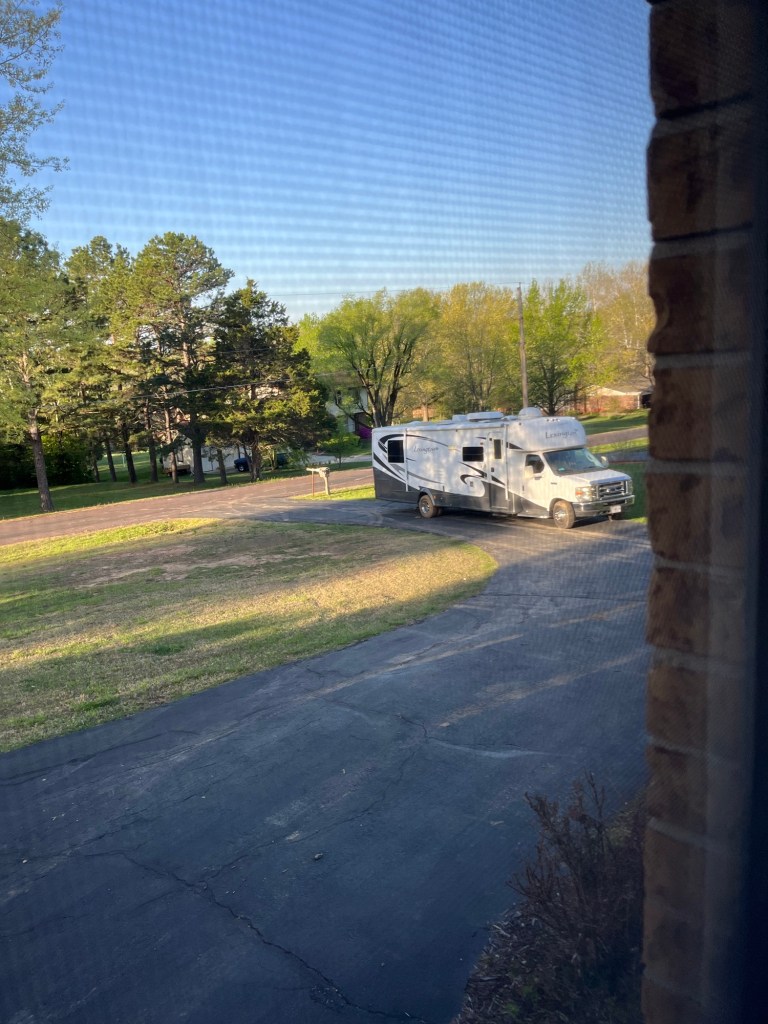
After an eternity I am off the phone, it but almost immediately it rings. “Yes, we do need assistance. No, we don’t need a mechanic. What do you mean you don’t know where to find the rv? It is at my home address. I understand you have my home address. No you don’t need me to tell you the location of the rv. I have done that four times. The rv is currently stuck AT MY HOME address.”
I wasn’t stressed, but now I had adrenaline crashing through my body. What if they are not able to remove the rv from the mud? The professionals weren’t very reassuring. I spent the rest of the evening thinking of plan b’s.
As it turned out, everything went fine. I wasn’t home for the great rv rescue operation. My husband tells me that he had to call back and go through a similar phone process to get someone to the house. But finally, after a series of additional calls, a highly competent local tow truck operator showed up with a winch. The construction team helped guide my husband past their equipment and all went well.
I try to learn from adversity. Isn’t typical that we often cause a new problem by trying to “fix” a situation? (We will save the construction crew a headache by moving the rv). Then when we notice a problem we race into action (I can take care of this by doing what I know from a prior experience)…sometimes making it worse (those four things I tried actually sank the tires further into the earth). Thankfully, we have friends to help us along the way, even if they often can’t fix things for us. They lighten the load and give us encouragement and suggestions. (Neighbors are the best. Seriously love them.) When it is time, we sometimes need to call in the professionals. (We have insurance for a reason.) Getting help from strangers can be challenging. They don’t know you or your circumstances. It feels frustrating having to tell the same story repeatedly to people who only want to know their narrow slice of information. But when help arrives and the right person with the right skills and resources gets involved it is a lifesaver.

Thankfully, we are no longer stuck in the mud. The rv, muddy wheels above ground, is sitting in the middle of our driveway. It is a bit of an obstacle until the construction is done and it can go back to its usual parking place. I don’t mind driving around it. It is a visual reminder that help is available when you are stuck in the mud….. if you are not too stubborn or frustrated to use it.
-
The currency of currency: Travel Goals
Currency: the quality of being generally accepted or in use. The U.S. dollar (and also the Euro), as we were to find out, is the ultimate currency. ..at least in South America.
After arrival in any country, one of first stops we make is a bank or currency exchange. In recent years it has become easier to use an atm or credit cards than exchanging lots of cash. In fact, if we are staying in cities (or Iceland) there is almost no need for anything other than a credit card. We, however, I love the small shops and markets where cold, hard cash is essential.

On our latest adventure through South America, we had a variety of experience with money. In Argentina, we raced to a money exchange and got there just before they were closing for the weekend. Without time to ponder the exchange rate we exchanged about $200. We handed the clerk four bills, figuring that it would be enough for the five days were in Argentina.
Much to our surprise, he handed us back two gigantic stacks of bills. Apparently $200 U.S. dollars is almost 200,000.00 Argentinian Pesos. Live and learn. I felt like a bank robbery had occurred as we left with bills stuffed in pockets and my travel bag. I am not sure I have ever held so much money. It was wrapped like it should be stacked in a briefcase.

We did our best to spend it in open air markets, shops, and restaurants. It felt strange paying 10,000 for two glasses of fruit juice. We bought meals at Burger King with the total cost 16,0000. There were a few times where we used credit because we didn’t want to have to count out 60 bills. My husband, who always says he doesn’t like large bills was wishing for something larger than a 1,000 bill. So different than our normal.
While I was thankful for the exchange rate, I was painfully aware that I was blessed to be from a country with a thriving economy. Despite the complaints you see on social media, the U.S. dollar is strong. In Chile, we didn’t exchange for cash. They were clear that they didn’t want Argentinian money, but they happily took our U.S. dollars anywhere we went. It was almost preferable. If we had exact change great, if not we got change in Chilean pesos. Granted the change was always much less than the exchange rate, but at the low prices we encountered, I was always happy to give a little extra.
In the handcrafts markets, I always tried to give a little more when I could, in honor of their talents and the lost art of handcrafts. In a mall, somewhere in Chile, we used a credit card. After signing for the purchase, we were asked to produce a national id. Of course we didn’t have a Chilean national id. In broken Spanish, I tried to explain, while we offered a driver’s license. In the end, everyone was confused. But we left with sweatshirt and glasses in hand.

In Peru, we had already learned our lesson so we only exchanged a very small amount of money. Fifty dollars for two days. I bought museum entrances, icecream, soda, specialty chocolates, a pair of shoes, a hand carved ornament, a hand woven alpaca hat, and other trinkets. Seeing the high levels of poverty, I gave extra when I could. I was determined to give and I still couldn’t manage to spend it all.
I took several college level economics classes so in theory I understand valuation and market cycles. I can’t reconcile it in my head. At home people endlessly complain about inflation etc. Compared to the woman selling me a handbag made out of scraps, we live like kings. We have everything and can’t stop complaining. They have little and are generally joyful and thankful. There are deep lessons here that I am still internalizing.
In Ecuador, there is no need to exchange money. They use the U.S. dollar as their currency. Apparently their currency continued to devalue and they adopted ours for stability. I had no idea, but it made our small purchases quite convenient. According to the locals, they are very happy with the dollar and no longer worry about the value of their savings collapsing overnight.
The final stops of Panamá and Aruba were simple as they also widely accepted U.S. dollars. So convenient, even if the exchange rates were more even, I was secretly relieved. In these countries, prices were more in line with what I expected to pay and I felt less like a thief.
The moral of the story is that money is just paper unless it has value. The $20 I spent on a handmade necklace was much more valuable to the seller than it was to me. For them, $20.00 is a weeks wages. For me, it is often less than the cost of a meal.

The lesson is that money is a means to an end. Its value changes over time based on a variety of conditions. Greed is immoral. Humans can live and even thrive on less than I can imagine. Humans can also hoard more than they ever need while others go without. I was lucky to be born in a country with a stable currency. I hope to be more mindful of the blessing and live accordingly. To those whose only goal is more and more money…travel…meet people….get some perspective. I’m still hoping that compassion and cooperation gain currency.
-
Subscribe
Subscribed
Already have a WordPress.com account? Log in now.
 Prisoner of Hopes