-
Hills to Climb: Travel Goals
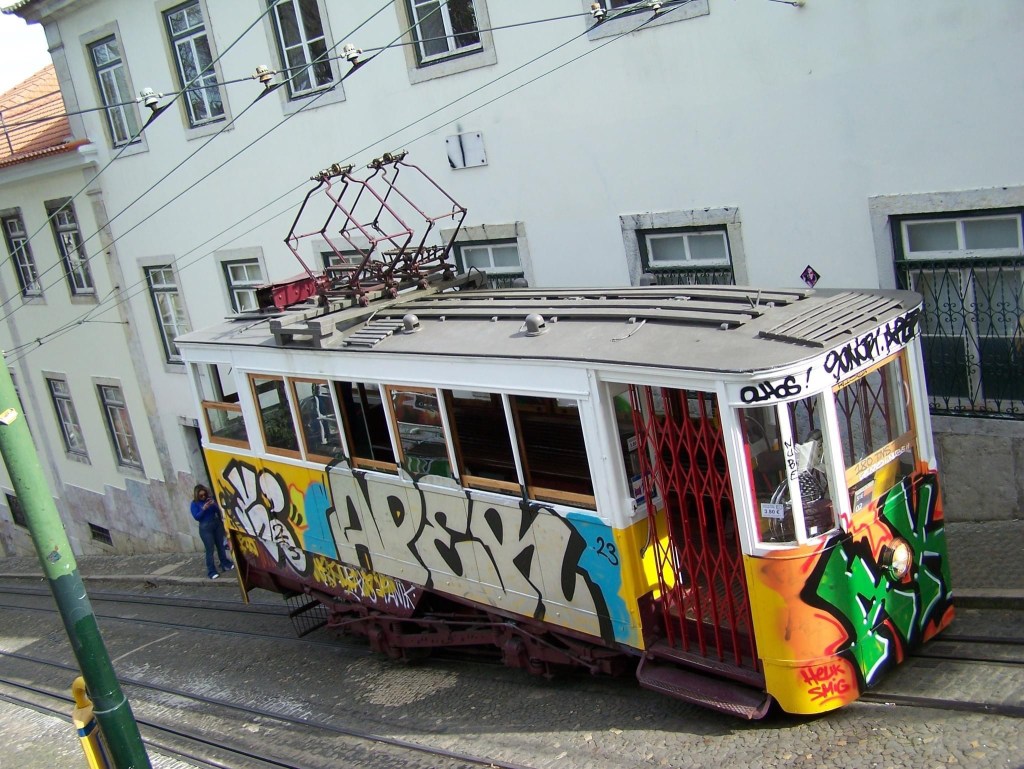
There is a train strike in Portugal. Any plans to venture out of Lisbon are on hold. Because we are in town for a month, we don’t feel much pressure. The day will unfold as it will. We take the metro to Restauradores and try to find Foz Palace. From the outside it looks like any other building so we keep walking to the Ascensor Gloria. The little funicular is covered in graffiti. We board and await the ascent up a hill that seems to go on forever. It is fun to look down the steep incline behind us.
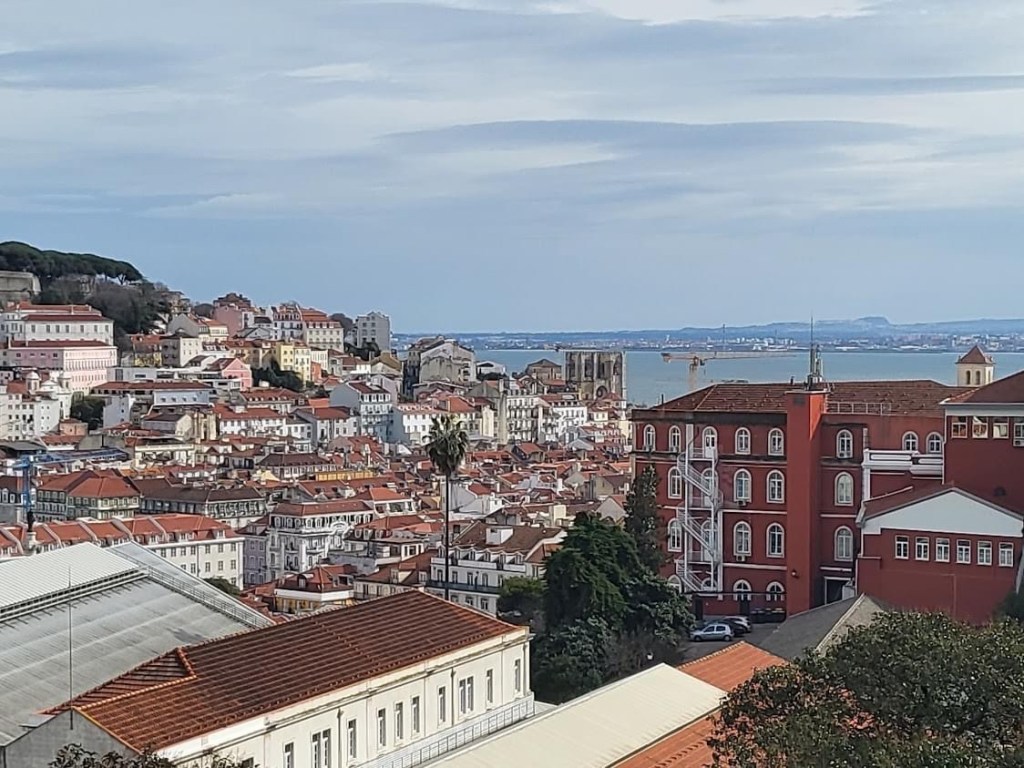
We arrive at the Miradouro Sao Pedro de Alacantara. It is a beautiful little park with breathtaking views of the city. I smile immediately when I notice a man playing and accordion with a dog sitting on his head. The dog clearly likes to climb. He lives in the right place. There will always be hills to climb in Lisbon. A local artist shouts that I should get a job because I seem too happy. I answer, “retirement is a beautiful thing.” I could not tell is she was joking, but it made me laugh. Children nearby are playing in the fountain and laughing. I add my laughter to theirs and am thankful for my life.

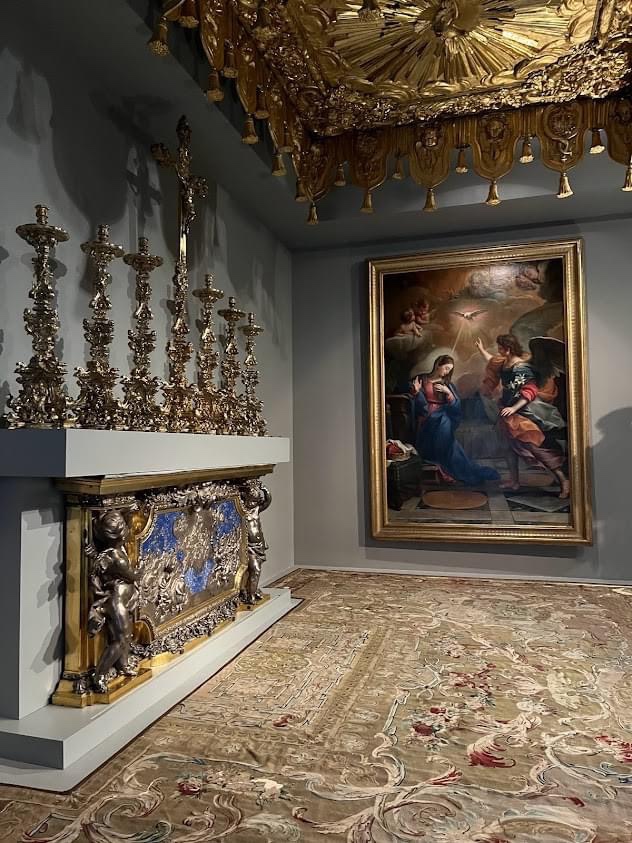
After some time spent sightseeing from the Miradouro, we decide to walk downhill to the Igreja Sao Roque. The church and museum are full of treasures. The church was built and dedicated to Saint Roche in the reign of King Manuel I. He thought having a relic and church dedicated to Saint Roche would protect the city from the plague. Over the years, the society of Jesus used the campus as a headquarters. Today it houses an impressive collection of religious art and artifacts. I sit in the church and feel at peace. My eyes roam the ceiling and the walls. The chapel of John the Baptist is ornate, but I love the painted ceilings. I stare upward while saying my prayers.
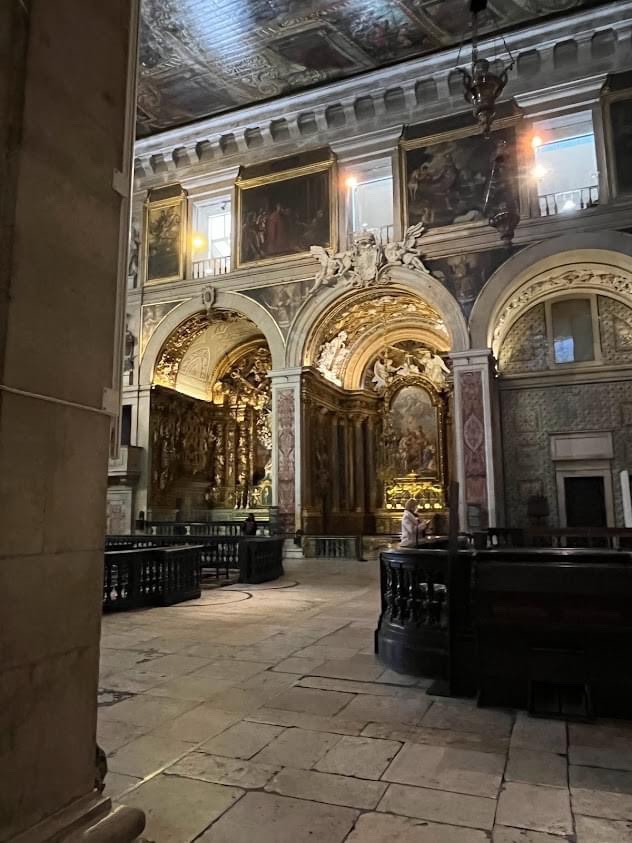
We enter the museum to find unexpected delights. Paintings and silver work are here, but also relics and statues. A glass case claims to hold a thorn from the crown of Christ. There are finger bones of Saints and dresses for baby Jesus.
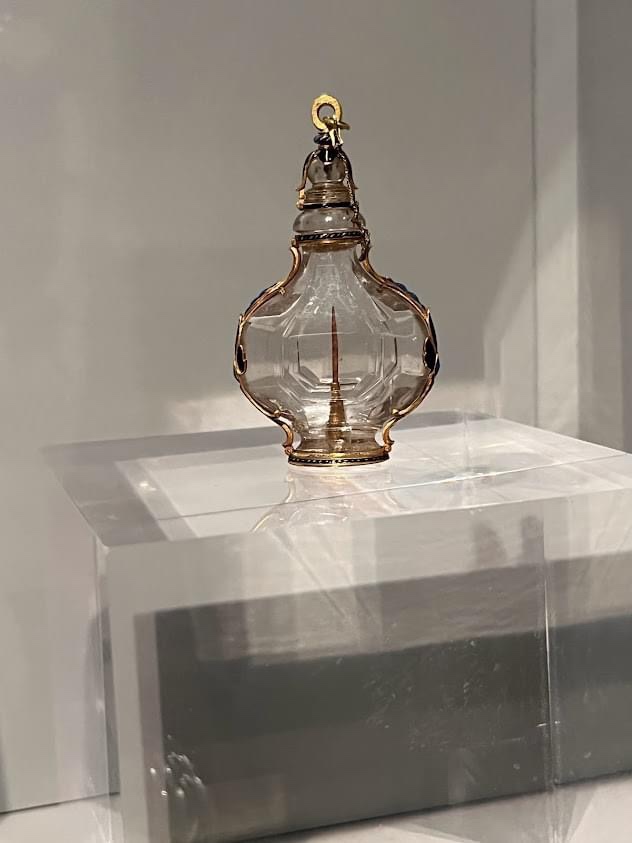
Just when we think there can’t be any gold or silver left to see, we encounter more opulence. We take our time. We have nowhere to be.
I decide I want to visit the Jardim Botanical managed by the University of Lisbon. We walk through hip neighborhoods, past the park and the artists selling their wares. When we reach the garden, my husband rebels. He has had enough of aimless walking. He wants no part of another hike. He decides he wants to sit and watch people. I buy my tickets and press on alone.
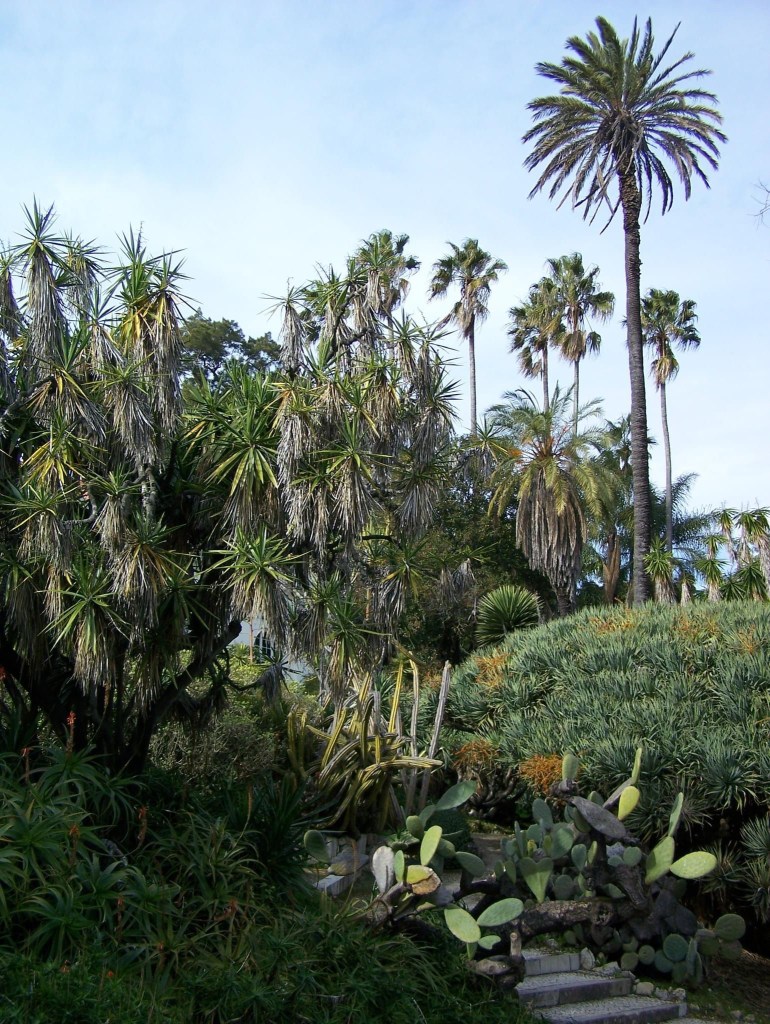
After a quarter mile, I am glad he didn’t come. The garden is wild and unkempt. The terrain is difficult and steep. There are plenty of hills to climb. The garden is built on a hillside and is accessible only by stairs and impossibly steep paths which sometimes lead to dead ends. Twice I have to circle back because the pathways are closed due to fallen trees. While I am glad I came, I do not linger.
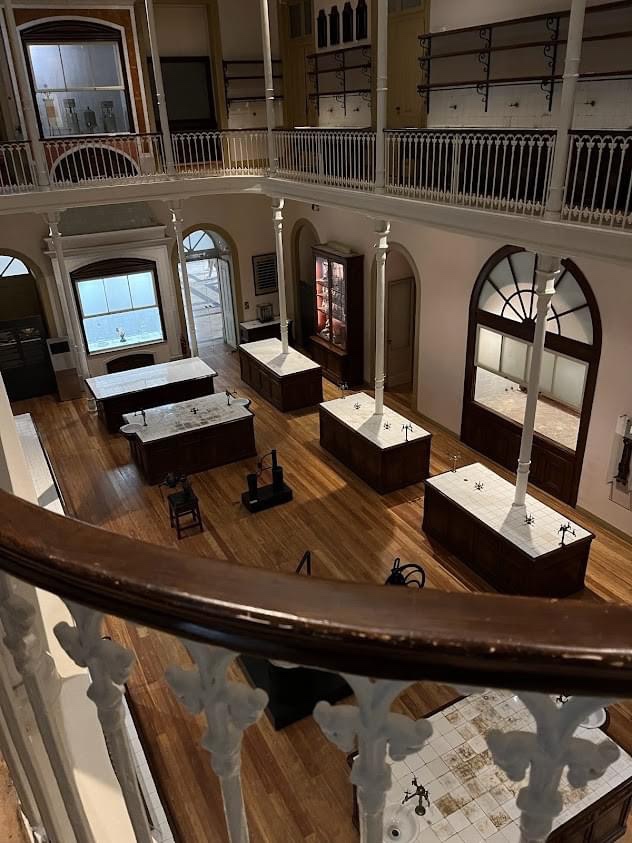
I check in with my guy, but he is happily playing word games on his phone. So I head off to the Museum of Science. The historic laboratory transports me to another time. The adjacent lecture hall is straight out of movie. I imagine Dr. Jekyll or Sherlock Holmes sitting beside me. I thrill at ancient telescopes and am a little saddened by the stuffed animals in the collections. I climb stairs and giggle that an exhibit on the landscapes of Portugal requires me to climb an artificial hill within the building.
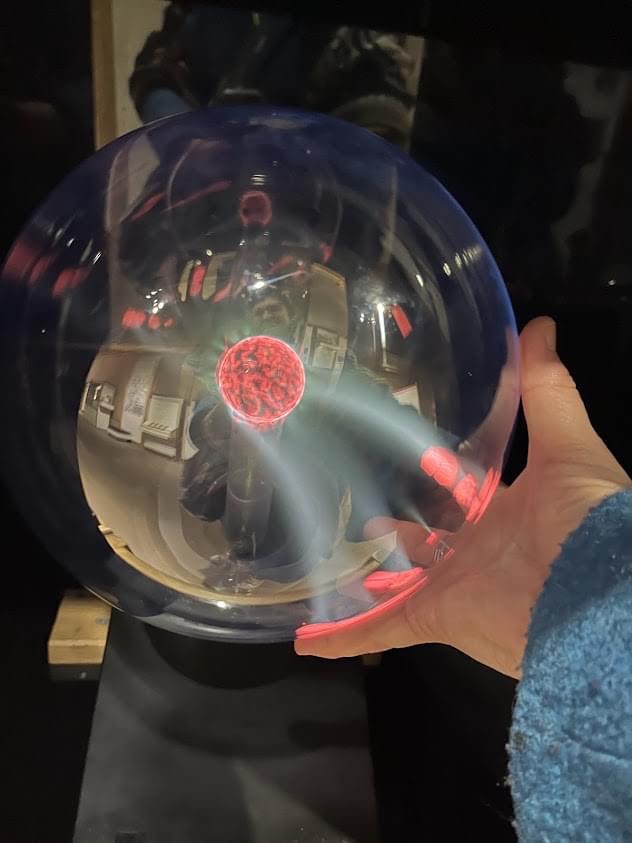
I make energy waves with my hands and watch sea life on camera. I encounter extinct animals like a triceratops and a giant Moa. I study Medicinal plants and terra cotta warriors. At some point I realize that my feet are numb and my heart is full. I have climbed enough hills for one day.

I collect my husband from the park and we take the tram to the river. We still need to walk home through Alfama. The haunting sound of fado drifts through the twilight. I am a little slower on the stairs tonight. The last hill before home seems the steepest…and the sweetest.
-
When Your Train is Going Nowhere: Travel Goals

We get up early and head to the train station for a trip to the seaside. I have maps on my phone and lists of things to do. We head into Cais Sodre station and notice that the gates to the train platform are open. The trains aren’t running. A quick translation of the schedules just says “undetermined” by every train. People are standing around looking confused. I ask a man in a transport uniform if the trains are running today. He shrugs in the universal symbol for who knows. After a half an hour, we decide to scrap our plans and just explore the nearby neighborhoods of Baixa and Chiado.
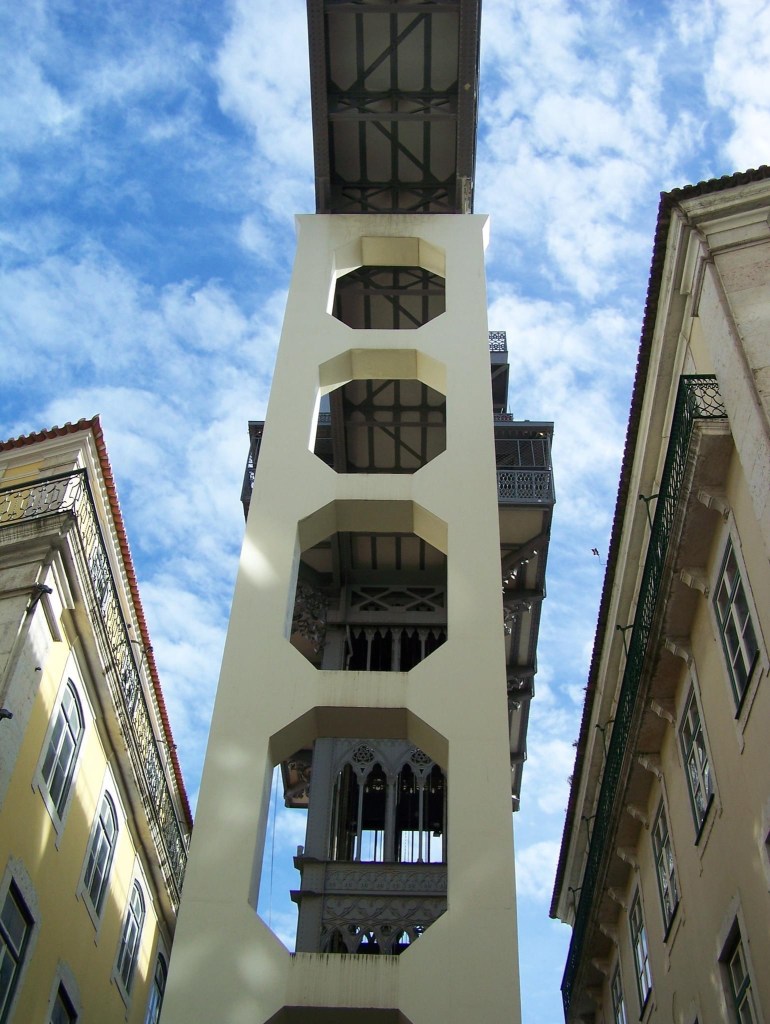
We head into the city and past the Santa Justa lift. I thought taking the historic elevator would be fun and save us a walk uphill. The line was so long we decided to walk anyway. After all we aren’t sure where we are going so any road is fine.
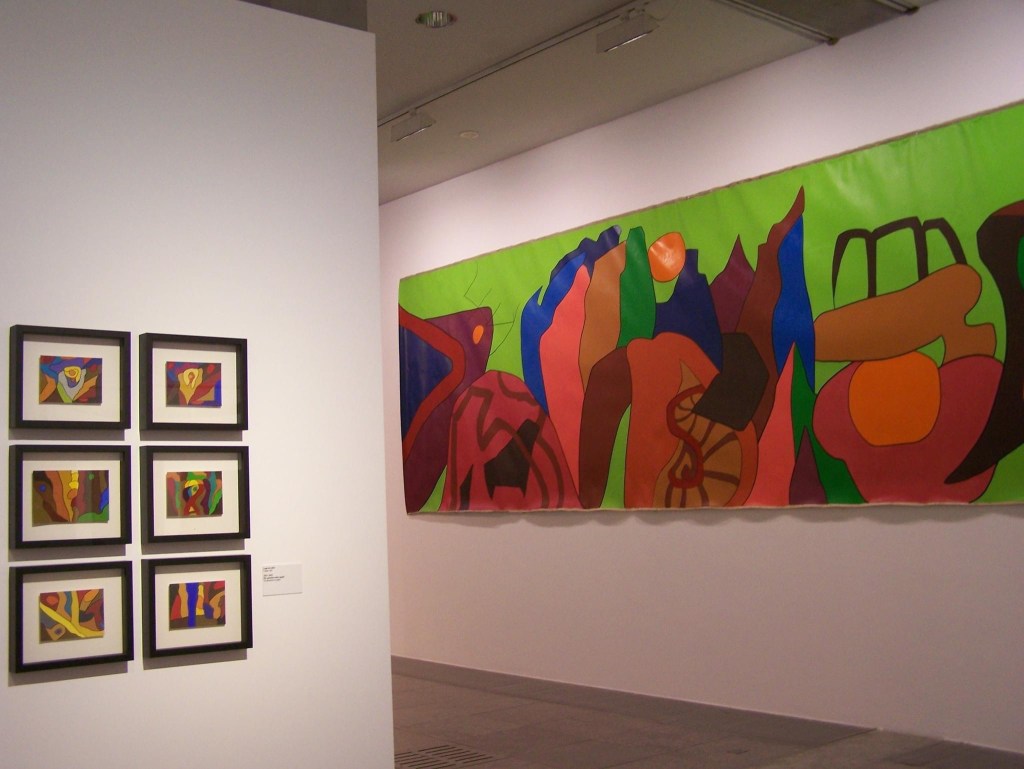
We have tickets to the Museu Chiado, a modern art gallery as part of our multi-museum purchase. We don’t love modern art but decide to give it a try. It is a very small museum with only a few galleries. We try to make time to appreciate the pieces. But it is hard to love abstraction, especially pieces that look like I could easily create them. I find a few that interest me, but realize that I appreciate skill more than concept. I also value history. The only thing historical is the building that houses the museum.
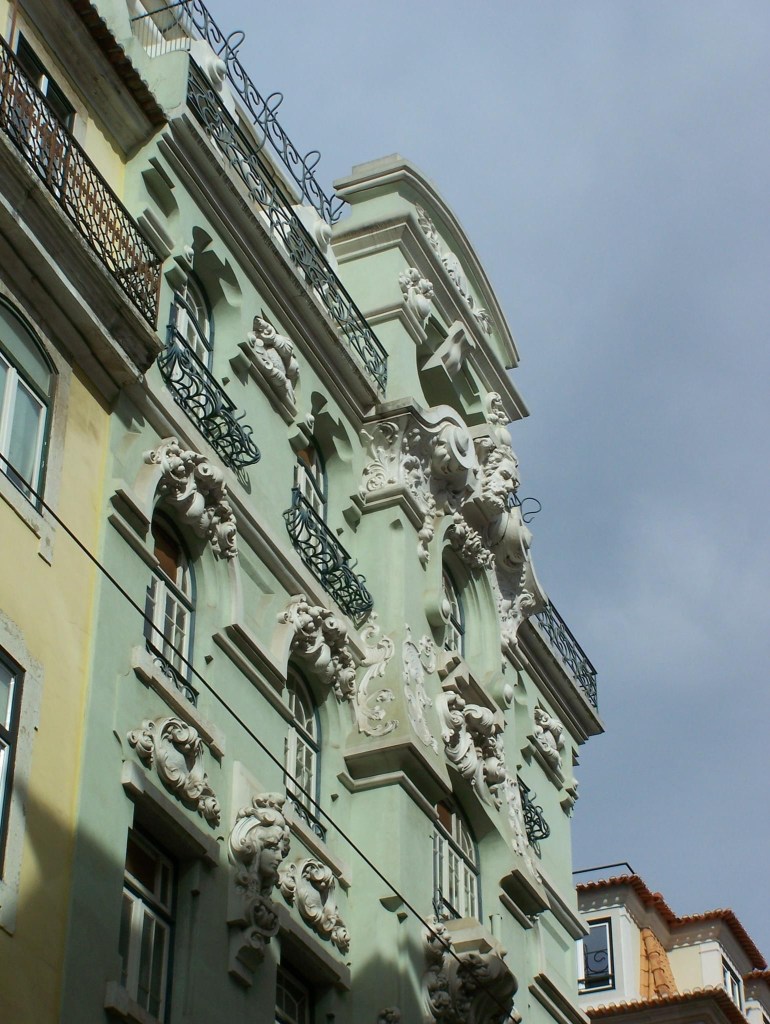
Underwhelmed, we head back uphill and visit stores in Chiado. We find a Scandinavian dollar store where we spend way to much time playing with the unusual inventory. We try to shop, but clothing here is not my style. I am kicked out of a department store because I am holding a cup of coffee (it even has a secure lid). Rules are rules.
We find a McDonald’s. While I don’t love Mickey D’s, it is fun to order from the giant screen and to see all the things they offer that we can’t get at home. It is also fun to order a full quarter pounder meal for less than $6.00. It is not fine dining by the sea, but we have to make our own fun.
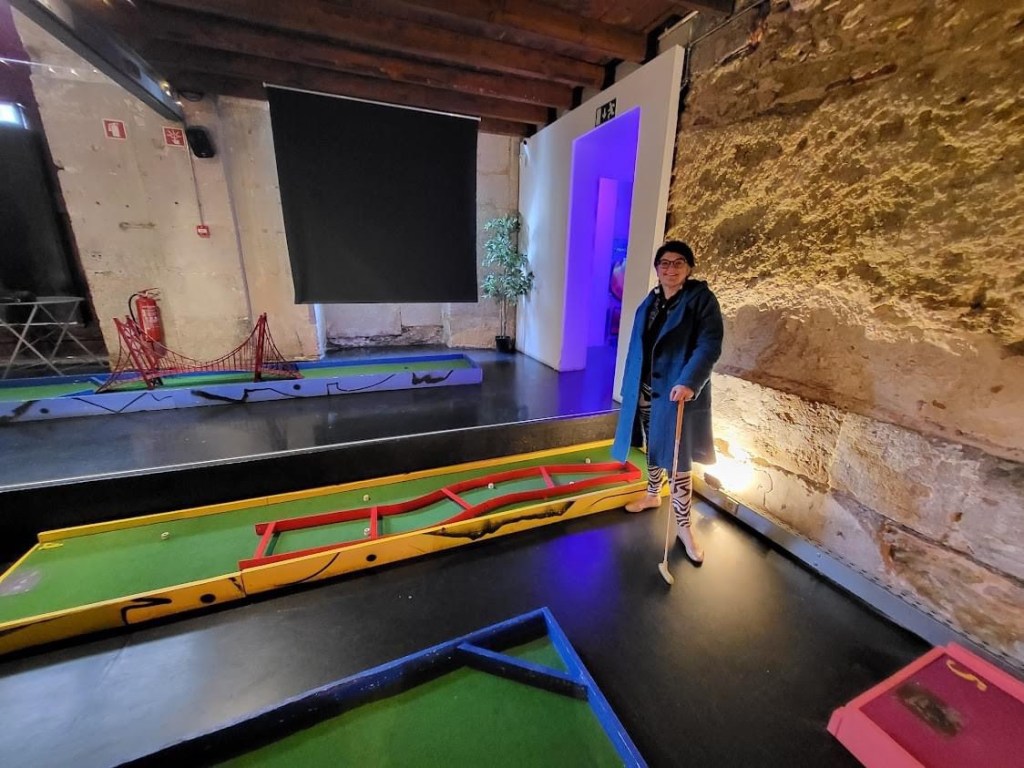
We try to decide what to do. We are not prepared for this neighborhood and are unsure of our options. We are close to a mini golf course and decide to check it out. We enter and pay. We are told that half the course is downstairs and half the course is upstairs. We walk down alot of stairs into a room about the size of our living room. They are the tiniest courses I have ever seen arranged in little boxes throughout the room. It is hard to even stand in the box to putt. There is another American couple attempting to play. We laugh and try to figure out how to make this tiny golf situation work. A few holes simply require you to drop your ball in a tube and hope for the best. We take it in stride and make our own fun.

After golf, we walk down to the river and follow the shoreline. The day is a little overcast and windy. Birds line the rocks. A few homeless men stack rocks in the hopes that tourists will leave coins. The gentle lapping of the water is relaxing.

The crowds pick up at the Terreiro do Paco. People jockey for a position to take pictures at the water gate. I wait my turn. It is good day, as the water level seems lower and more steps are accessible. We sit and people watch for awhile. This day is nothing like I imagined.
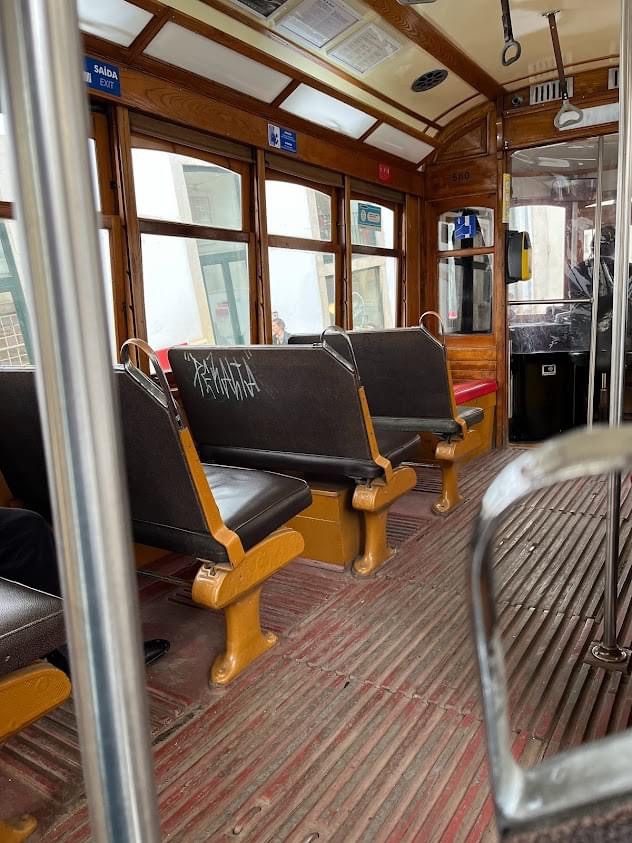
Eventually we decide to take a tram toward the Convent do Carmo. We haven’t been on this line yet and we are pleasantly surprised when there is no line. The tram is empty. We can pick our seats. We can sit in all the seats. This is so very different than our usual cram packed ride on tram 28. We celebrate by taking a number of silly photos.
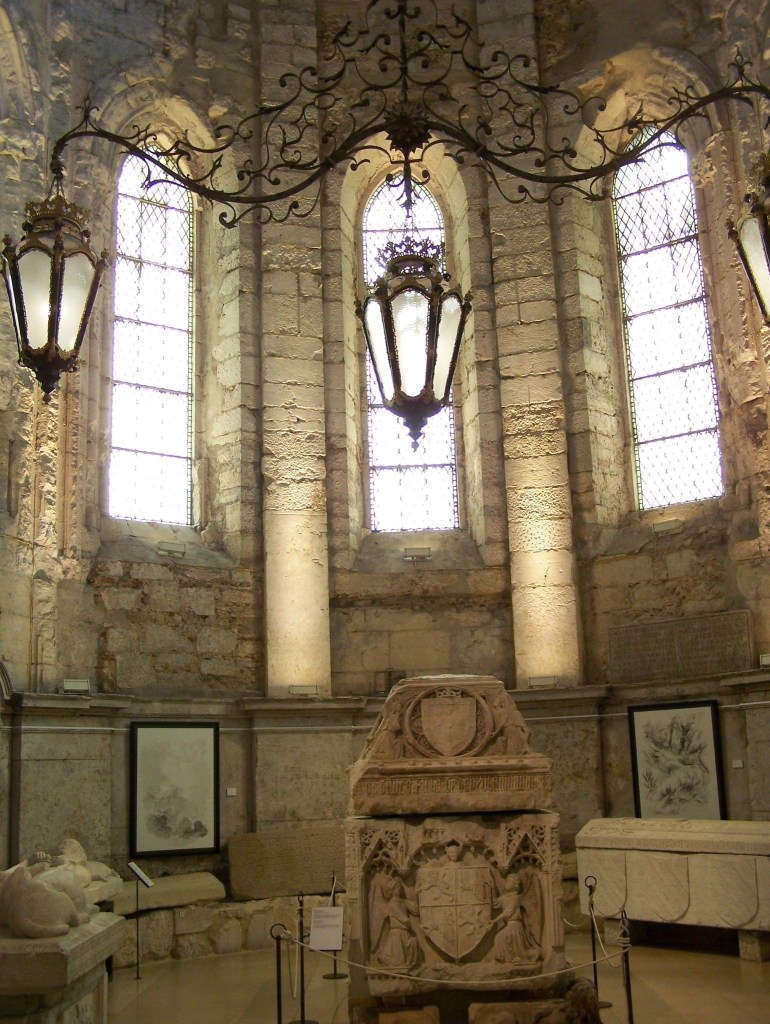
The Convent do Carmo is just ruins with a small museum attached. After the earthquake of 1755, the convent was never fully repaired and in the 1860’s it was given to an archeological society. We look at the sky through the open roof and read inscriptions on tombs.
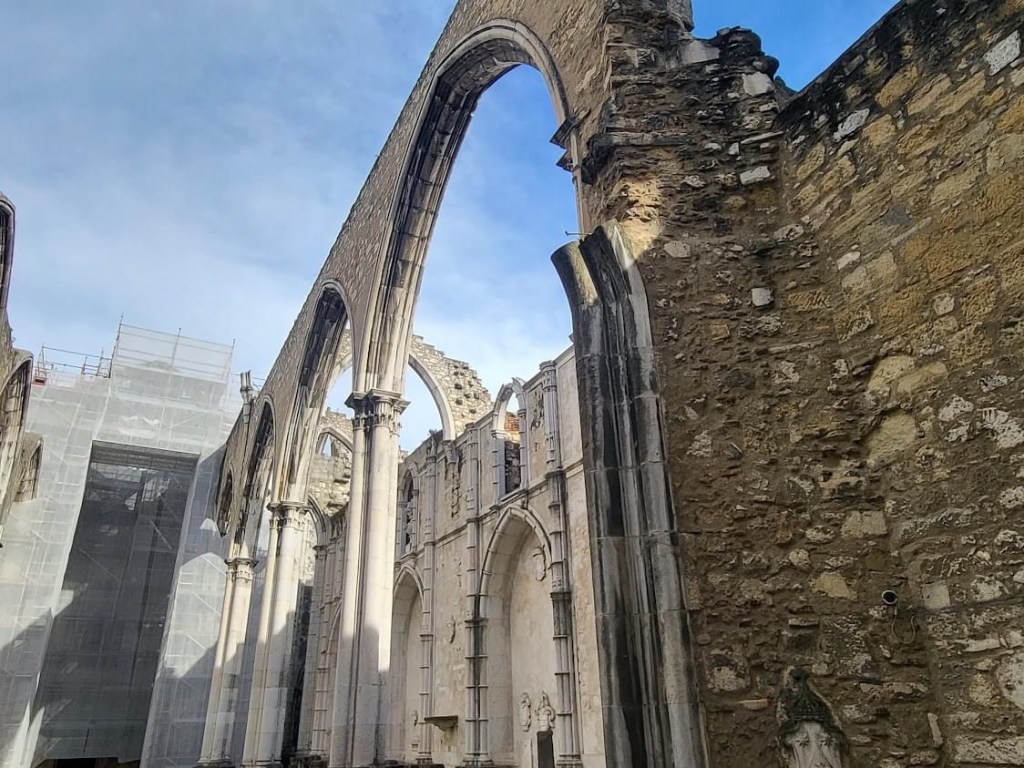
In the small museum we watch a film and gross out after an unexpected encounter with a Peruvian mummy complete with teeth and hair. The museum collection is eclectic and most of the signs are in Portuguese. My translation skills are improving as many of the words are similar to Spanish, but there is not much of interest. I am happier among the ruins outside.
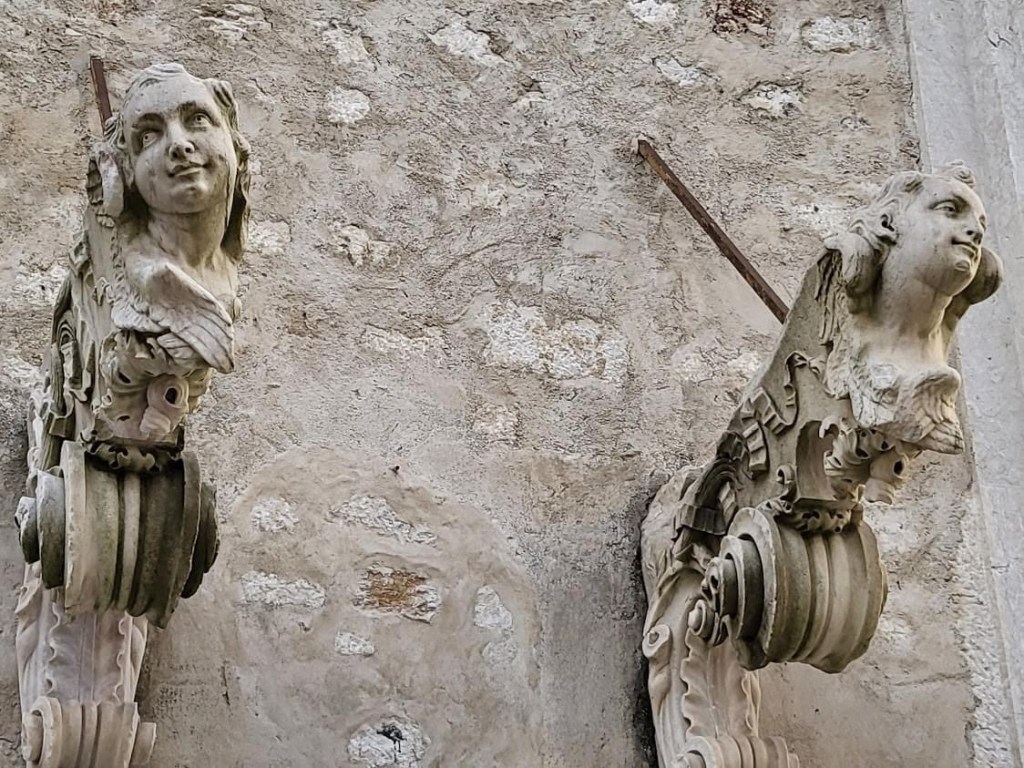
We linger in the courtyard. My husband stops and points across the street where I was heading to visit a church. A car is stopped in the middle of the street. Two older men are yelling at each other and chasing one another round and round the car. At first it looks like a joke or an Abbott and Costello comedy sketch gone wrong. We notice a women at the corner looking worried and begging one of the men to stop. It is clear that one man is angry. The other man is faster and more provocative. He looks smug. We watch this little farce for a long while, until the angry man gets in his car and drives away. The remaining man smirks and joins the woman who is speaking very fast to him as they walk away. She looks angry. We will never know what just happened.
By the time I make it to the Basilica, I am tired. This day has been full of surprises. I sit and contemplate. The ceiling is beautiful and lovely to stare at. Why do we let things like missed trains and traffic make us so out of sorts? I count my blessings and resolve to be more patient and kind. I realize that surprises are part of life. I get to choose how I react to them. When your train is going nowhere, decide that where you are is the place to be.

-
Lost in Lisbon: Travel Goals

We start the day with confidence as we no longer feel lost in Alfama. We don’t know all the roads but we can identify landmarks that keep us moving along the rabbit warren of streets with at least some confidence we will end up near the river and reasonably close to our destination. We even know the bus stop and the bus number that we want to take on today’s adventure. That is all we know about the day.

We take the stop for the Museu de Arte Antiga and are put out on a median, barely big enough for a bus stop sign, in the middle of a multi-lane highway. We look across the street and do not see a road. The gps is clearly directing us across the street. I am confused until my husband notices the stairs. I cannot see the top of the staircase and that is not good. Since there was no way but up, we begin to climb. Halfway up the stairs, we rest on a landing and then climb some more. At the top we find a park with amazing views and a sign that tells us it is illegal to feed the Pombas (pigeons). Poor pombas.
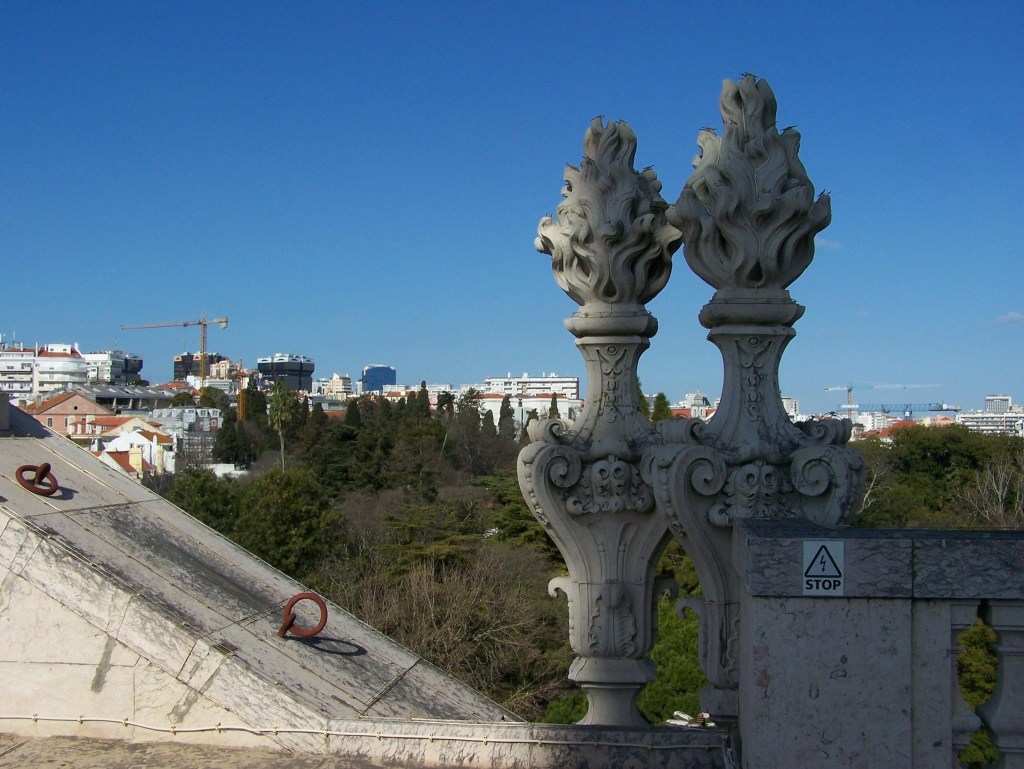
We wonder around and look for the art museum. Signs are not really a high priority in Lisbon. With my trusty GPS, we find the door. The museum is full of Portuguese furniture. Lace from the 1100s, chests from the 1400s, chairs, clocks, and objects from the colonies line the galleries. We admire the artistry, craftsmanship, and ingenuity. I am reminded that people in prior centuries were every bit as skilled, smart, and technologically savvy. In many ways, I am saddened by what has been lost in the era of mass produced goods. But that is a thought for another day.
Putting thoughts of corporate greed out of my head, we head into the galleries of religious art. There are panels of the apostles that capture my attention. They are life like. Each man’s personality writ large on canvas…fierce, loving, protective, pensive. All other works pale in comparison, but we head deeper into the museum. With no signs and no map, we try to follow a path. A gallery is shut off. A stairwell leads to a parking garage. An open doorway leads to a sad little outdoor garden. Eventually we find our way out.

Based on the google map, we are near Estrela. We laugh because google maps says 15 minutes and mostly flat. I don’t need google translate to tell us that this means 30 minutes walking down roads that are uphill roughly the same distance they are downhill. Mostly flat in Lisbon is a euphemism for not straight uphill the entire way.
We eat near the Basilica de Estrela at the Cafe Estrela. There is a line to be seated, always a good sign. All locals and no one speaks English, also a good sign for authentic local food. Ordering is a challenge, but with smiles and goodwill we muddle through.
After an hour of good food and people watching we cross the street to visit the Basilica. My husband thinks it is my mission to visit every church in Lisbon. Perhaps he is right. The church doors are closed, but a tiny side door is open. A man smiles and asks for a few euro. We pay and he points to a door to his left. The basilica is to the right. We go left and find a small door in a dark tower. “What did we pay to do? I thought you wanted to visit a church?” So I did.
I step into the dark and see only a winding stone staircase. I laugh. How bad can it be? We have to know what we paid for. We go up, landing after landing. About halfway up we pass panting German tourists on their way down. My German is terrible but I am sure I hear something like, “I thought we would get to see the church…”. Where are we going exactly?
We step into the light between two giant bell towers at the same time the bells begin to chime. I scream and my husband catches his heart with his hands. We laugh because we are so startled and it is so loud. I feel like Quasimodo at the top of Notre Dame. We are on the roof. There are spectacular views of the city. We see the Castelo and the sea. There is a glorious blue sky. The only view we get of the church is from the inside of the dome. The doorway is open and I peek at the altar. It is a long way down and not at all what I was expecting when we paid to visit the church. Never the less it is oddly peaceful up here away from the crowds.
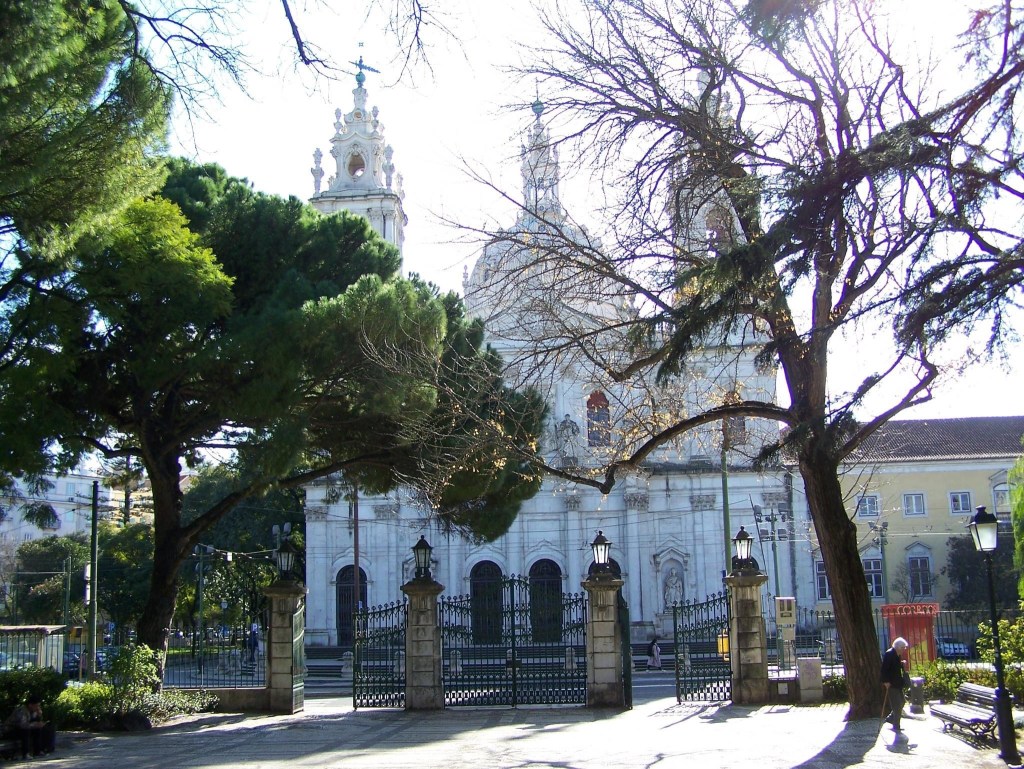
Across the street is the Jardim de Estrela. After climbing hundreds of steps, whiling away a sunny afternoon in the park seems like a good idea. We sit for awhile, but I am ever restless. So I wander, taking photos of statues and birds. I smile at dogs and small children. My husband waits patiently on a bench in the sun until I return. We find a small cafe. We rejoice that the tram stop is only steps away.

Our return trip is unexpectedly cut short. Tram 28, which should run all the way to our house comes to a halt two stops after we get on. We are all told to get off. Everyone looks confused. After some time, a tram driver tells us that there is a protest in the Praça Comercio. No trams can get through. No one is sure when the trams will run again. This is not great news when you have been climbing hills and basilicas all day. It is worse news when it is the only way you know to get home.

Ever resourceful, we walk to a bus stop that can get us to Graca. At least Graca is at the top of a hill. Walking the rest of the way home will be a downward journey. We love Graca. The Igreja de Graca stands watch over a peaceful park and a lofty Miradouro. We settle into “our” table at Mouriscos and order dessert. I can’t decide, so I take one Pasteis Natale and one biscuit cake. We share. Some time later after sweets and Sangria we are replenished enough to walk home.

We are feeling so much better that we take the long way to the Portas dol Sol. The views are beautiful here at the end of our street. We made it home to Alfama. We can hear the protest far away and detached from our lovely view. There is singing and serious voices over loudspeakers. Some one says it is a teachers strike. Ever an educator, I wish them good luck. I don’t even begrudge them the transportation disruption. If we hadn’t been lost in Lisbon there would have been no biscuit cake and I likely would not be enjoying this wonderful view. Sometimes lost is an okay place to be.

-
A Short Train Ride to Fairytales: Travel Goals
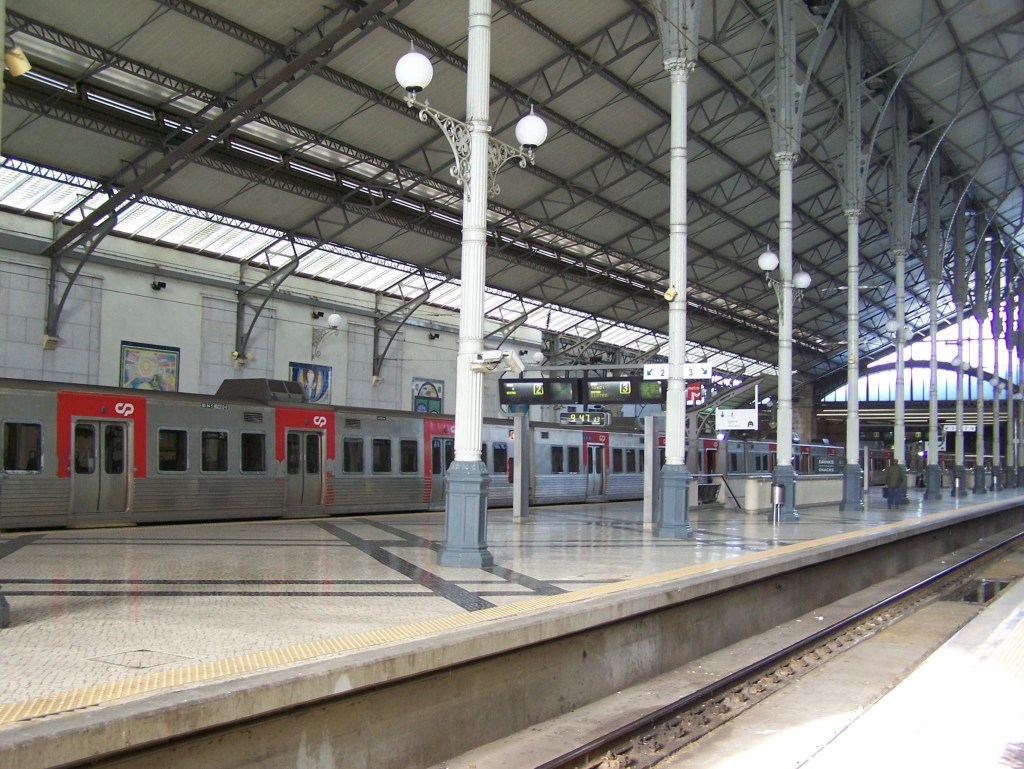
Standing on a train platform and waiting with anticipation, we are alert for the train to Sintra to arrive. I check and re-check that we are on platform three. It doesn’t make the train come any faster. Once the train arrives, we select our seats near the large windows and in view of the display board that will announce stops. The ride is only forty minutes but it is our first time venturing outside of Lisbon. Anticipation is high as I catch a glimpse of the aqueducts. The ride is uneventful and before we know it, we are queuing to exit the Sintra station.
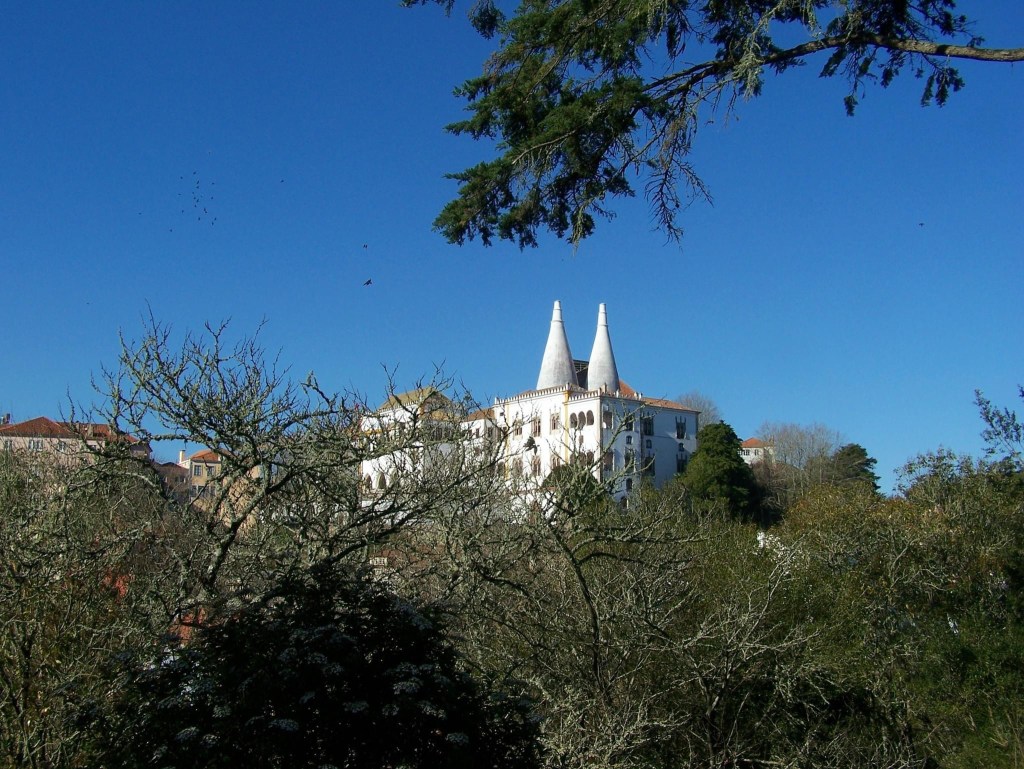
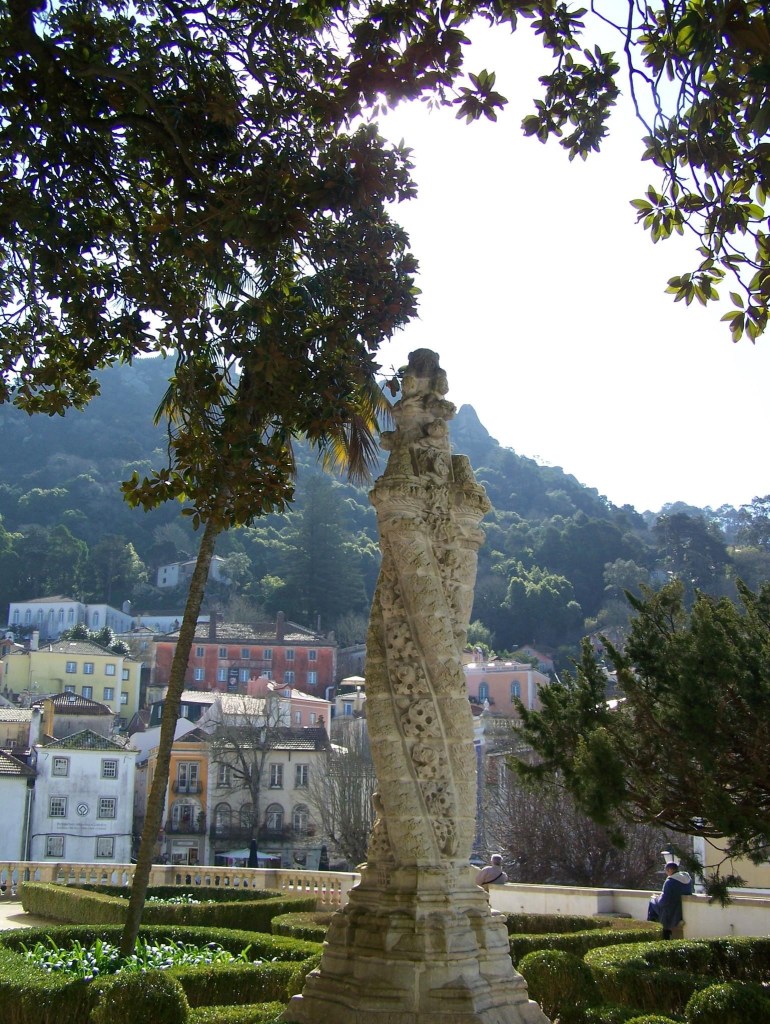
It is a barrage of tuk tuks and tourism office representatives at the train station gates. We are overwhelmed by picture cards shoved in our faces. We try to walk away as quickly as we can, but we need information. I ask a man how to get to the national palace. He says left and then follow the road to the right. We follow the road but I can see the national palace (it’s smokestacks are unmistakable) on the right. It is tempting to go right. Bu the tourist office man said to turn left, so we turn left. On the road We pass a man dancing and yelling “Carnivale”. He is having a great time but seems a little crazy. We cross the street and hope we are not lost. We climb another steep hill and wander around the hillside some more. We are good at wandering around. A castle peaks out further up the mountain. Palatial homes dot the hillsides along with statues and Moorish architecture. I find a throne to sit on among the pieces of public art that line the roadway.
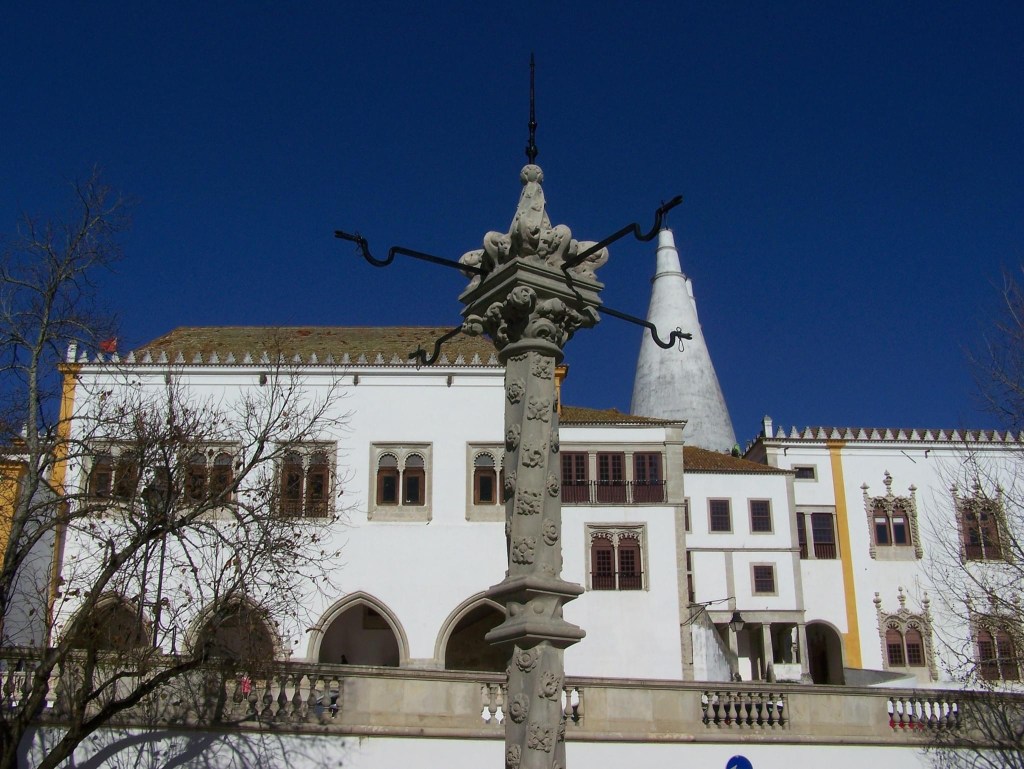
Eventually we reach the national palace of Sintra. We enter and follow the tour path. A palace has sat on this spot since the 8th century under the Moors. By the 1100’s, during the 2nd Crusade it was again under Christian influence. Subtle arches still whisper of Moorish roots. Numerous additions bear witness to the reign of Portuguese royalty.

Upon entry, we are agog at the painted ceilings. Swans wearing crowns hint at the marriage of John I and Philippa of Lancaster. Their initials entwined, linking Portugal and England. There are mermaids and sailing boats looking down from above. There is even a room crowned by magpies. It is said that King John had one magpie painted for each lady at court to shame them for gossiping that he had kissed one of the queen’s lady in waiting.

The rooms are not overly large, but the views to the sea are lovely. As you move through the palace you move through additions planned by subsequent Kings. There is tile and ceramic art. Priceless furniture in a fairytale setting. I realize that life in a palace is not always glamorous. Endless narrow staircases, no indoor plumbing, cold rooms in winter, hot rooms in summer…but always on a grand scale.

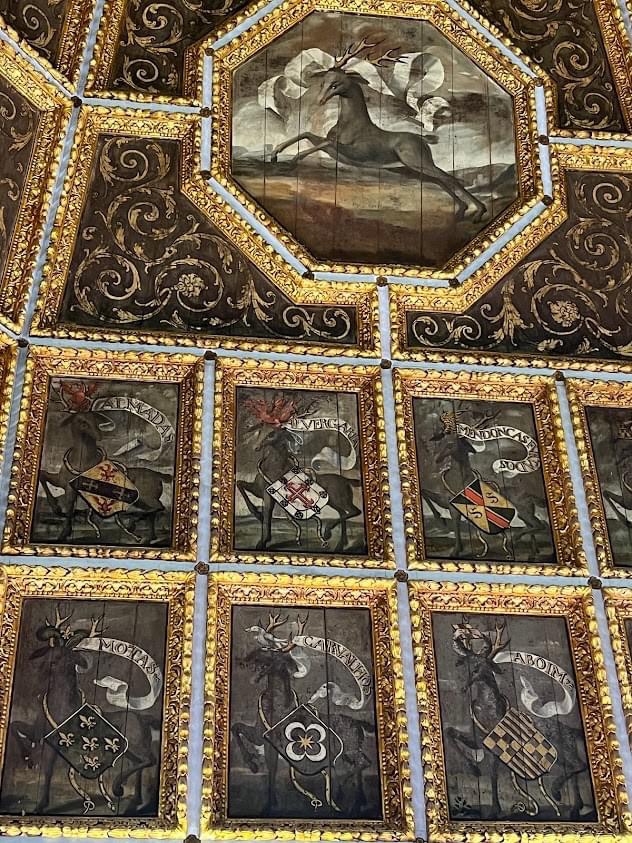
In the 16th century wing, King Manuel ordered construction of the magnificent coat of arms room. Beautiful tile and intricately painted domed ceiling merge into a fantastic whole. The coat of arms of each noble family emblazoned on panels under the royal seal. In a not so subtle message, the noble houses are depicted as stags in the King’s hunting lodge. In one stroke, their importance is both affirmed and put in context. I am silenced in such beauty.
We press on to a chapel under restoration and more modernized sections of the castle where the last of the monarchs set up residence. Always a romantic, I prefer the older sections. Although indoor plumbing has its appeal. Perhaps the most fascinating room of all is the massive kitchen. The entire room is a massive oven. The two large smokestacks vent this room. Every surface is a stovetop or an oven. Fires could be built directly on the floor under massive spits. I try to imagine the heat endured by the army of cooks who kept the fires burning and the food flowing. I look up into the giant smokestacks and realize how many people this palace supported.

Humbled, we make our way outside to wander the garden along the hillside. Sea views through graceful pines tease my senses. But we are hungry, so we begin our quest for food.
We read several menus and reject them. He won’t eat seafood. I don’t want tourist fast food. We move deeper into old town and find a simple room tucked behind a wine shop. Charcuterie, simple cheese, Portuguese sausages, bread, olives and jam…..perfection on a plate. Good music and good food replenishes our energy.
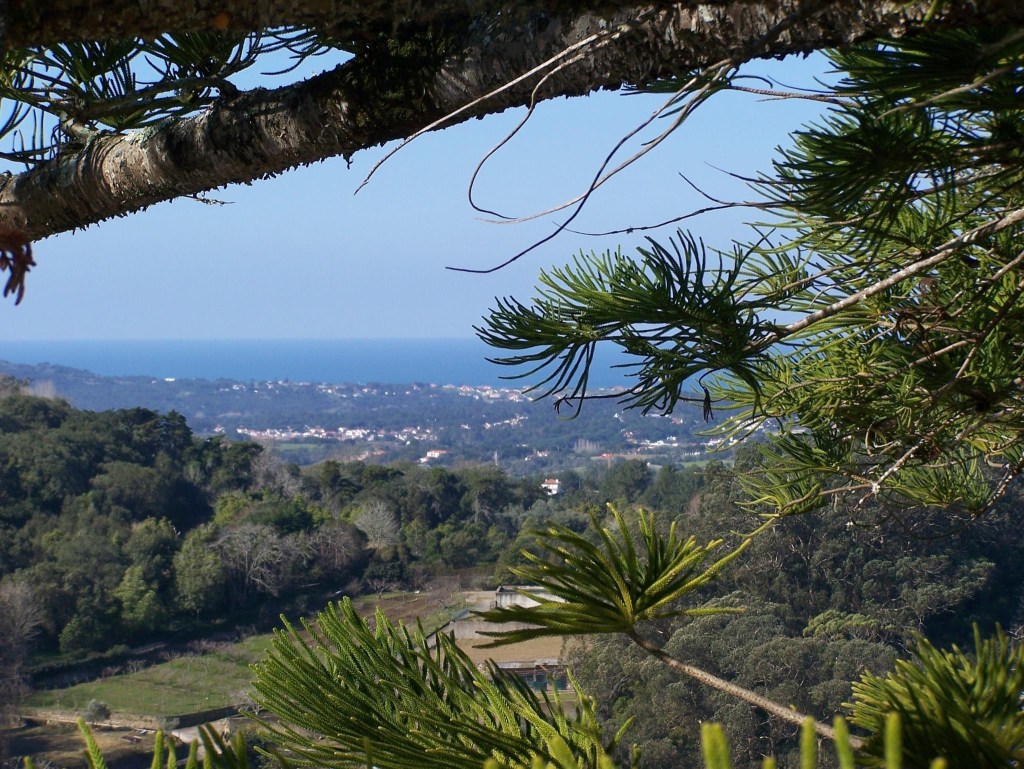
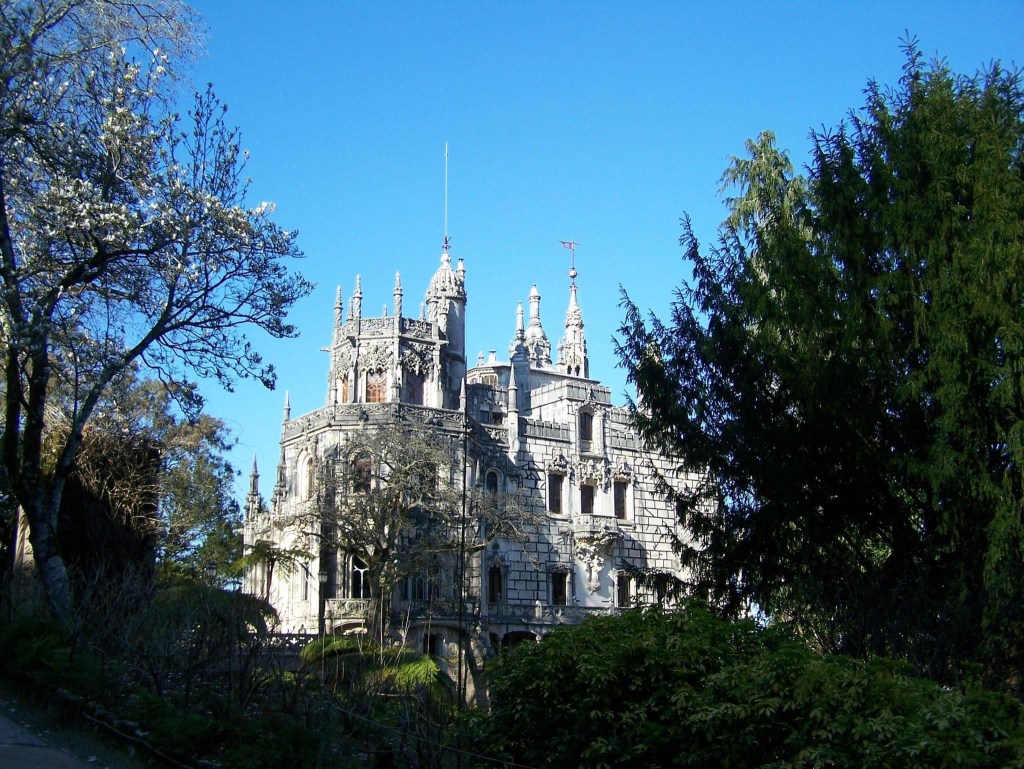
Rejuvenated we decide to visit Quinta da Regaleira also known as the Palace of Monteiro the Millionaire. It doesn’t look too far away. Looks can be deceiving. We trek ever upward. We reach the gates to property but the entrance is up the hill. We round the corner. Upward still. We rest by the side of the road. Upward still. We finally find the ticket booth. Upward still. I want to find the Templar Initiation Well. Upward still.
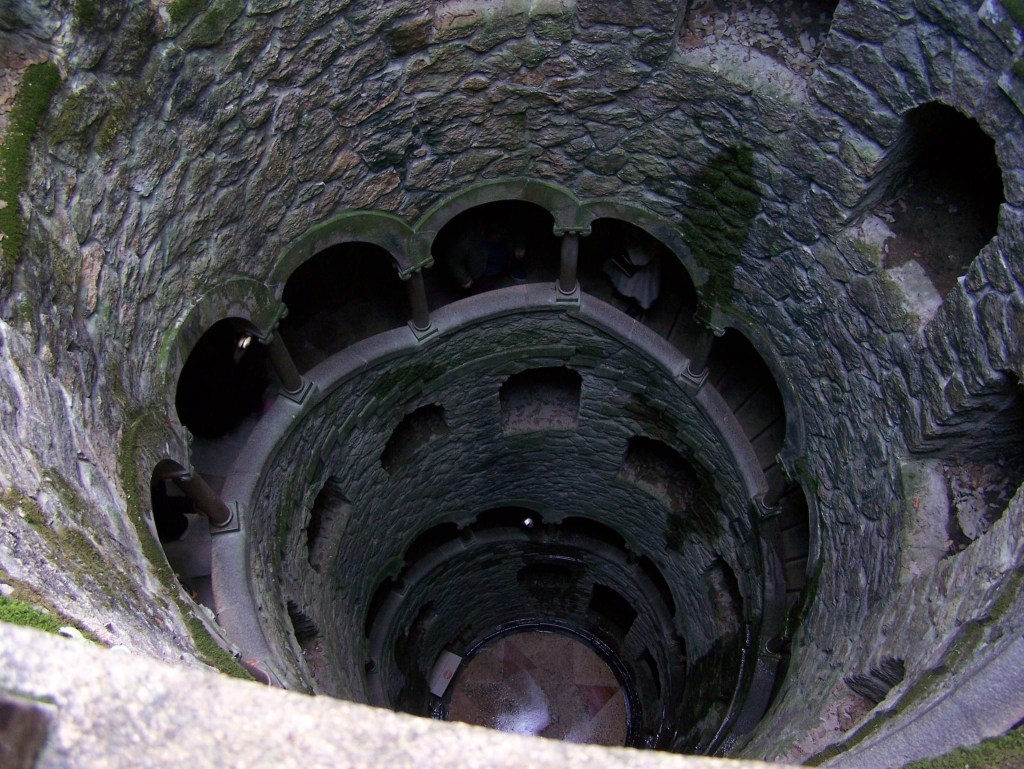
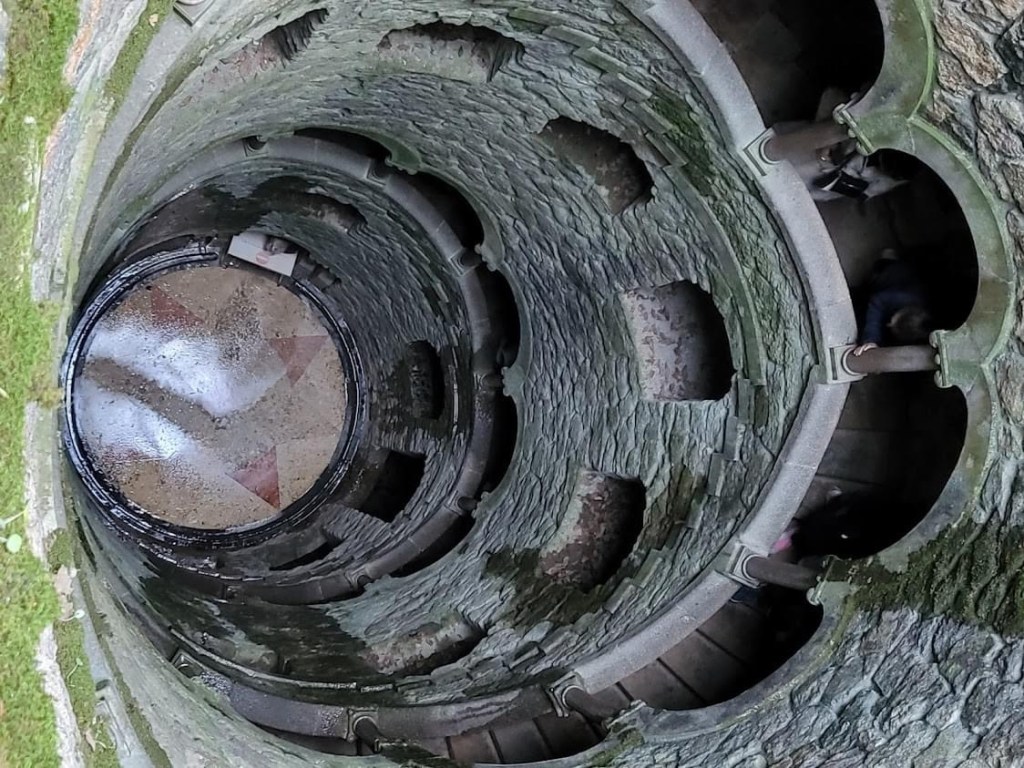
We reach the well and the climb is worth it as we encounter an inverted tower leading into the earth. I feel like I am in a movie as I start a descent. Water drips and flows. Daylight fades with each downward step. I climb down and then down some more. We find the bottom of the well and underground caverns.
Caves and garden follies dot the hillside. Waterfalls and statues of Greeks gods great us at every turn. There are miles of trails but we are tired and we haven’t yet visited the house. So we head downhill and encounter a fantastic chapel. It is small and enchanting, like a fairytale encounter.

The house is large and whimsical. We trudge through appreciating as much as we can nearing exhaustion. It is all a blur really. My husband sits down and I trudge on over hills and around small lakes. The day is warm and I am determined to conquer all.

All good things must come to an end, so we head back to the train station. Down the hill and to the town. Through the narrow lanes lined with shops. Down the hillside to the national palace. Up the hillside and past the fountains. Down again along the ravine. We pass the dancing man. He is hoarse and dancing a little slower, but still smiling and chanting “carnivale”. Perhaps we have been in a fairytale after all. We should catch that train before the clock strikes. I don’t want to find out what happens when he decides to chant “rumplestilskin”.

-
Beauty and Destruction: Travel Goals
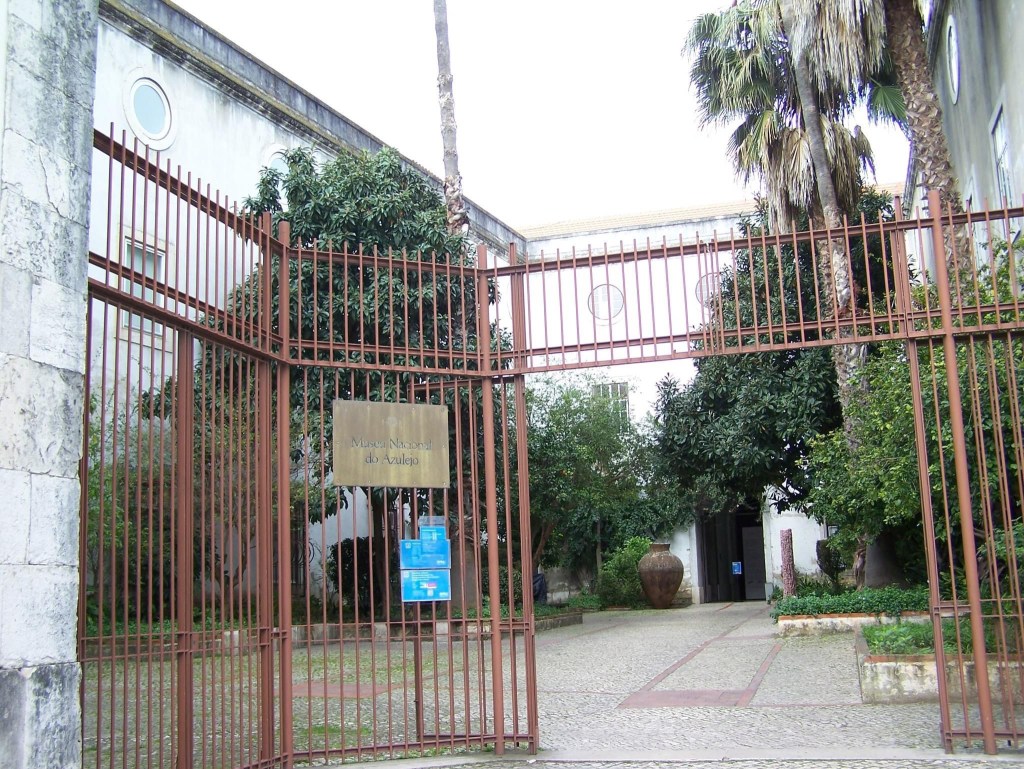
The Museu National do Azulejo is not much to look at from the outside. Looks can be deceiving. The inside of the museum is a treasure chest. Tiles from across Portuguese history are on display in the rooms of this former convent. Beauty awaits at every turn.
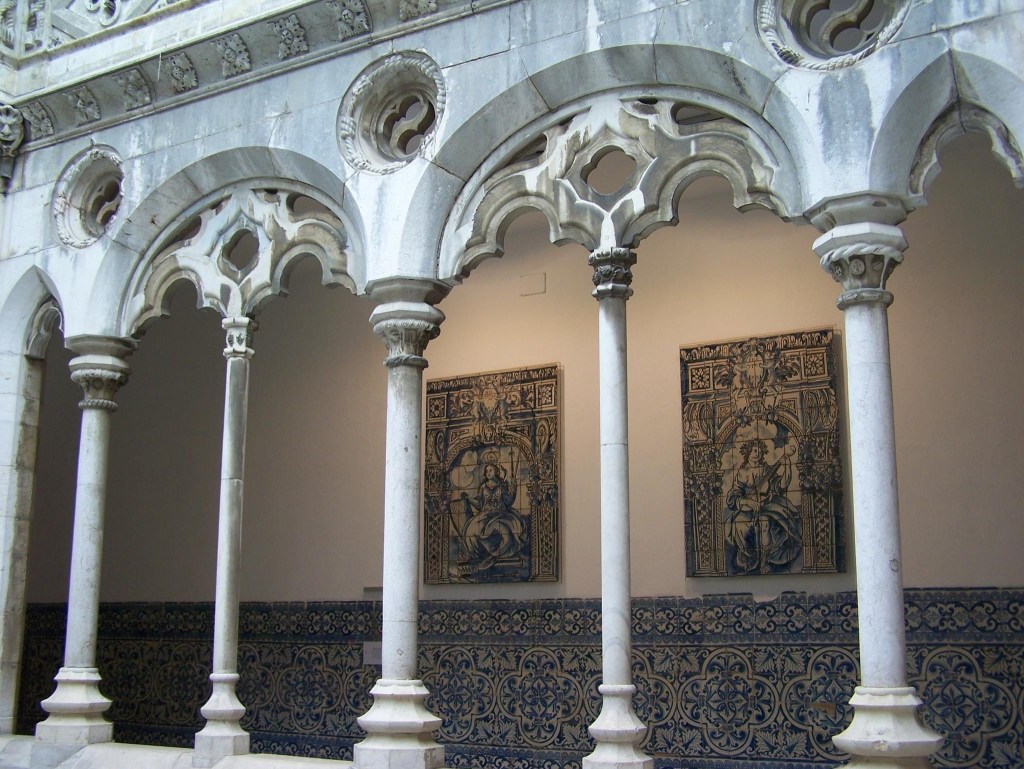
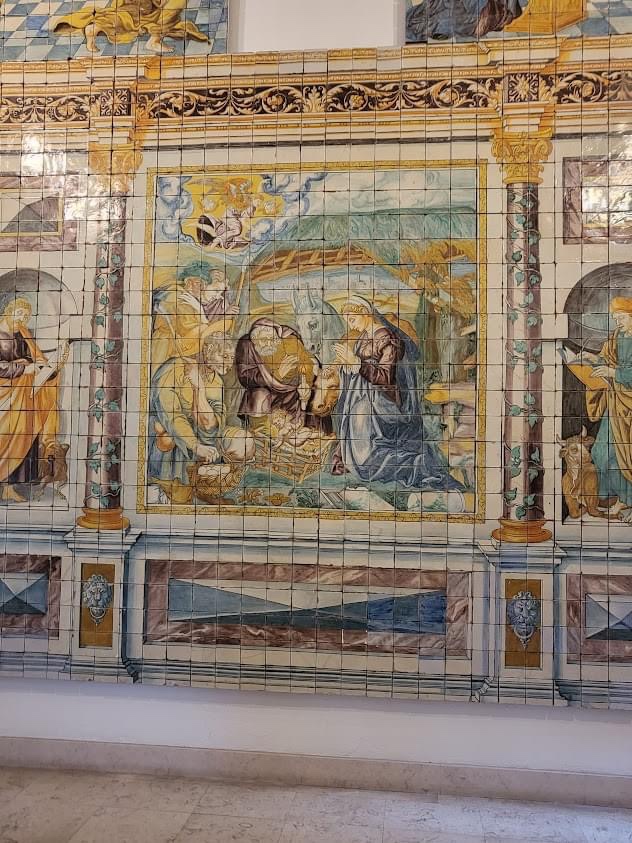
Tiles in colorful scenes from the Bible line the walls. The nativity, archangels, lives of the Saints and the many stories of Jesus come to life in tile. A uniquely Portuguese art form, humble and beautiful, unassumingly on display.
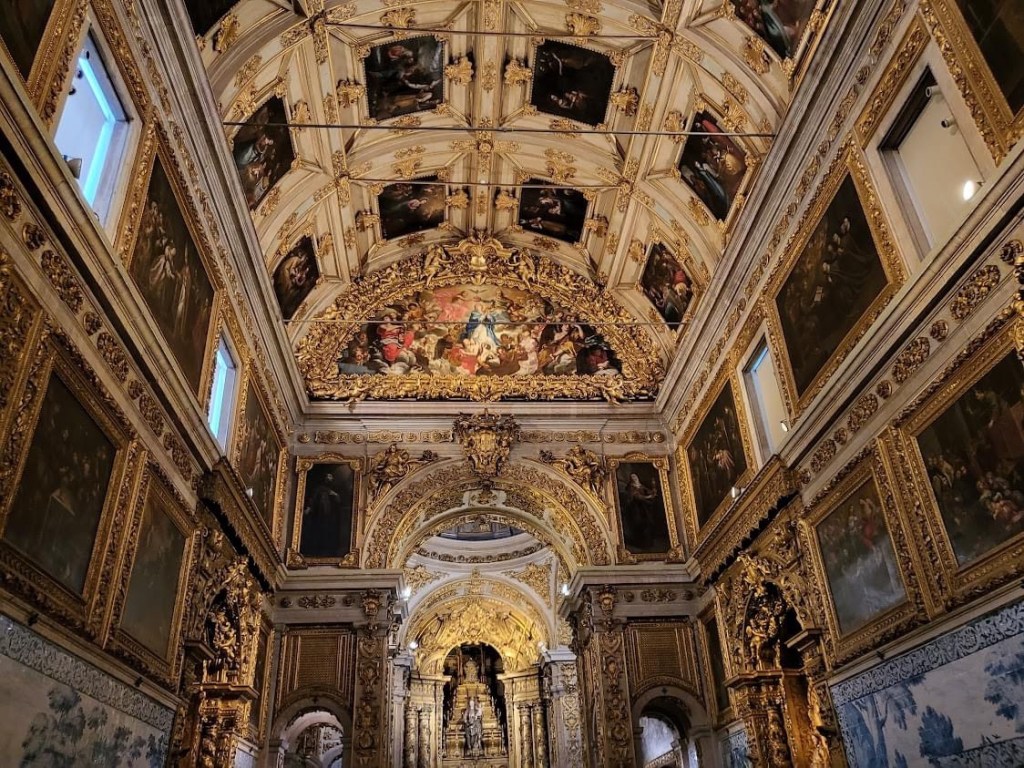
After many galleries of tile, we enter the chapel of the former Madre de Deus convent. It is an unexpected riot of beauty. Tile walls and carved and painted art adorn every available space. Golden carvings at the altar draws attention to the Madonna and child. Gilded domes lift my eyes to heaven. I need to sit and absorb the grandeur. I am again overwhelmed by the beauty of a sacred space. I was not prepared for this encounter. I can’t process the experience. I leave and then return for another look. It is so…. I have no words.
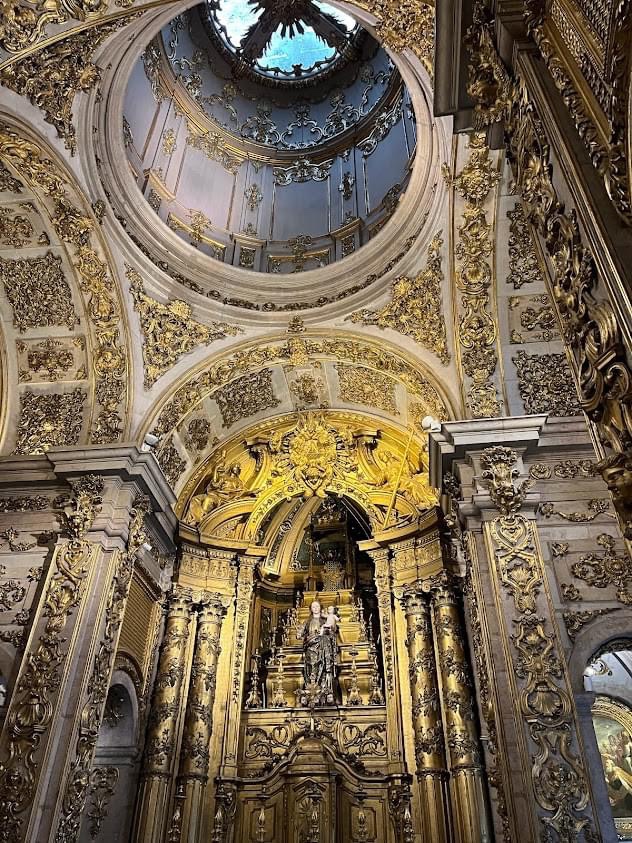

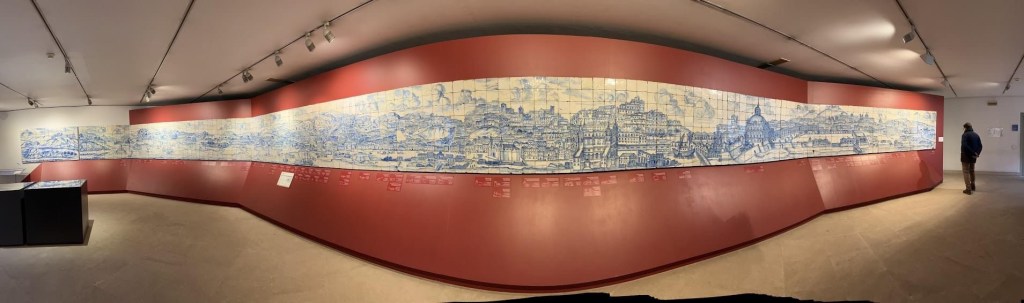
We visit the rest of the museum. History in tile. An ever evolving art form, the tile is influenced by contemporary encounters. The museum ends in a room with the entire city of Lisbon painted in tile. We walk the length of the room picking out our neighborhood and landmarks across the city. What kind of talent does it take to produce a work this accurate and this massive? There is a lot to ponder as we sip coffee and enjoy pastry in the cafe. Seldom do we encounter so much beauty in one morning.
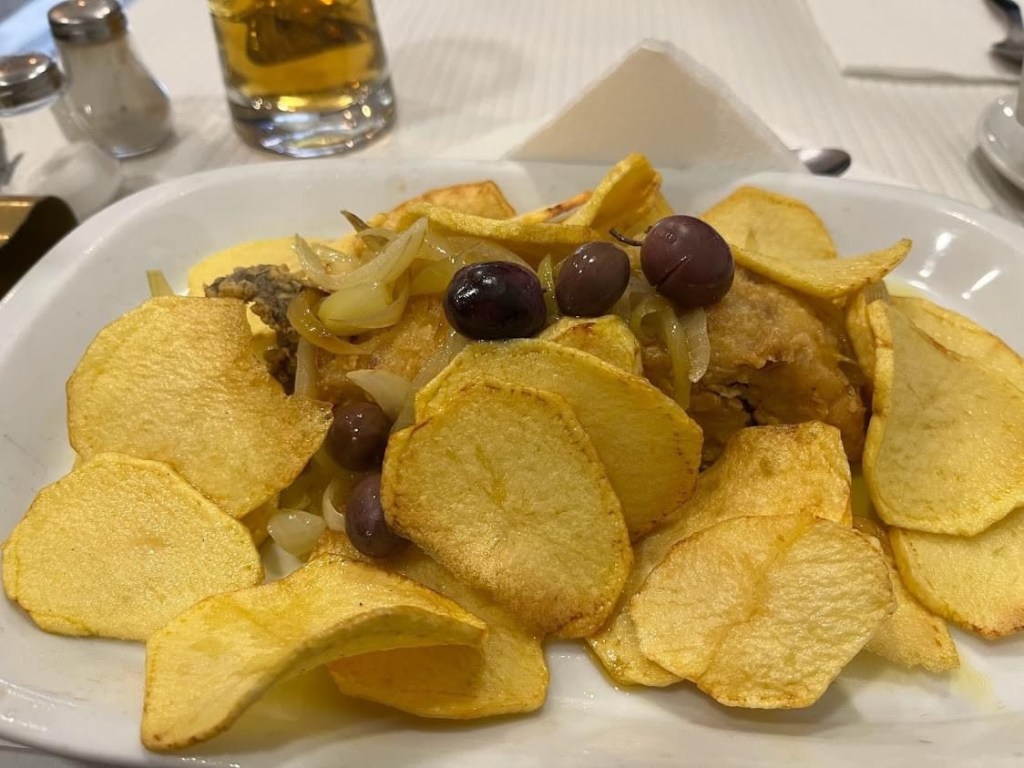
Returning to Apolonia station, we select a nearby restaurant for lunch. I choose Balcalhau (cod), a local favorite. My husband opts for a turkey steak. Simple pleasures in a simple space. The television in the corner is broadcasting Vladimir Zelinski as he addresses the British Parliament. The people here are solid supporters of Ukraine, their democracy relatively new and hard won. Coverage is at the forefront of local news. I watch the images of destruction and I say yet another prayer for my friends in Ukraine. It is hard to reconcile this harsh reality and the beauty of the morning.
A short walk away is the National Military Museum. Housed in a former palacio, the museum contains artifacts from the span of Portuguese history. Canons from early explorer’s ships line the entrance. Knights in armor are stationed at the stairs.

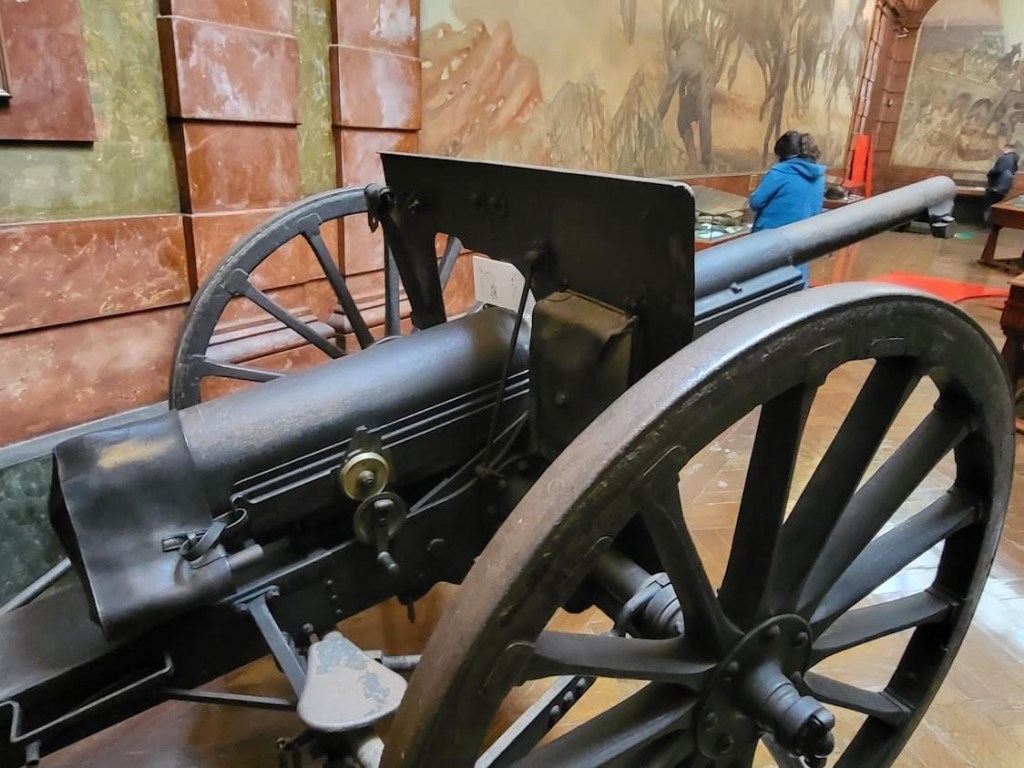
It doesn’t take long for the little boy that watched Combat and played with little green army men to surface. My husband is lost in the World War I galleries. I smile and watch as he moved from display case to display case. Hand grenades, gas masks, and endless varieties of fire arms capture his attention and he takes pictures with abandon.
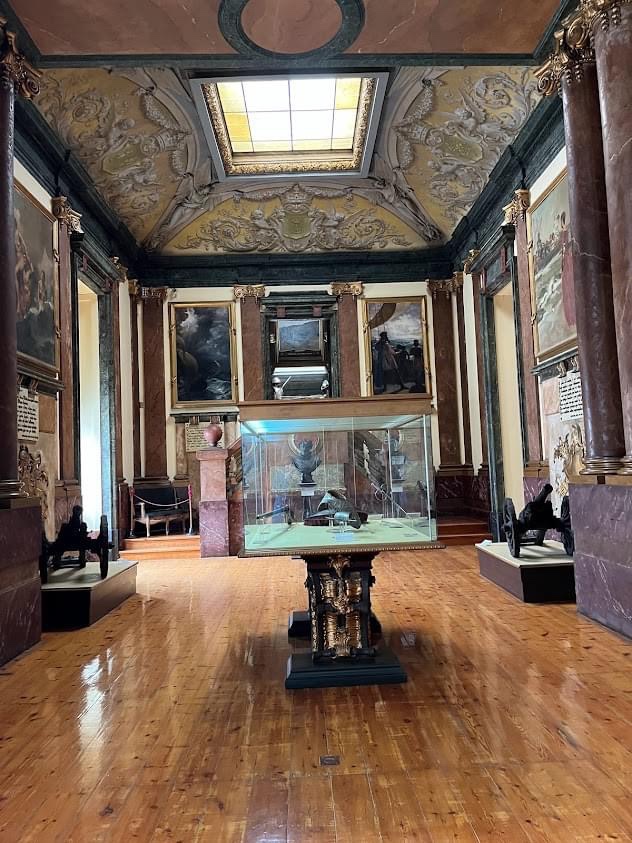
Practical tools of war and decorative weapons of mass destruction are on display in room after room. Cannons and swords from across the centuries line the galleries. I am amazed at the ancient weapons of mass destruction. Power and conquest. The clash of cultures throughout the world. Endless ways to kill and subjugate.
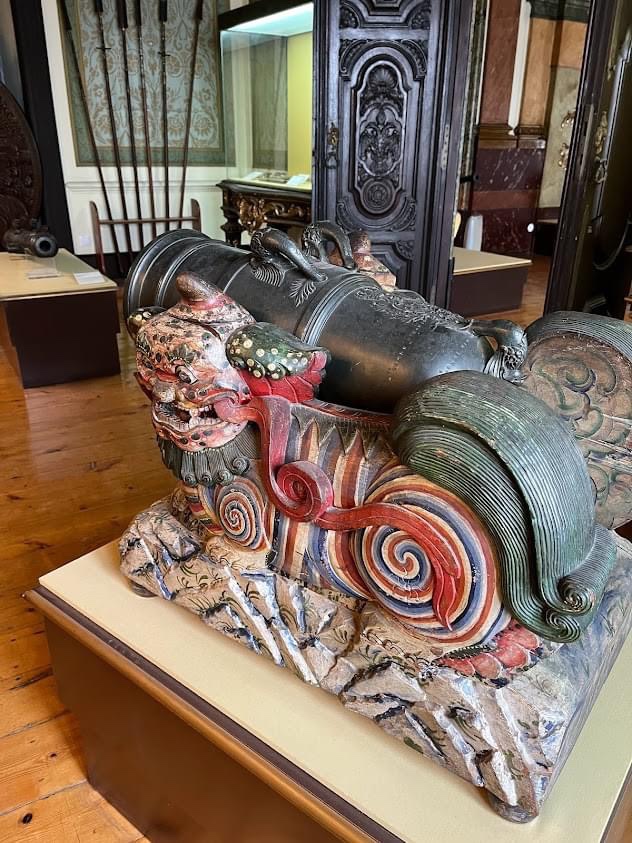
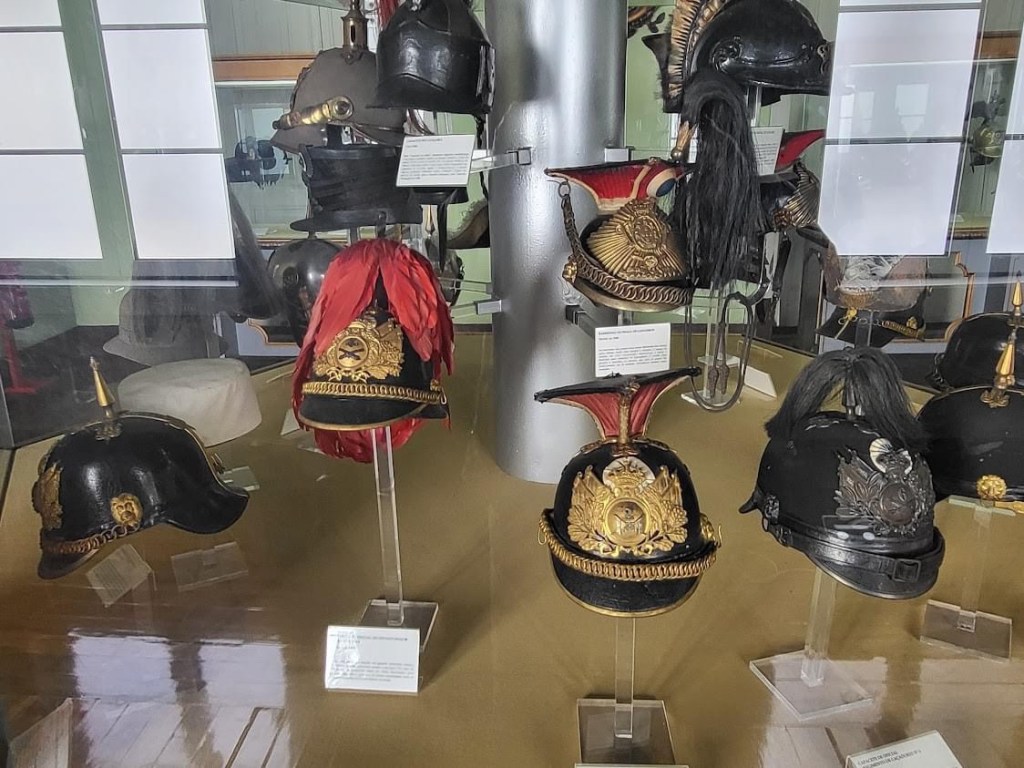
I shudder as I look at guns, knives, and cannons used to kill and maim. I giggle at the displays of hats and ribbons and medals. Warriors turn to peacocks. It is hard to look ferocious under a mass of feathers and horsehair. Big guns and even bigger medals are prevalent.
At days end, I reflect on the day. This morning I was surrounded by unimaginable beauty. Our afternoon was spent studying tools of destruction. The arc of history is strange. Nations taken by force become sources of wealth that pay for building projects that in turn create beauty. The grandeur of public art creates national pride. Nationalism in turn fuels more exploration and conflict. And so it goes…
I can’t help thinking of the beautiful places I have visited in Ukraine. Spectacular golden domes churches in Kiev juxtaposed with the images of the bombed out cities that I saw during lunch….friends in the line of fire…beautiful people in a beautiful city…..power and domination …..the fight for freedom…..and so it goes…
-
Of Castles and Cathedrals: Travel Goals

Today we set out to find a castle. Castelo Sao Jorge casts a shadow over Lisbon. It is only a few blocks from our apartment (supposedly). Yet we have been in town for several days and have yet to see its walls except from afar. And in those instances it seems very, very far away.
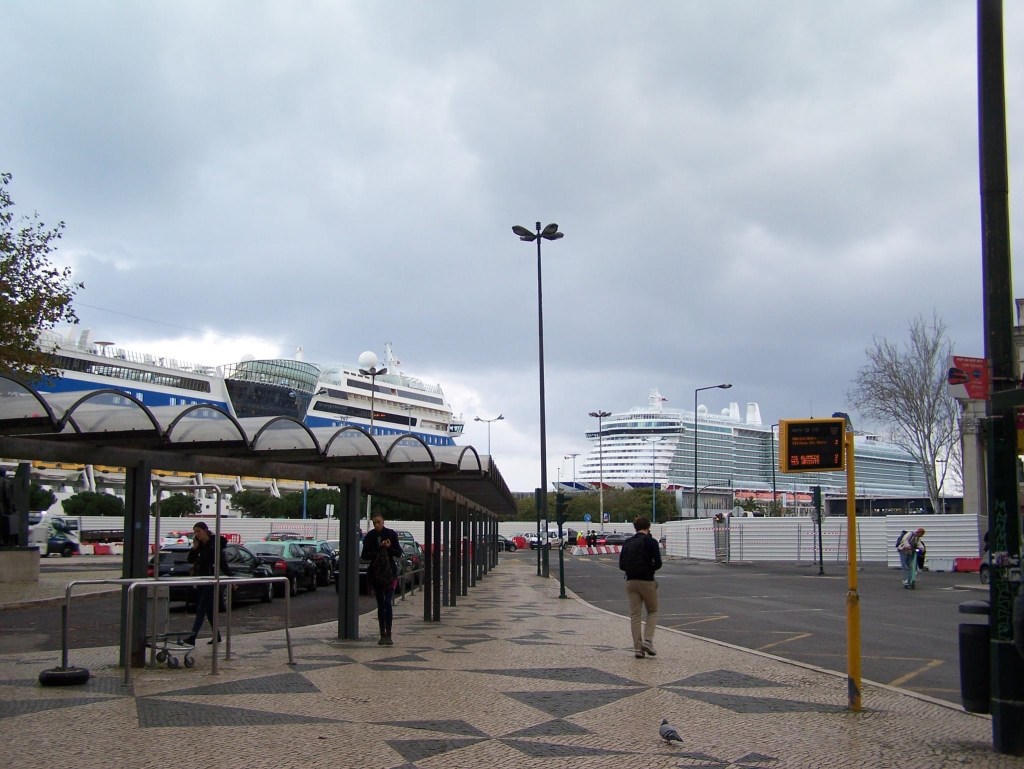
An alley leads us to a doggie daycare drop off. Another alley takes us up a hill past a bus stop labeled Castelo. We are here and I still can’t see a castle. We enter under an arch and find ourselves in a ticket office. Cruise ship people in front of us get out of line when they realize they have to buy a ticket. I’m not sure why you would travel halfway around the world and then balk at $5.00 but what do I know?
We enter the grounds and I still don’t see a castle. I see a lovely plaza. It has dazzling views in every direction and pine trees. There are statues and a cannon. We take photos and look for landmarks across the city. I find peacocks and Glenn finds an American college basketball fan. Both are entertaining in their own way. We wander through a tunnel and up some stairs….. I found the castle.

It is large. There is a dry moat and a large gate. There are wall walks and a keep. Guard stations along the battlements beckon. I try not to think about the number of steps required to circumnavigate the walls. They are there and must be conquered.

People have lived here since the 8th century B.C. There are archeological remains in every direction. Phoenician, Carthaginian, Roman, Moorish, Celtic, Goth…an international locale throughout its history. The castle was reclaimed by Christian knights in the 2nd crusade and became a seat of the Kings of Portugal. It was here that Vasco de Gama was received after his return from Portugal ( you didn’t really think I would leave him out?).

Apart from the beautiful ruins, there is not much left of the Castelo de Sao George. We take in the views and laze away the morning. As we descend the steep streets, we are stopped by an old man paid to encourage visitors to a local wine bar. He is talkative and wants me to understand that he was a young Casanova back in the day. He describes in some detail how he learned English and the effect he feels it had on American tourists. We make our escape before his story gets any worse.

Se cathedral beckons. Built in 1147, it is the oldest church in the city. We pay a small fee to visit the museum spaces and immediately have to climb several fights of stairs. Our knees are already numb from the Castelo, so it doesn’t phase us.
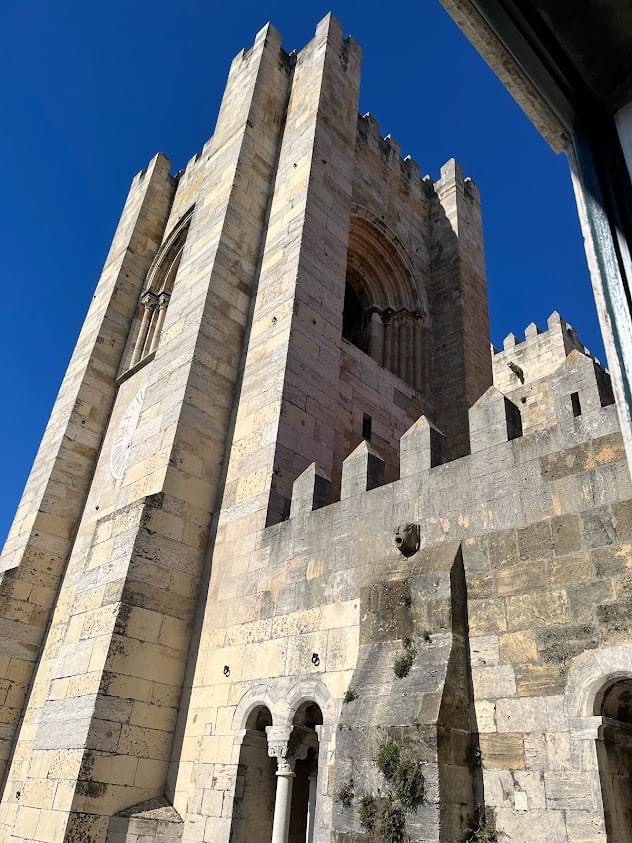
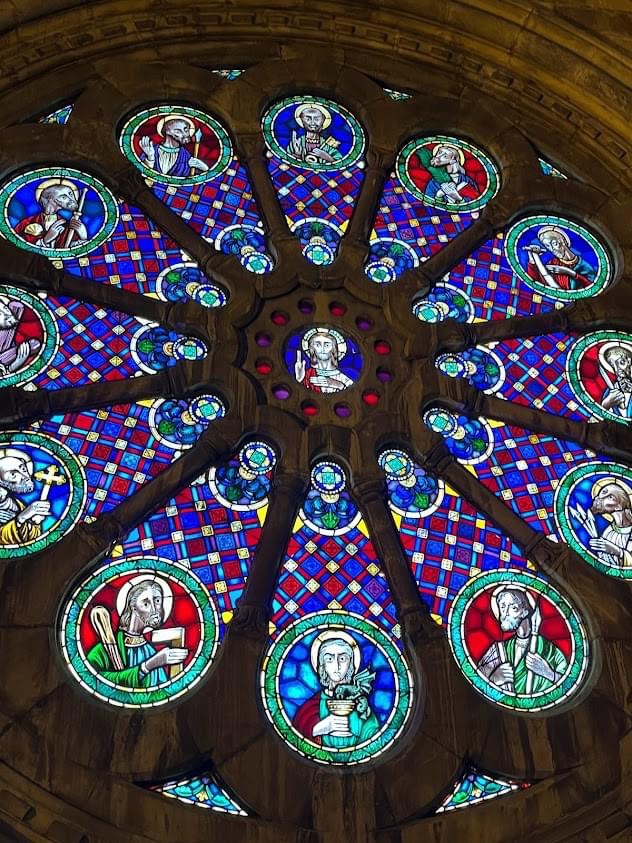
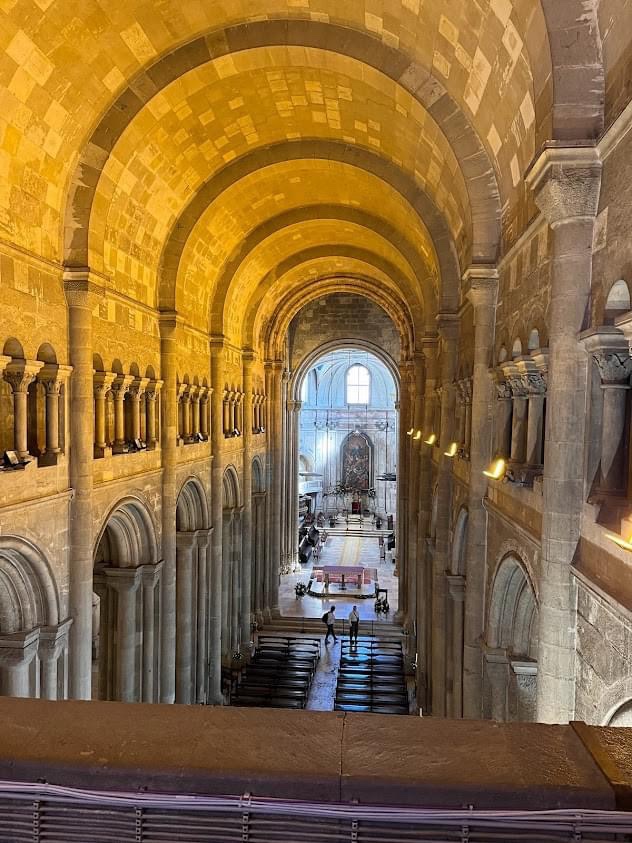
At the top of the stairs we are able to visit an outdoor balcony (where a bishop was tossed to his death for supposedly colluding with Spain). Once inside we encounter a spectacular rose window. Jesus and the apostles glimmer in brightly colored glass. We also get an aerial view of the interior of the church in all its glory.
We see thrones used by the Patriarch of Lisbon and relics of Saints. We wonder how many fingers St. Vincent actually had since every urn we have encountered across the city supposedly contains a knuckle.
There is silver aplenty. Candlesticks and reliquaries on endless display. The wealth locked away in these rooms is staggering and yet probably only a fraction of what was once here. Even as some sought to feed the poor, others in the Church amassed wealth and power. It is a dangerous thing when Church leaders confuse politics and religion.
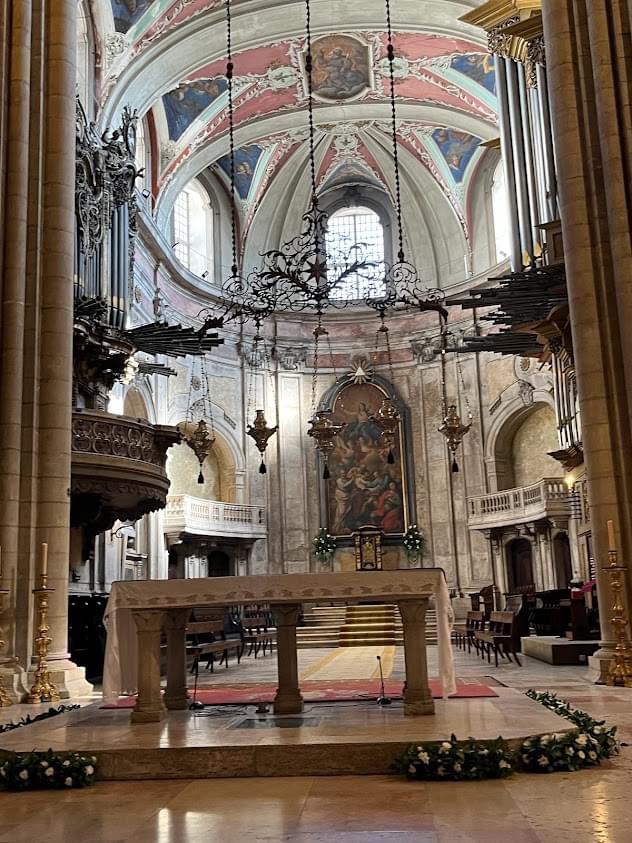
In spite of the questions about power and greed, I love these spaces. These massive cathedrals remind me that I am small in the presence of a beautiful and almighty God. I can feel the whisper of the Holy Spirit in the tranquil spaces and the echo of marble. The grandeur is inspiring. The silence is holy.
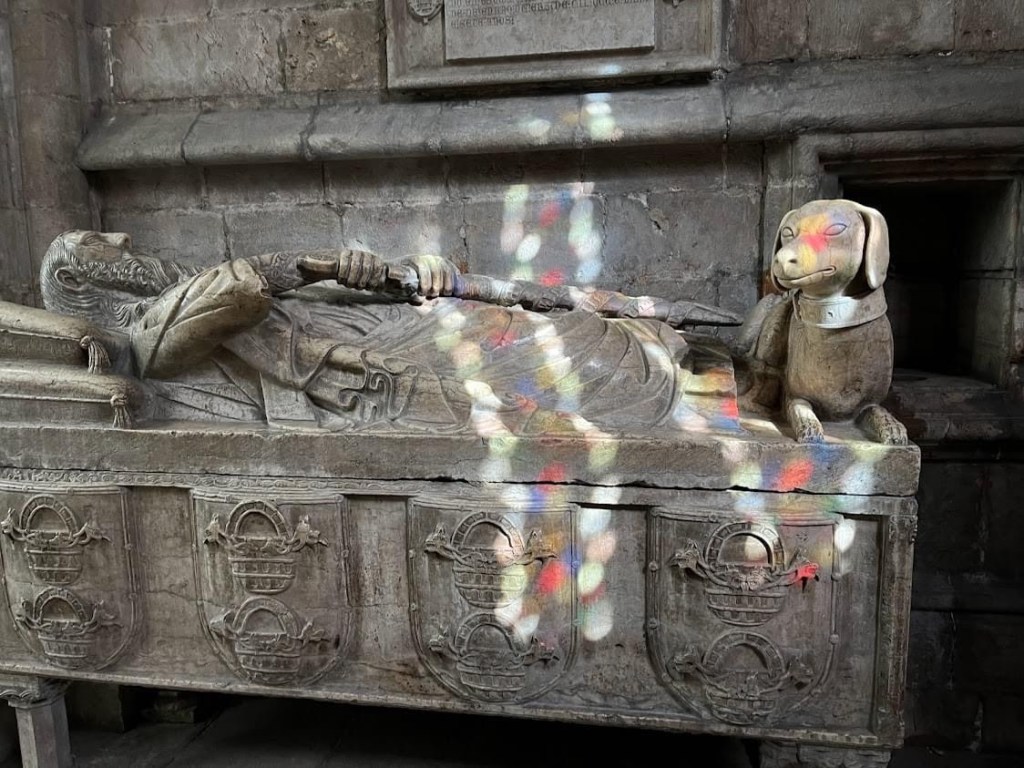
Each side chapel brings many questions. Who is the knight with the dog? Who is Saint Roche and why is he always baring his upper thigh? Why does Jesus look like such a creepy baby in all medieval art? St. Anne, St. Sebastian and St Vincent all make appearances. But the most beloved saint is clearly Saint Anthony, a local boy born just up the street.

We circle the altar and visit each side chapel and crypt. Near the door, we find a sacristy glittering with gold. Green silk robes and golden mitres await clergymen. In the main chapel, people pause in prayer. I fish some coins out of my bag to leave with the begging old woman I noticed on the way in. She smiles and I say a prayer to ask for God’s blessing on both of us. Castles and cathedrals from centuries ago have touched my imagination, but I am very thankful for my present reality.
-
Museum Overload: Travel Goals

Today we ride the metro for the first time. It is clean and bright. I wish for the millionth time that my city would embrace public transportation, but probably not in my lifetime. Midwesterner’s have a lifelong love affair with their automobiles that precludes discussion of public transportation options.
We exit the metro station into parts unknown and I have to turn on data to use the GPS in order to find the way to the Calouste Gulbenkian Museum, a private art collection. In typical Portuguese fashion, there are no signs designating an entrance. We in typical fashion, pick the wrong door. However, we are informed that if we want to see the special exhibit we can buy tickets at this entry. We buy tickets, mainly because we didn’t want to climb more stairs to find another entrance. Lisbon has carved itself into our hamstrings.
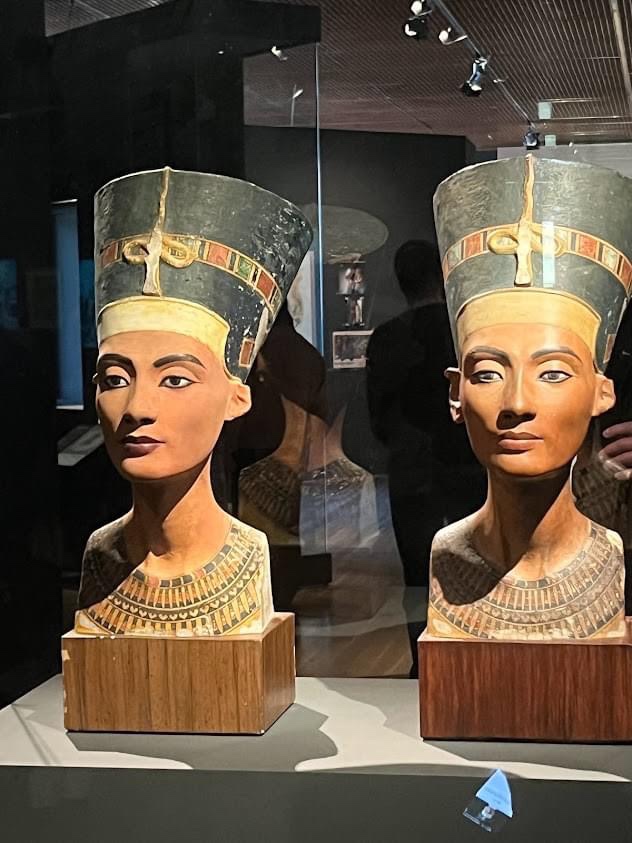
The special exhibit is about the effects of ancient Egypt on popular culture. It is art inspired by Egyptian art and kind of trippy. There are replicas of famous artifacts and art depicting scenes in Egypt. There are movies set in Egypt playing on the walls and statues in Egyptian themes. Scattered among the copies are actual ancient artifacts.
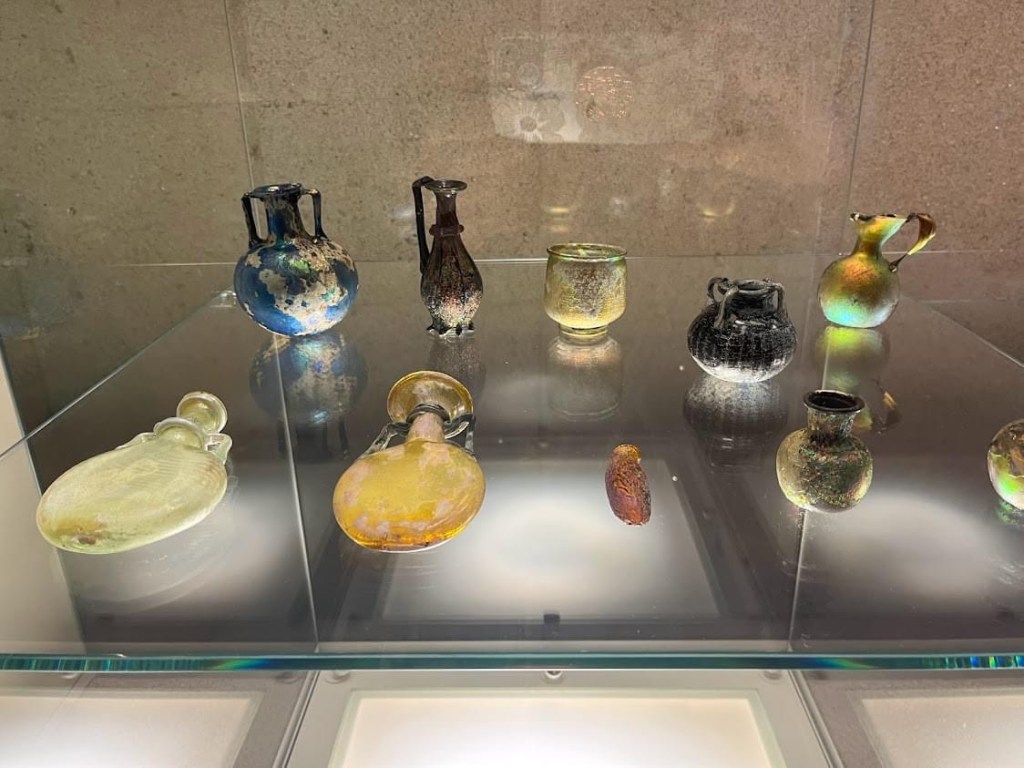
I am always a little dumbstruck when I encounter artifacts that are centuries old. I stare at Egyptian glassware that held makeup and ogle the jewelry of pharaoh’s. We like to pretend that modern life is so advanced. In all honesty, the more I encounter history, the more backwards my society seems. There is nothing we produce that doesn’t have an equally impressive historical counterpoint. Perhaps only communication and transportation are more advanced in the modern era.
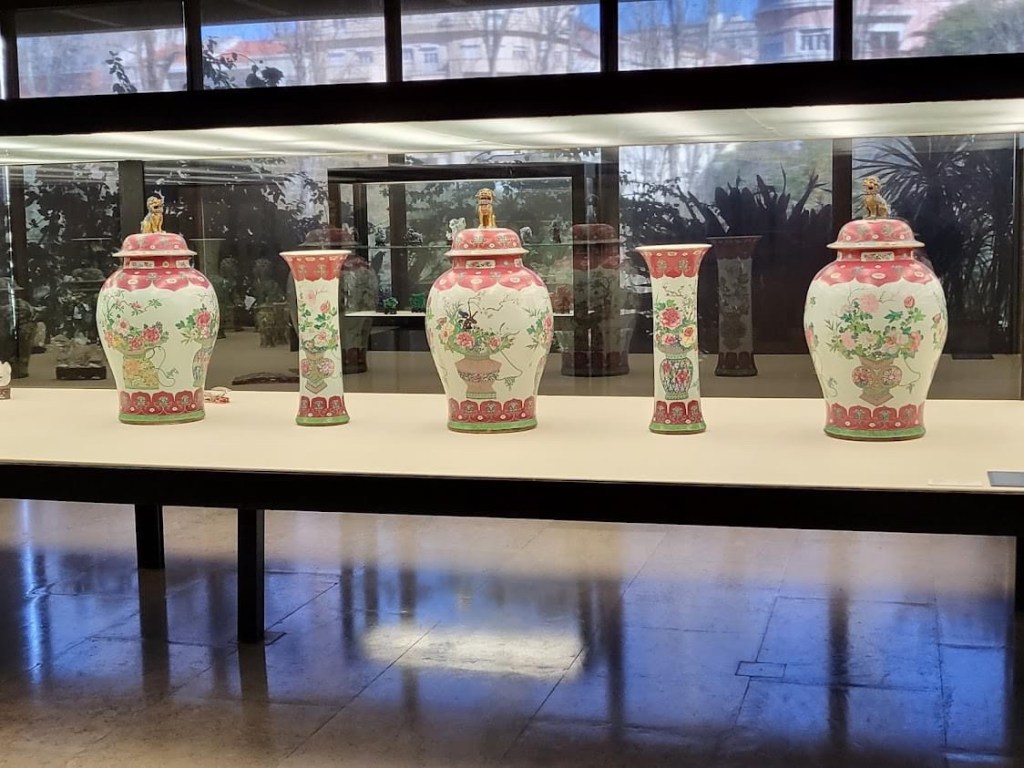
The main collections are full of Eastern artifacts. Persian carpets, Chinese porcelains, Arabic lamps . . . Here are items rare in the U.S. We try to appreciate them, but our lack of background makes it a bit harder to contextualize. I am a lifelong advocate of true “world” history as opposed to Western Civilization masquerading as world history and yet I find that I am struggling to contextualize what I am seeing. I am a product of an American collegiate experience where European history was the order of the day and everyone else an aside. There is so much I don’t know. I feel my ignorance in the Asian galleries.
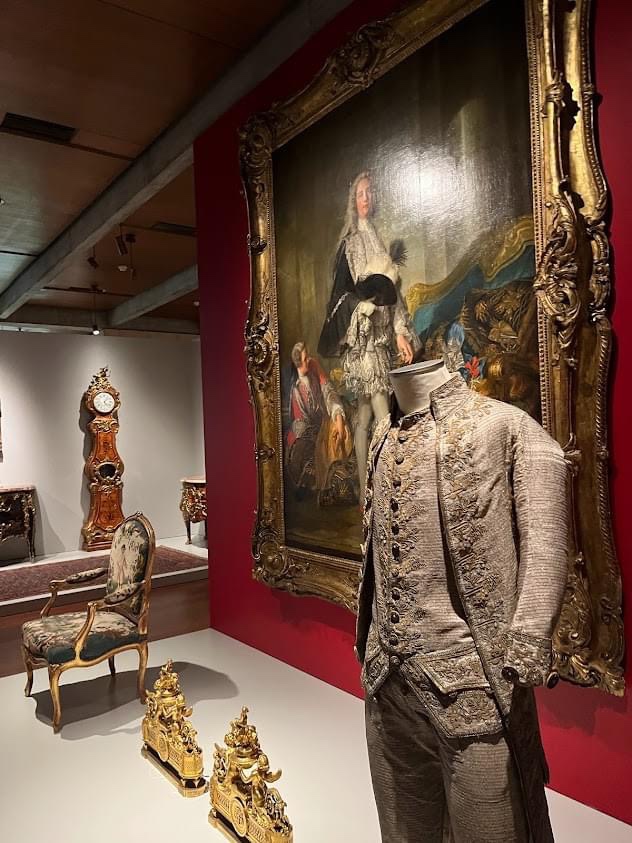
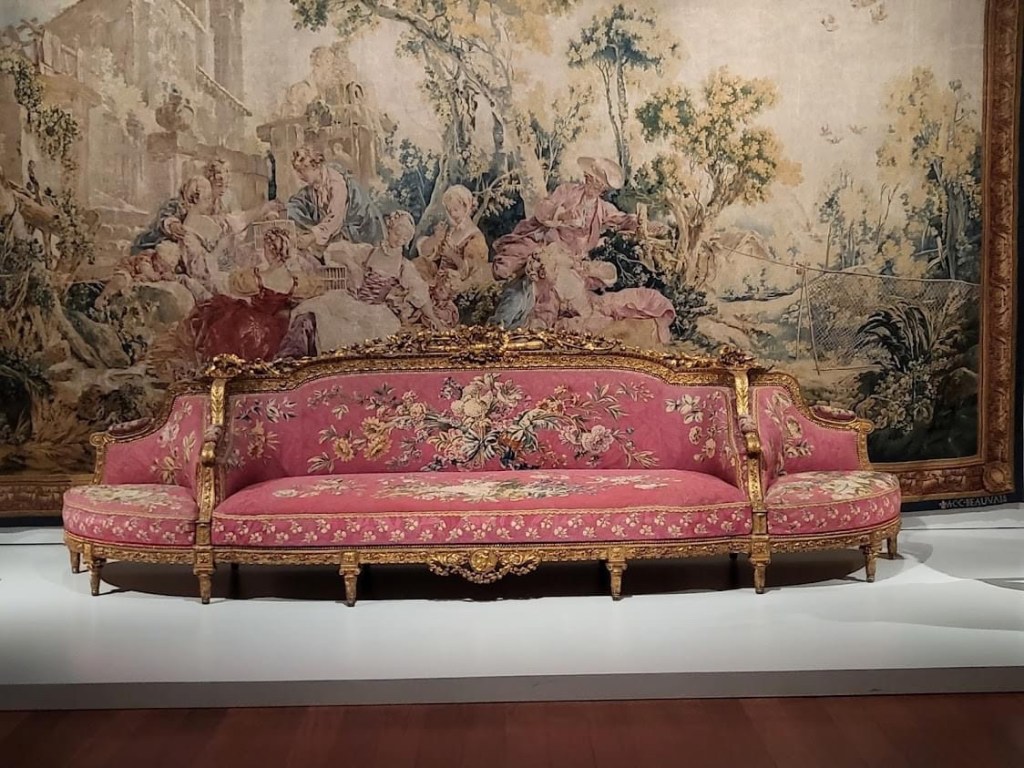
The next wing is 17th and 18th century French artifacts. My confidence level is high as I recognize the people, places, and furnishings more familiar. Clocks, chairs, tables, and chests occupy several rooms. The craftsmanship is exquisite. The items are priceless. We linger to admire time gone by.
We are hungry. As we walk toward another museum in the area, I notice “Ground Burger”. It promises American style burgers and fries. There is a 30 minute wait, but we climbed three flights of stairs to get here so we wait. The place is hectic with Portuguese families enjoying their Sunday afternoon. We enjoy watching others enjoy an Angus burger and American beer. We are clearly the only foreigners in the place. It is strange to be a tourist in an American burger joint where no one is speaking English. Isn’t traveling great?
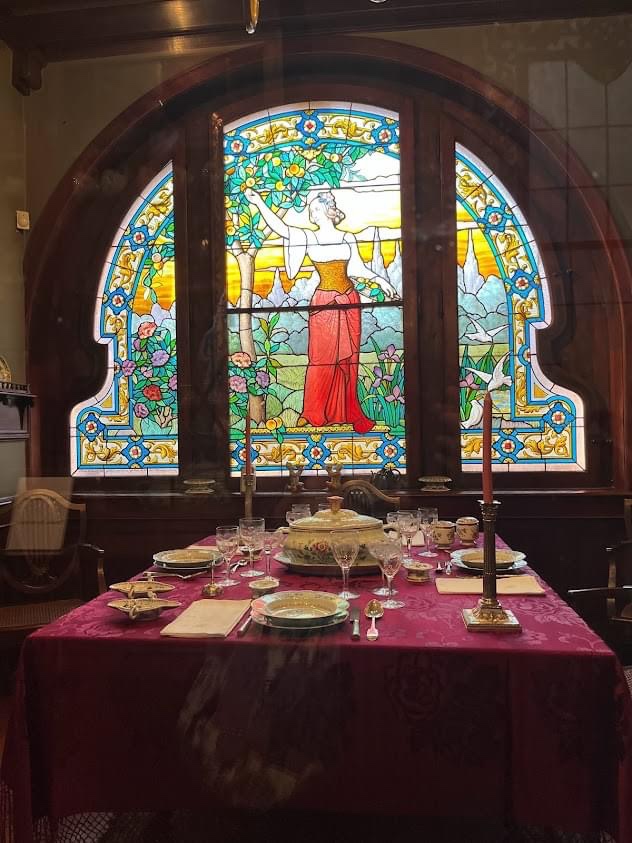
We have tickets to the Casa Anastacio Goncalves. This house is preserved in time even as the neighborhood has grown around it. As normal, the entrance selected by GPs is closed with no indication of where else to go. We wander around. A man beckons us inside and we present our tickets. Three people are gathered in the entryway. They do not respond to English but gesture us up the stairs. We proceed through the house. I read the signs in Portuguese and use google translate when I get stuck. An older woman follows us from room to room. It is starting to feel a little wierd. I smile and speak to her. She does not speak English. We are starting to feel like they don’t get many visitors.
On the next floor a man joins us. He is very talkative and wants to explain everything…every single painting and artifact. His English is broken, but he is expressive and animated. We find out that the owner was an ophthalmologist. He had collections and lots of art. We find out the history of each of the locations of each of the paintings. It takes a long time to hear about every aspect of every object. My back is starting to ache. It is hard to be annoyed. He is so sincere and kind. He is clearly happy to share something he loves. He returns our smiles and for our thanks he launches into an explanation of the pottery in the room. So many pots…
So many artifacts today. So many encounters and interpretations. Some were comfortable and familiar. Some were jarring or confusing. Even the familiar things (like burgers), I saw through a new lens. I am learning to take the time to look and listen, especially when I am uncomfortable and having trouble making connections. Sometimes painfully slow translations have the most promise. I think I accidentally learned that today from an incredibly kind docent who triggered a bout of museum overload. But we persevered, we connected. I now know that Lisboans love their beach communities, that the area around Sintra is no longer as rural as it once was, and that you should never use an ancient Chinese pot to house goldfish. I also learned that humans are so much richer for the many encounters with each other, and our collective past.
-
Patron Saints and National Heroes: Travel Goals

An afternoon visit to Sao Vicente seems to be a relaxing compliment to our morning visit to the market, so we trek back up the hill to the monastery. Tuk tuks line the area in front of the church and we carefully make our way to the entrance and pay the five euro fee. We are not sure what to expect. We step into an ancient cistern that collects rain water as a first stop before endless stairs.
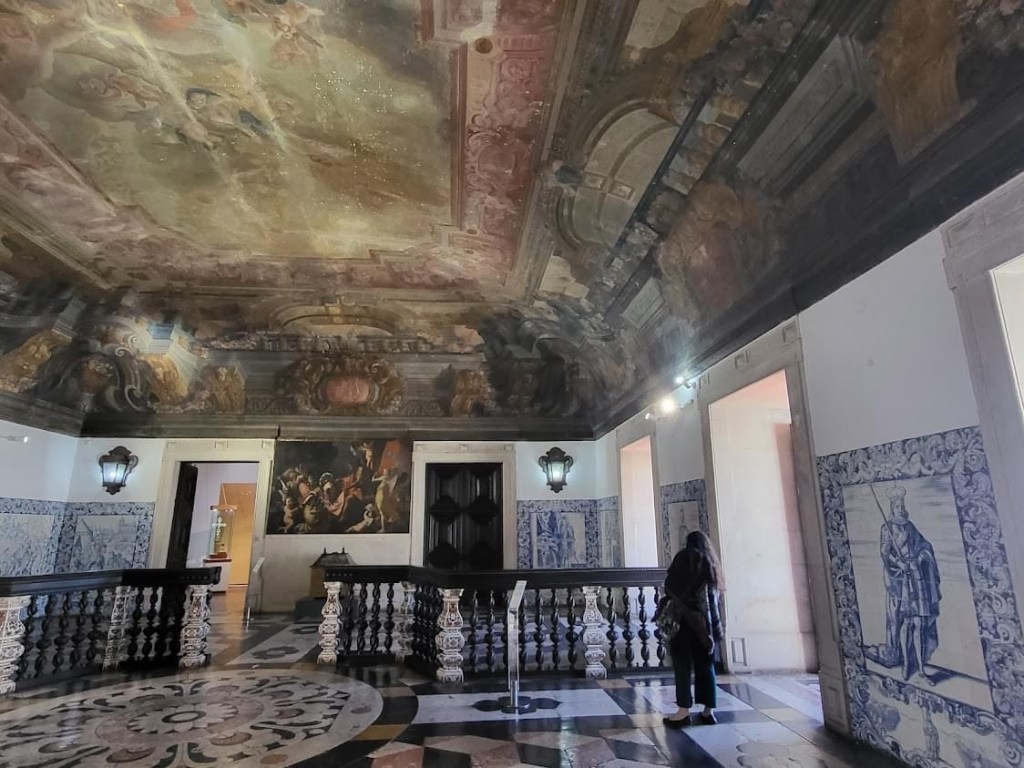
The entryway to the monastery is a thing of beauty. Ornate painted ceilings, mosaic floors, tile murals, and ceramic spindles compete for attention. I move slowly trying to take it all in. St. Vincent is the patron saint of Lisbon. I am told a monastery has been standing on this site since the 1100’s. You can feel the history in the room.

We stroll through simple inner courtyards and room after room displaying religious artifacts. All of the silver in Portugal must be in these endless cases. Each silver candlestick and crucifix is an overt display of wealth. We talk for a bit about the plight of the poor in an era when the church flaunted such wealth and power. The bishops of Lisbon clearly lived like a king.

When we enter the church, I am silenced. The archangels draw me to the altar. The side chapels have their own mysterious pull. A simple wooden carving of Christ catches my eye. It seems to say, ignore all the noise and come to me. So I do. I say a prayer of thanksgiving for my many blessings and I linger in the feeling of peace.
We visit the sacristy, where the priests dressed for services. It is awash in tile and paint. The ceiling is a work of art with the lamb of God looking down from above. We continue our slow progress through more rooms. We read about kings and queens, illegitimate children, power, and despair. There are centuries of history here in Sao Vincente de Fora/ St. Vincent Beyond the Walls; a monastery converted into a palace for the archbishops of Lisbon.
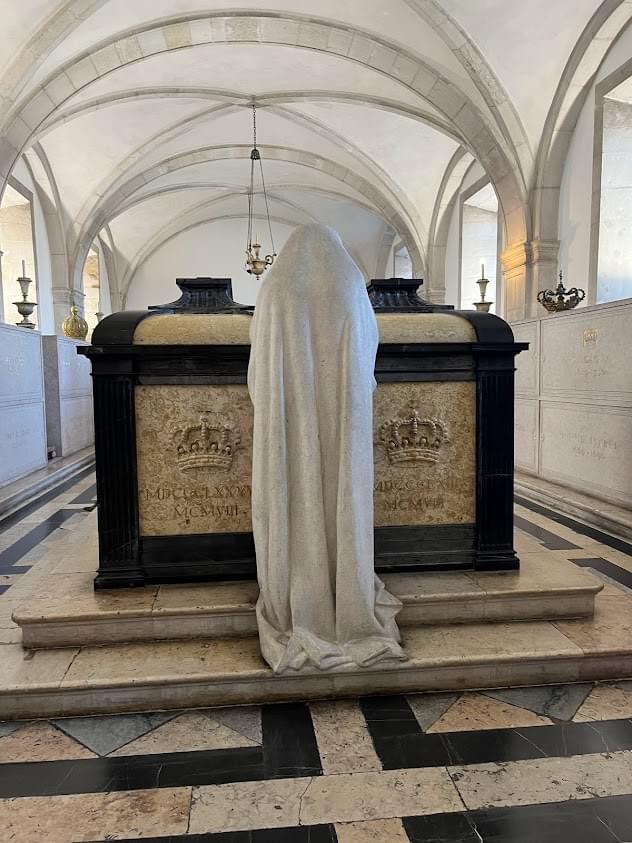
In what used to be the monks dining room, we encounter the tombs of the kings and queens of the house of Braganza. Symbols of crowns and scepters are everywhere. Marble mourners stand among the crypts. We wander the aisles unsure of the history of the Braganzas, but drawn by the imagery. Loud laughter seems out of place as a group of young girls bounce into the room. Sshhhh! Giggles and then they are gone.

Up stairs and down stairs, we trudge on. We walk through an entire floor of tiles that represent the French fables of La Fontaine. The tiles are beautiful. Panels display the accompanying fables. They are strange and dark. Perhaps they suffer from translation to Portuguese and then to English. I keep reading trying to figure out why the fables are popular. The tales do not improve as we go along, so we make an escape to the roof.
From the rooftop, Alfama lies at our feet. We peek into inner courtyards. My husband points out our apartment building and other sights along our street. I can see Graca and Santa Apalonia Station. The Vasco de Gama bridge is visible in the estuary. The most prominent building is the Panteao National. It stands like a fortress against the backdrop of sea and sky. We determine to visit as soon as we can bring ourselves to leave the rooftop and the sun. Eventually we make our way down endless steps and through additional courtyards to the exit. Sao Vicente is surprising and so much more than it appeared.
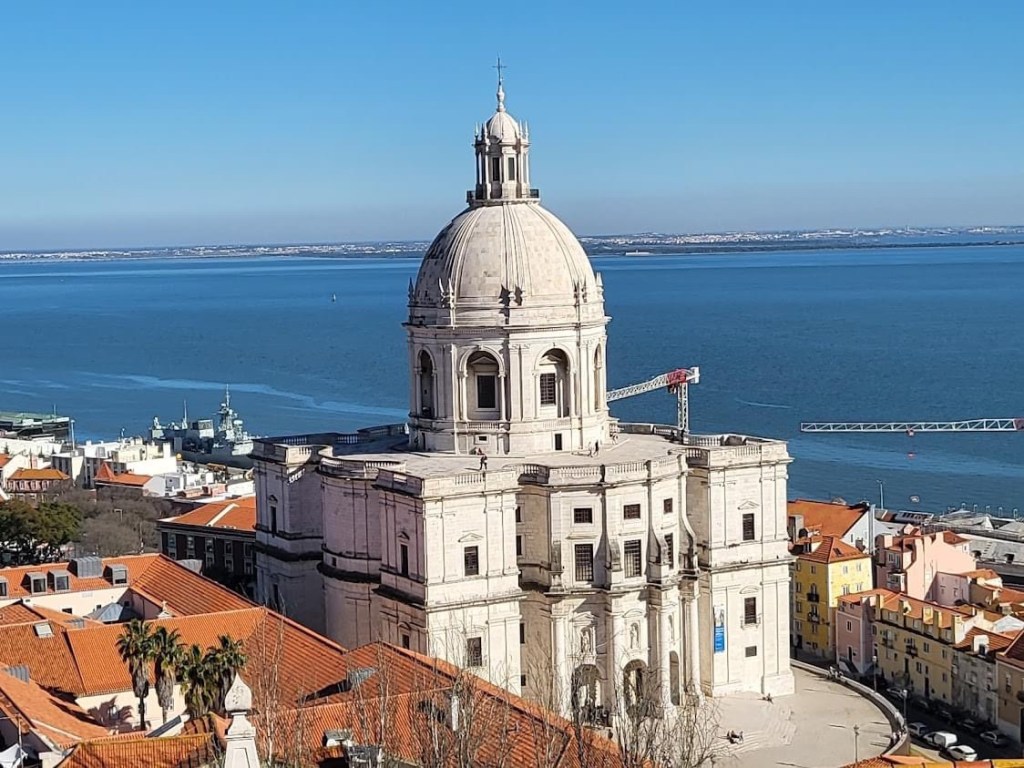
We rest for a moment in the courtyard before the massive national pantheon and watch the vendor selling drinks in pineapples. Children run and play. I find myself wishing that we had courtyards and pineapple carts at home. Everything feels so alive and vibrant.

Eventually we wander into the building. I tell the attendant that I want to purchase the multi-museum pass. She panics and says that it is for museums that are far away. I smile and ask for the multi-museum pass again. She says that we ldon’t have time to see them all. I ask how long they are valid. She says one month. I smile and ask for the multi-museum pass. She shrugs and goes to get someone to show her how to produce the tickets. Meanwhile we look around the inside of the Pantheon.
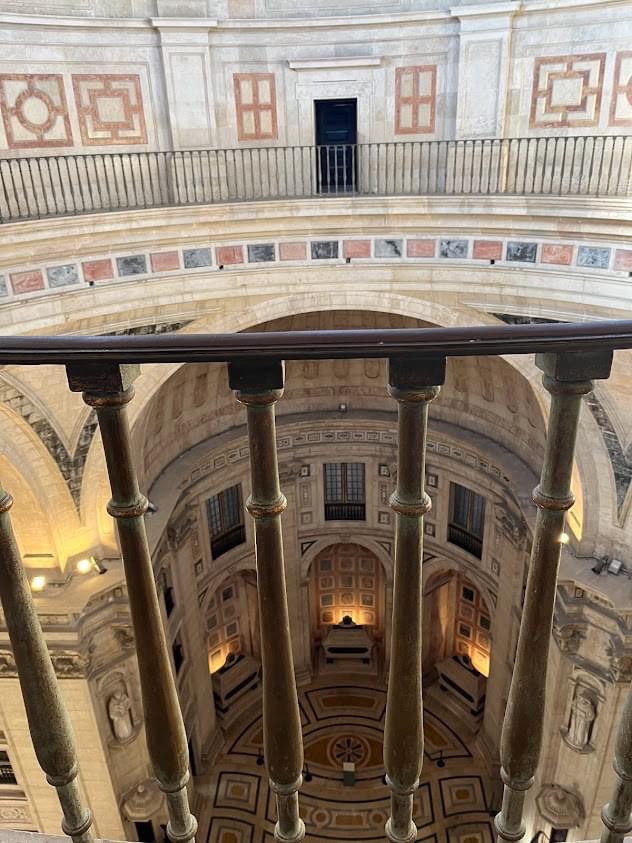
It feels like we are in a Dan Brown novel. Enormous domes overhead intersect with hidden nooks and crannies filled with tombs. Some are actually tombs and others are only empty shells. Presidents, futbol stars, singers, writers…Portuguese hero’s laid to rest in a place of honor. We climb hundreds of stairs to reach the roof. I walk around the inner dome and take a selfie looking down. It makes me dizzy and I back against the wall. It really is a long way down. Hundreds of more stairs headed down to ground level being us to Vasco de Gama. He isn’t really here. He is buried in Belem, but there could not be a National Pantheon without him. So a fake crypt ensures that de Gama takes his place in the hall of heroes. We pay our respects to de Gama again and exit.

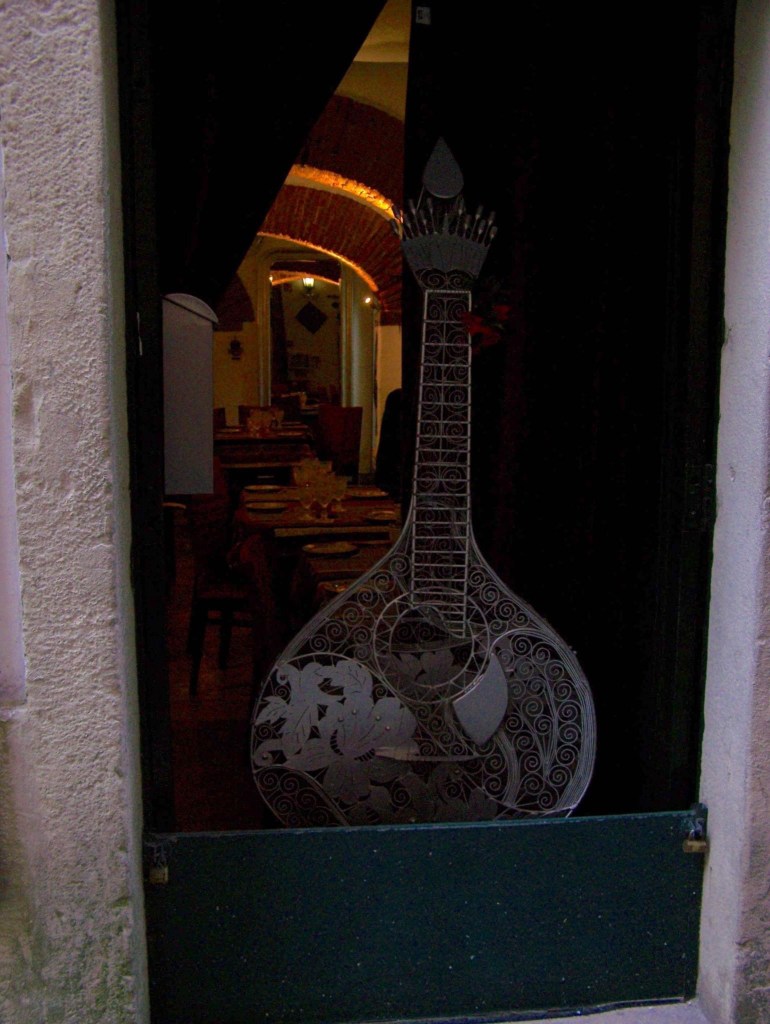
We venture back into the streets of Alfama. Uphill sidewalks seem impossibly steep after the countless stairs we have climbed, but we press on. We find a quiet courtyard to sit and have an appetizer. As we sit we hear music drifting through the neighborhood. Fado, haunting and sweet. I look to my right and notice mannequins line the balconies of the building. A closer look, reveals an outdoor restaurant has appeared. Tables and umbrellas are set in what had been an empty courtyard earlier in the day. Night falls and we sit down at a table under the lights and umbrellas.
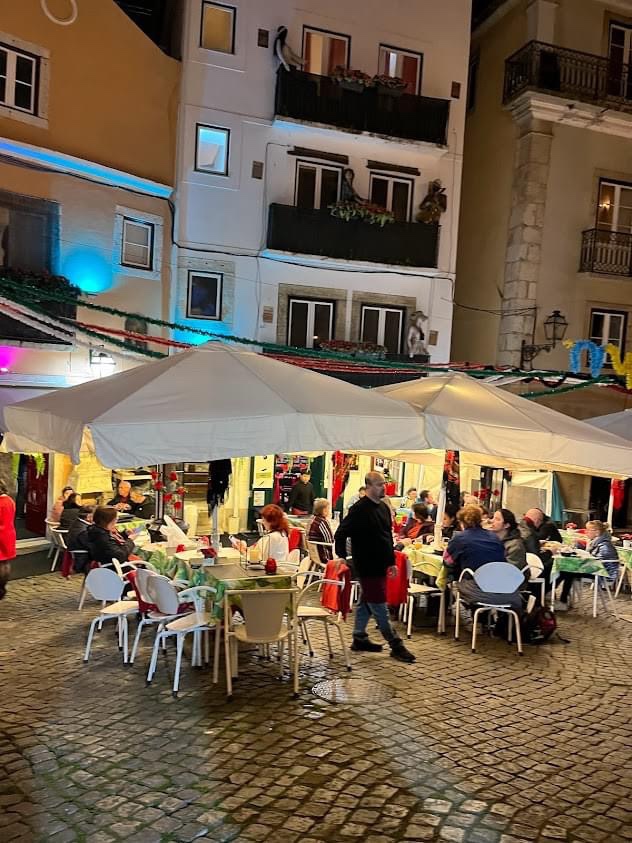
I order fish and green Sangria. Various family members take turns singing Fado. Furious guitar accompanies strong alto and baritone. Generations play and sing together. I am tired, but I don’t want to leave. I am full, but try the biscuit cake anyway. I have earned it. Besides, I know that I still have several hills and stairs to climb in order to reach my bed. Every street in Alfama is uphill at some point.

-
Inside the Fiera da Ladro or How We Make Out Like A Bandit at the Thieves Market: Travel Goals

It is Saturday morning and we make a slow start. We wander up the hill toward Sao Vicente da Fora and immediately notice an increase in pedestrian traffic. Every seems to converging in the alley that flanks the monastery. Trying hard not to be flattened by the endless parade of tuk tuks, we follow the people through the alley and under the arch.
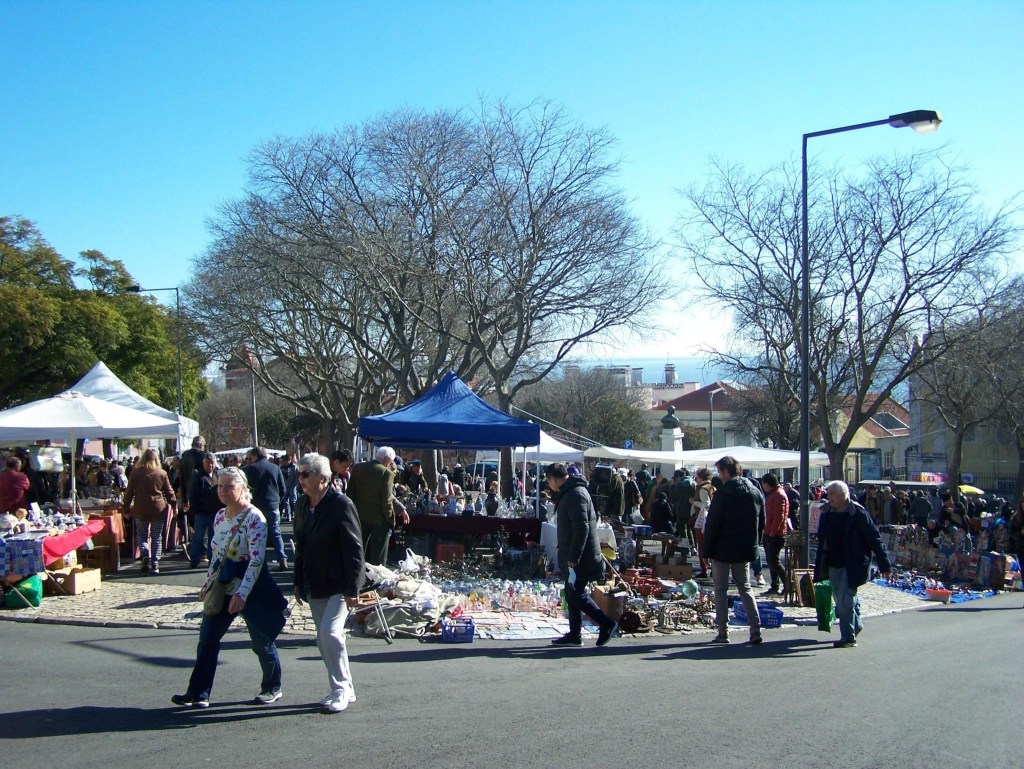
I am not prepared. I have visited flea markets my whole life. Countless Saturday’s following my grandparents through aisles of junk should have made me ready. Multiple encounters in European markets should have me in shape. But nothing can prepare you for the Fiera da Ladra. The thieves market is massive. It stretches over many blocks and parks. It takes over streets and sidewalks. People use buildings, tents, and blankets on the ground to hawk their wares.
I am immediately drawn to the myriad of stalls selling tourist goods. Cork purses, tea towels with sardines, brightly painted roosters, and endless painted tiles. Locals push past to the heart of the market where used clothing and household goods are up for grabs. They jostle, push and dig through boxes hoping for the best bargain. Less rushed are the antiques stalls, where leisurely negotiations sound like a conversation between friends. Underwear and socks are available from bulk wholesalers. Handmade shoes beckon. Bread and cheese straight from the farm is ours for the taking.
We wander in circles, unsure how to plot a course to cover as much ground as possible. Just when we think we have a plan, we find entire buildings of more stalls. I buy wool hiking socks, three pairs for five euro. I ogle the tourist goods, but we have just arrived and I have a month to decide what I most want. I control my urges to spend, spend, spend. So many beautiful things that will never fit in our suitcase. I find designer jeans for 50 cents. My day is getting better and better.
Fatigue sets in as we wander through the crafts section. Artisans beckon with jewelry and clothing and paintings. I make a bee line to the bread. Older woman at their booths who seemingly only speak Portuguese apparently have a sacred agreement that “ten euro” is the correct answer to every inquiry about cost that is spoken in English. Farmers are funny and friendly as they showcase their cheese. They offer free samples of sausage and bedazzle me with homemade pastries.
As we leave the market with fresh bread, cheese, and half of a new wardrobe, I find I am smiling. We met some interesting people today and saw a side of local life that reminded me of my own childhood. Best of all, I am the proud owner of a Malasadas or horse hoof. It is pastry stuffed with nuts and jam. According to my farmer friends, I have selected an authentic Portuguese dessert. I can’t wait to get back to the apartment for lunch. Now, if I can only manage to not get run over by a tram or a tuk tuk on the way home; a feast awaits.
-
Journey to Belem: Travel Goals
The journey to Belem, the birthplace of Portuguese exploration, begins with a little exploration of our own. The walk through Alfama had fewer mistakes and backtracks than our walk yesterday. We celebrate our progress. It is now time to conquer the bus system. We look for the 728 bus stop and with some assistance from a local are able to find the boarding area. Unlike the tram, the bus is spacious, clean, and comfortable. The ride is short and I am captivated by the riverfront parks along the way.

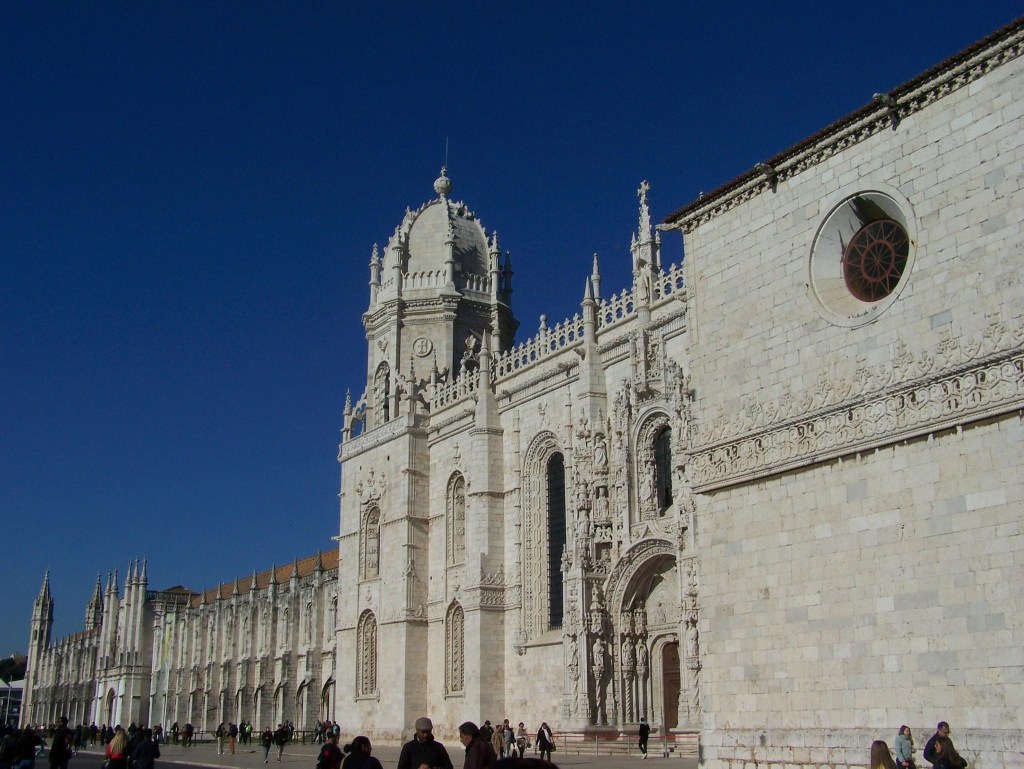
We are deposited just steps away from the Monsteiro Jeronimos, a massive monastery built in the early 1500’s. It is on the site where the Templar knights assisted the seafarers and near the docks where the explorers started their journeys into the unknown. There is already a line forming for entry. We run the gauntlet of people trying to sell us sunglasses and cheap jewelry as we try to figure out where to go. Eventually we are told that we have to walk down the block to buy tickets before we can get in line.

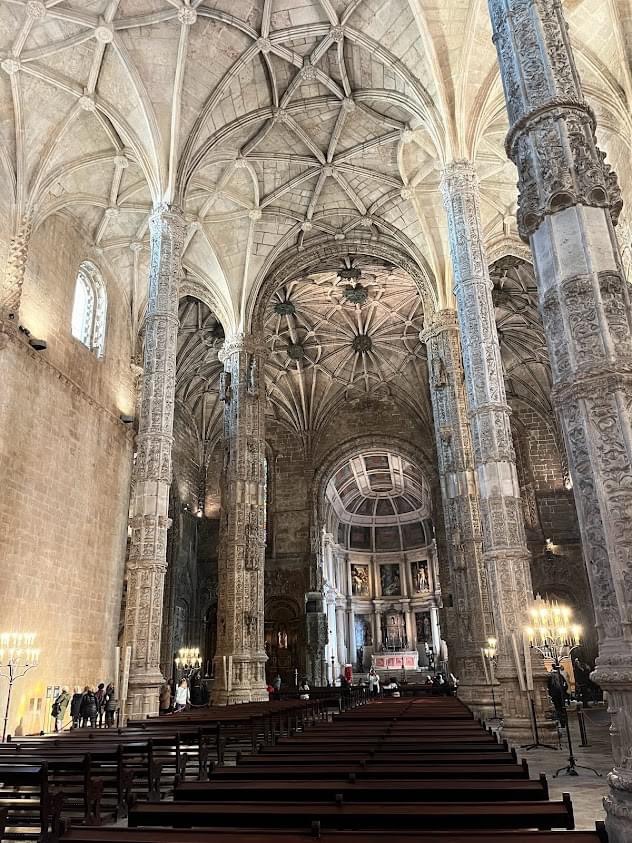
Tickets in hand, we wait. I ogle the intricate stone carvings. I learn that they are done in the Portuguese Manueline style. Once inside I feel as if I am in another time. The stones are cool beneath my feet. It is peaceful and calm. The tile work takes my breath away. Scenes from the Bible painted on endless tiles in blue and yellow and green fill up entire rooms. I take way to many pictures. I am reluctant to leave.

I am lured away by the promise of the Santa Maria chapel, the main church at the monastery. We wait in another line for our turn to enter. The soaring ceilings take my breath away. As we enter, I am drawn to the crypt of Luis Camoes a Portuguese poet. The large stained glass window casts prism of colorful light. As we approach the altar, I see the tombs of Kings and Queens resting on marble elephants. I sit for a minute and say a prayer, connected to the many who have worshipped here. I take a quick look in the sacristy where medieval art is on display.
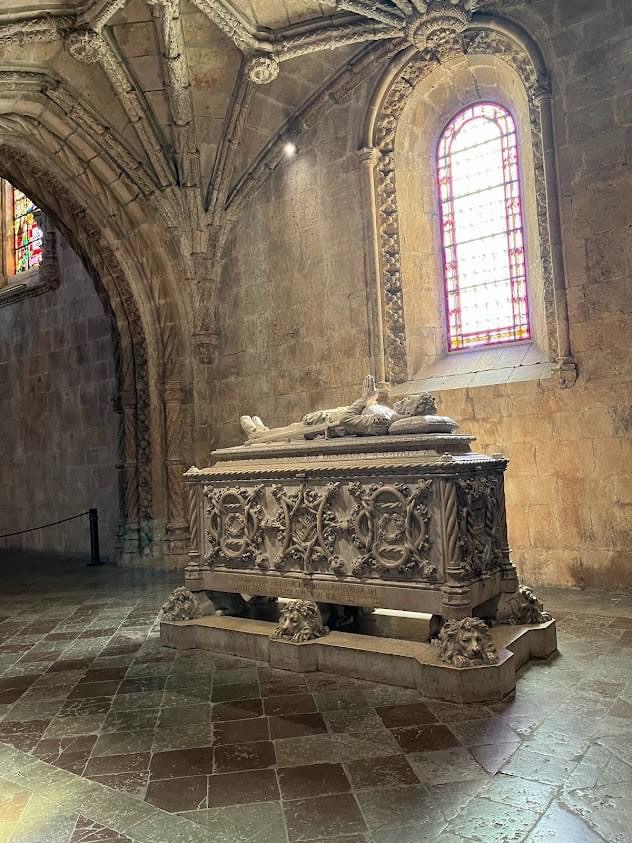
On the way out, we find the final resting place of Vasco de Gama. It may be our first de Gama sighting, but will not be our last. The national hero lies in state as a marble effigy. His spirit is alive and well throughout the nation in pictures and statues and verse.
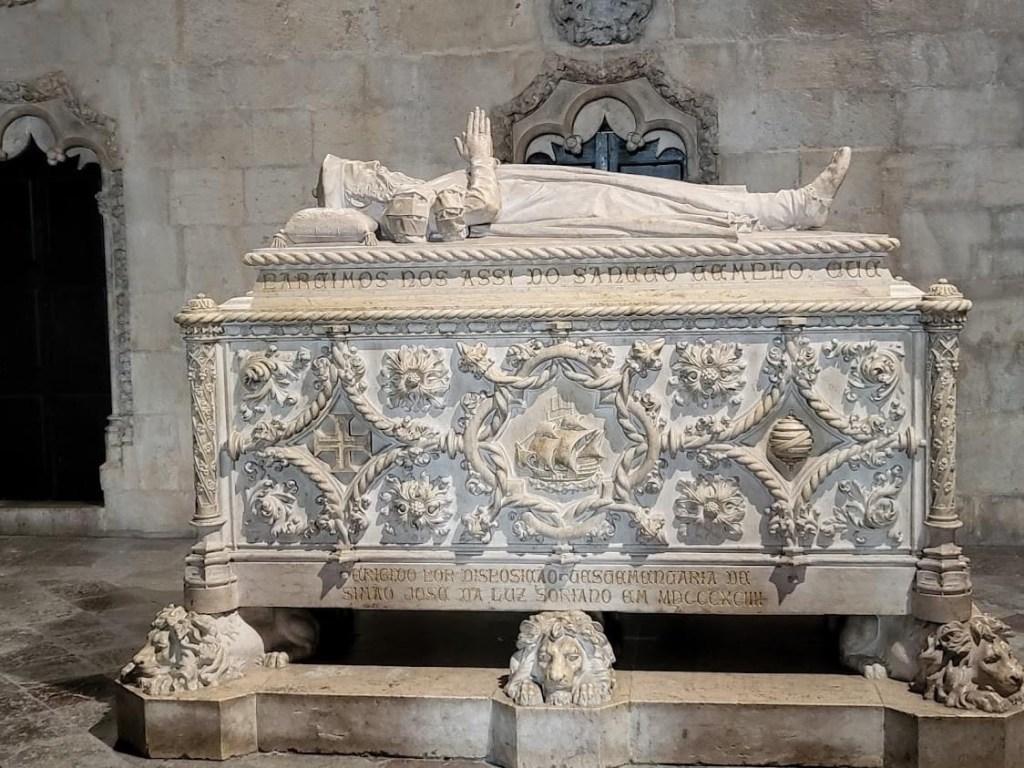
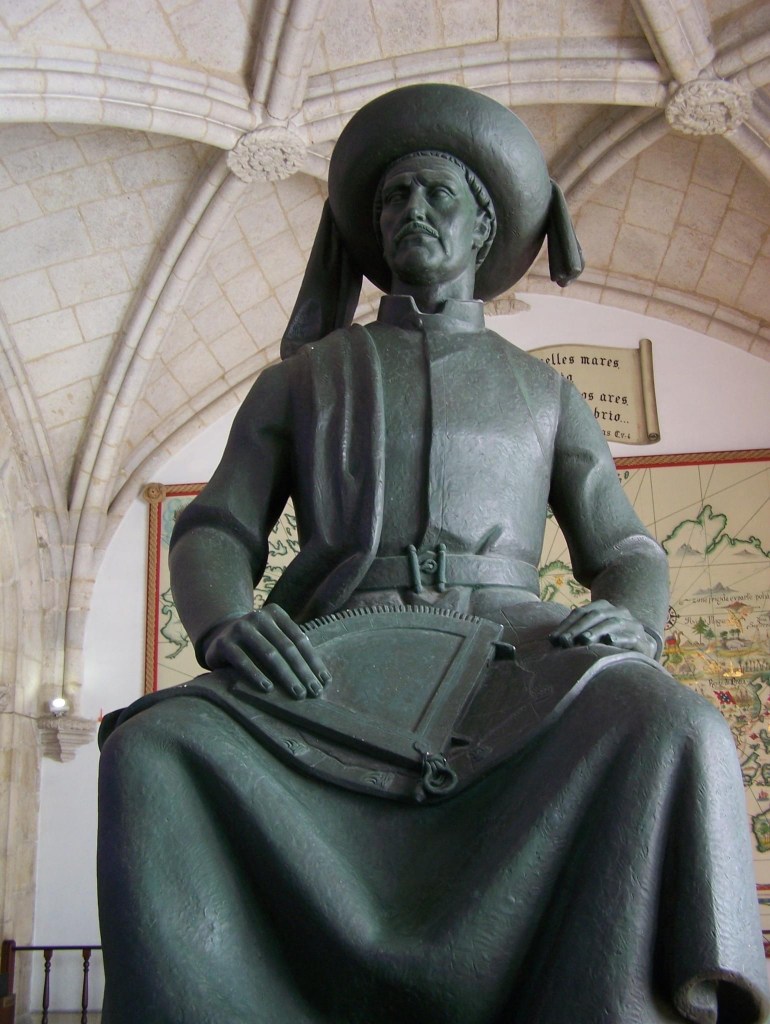
After paying homage to Portugal’s great explorer, we walk down the street to the end of the monastery walls to enter the National Maritime museum. At the entrance we are greeted by an enormous statue of Henry the navigator. He is surrounded by countless explorers that sailed for glory of God and country.
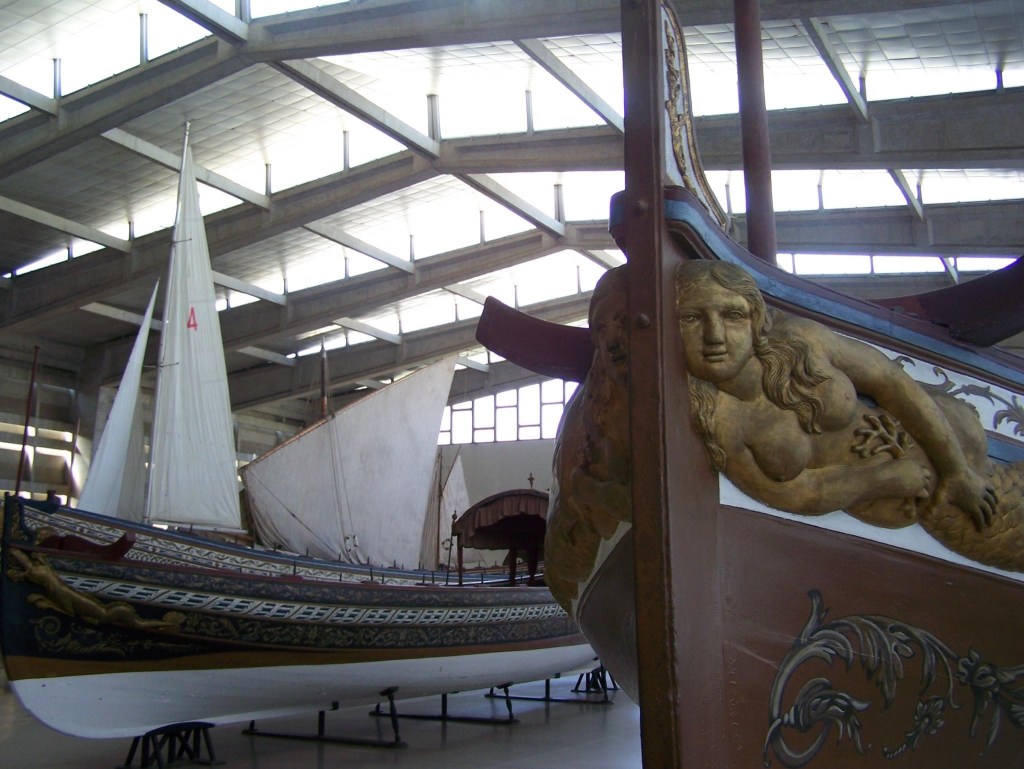
The museum is a sprawling collection of all things naval. Astrolabes and sextants from early ships. The wooden statue of the archangel Raphael taken from de Gama’s ship. Cartographers maps. Model ships. There is a large gallery for the Portuguese navy and another for the marines. You can explore the cabin of the kings yacht and early fishing boats. We wander in and out of galleries. The history is fascinating. After a quick walk across the courtyard we enter a large hangar filled with royal barges. I try to imagine life as it was when the King and his court would be rowed into Lisbon.
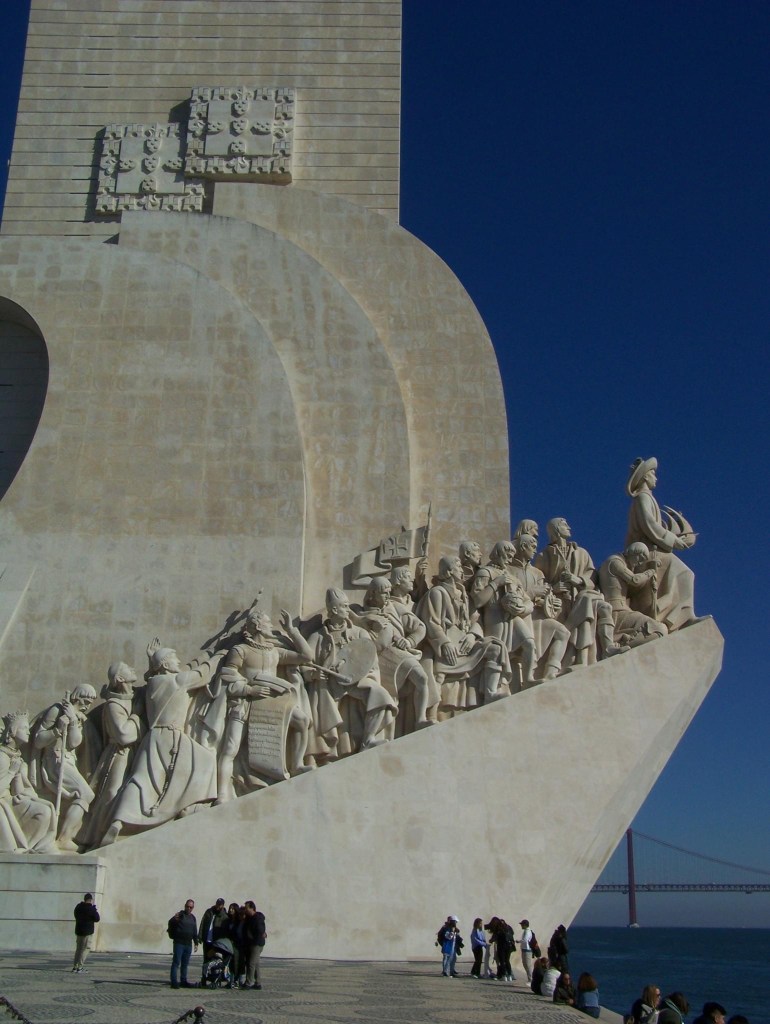
But we are hungry and it is already early afternoon so we walk toward the Docas de Belem. The waterfront is close, but how to get there? The garden is fenced off. The train tracks cut off any possibility of crossing the street. We walk back and forth for awhile until we notice stairs leading underground. A tunnel takes us under the trains and the highway. Suddenly Pedroas dos Decembrimentos looms ahead. The monument to the explorers is inspiring in size and detail. Prince Henry leads the navigators who changed the world. We circle the dock, trying not to be run over by electric scooters and bicycles. We eat lunch at the dockside restaurant and plan our return to Alfama.
After the bus ride home, we decide to search for icecream. The five minute walk turns to ten as we walk up the steepest hill yet. But we are rewarded with Graca park. The park is lovely with children playing futbol and musicians strumming Fado. Mouriscos restaurant has set up chairs on the plaza and we order Sangria Branca. The citrus is crisp and refreshing. The music is mesmerizing. This is how life should be lived. Peaceful and slow.
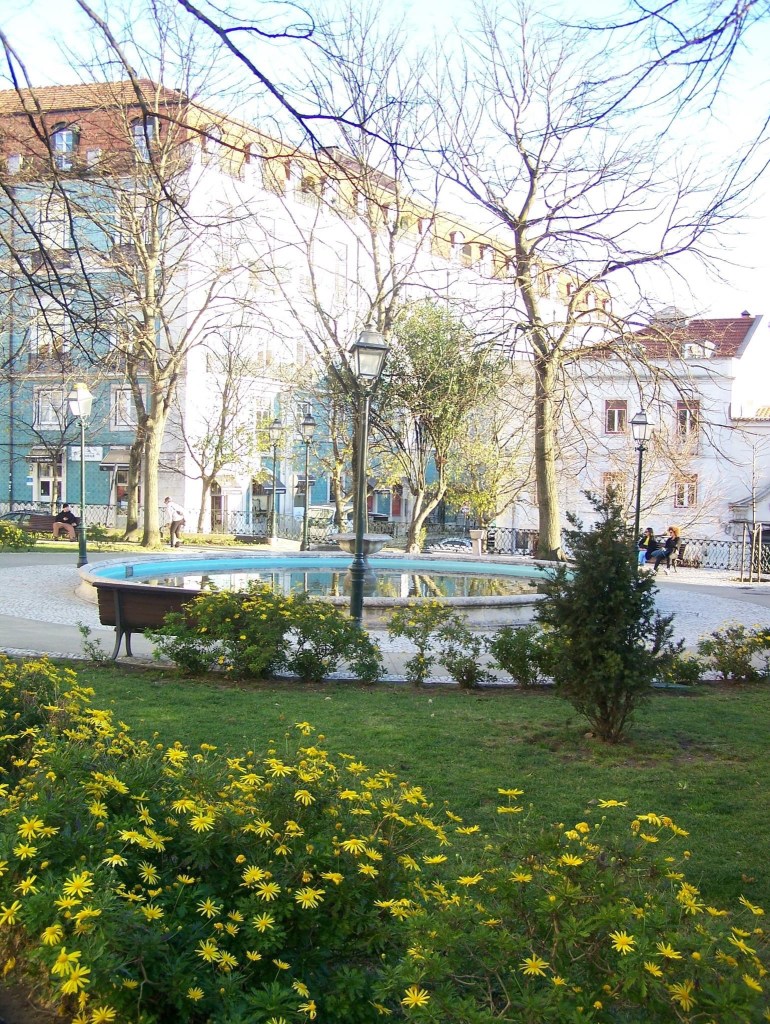

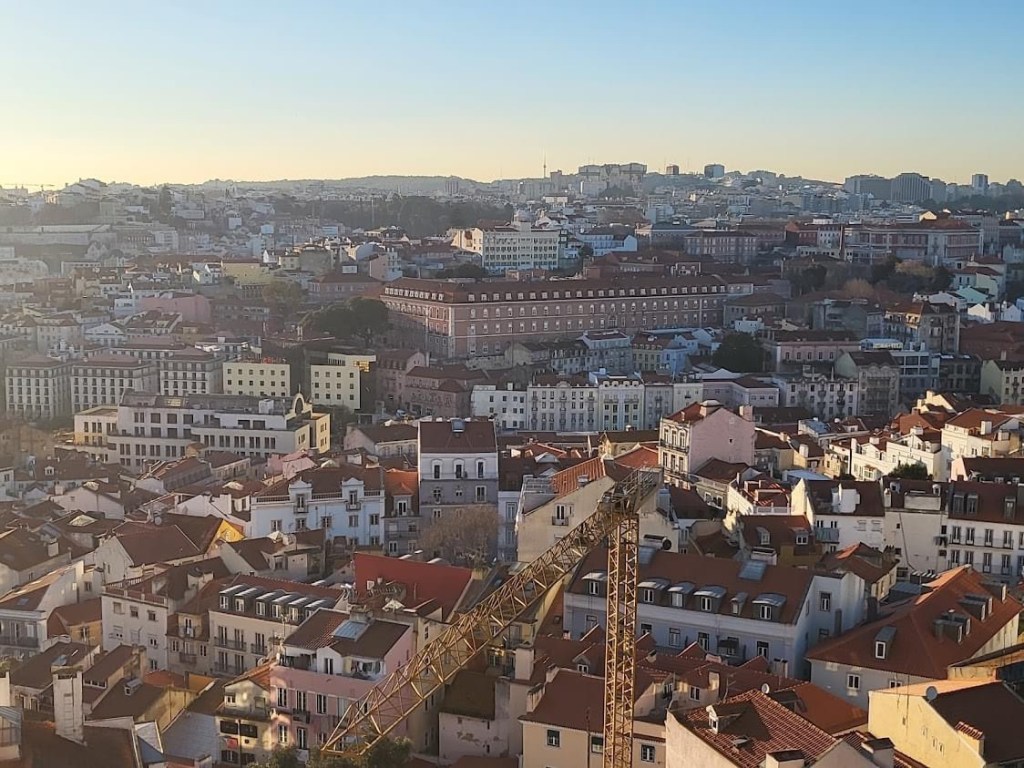
At sunset we walk over to the miradouro and take in the aerial view of Lisbon. I squeeze the hand of the one I love and feel that everything is right in my world.
-
Subscribe
Subscribed
Already have a WordPress.com account? Log in now.
 Prisoner of Hopes