-
Saguaro Shut Down: Rural Road Trips
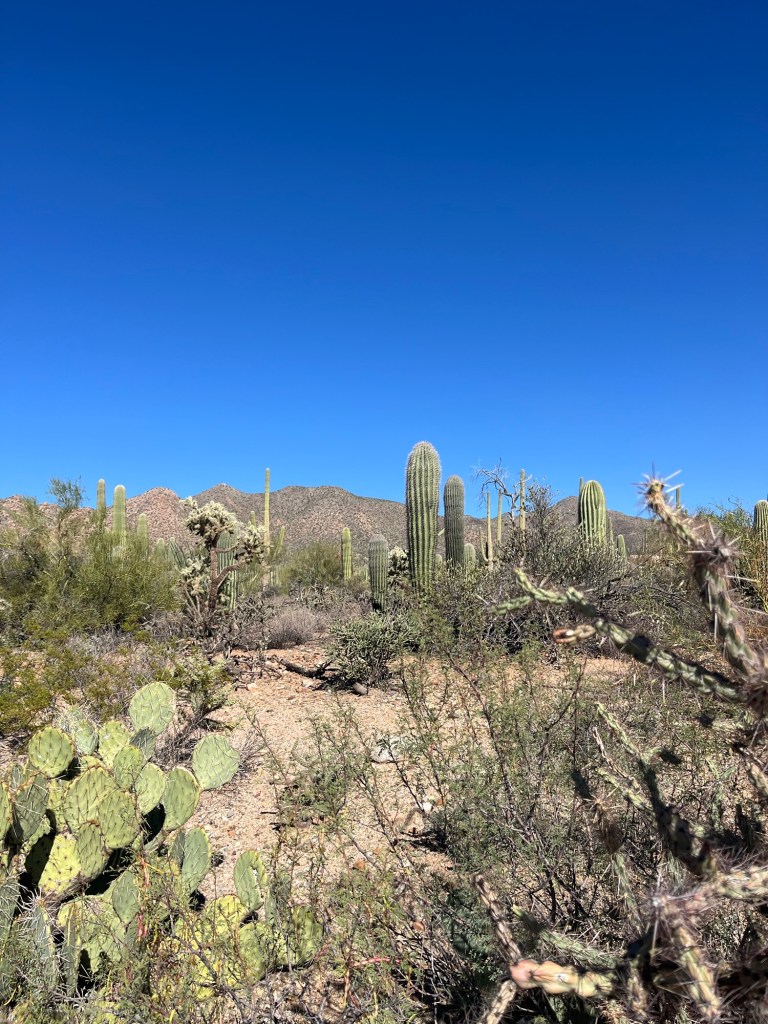
During the latest government shut down, we find ourselves in Tucson. We had hoped to make this a national park trip, but many of our lesser known destination parks have been closed. So with a bit of apprehension we drive across town to Saguaro National Park.
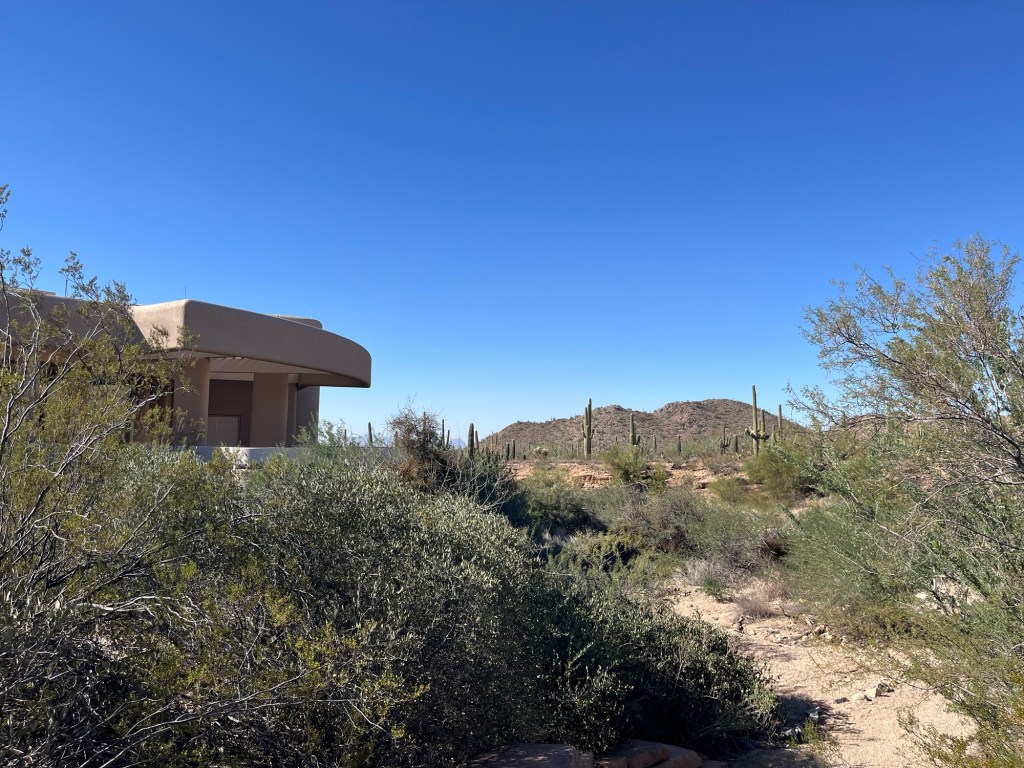
The visitor center and its bathrooms are locked up tight, but the trails and the park road are open. I am actually a little nervous about heading too far from the visitors center. It is hot and desolate and as the signs make very clear, if you get in trouble….no one is coming to save you. Today we are on our own.
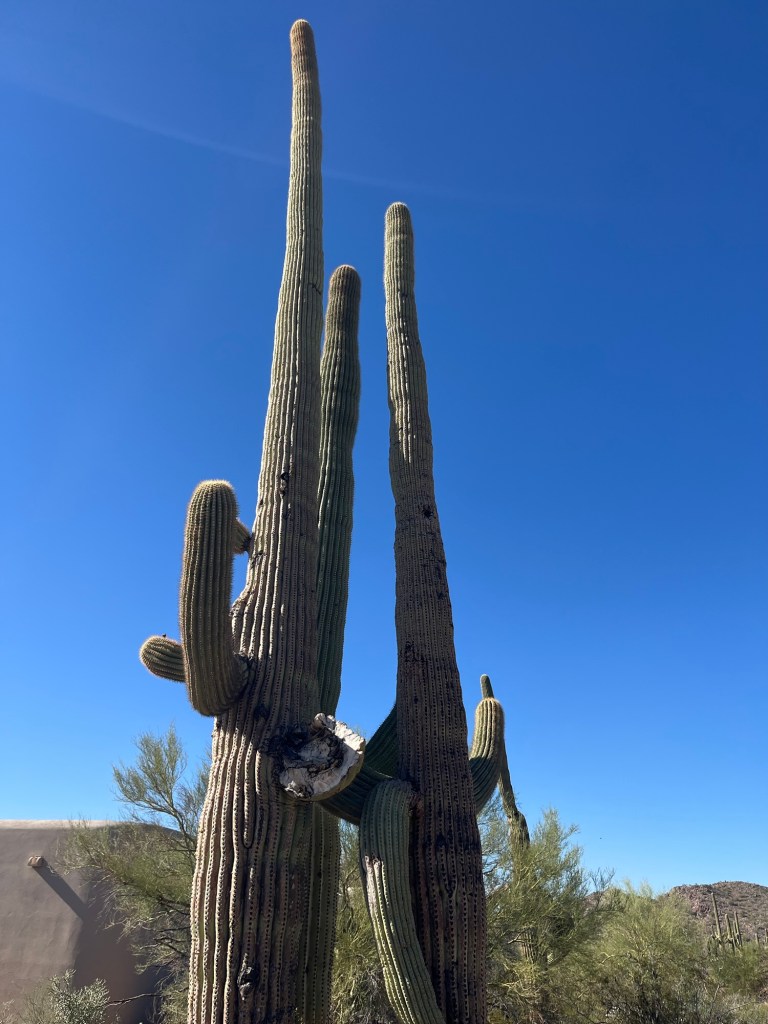
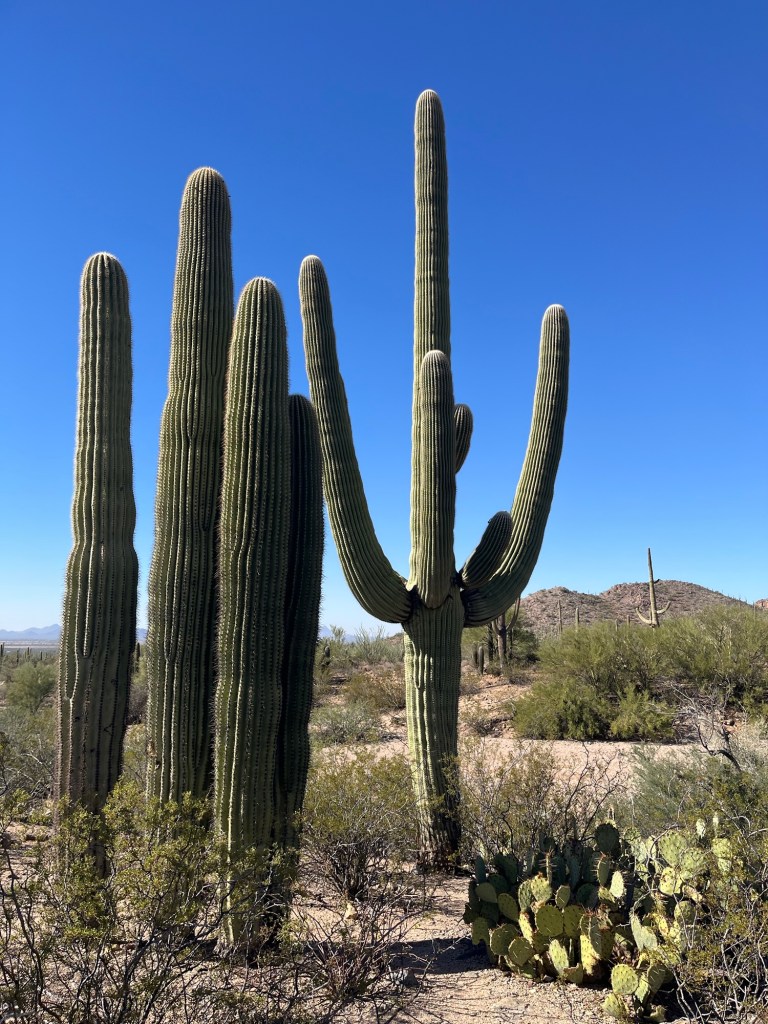
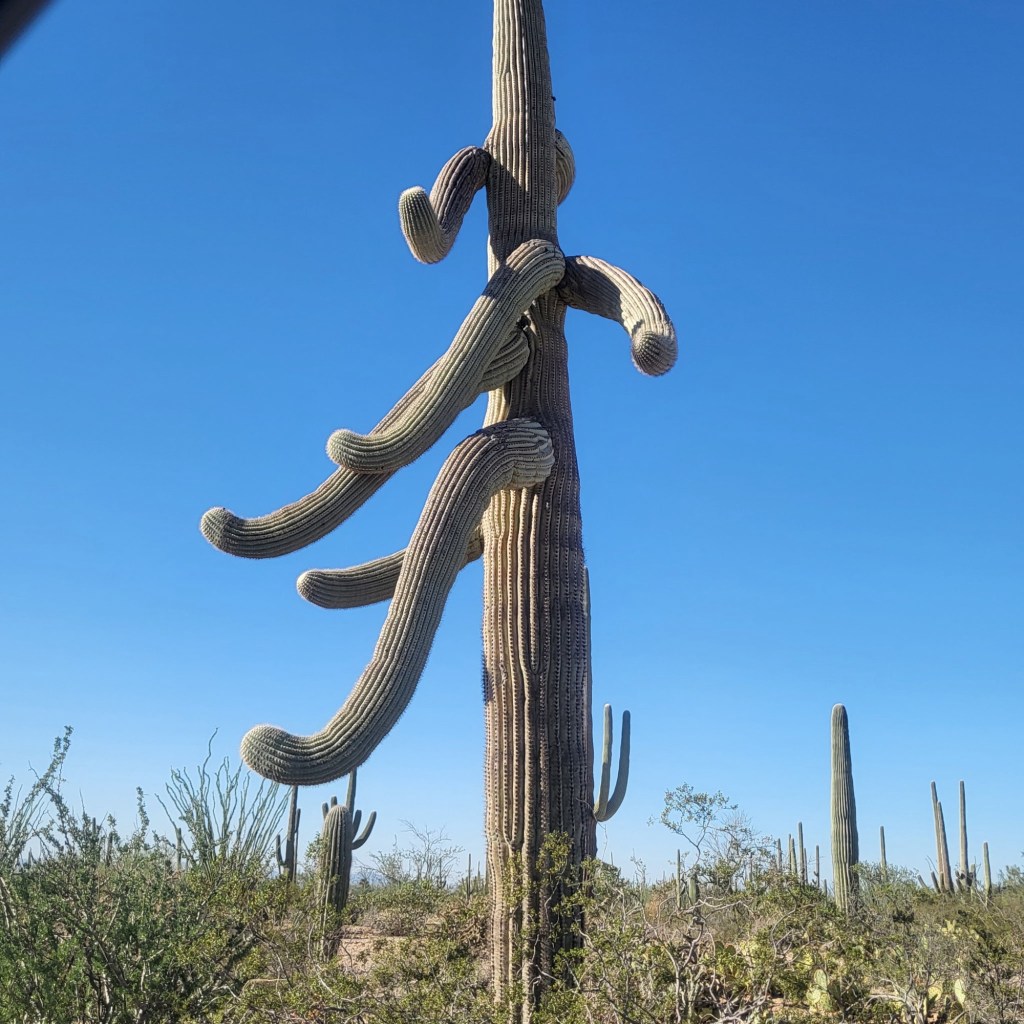
The trail that circles the visitor center has plenty of large Saguaro to look at. I alternate from looking at the giants up close, looking at the desert landscape in the distance and looking for rattlesnakes along the trail. Why does everything seem more ominous when you are the only ones present and there are lots of signs saying Beware?
The birds have made holes in the cacti, carving out nests near the top of the plant. The fuzzy cholla pop up every now and then…a new plant (for me at least) that looks like a torture penalty for getting off the approved walkway. I won’t risk it.
Though it is a pleasant autumn day, I am glad I have water. I can’t imagine being here in the summer sun. Deserts are not my happy place. I much prefer a dense forest with a lovely mountain stream. I question the sanity of the people who willingly hike here in summer.
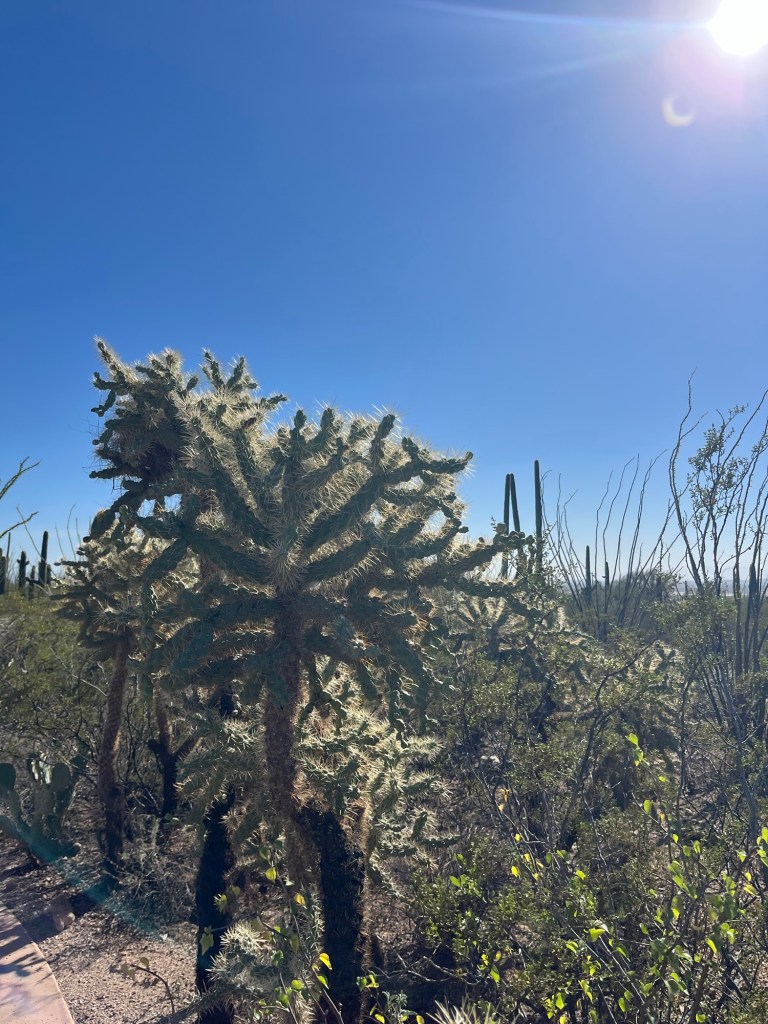
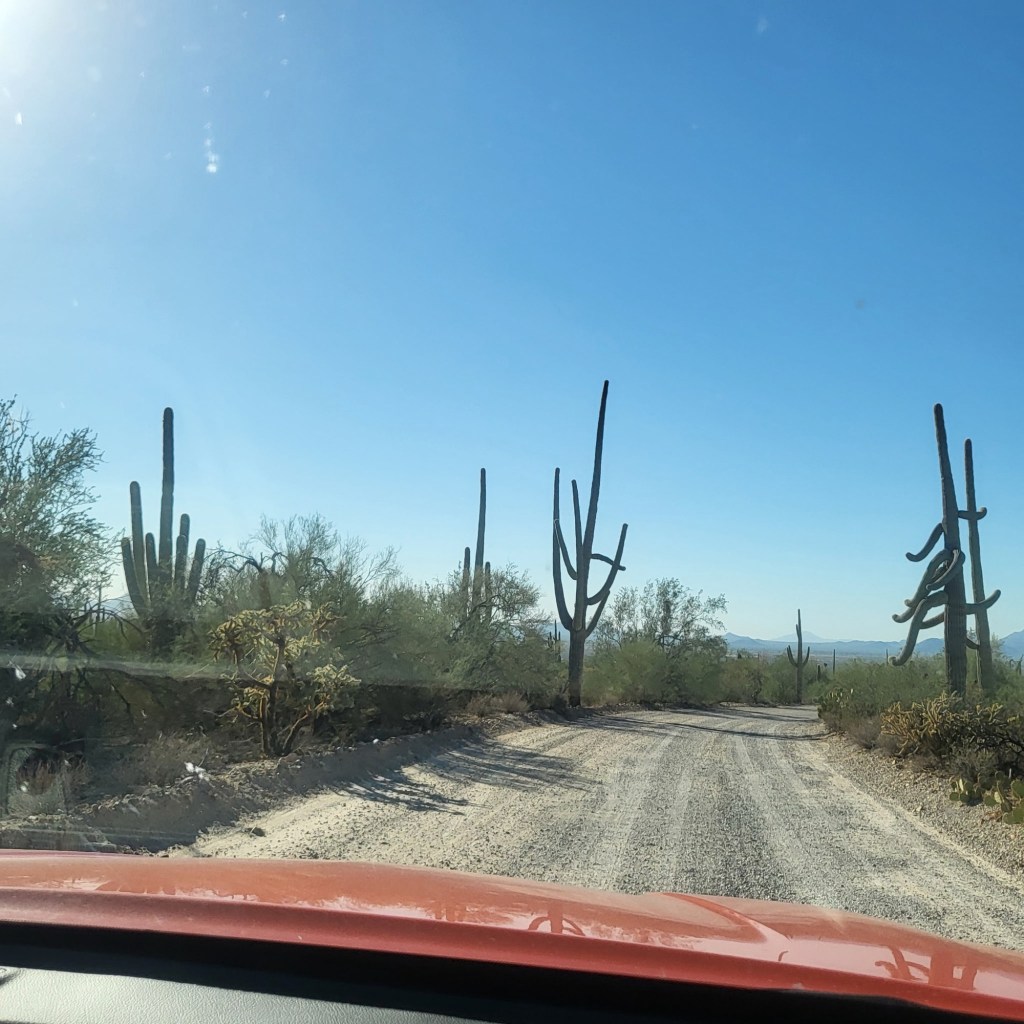
Next we follow the road signs to a trail that leads to petroglyphs. I didn’t know that it would mean a few mile drive over a washboard dirt road. Yikes! It is really desolate out here. It is a good thing that I am a small town girl. As a teenager I could speed down a gravel road and create a dust storm in my wake. As a retired adult, all I can think about is how long it is going to take to wash our big orange truck.
At the trailhead, there is only one other car. No one is visible. I wonder where they could have gone? I survey the terrain. We will have to cross a field of rock debris, climb a large hill and hike around a bluff to find the petroglyph. Each rock pile looks like a rattlesnake hotel. They may as well put up welcome signs.
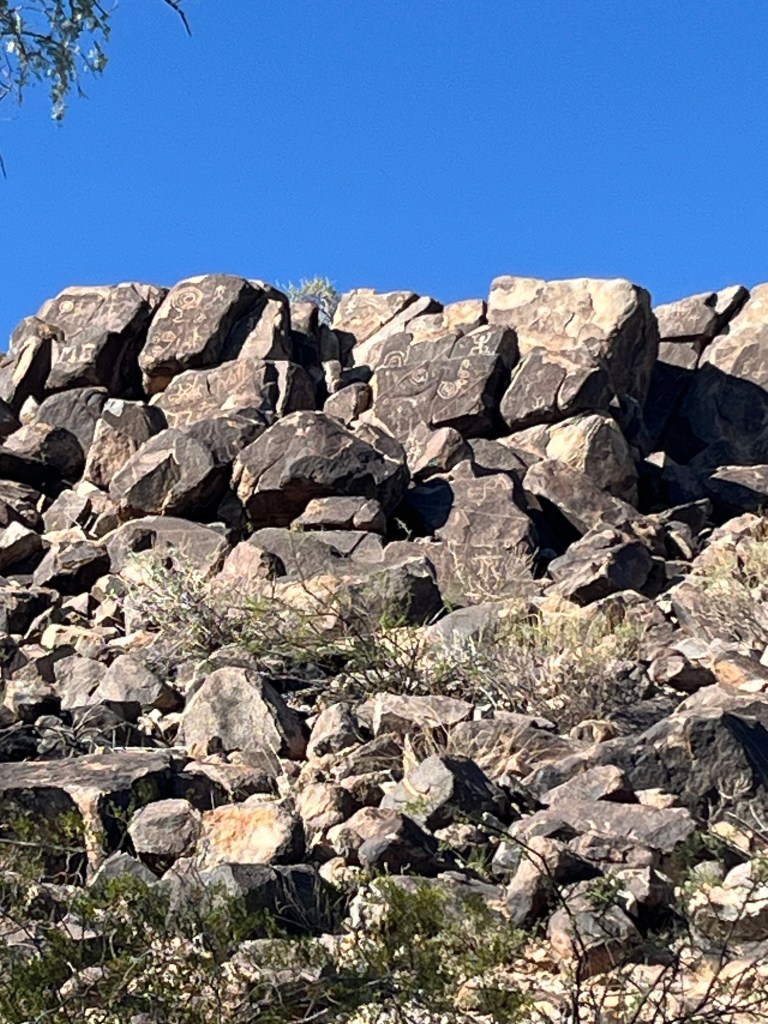
I tighten my boots and pull up my thick wool socks. If I get bit, I at least want to make it challenging. The walk is easier than it looks from the car. With no snakes or other hazards in site, I relax and take in the view from the top. We can see for miles. There is no sign of the other hiker(s). I hope they know what they are doing out there. I will stick to the trails today.
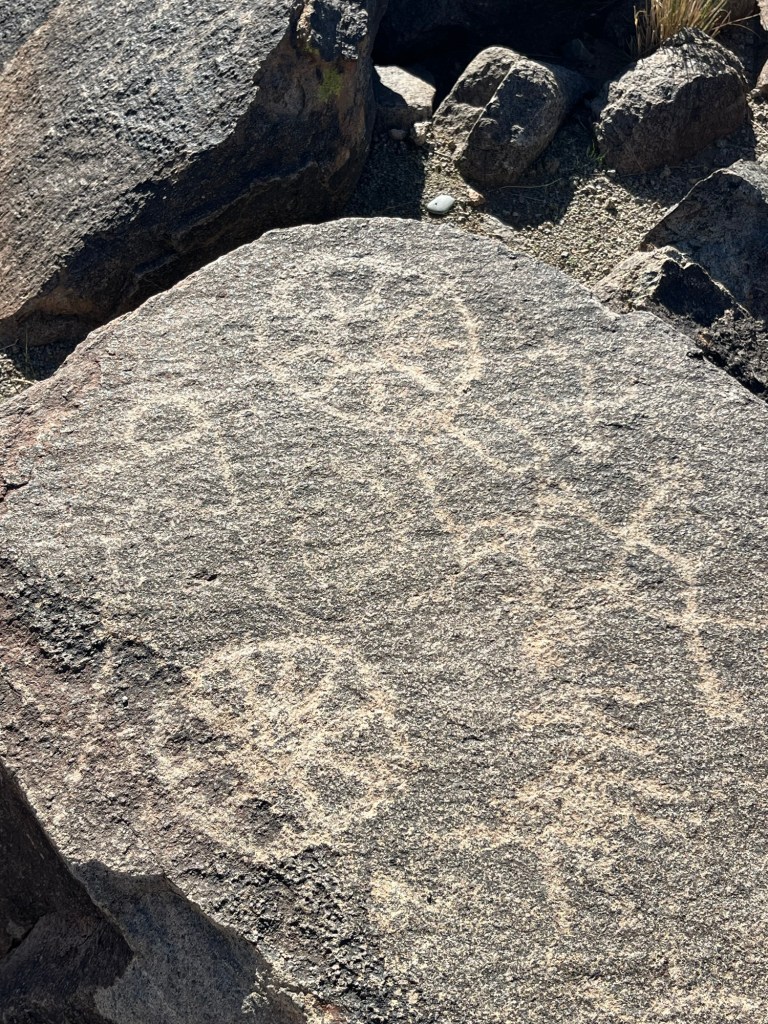
We came to see petroglyphs and there are hundreds crudely carved into the rocks. Many appear to be lines, wheels, sunbursts. I guess you can think of them as early landscapes. From this viewpoint, all you can see is the sun, a flat horizon, and thousands of saguaro. So a circle for the sun and some lines for the cactus and would be logical choices I guess. Think of them as ancient stick figures.
We head back to the truck. My head is full of wondering. Who made the carvings? What would it be like to ride a horse through all that scrub? What would it be like to get lost out there? How could you survive without shade or water?
Before I know it, we are back to the truck. Soon, I am zipping down the dirt road with the radio on. I am 16 again….in my head. My current self can’t bring myself to roll down the windows and let the wind blow through my hair. I don’t want to deal with the dust.
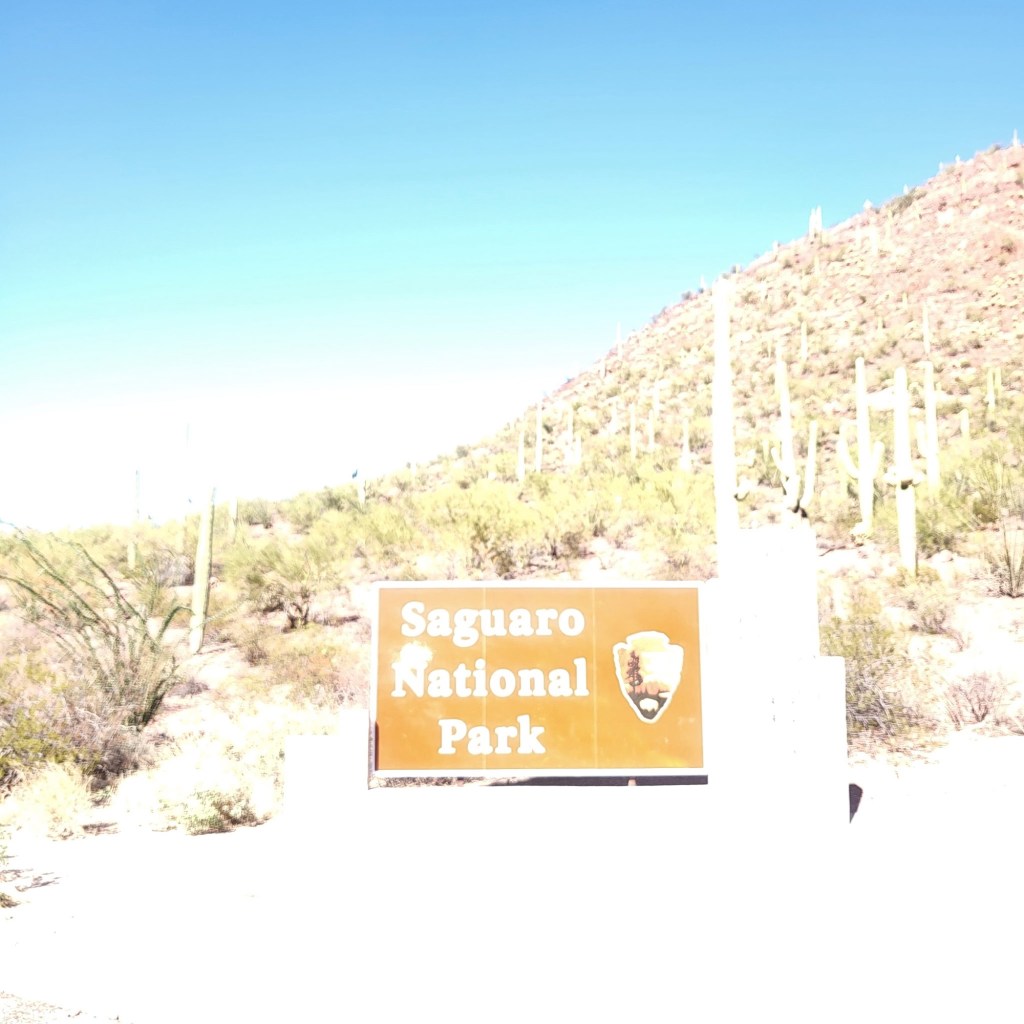
We stop at the intersection and take a picture of the park sign in the harsh afternoon sun just to prove we were here. What’s a road trip without a souvenir sign picture?
-
Inari Tokyo: Travel Goals Japan
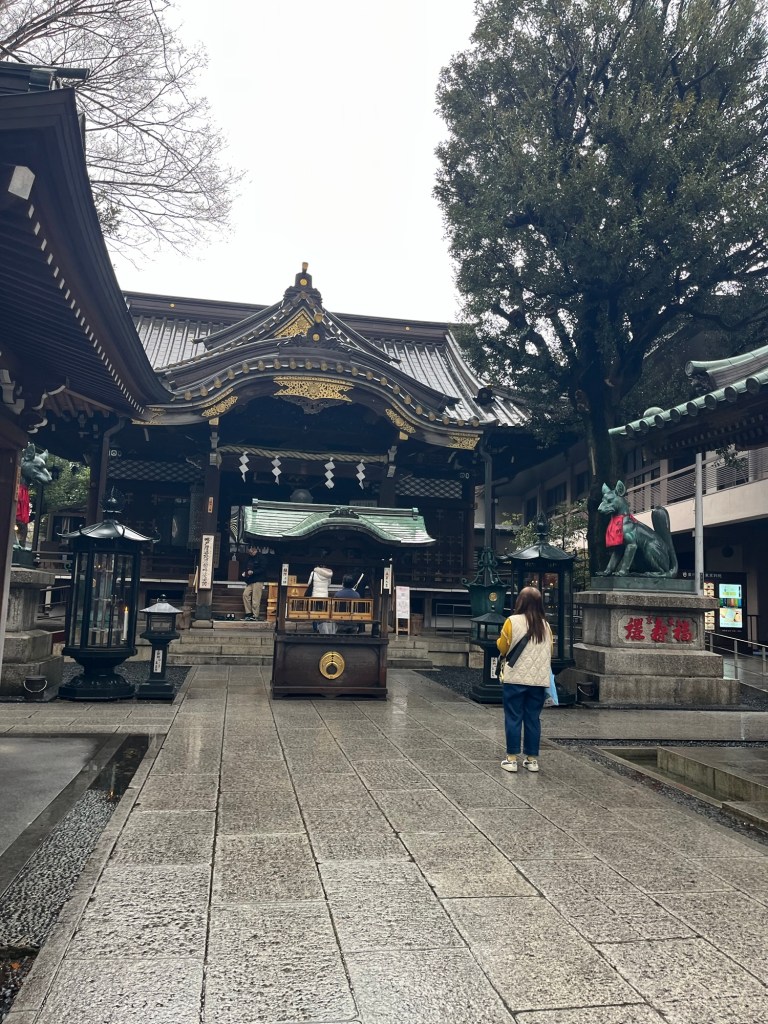
Walking down the street in Tokyo in the rain, I pass a colorful temple. It is local, clearly not a tourist hot spot, and very much in use. Since I love the quiet and reverence of sacred spaces, I step inside. This feels authentic, like a local church.
I have only visited one other Buddhist temple in my life and that was just yesterday. I want to be very respectful so I follow the steps I learned to cleanse my hands and lips before entering. I hope I do it correctly. There are only a few other people here so hopefully no one is offended if I don’t get all the steps in order.
This temple, the Toyokawa Inari Tokyo Betsuin is dedicated to an O- Inari who is said to have appeared to a son of Emperor Juntoku while riding a white fox with a rice plant on its shoulder. In Shinto tradition, Inari is said to have come down from Heaven riding a white fox and bringing rice. A vision or sighting would bring good fortune, so farmers began leaving gifts for the fox. This temple is a continuation of the Shinto tradition of prayers to the Kami of foxes. Inari worship was blended into the Buddhist tradition in the 800’s, when Inari was named protector of Shingon Buddhists.
Honestly, the traditions of the Inari and their white fox messengers (kitsune) are so varied and intertwined that I have trouble making sense of all the details. What I know is that this is where you come to pray for prosperity, happiness, wellbeing, and good fortune. I can certainly ask God for peace and happiness while I am here.
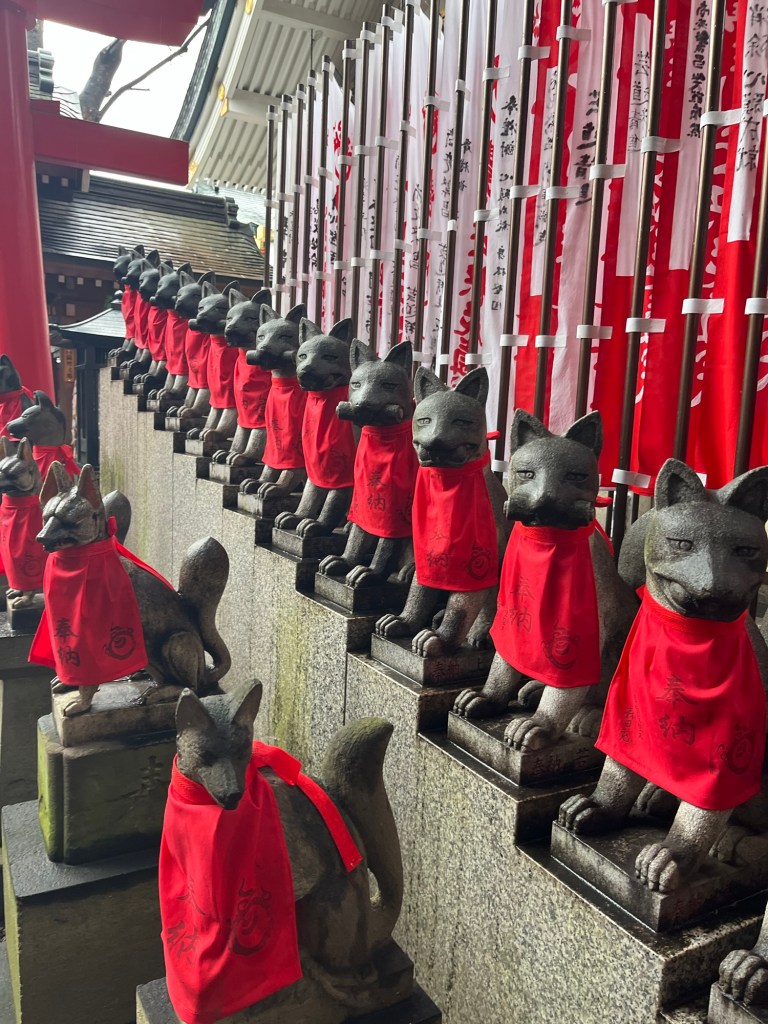
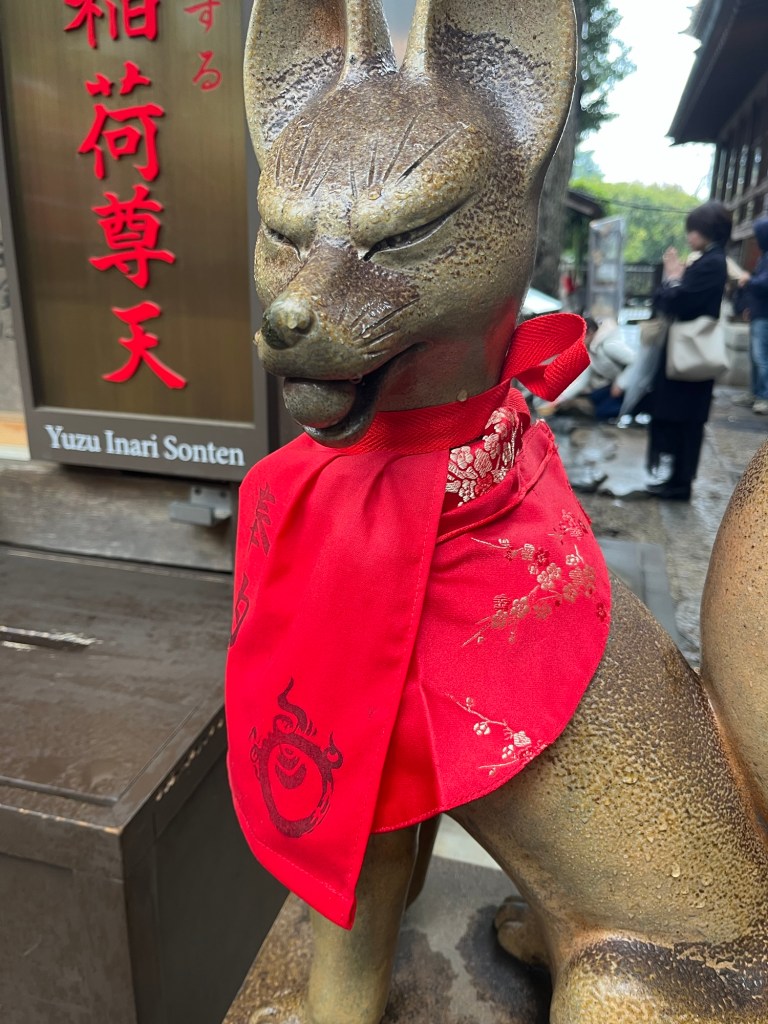
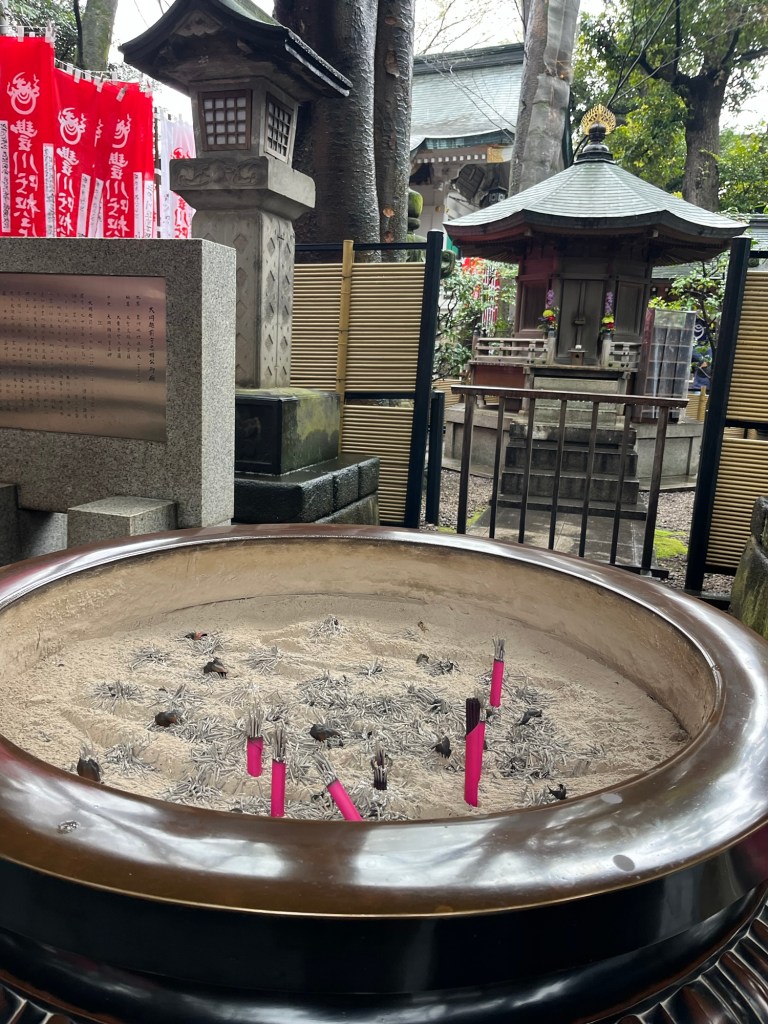
The kitsune (fox) are everywhere. They wear red bibs which have been placed by parishioners as a sign of respect. Each is a unique and colorful reminder of messages of peace and abundance. Red banners carry messages of well being. Candles and incense burn as symbols of requests ascending to heaven.
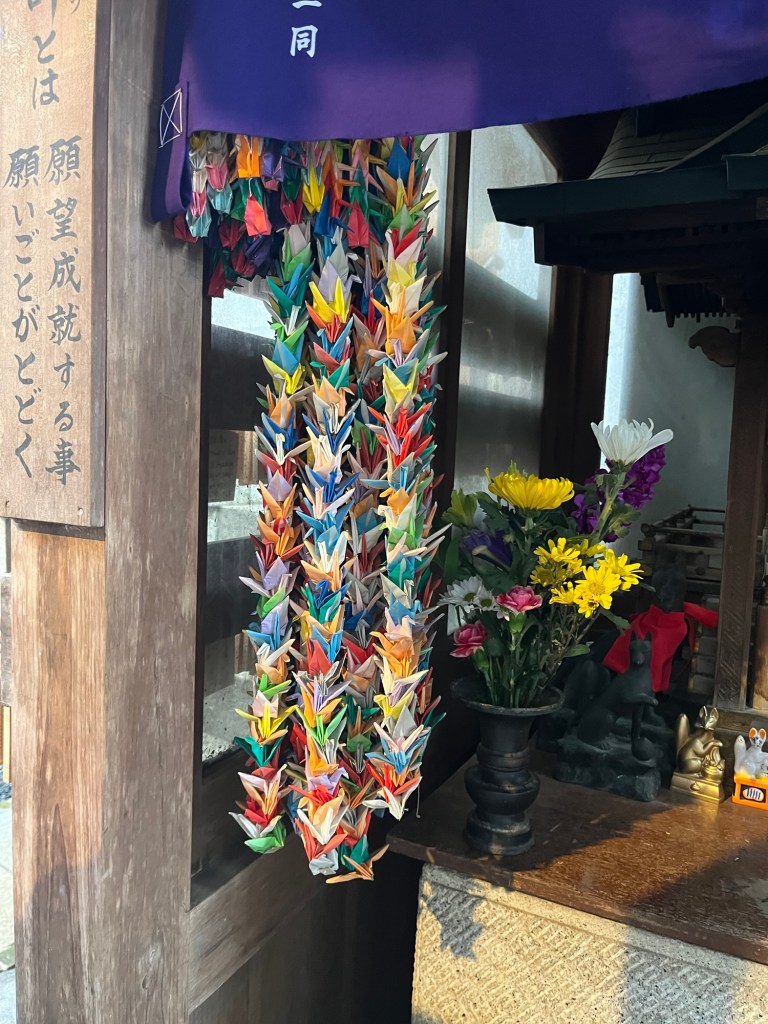
Like most Buddhist temples, you can purchase prayer cards to make a prayer chain or wooden ornaments. At this temple they are in the shape of a heart. Apparently this temple is a favorite place to seek help for romance and family matters.
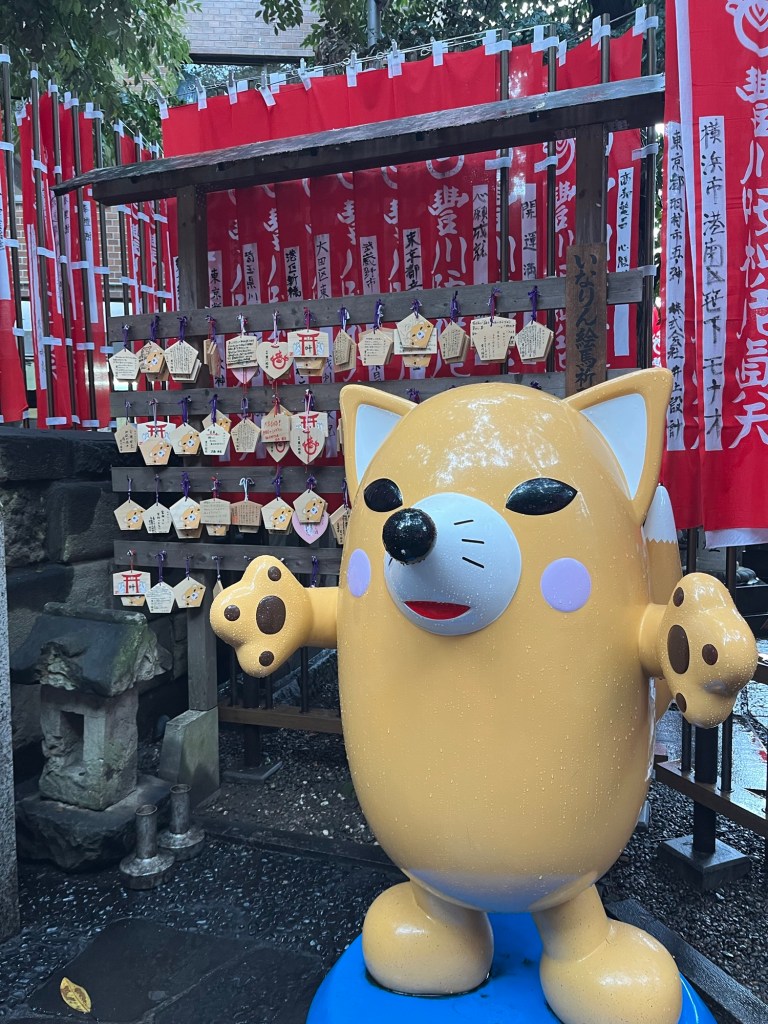
And so I wander the walkways and try to stay far away from people engaged in prayer. It is not my intent to interrupt their offerings. And yet I can’t help but notice the ritual. It is a foreign concept to me that you would need to pay to pray, but each person leaves some money and bows before they leave. Perhaps it is left in gratitude and not as a means of enticing the Inari to help them. There is so much I don’t know.
I can, however, appreciate the beauty of the temple. Like the cathedrals I love to visit in other parts of the world, this place feels sacred and set apart. There is a reverence in the space as people come to petition for something beyond their own power. While I am Christian, I respect the seeking and the devotion. I recognize the sincerity. I say a prayer of blessing and thanksgiving. I am a stranger in a strange land, and I am grateful for the experience.
-
Movie Magic In Old Tucson: Rural Road Trips
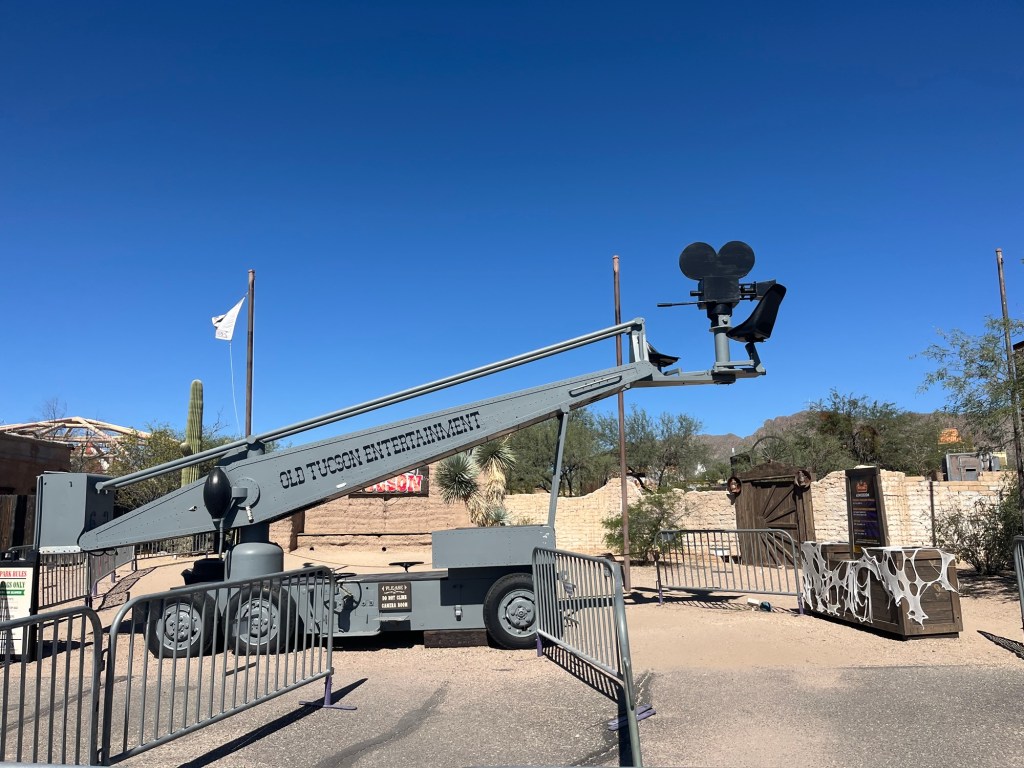
I have zero expectations when we arrive at old Tucson. I didn’t even know it was a movie studio set. I thought it was an older part of town. We are only here because our waitress at dinner said we should come.
I am taken aback by the haunted house advertisements and the excessive fake spider webs. What is this place? Why did we pay $50.00 for a guided tour? I feel cheated before we even enter. I may be the youngest person on the tour and even I am retired.
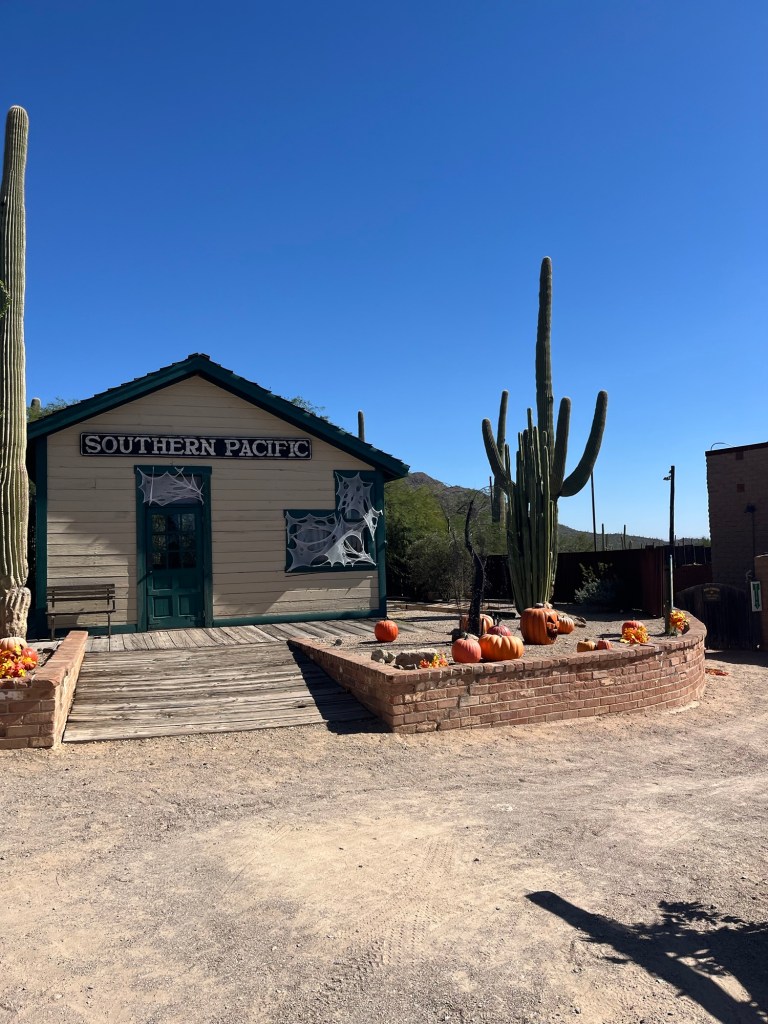
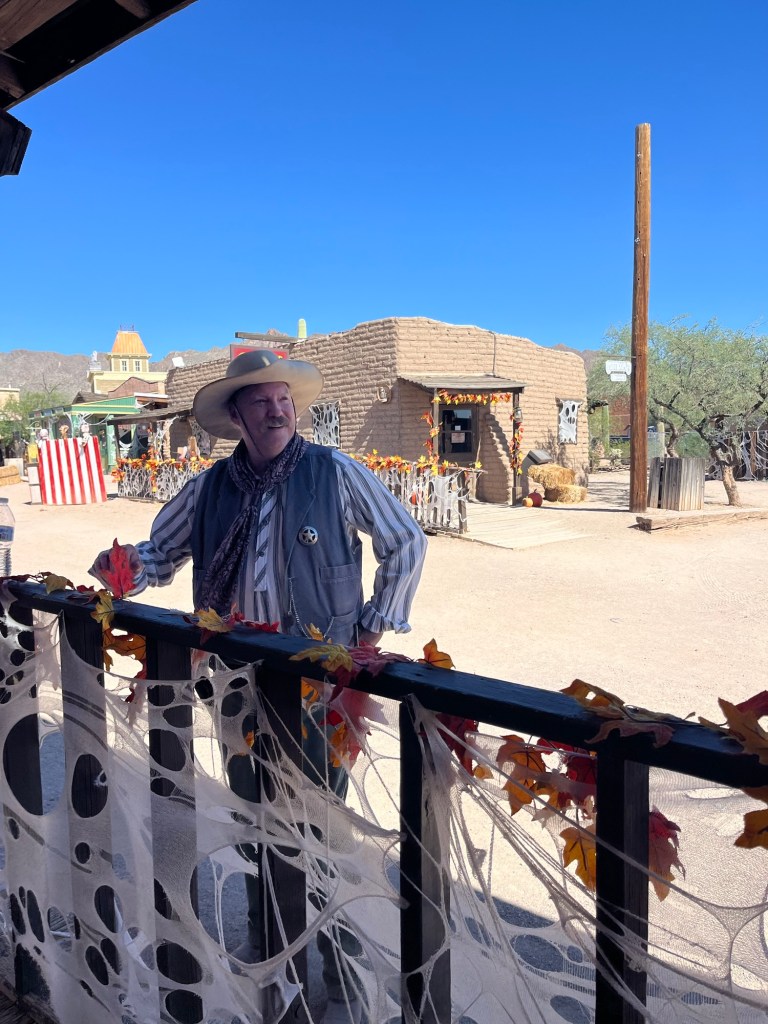
We are met by a historian dressed in cowboy costume. Yes, he is an actual historian who serves as consultant for the Westerns that are shot on this lot. He is also a movie buff. Best of all he is delightfully entertaining. I felt myself relaxing into his stories. This man knows his Westerns.
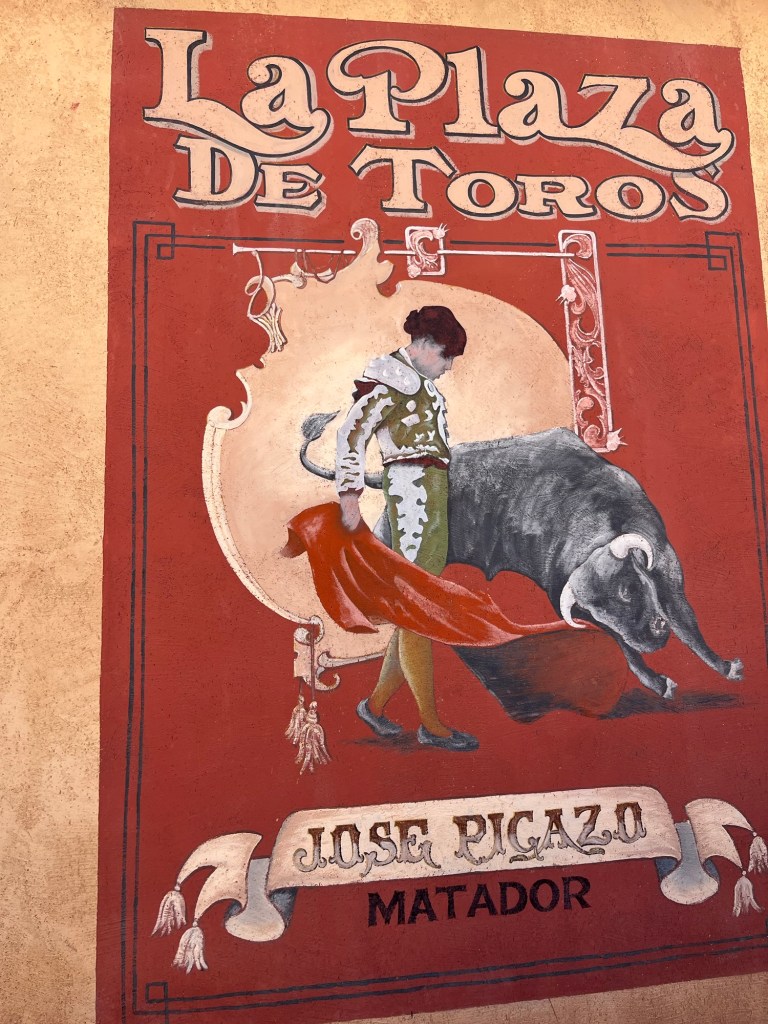
As we walk the dusty streets, I begin to smile. I have watched a lot of Westerns. My grandpa had all of John Wayne’s movies on vhs. There was always one playing, unless Grandma had managed to find a Cardinal’s baseball game. My other Grandpa was more likely watch Gunsmoke or Little House on the Prairie. You might say I was raised on Westerns. To this day, I turn on Wagon Train or another classic while I do laundry.
As we walked, I realized most of the shows I remembered were filmed here. Built in 1939 for the movie Arizona (1940), it has been used for the filming location of many movies and television westerns since then, such as Gunfight at the O.K. Corral (1957), Rio Bravo (1959), El Dorado(1966), Little House on the Prairie TV series of the 1970s–1980s, the film Three Amigos!(1986), The High Chaparral (1967 to 1971) and the popular film Tombstone (1993). Our guide shared that over 500 productions were shot on these streets.
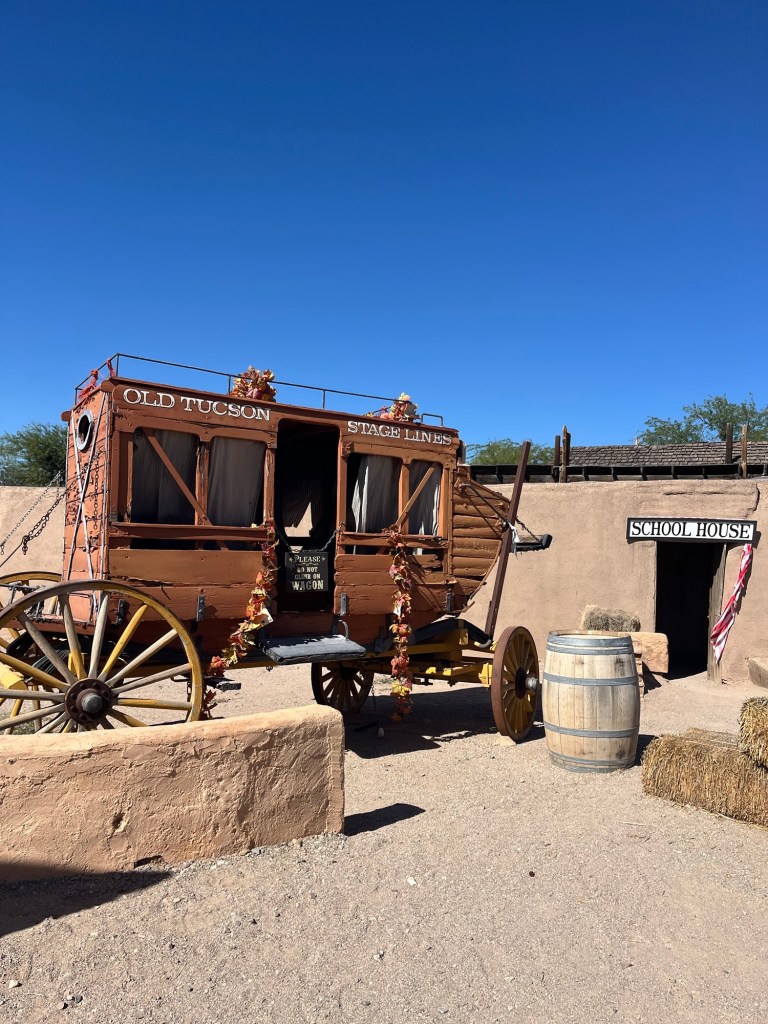
I stood under the porch where Glenn Ford pulled his six shooter. I walked where John Wayne and Maureen O’Hara fought. I saw the church where a massacre at a wedding started a march toward the ok corral. As I walked I realized that the bridge and the buildings were in almost all the movies I have watched. How did I not notice they were the same? I guess there is something to be said for movie magic.
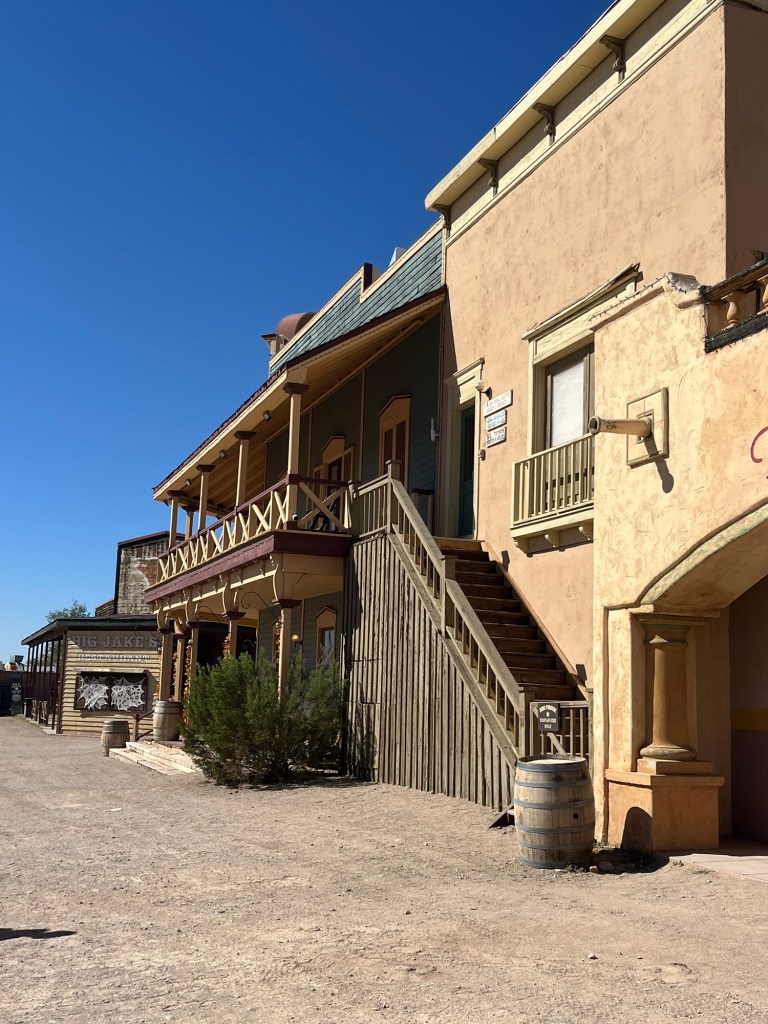
I found myself quoting lines from movies as we walked. Of course I had to do the Three Amigo salute in the town square. I turned circles on the town board walk looking for the bad guys. I was distracted by the fact that Bonanza, Wagon Train, Rawhide, and Gunsmoke were all shot here. I mean … I was standing in the Long Branch! Grandpa would have passed out already. So many memories.
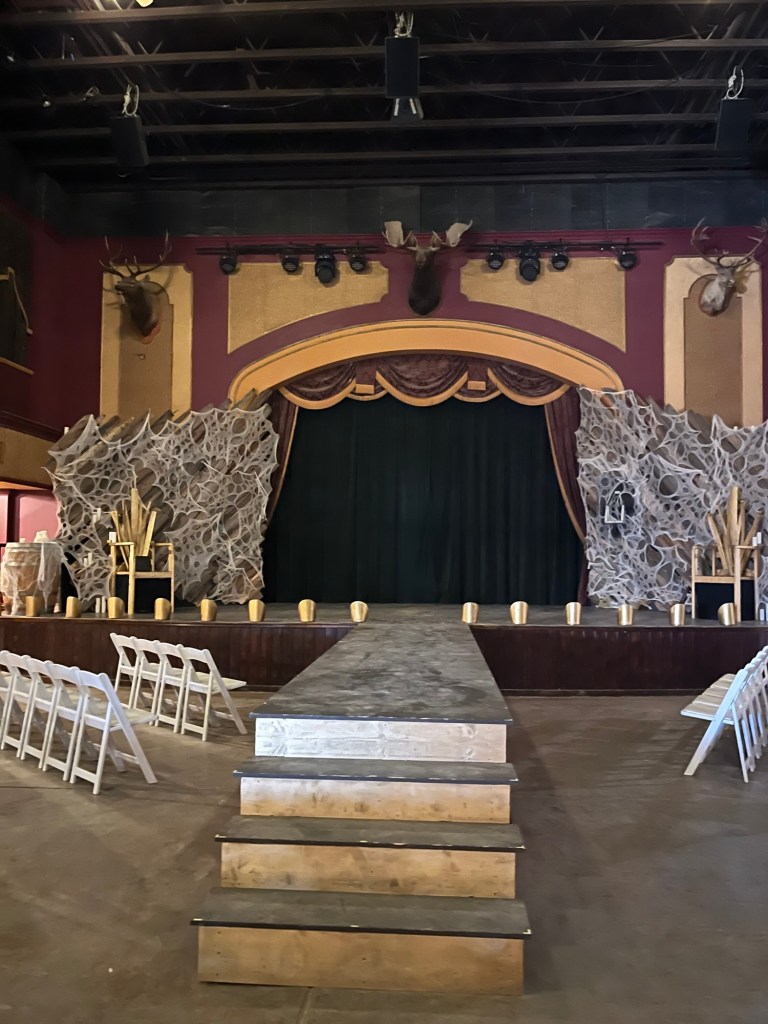
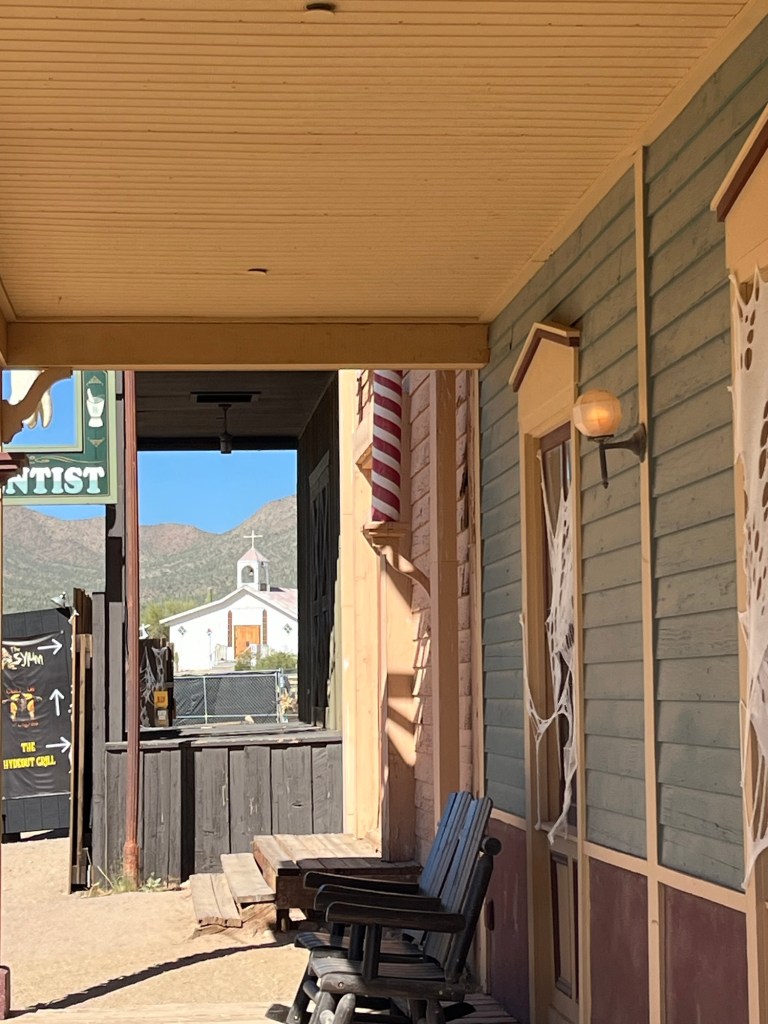
Before I knew it, it was time to go. I was wistful. I could see the church and the water tank in the distance. We passed the train depot where countless scenes have played out. I was not ready to leave and yet all good things must come to an end.
There was only one thing left to do. I must go back to the RV and find Young Guns and the Sacketts and at least one John Wayne. My husband will have to endure a Western movie marathon. I have a whole childhood to recapture. He likely won’t understand. But like John Wayne says in McClintock, “Pilgrim, don’t tell me. Show me.” Maybe I can win over my favorite greenhorn if I show him enough movies. If not, at least I have Tom Selleck and Sam Elliott to keep me company.
-
Remembrance: Travel Goals Japan
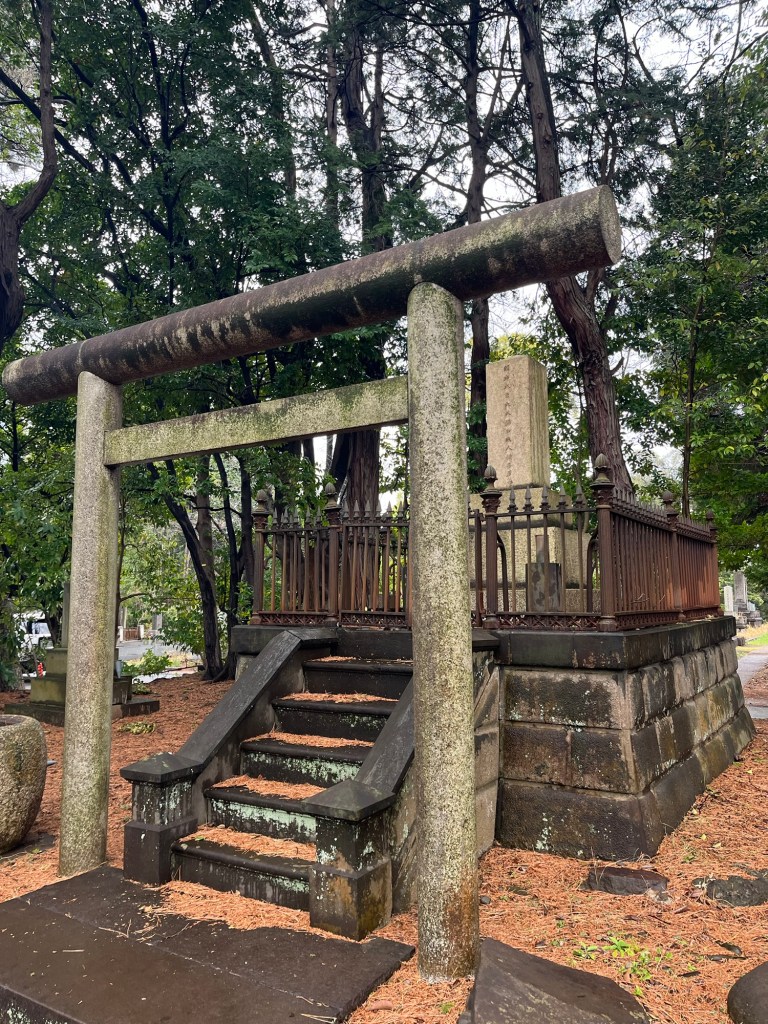
It probably seems weird to hang out in a cemetery as part of travel. It did to me once. I am not sure when or how that changed. Perhaps it was in England when I was tracking down ancestors in the Cotswolds. Or perhaps it was in Ireland as I marveled at the magnificence of a high cross. It could have been in Argentina as we wandered through the mausoleums in Recoleta. I know I was moved by the magnificent lanes and trees in the cemetery in Punta Arenas, Chile.
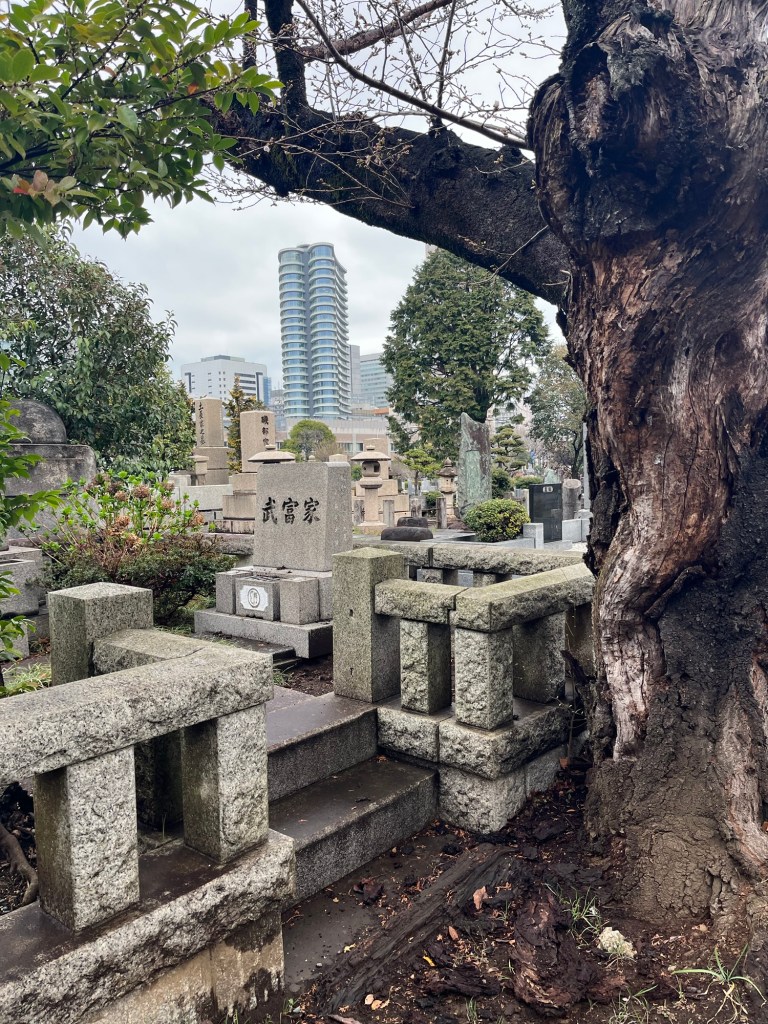
You learn a lot about a culture in its cemeteries. Values are carved in stone. Here in Japan, stone cut in clean lines mark the graves of generals, housewives and artists.
It is a damp and grey day, fitting for a visit to a cemetery. But even here the cherry blossoms are budding. It is a reminder that new life follows the winter and time marches on.
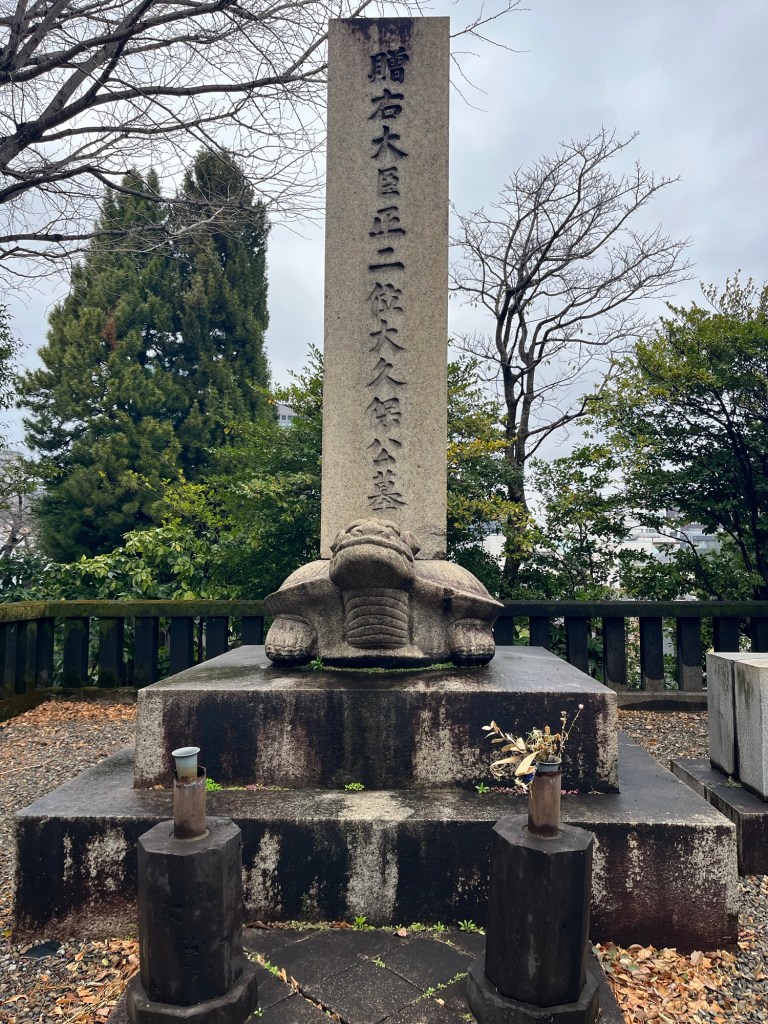
We wander along the avenues stopping at monuments to the shoguns and samurai. I am fascinated by headstones in which guitars and dinner plates have been embedded in the stone. Favorite things placed lovingly beside the people who used them. Here too are long prayer boards called Sotoba. They are purchased at Buddhist temples and personalized for the deceased. Occasionally there are food and drink offerings left behind.
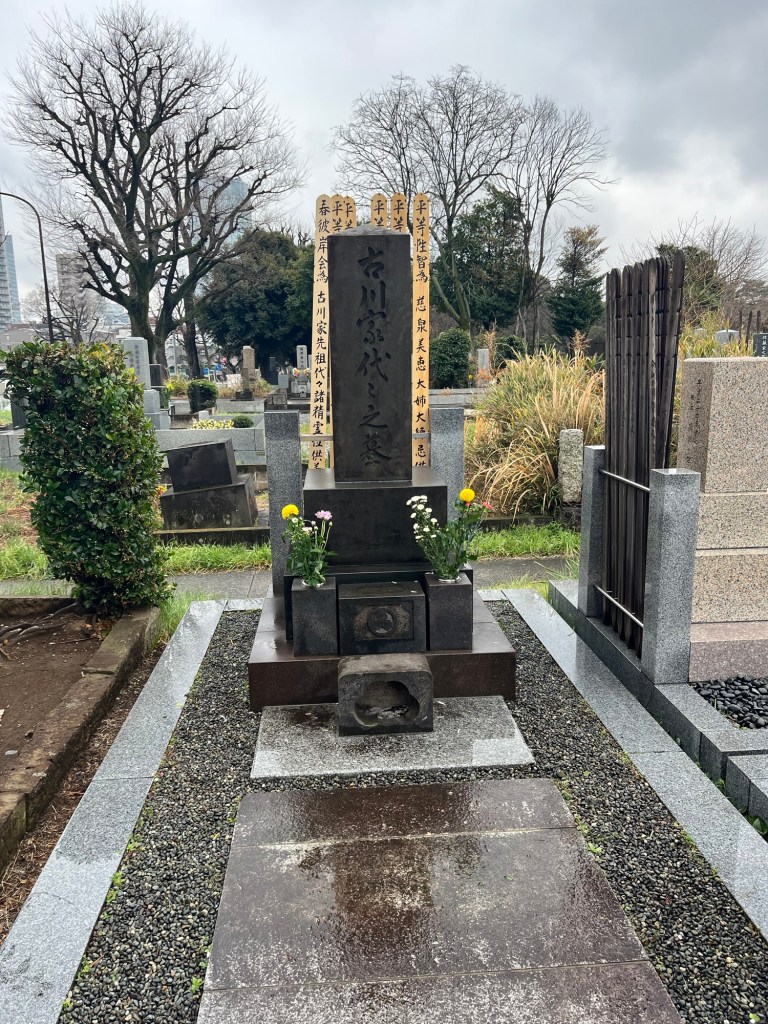
Sandwiched between office buildings and a grove of old trees, there is even a grave for a dog. The famous Hachiko who is known for his loyalty to his master lies beside him in death. Hachiko went to the train station daily for years to wait for a man who would never return. As a symbolic memorial, a city captivated by his faithfulness buried him with honors.
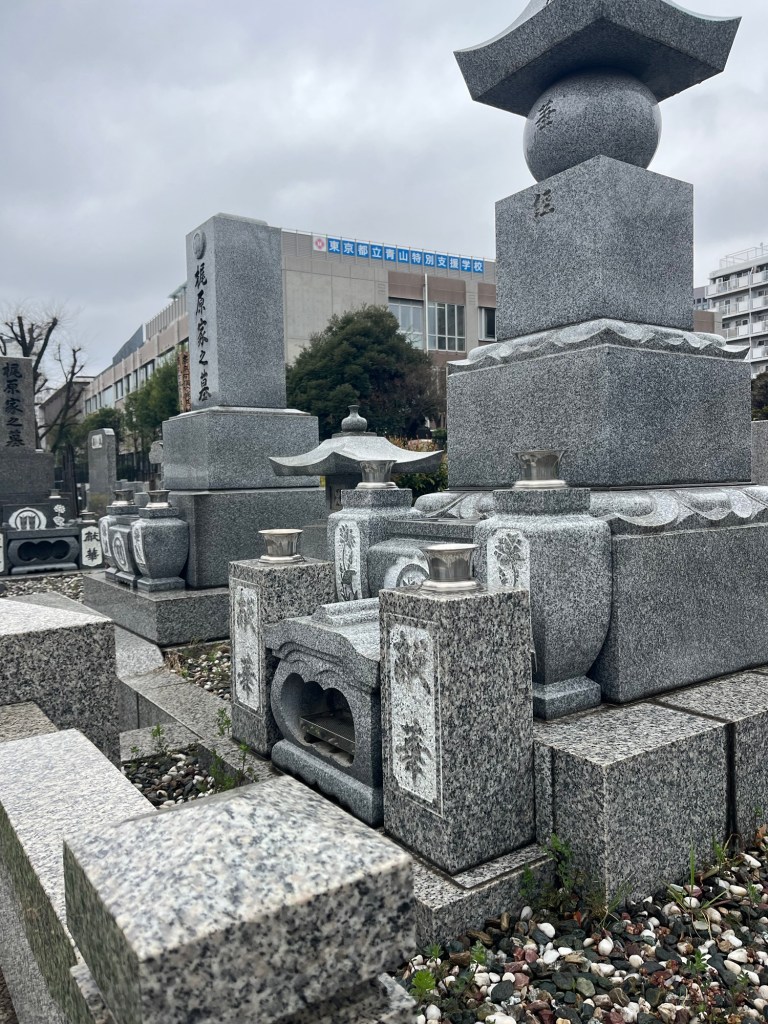
As we leave the cemetery, I am reminded that life is short. I look out over thousands of graves. What did they leave behind?
Character, service, and family are the important things. Everything else is illusive. I am more aware and a little bit pensive after our visit with the dead. The rain drops hit the granite in a steady rhythm. I walk on. There is a chill in the air and I am ready to return to the land of the living.
-
Dove of the Desert: Rural Road Trips
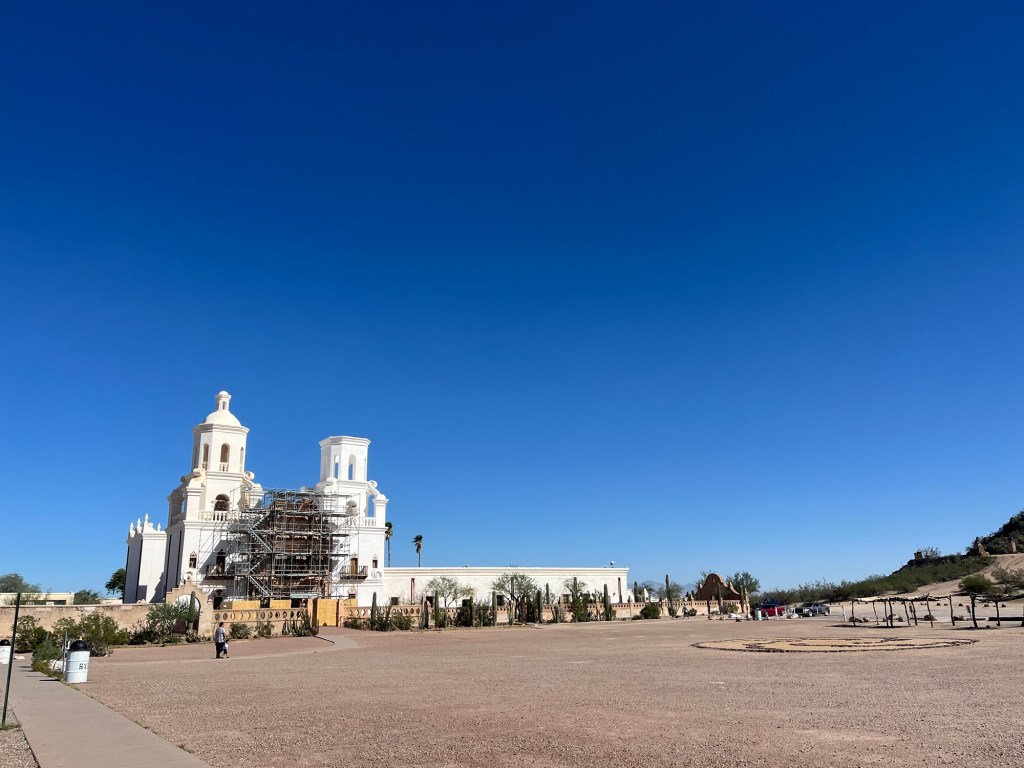
In the Arizona desert just South of Tucson is the Mission San Xavier del Bac, known as the “White Dove of the Desert. This historic 18th-century Spanish Catholic mission located on the Tohono O’odham Nation reservation was built between 1783-1797. It is the oldest intact European structure in Arizona and a National Historic Landmark. Many consider it the finest example of Spanish architecture in the United States.
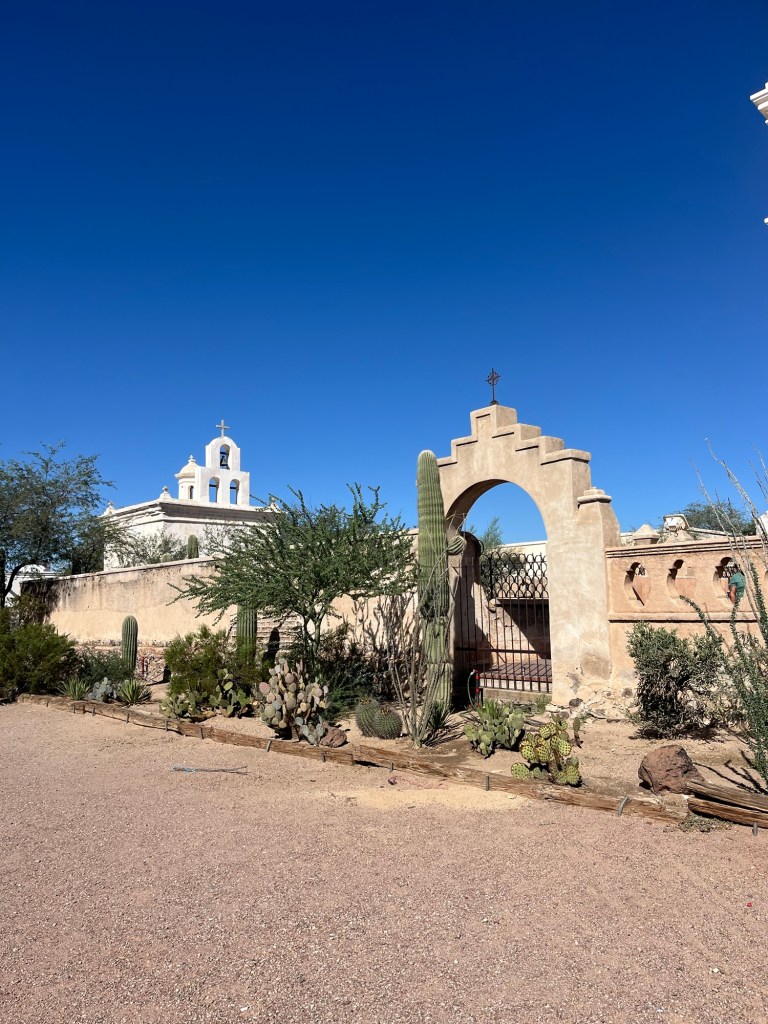
I am a fan from the minute we pull into the parking lot. The architecture is stunning, despite the scaffolding covering part of the exterior. There are Tohono O’odham tribal members barbecuing at the end of the lot, just a church fundraiser. I like the vibe. It reminds me that people always have more in common than we think. Our local Catholic Church fires up its grill every Sunday.
I am anxious to visit the church, but first we visit a complex of tribal gift shops and snack vendors. I love buying local and a native mosquito bite remedy seems like a useful purchase. So does fry bread. After dropping our purchases off in the truck, we finally cross the hard packed dirt to the church.
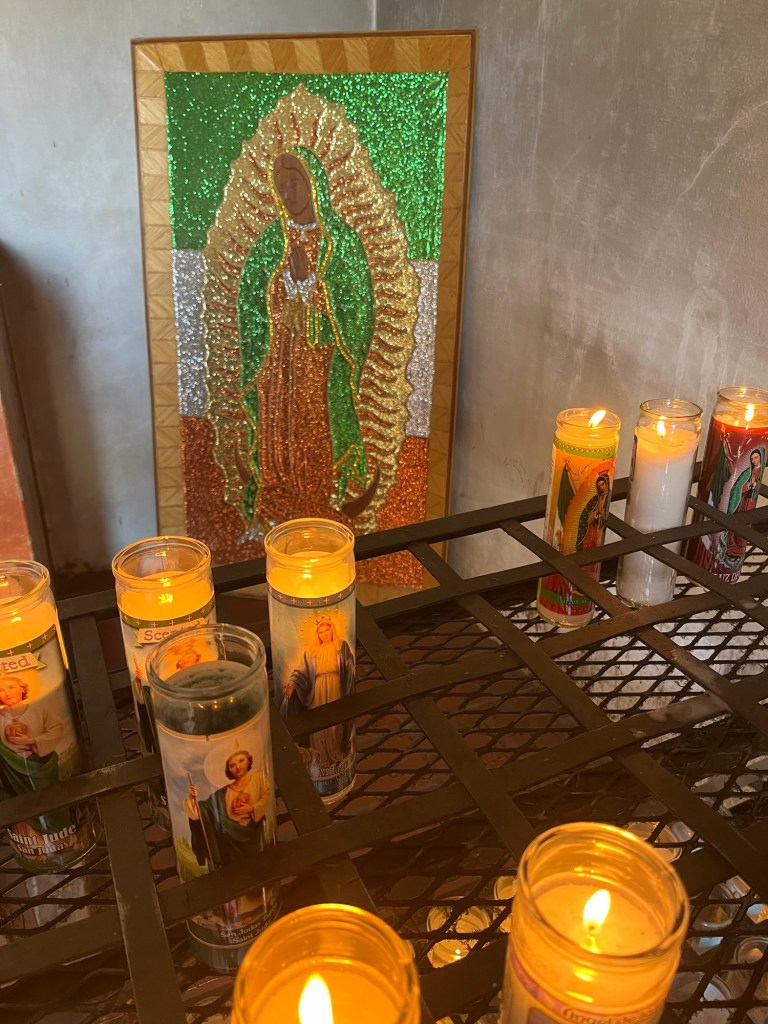
I’m not sure how it is possible, but the interior of the church is even more stunning than the exterior. People are actively engaged in worship. So I sit where I can unobtrusively look and then pray. I have to remind myself that this is a working parish that has been the tribes spiritual home for over 250 years. Mothers beg for protection for their children. A man sits beside me and quietly weeps. I am moved and pray for their unspoken needs. God hears the cries of the broken hearted.
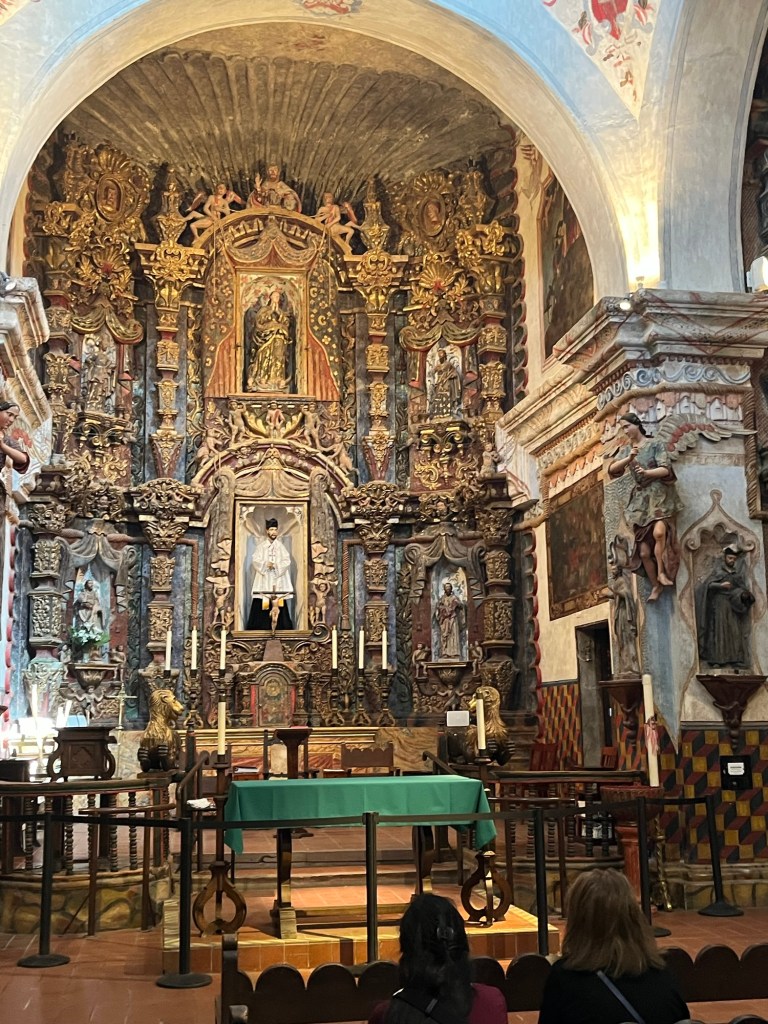
After my moments of prayer, we leave the chapel and head to areas that hold important artifacts from the church history. There are vestments and chalices sitting next to tribal baskets. Dating from its founding in 1692.
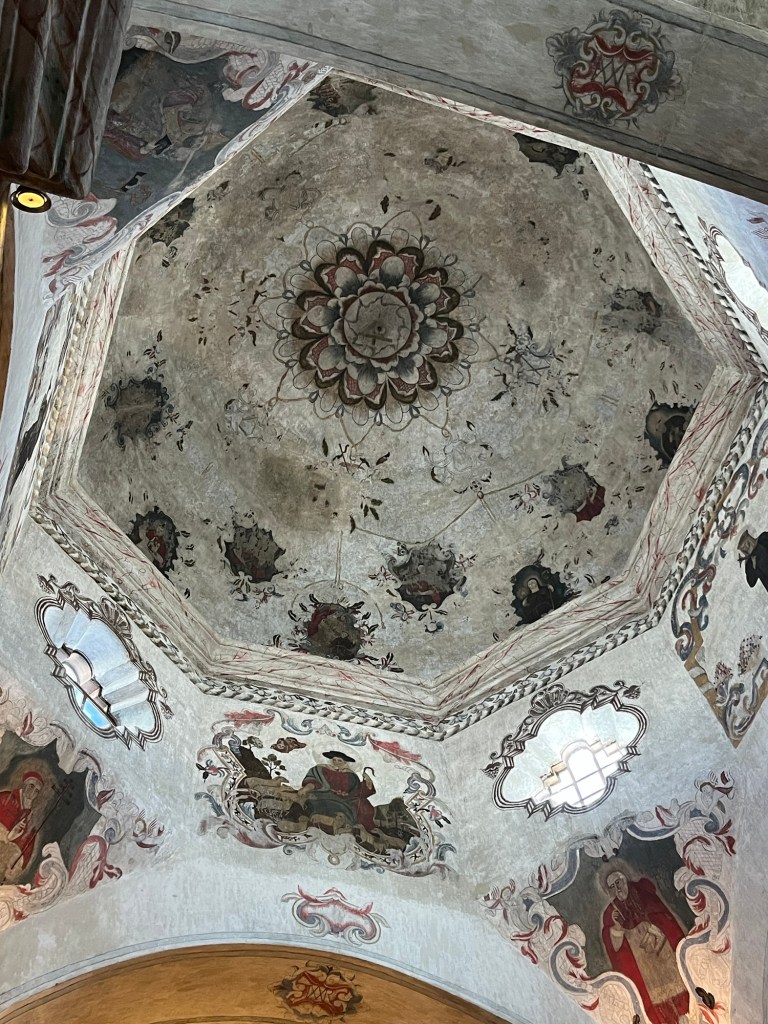
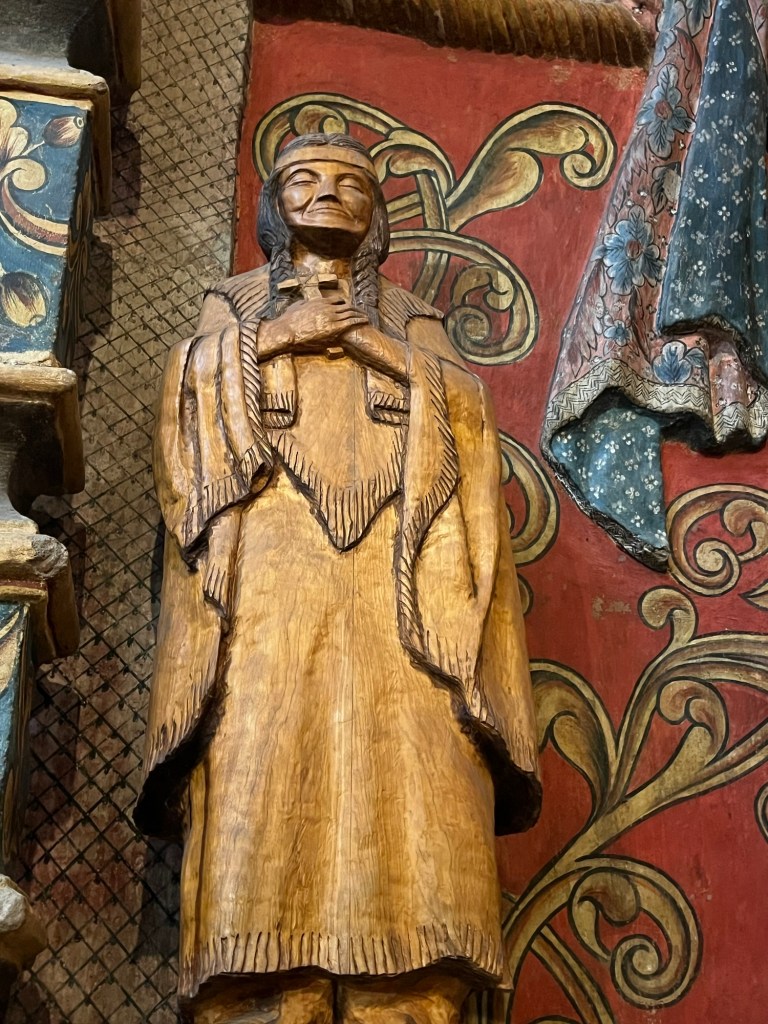
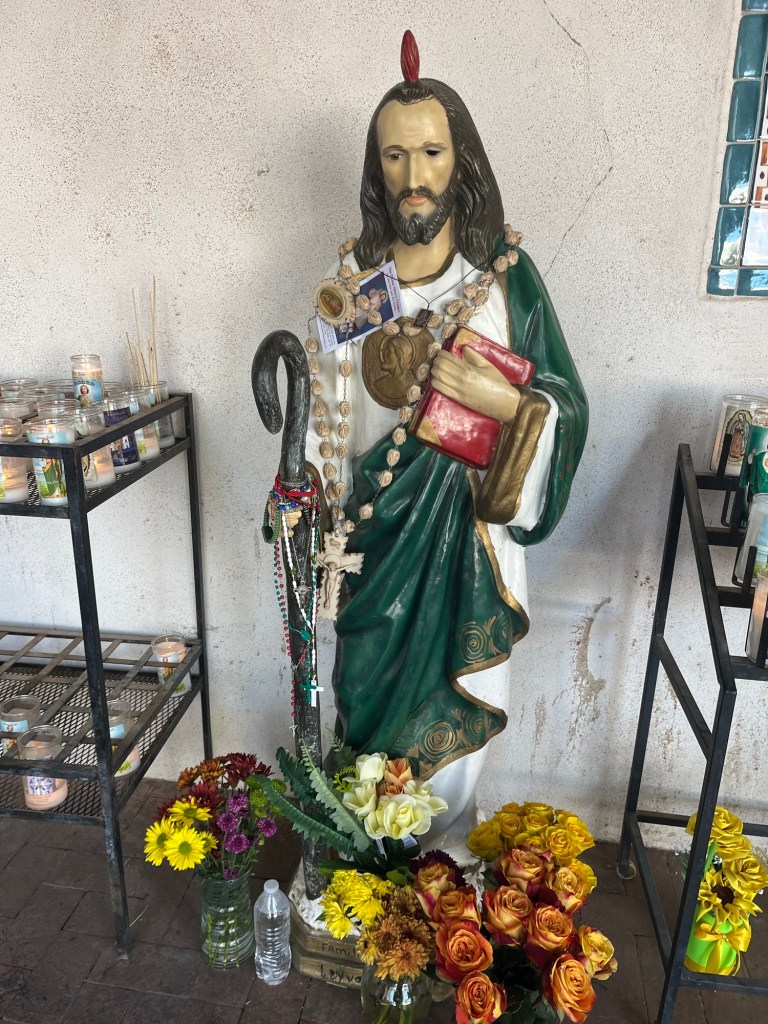
The place strikes me as a beautiful blend of old world European elegance and native simplicity. Amazing paintings are somehow elevated by simple wood carvings with the finest craftsmanship. A mausoleum houses a glass encased wooden carving of Saint Francis Xavier. Locals and pilgrims leave tiny tokens (Milagros) as they pray and ask for miracles.
The lovely cloister walk and peaceful courtyard reminds me that this is working Franciscan monastery. The good fathers have been here since 1767. They have survived Apache raids, fires, wars, and even a change in country of residence.
Eventually, I have to tear myself away from this gem. We walk up the small hill near the church and walk the stations of the cross. I keep one eye on the dramatic vistas and one eye on the lookout for rattlesnakes. I imagine that sums up this special place properly. One eye on God and his wonders and one eye on the harsh reality of life in a hostile environment. For 350 years, the people have been faithful. Despite many hardships, beauty remains.
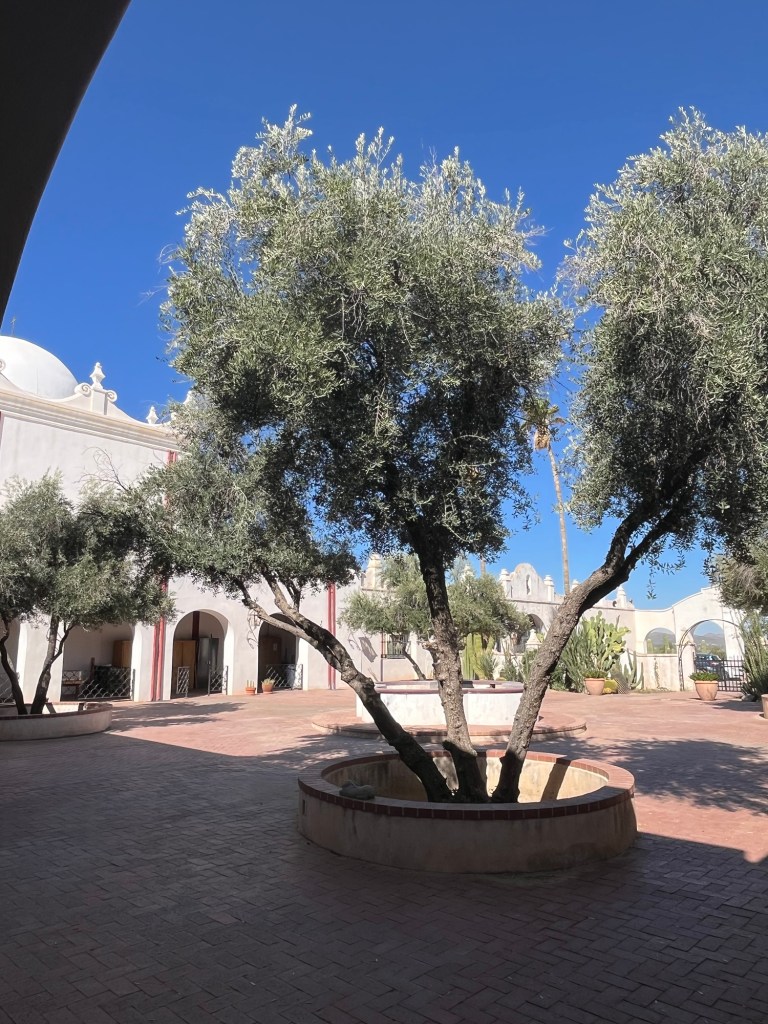
“Trust (lean on, rely on, and be confident) in the Lord and do good; so shall you dwell in the land and feed surely on His faithfulness, and truly you shall be fed.”
Psalm 37:3 “He wants me to help those in Zion who are filled with sorrow. I will put beautiful crowns on their heads in place of ashes. I will anoint them with olive oil to give them joy instead of sorrow. I will give them a spirit of praise in place of a spirit of sadness. They will be like oak trees that are strong and straight. The Lord himself will plant them in the land. That will show how glorious he is.”
Isaiah 61:3 -
Shinjuku: Travel Goals Japan
Our neighborhood for the next month is about fifteen minutes (bus) or a half hour (walk) from Shinjuku Station in the direction of Nakano City. It is quiet and residential. There are a few shops hidden in the apartment blocks that front endless back streets of houses. There isn’t much traffic. Here we are much more likely to be run over by one of the many bicycles that come blurring by without warning than a car. Grannies gotta get got to their groceries and you best not step into the preferred path, because they aren’t veering or slowing down for you. It makes for interesting sidewalk travel sometimes.
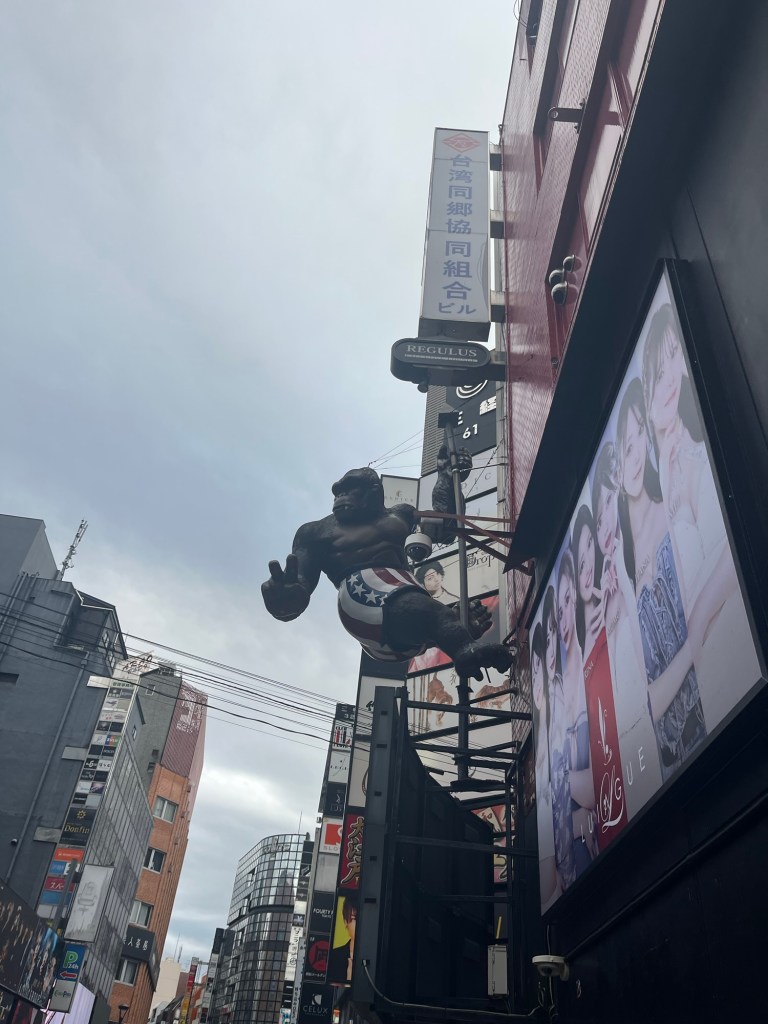
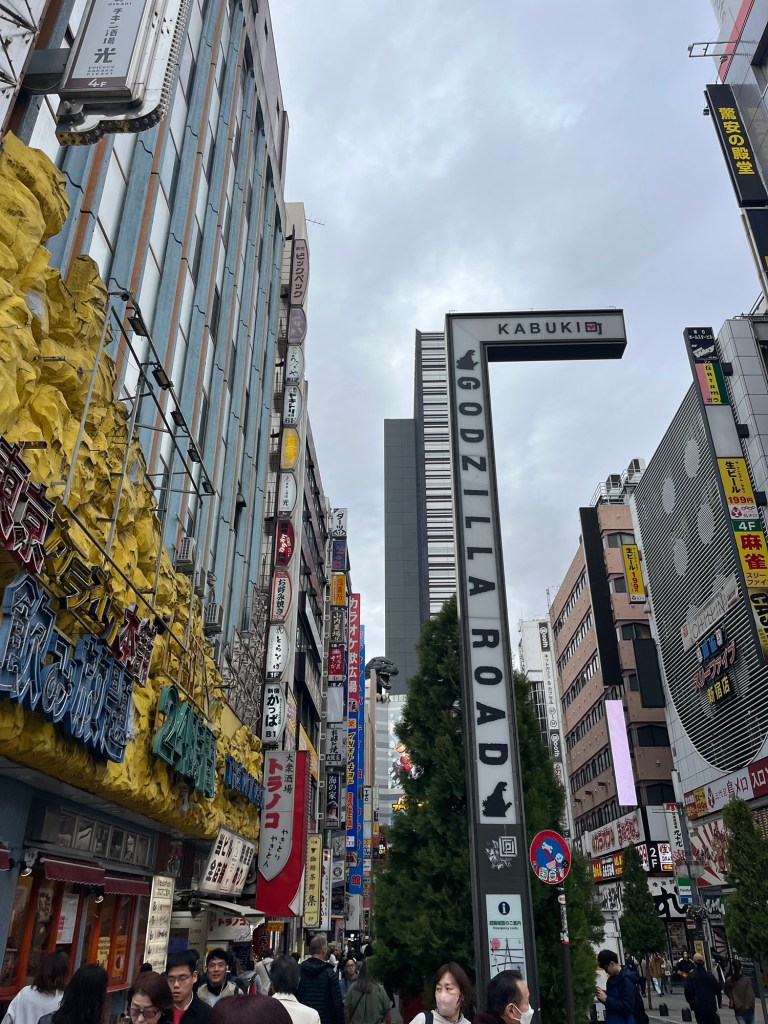
Today, though, we head in the opposite direction from the station. There are few bicycles as we walk deep into the streets of Shinjuku, but the (car and foot) traffic is intense. This part of town is a strange mix of offices, restaurants and entertainment complexes. Godzilla towers over buildings in one section. Further along King Kong hangs from the side of a bill board. He is sporting red, white, and blue boxing shorts. I guess he has a Rocky complex. Quirky is not an adequate description.
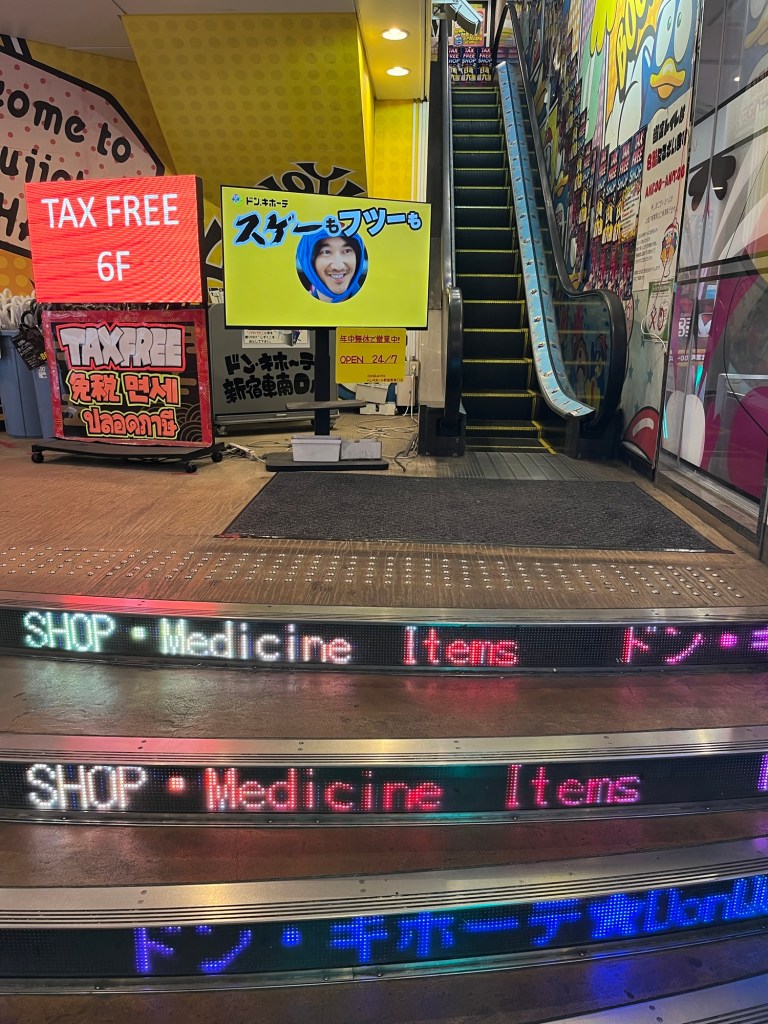
We visit a Don Quixote (one of many in Tokyo). It is hard to describe this multistory department store. Souvenirs have exploded into the aisles among health care products. There is luggage, alcohol, and lots of unidentifiable objects. It is has a circus like atmosphere as locals shop like there is a fire sale at a “Five Below” and tourists wander around with their mouths open trying to figure out what is in that container that looks like a monkey holding a sponge. Or why cookies are nestled between single use colored contact lenses with over enlarged tinted iris enhancers. Seven stories of crazy finds later, we are exhausted and ready to leave the chaos.
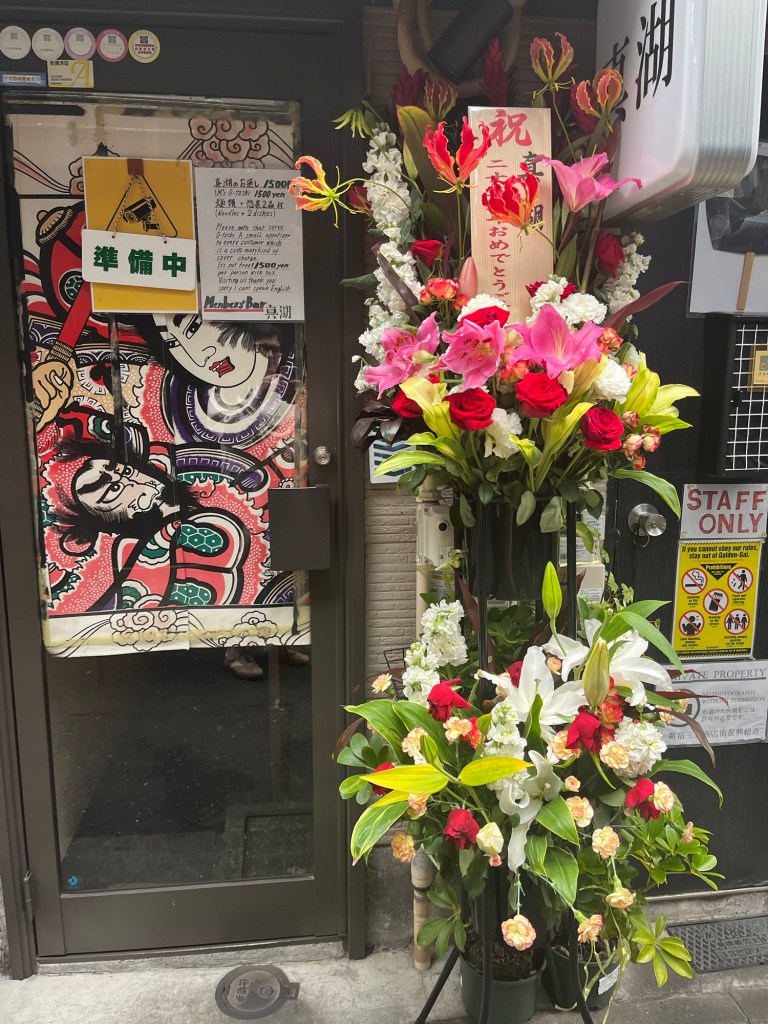
We stop for coffee and pastries at an outdoor cafe and watch the world bustle by. After a rest, we walk on to a small corner of the world called the Golden Gia. This is where people flock to experience an old Tokyo vibe. The streets are so narrow they hardly qualify as an alley. The buildings are all attached to one another with electric haphazardly strung. The establishments are mostly bars. Each has only room for a few people to enter at a time. Some charge a fee for the privilege. But it is afternoon and the crowds have not yet descended. I wouldn’t want to be here in the drunken rush. We look in open doorways and walk on.
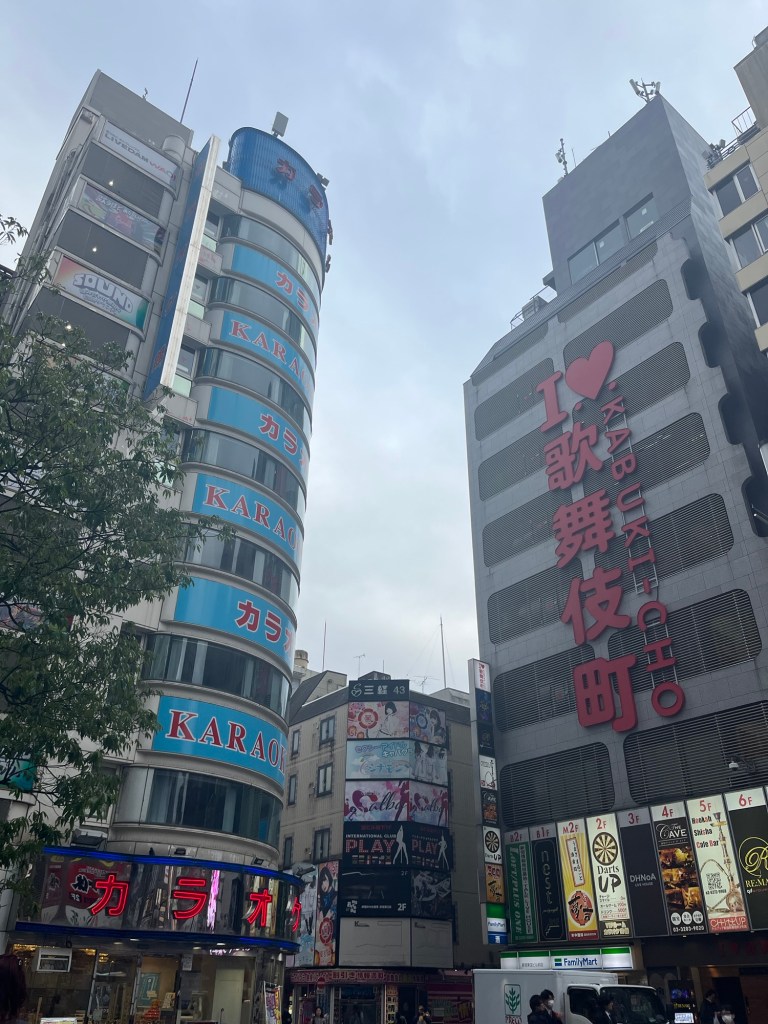
Our route back to the bus depot takes us through the former red light district. Today, only billboards of beautiful young men and women hint at strip clubs and gay bars. The Japanese are more subtle. If you didn’t know where you were, you may not even pick up on the signals. Wholesome looking college age individuals hand out advertisements and invite you upstairs for a “show.”
Further along, the street once again turns into a haven for business professionals who use the trains. There are shops that sell suits, electronics hubs, copy shops, technology support, briefcases, shoes and leather goods. There are quick food stops for ramen, soba, and udon. And it seems there is a karaoke complex on every corner. Nothing signals the end of a long workday like a sing along with your closest friends.
The many faces of Shinjuku reveal themselves as we walk our way across its many streets. Sometimes the best way to experience a place is just to walk.
-
Casa Grande: Rural Road Trips
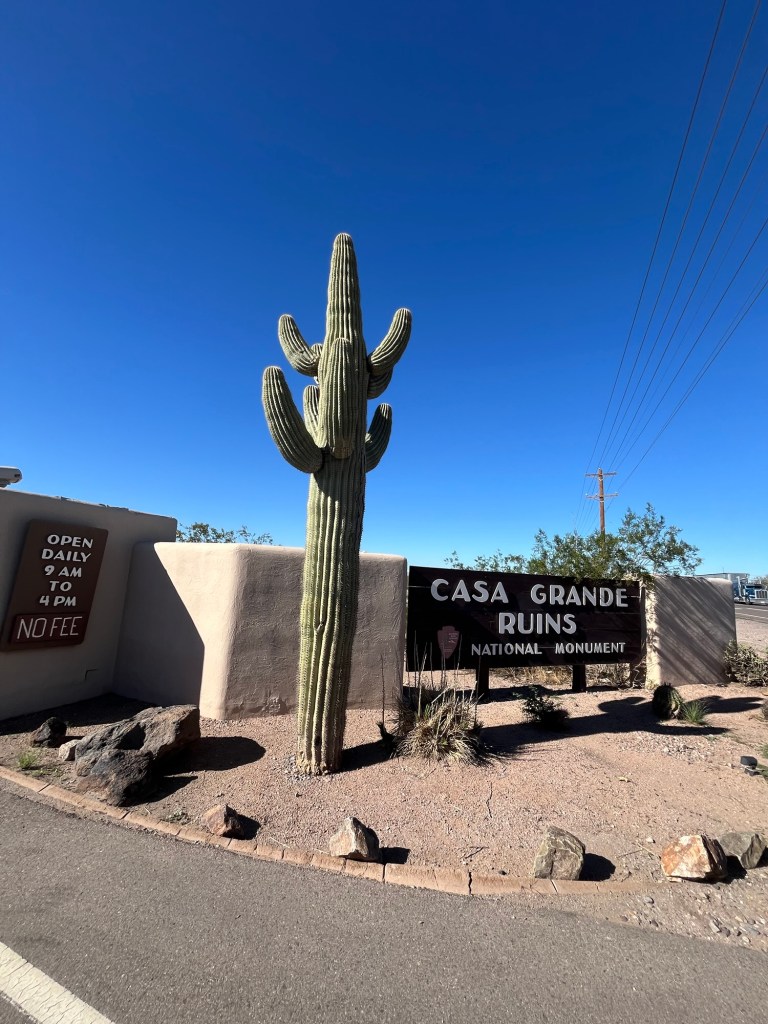
It is supposed to be a grand road trip to visit lesser known national parks and historic sites. Unfortunately Congress cannot agree on a budget. The ensuing government shut down has caused more than a few headaches on this trip. Sites we intend to visit may be closed and today is no exception.
We arrive at the Casa Grande ruins to find a locked gate. I get a glimpse of the ruins from afar and have to look at photos of the rest of the park on my phone. It is supposed to be a national park day. Now what?
A quick google search tells us we are not for from McFarland State Historic Park in Florence, Arizona. With no idea what we will find, we head that way. The large saguaro cacti line the highway. We pass fields of cotton. It seems longer than a dozen miles, but …..Eventually we pull into Florence, a town that time forgot.
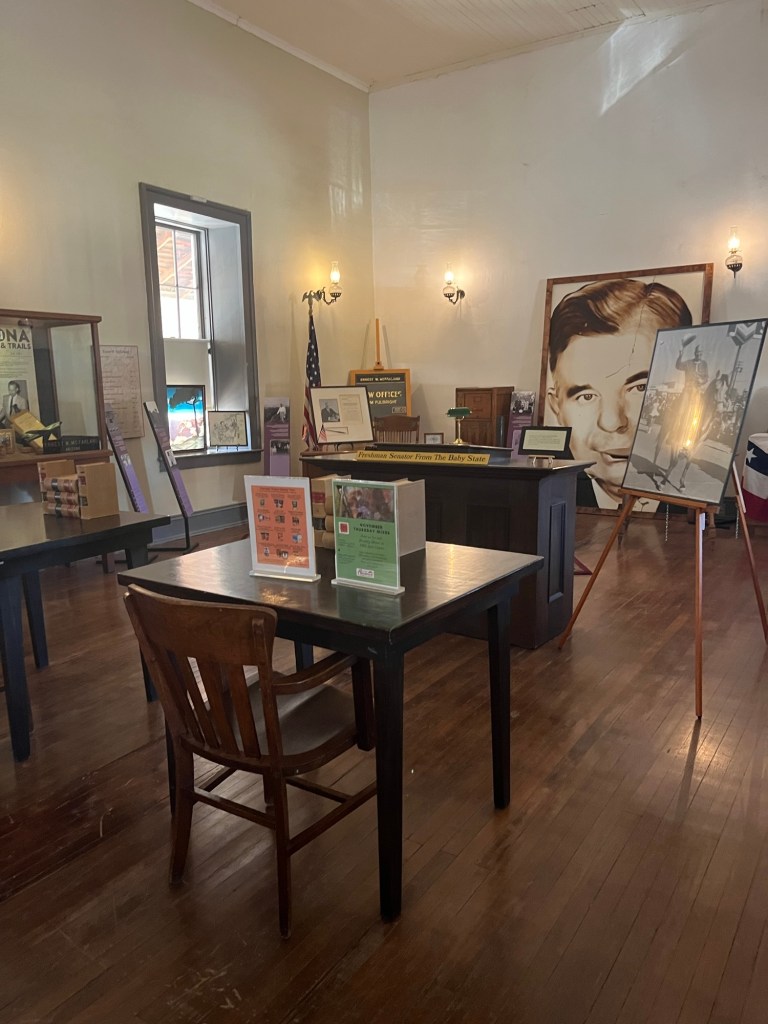
The state park is housed in what was one of the first courthouses to be built in Arizona in the late 1880’s. The building has also been used as a hospital, welfare center and social center. In the 1970’s Senator Ernest McFarland petitioned the state to preserve the building and promised to give them his private memorabilia. They agreed and McFarland State Park was born.
We know nothing about any of the claims to fame. I have never heard of McFarland. Turns out he was a lawyer, a governor, and a U.S. Senator. He authored a small piece of legislation called the G.I. Bill. (At least I am familiar with that piece of legislation.) After his departure from politics, he pioneered television, by opening an ABC affiliate in Arizona. See…..You can learn many things in the most remote places. We come away at least a little more informed.
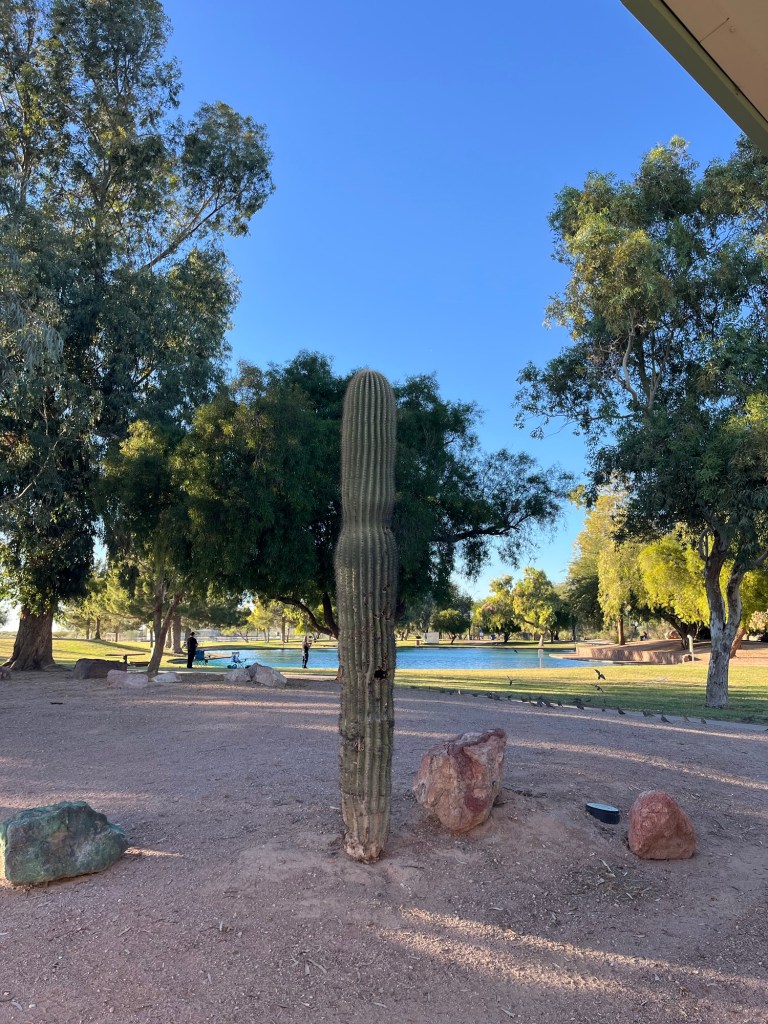
As interesting as our visit to Florence turned out to be, we had a lot of daylight left. I intended to hike today, so we try a few local parks. They are small with no trails. We don’t have a fishing pole or soccer ball, so that line of diversions don’t quite work out.
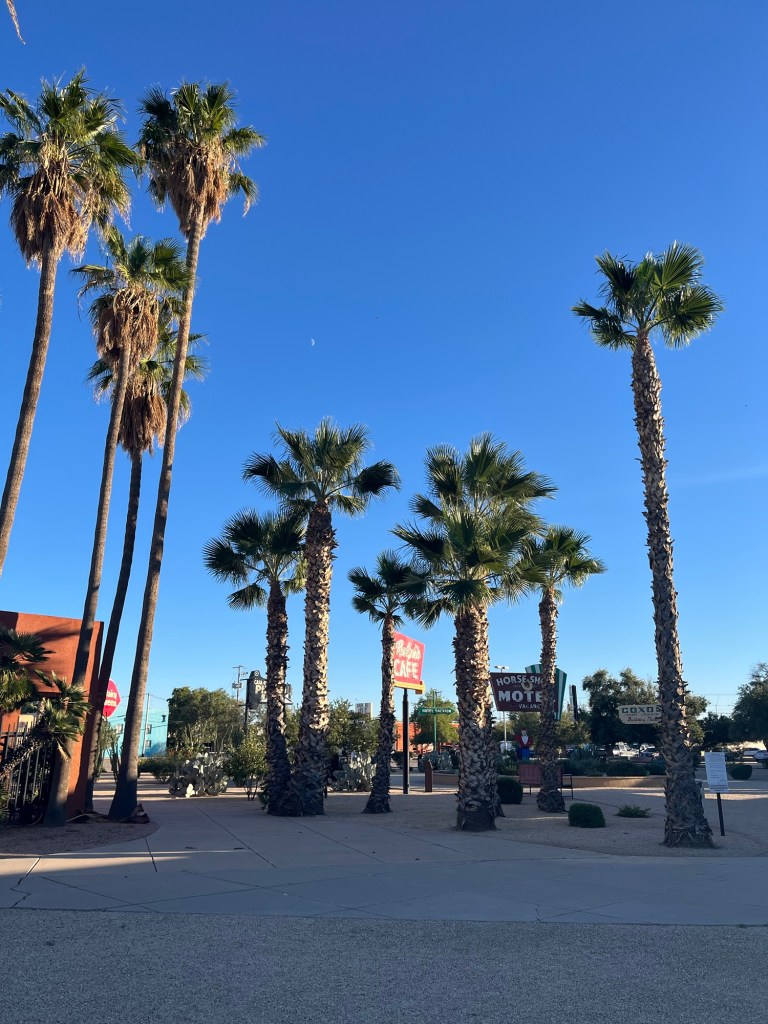
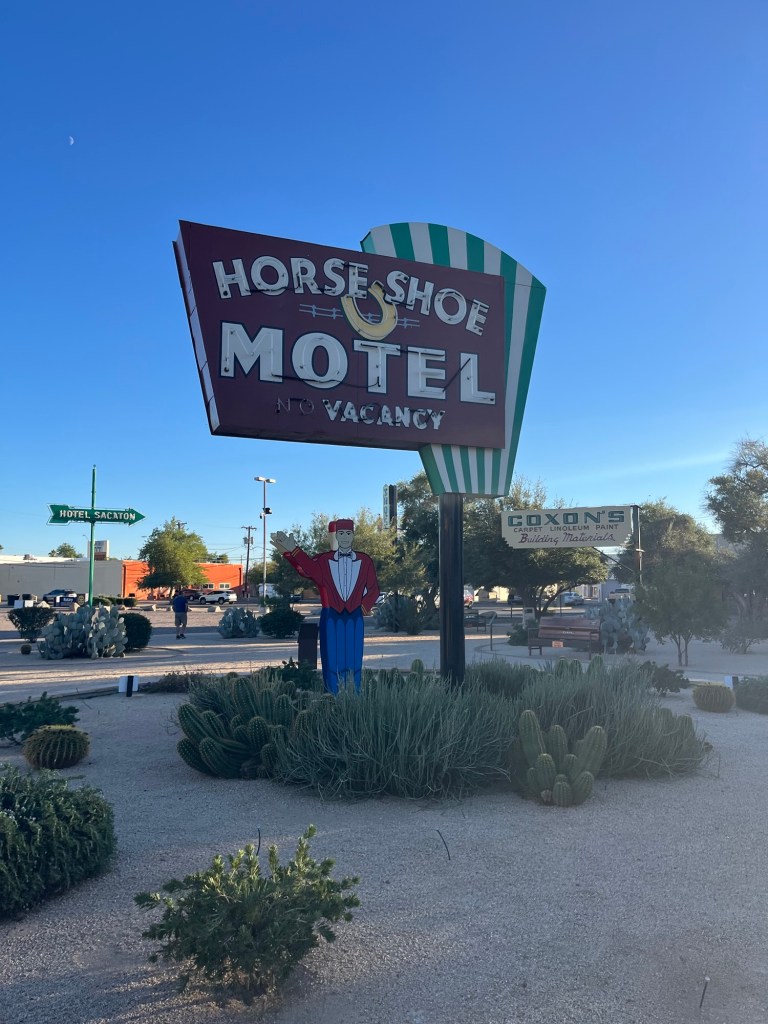
Across town, we find the Neon Sign Park nestled behind a strip mall. Casa Grande preserves about a dozen neon signs salvaged from old local hotels and businesses. They are retro kitsch at its best. But the park nostalgia only takes a few minutes to visit and we find ourselves again looking for something to do.
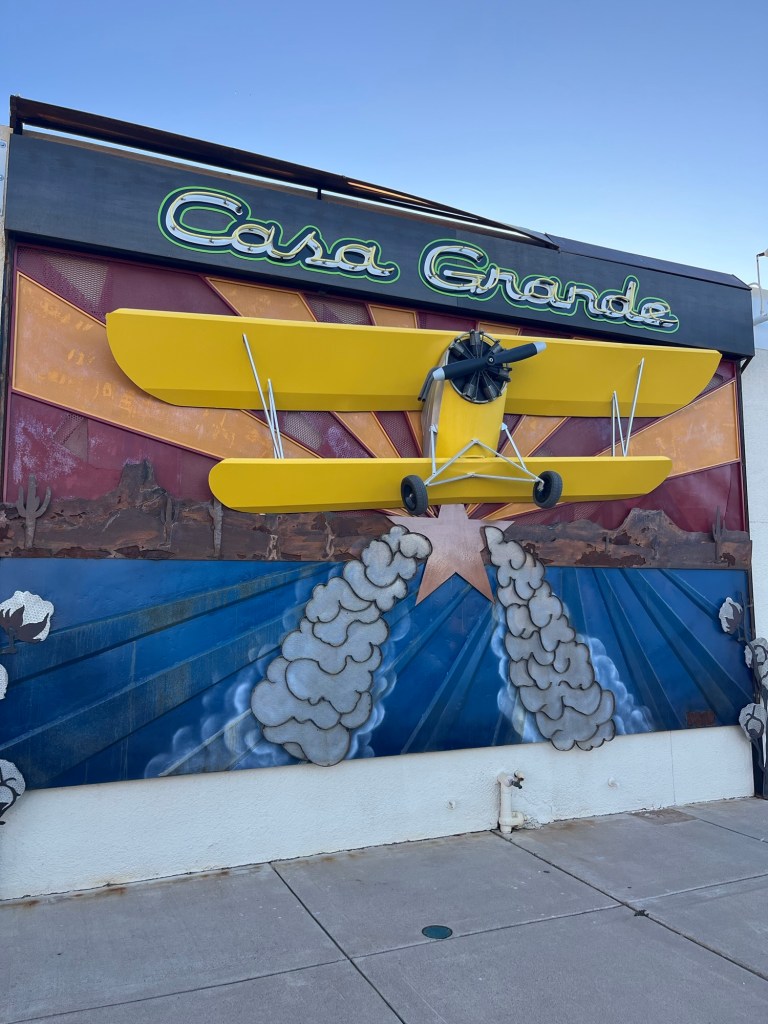
We drive downtown streets, but businesses are mostly closed. The local Walmart provides Halloween candy, just in case we get any trick or treaters at the rv later. There are retirement communities and rolled up sidewalks.
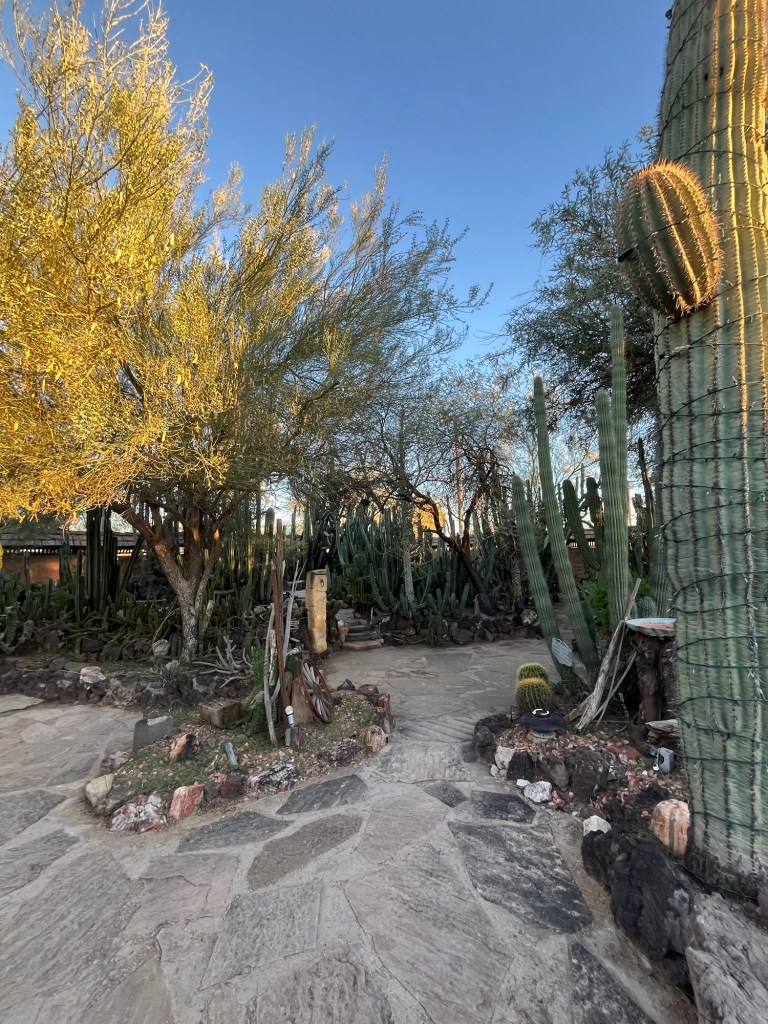
Eventually, I ask the internet to pick a local restaurant. The fast food we pass is not appealing. Through the magic of the internet, we end up at BeDillons. It is a local restaurant inside a former residential home. They have an amazing back patio surrounded by cacti. The place is busy, yet surprisingly no one is taking advantage of the patio. We do and so we have the magical garden to ourselves.
We find ourselves dining under the stars. There is good music and a great waitress. What a find! We mention how much we are enjoying ourselves to the waitress who said, “I’ll tell Dad.” She apparently has an “in” with the owner. Within a few minutes, he appears to chat. After finding out that we were former educators, he opens a large out building full of artifacts he has collected across his lifetime He proudly invites us to inspect his private collection at our leisure and trusts us with the building. We are happy to take him up on his offer.
Casa Grande has not gone as planned. That is okay. We certainly have experienced things we otherwise would never have planned. And that is what makes travel experiences memorable. It is a good day.
-
The Takeshita Experience: Travel Goals Japan
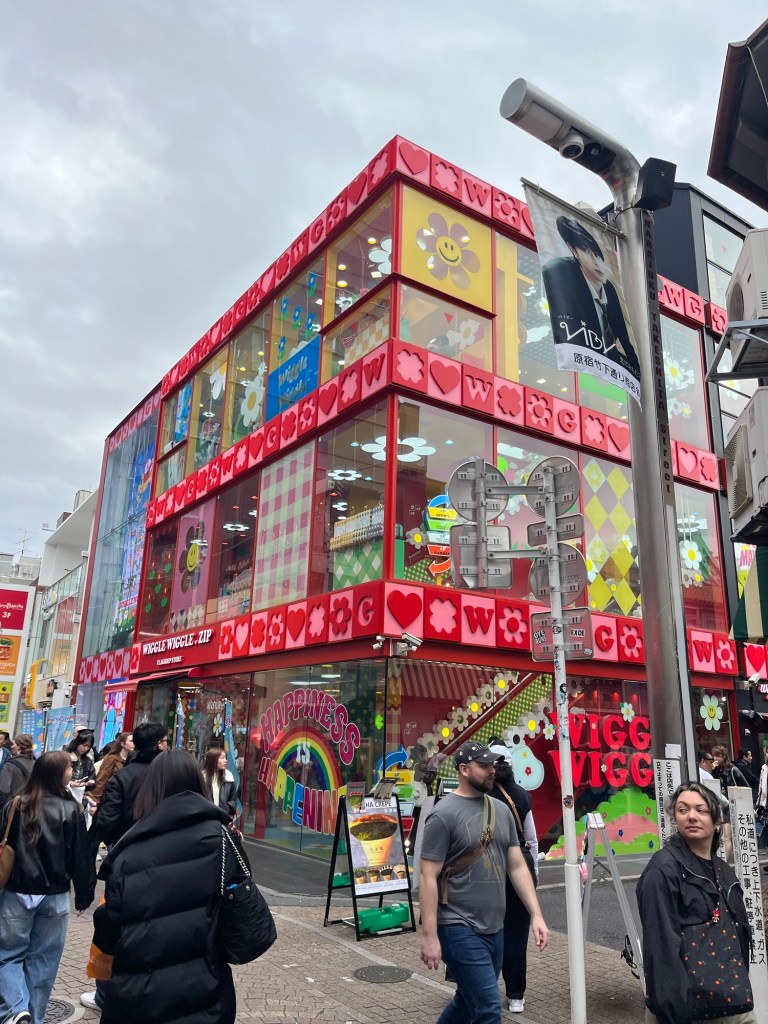
Explosions of sights, smells and sounds. People lining the streets in constant motion. Shops, food, pets…. On Takeshita street, you should expect the unexpected.
Just steps from the Harajuki Station, Takeshita street is a few blocks of weird and wonderful Tokyo shopping. Perhaps this is not the place for serious shoppers. You will not find name brands or department stores. This street is for people who want to experience a specific Tokyo vibe. Takeshita is all about having a good time.
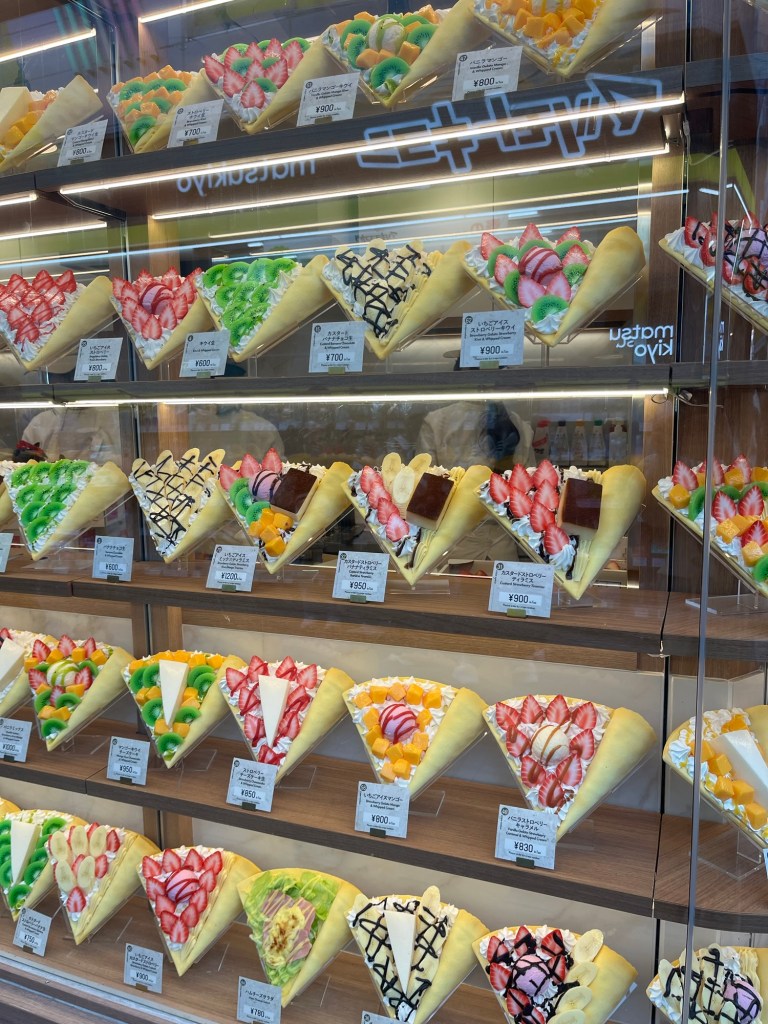
There is food. Multiple shops sell crepes filled with anything and everything you can think of from fruit to fish. You can get ice cream, tiramisu, and even spam crepes. I would stick to the sweets…. But that is just me.
Feeling thirsty? For a small fee you can visit a pet cafe and enjoy unlimited tea, coffee, and soft drinks while cuddling a pig. You can hold a meerkat or hedgehog. Traditionalists can play with dogs, ferrets or guinea pigs. Exotic animal lovers can hand feed capybaras or sidle up to a fennec fox.

Want to return to your childhood? No worries. You can visit the Sanrio store and say hello to kitty. Or, you can spend hours in capsule stores finding just the right miniature figure or gotcha. There are ninja costumes and themed shops connecting you with action heroes and anime characters.
Clothing shops are also represented. If you are into character apparel, sexy lingerie, kawaii culture outfits, platform shoes, or sports jerseys they have you covered. I even found a few well stocked vintage stores.

The streets are full of people and the energy is high. Teenagers outnumber adults by two to one. We scurry from shop to shop and try not to get separated. It is hard not to stop and stare. In a just few minutes I saw a girl dressed like little Bo peep, a man carrying a monkey, a child eating a crepe bigger than their hands could hold, and a grown man laying in a pile of pigs. Distracting does not begin to cover the sensation of Takeshita street. It is something that must be experienced.

-
Tlaquepaque: Rural Road Trip Arizona
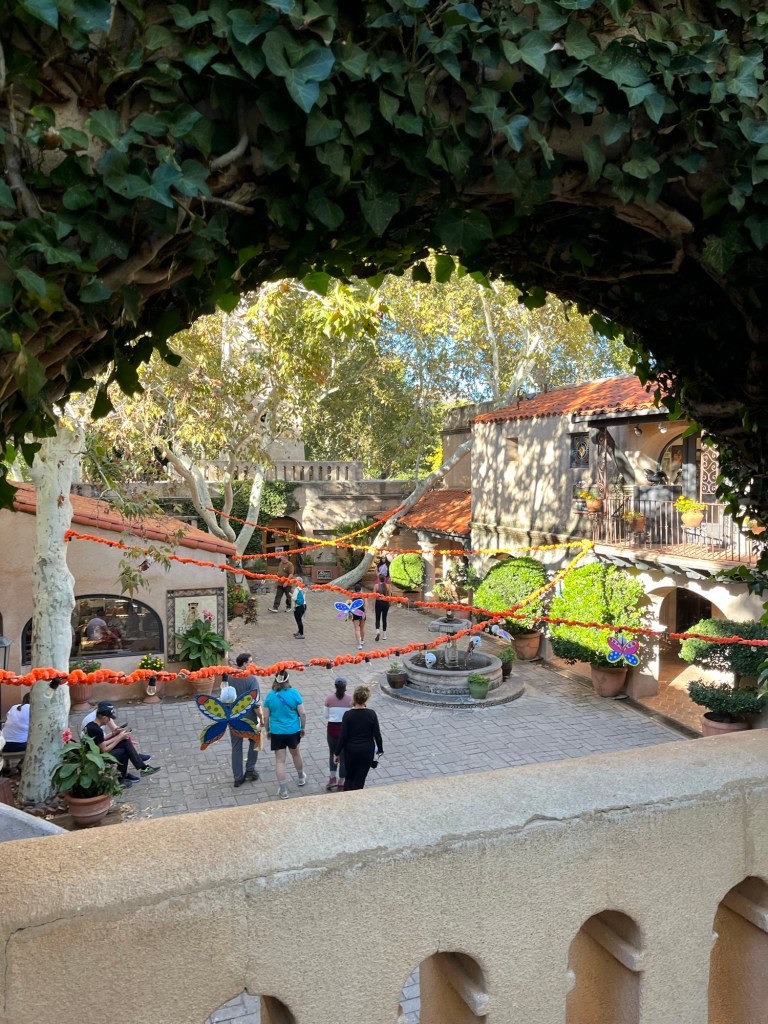
Somewhere in Sedona there is a shopping area that surprises. Tlaquepaque (tlock-ay-pick-ay) is a delightful and eclectic village of shops amid a historic looking adobe cluster of buildings. We decide to stop and check it out after hiking all day. We are not dressed for the clientele, but it is either now or never. We leave the area first thing in the morning.
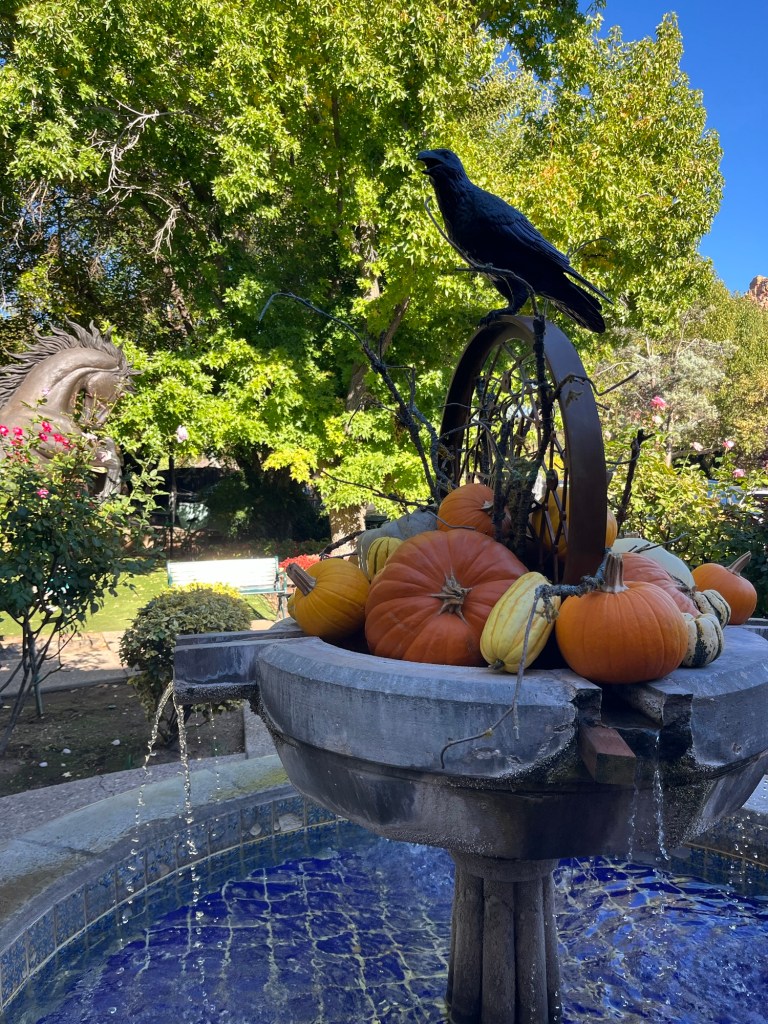
There are fountains in shady courtyards and enough pumpkins to start a farmer’s market. Workers are busy preparing for Halloween or Dia de las Muertos. My husband finds a seat under the trees and happily watches the chaos while I wander shop to shop.
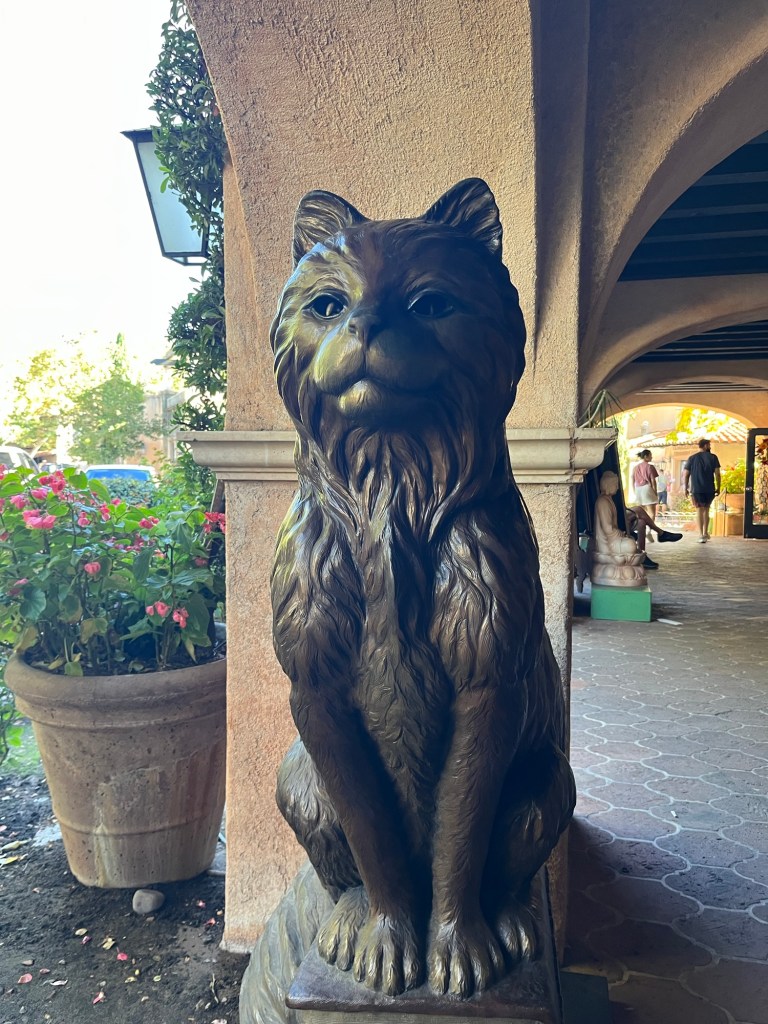
There are lots of art galleries. In some, the vibe is welcoming. Local artists who clearly enjoy their work and the people who visit, greet me with smiles. In others, there are whispers and suspicious looks as people with clipboards block the door and look at my jeans and dusty shoes and determine I don’t fit their profile.
But I am not easily deterred, rude salesmen are simply an interesting challenge. While I don’t intend to buy overpriced art, I may find something I can’t live without. And I am a “Show Me State” girl. I have never let pretentious behavior get in my way. A curled lip and rolling eyes only gets a smile and a “can I just walk past you to see the painting over there.” Apparently, smiling at people trying to be rude is confusing to them. It must be draining going through life judging and mentally sorting people into the worthy and unworthy.
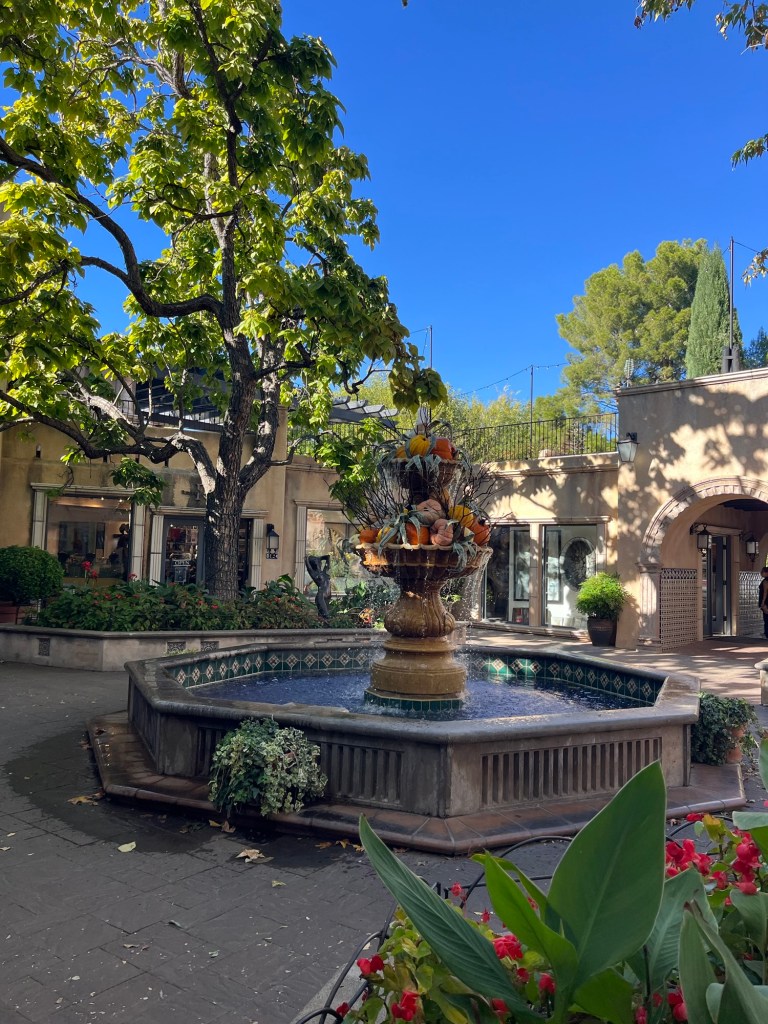
Outside, a fiesta of sound creates a party atmosphere. I dance my way to record stores, book stores and a variety of small businesses. There is clothing, candles, jewelry, shoes, antiques, yard ornaments, cooking gadgets, pet supplies, rock shops, and even toys. I am not really in a buying mood, but that doesn’t mean I am not enjoying the multitude of possibilities.
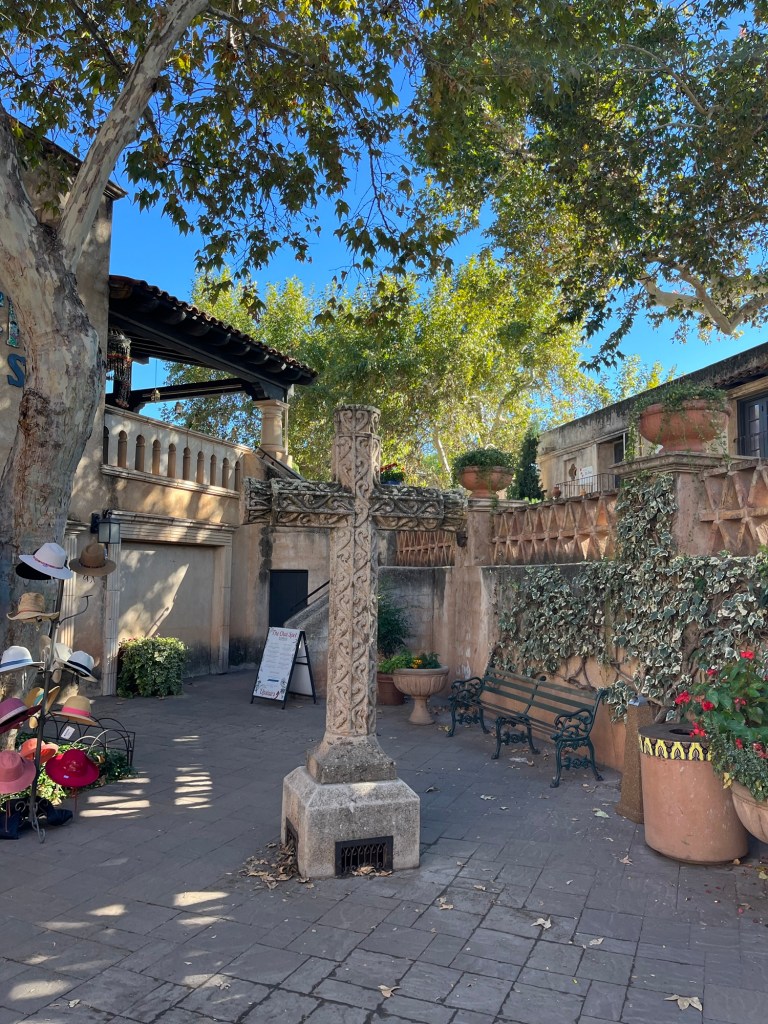
Eventually the day winds down. I come to the end of the shops. We have hiked all day and I have wandered this place for a good deal of the early evening. It is time to go.
My verdict? Tlaquepaque’s atmosphere is special. If you find yourself in Sedona, you should make time for a stroll….even if you are not dressed for the clientele. If you see a rude woman in a black suit with a clipboard blocking the door to a shop selling framed photographs, smile and tell her I sent you.
-
Red Rock Hike: Rural Road Trip Arizona
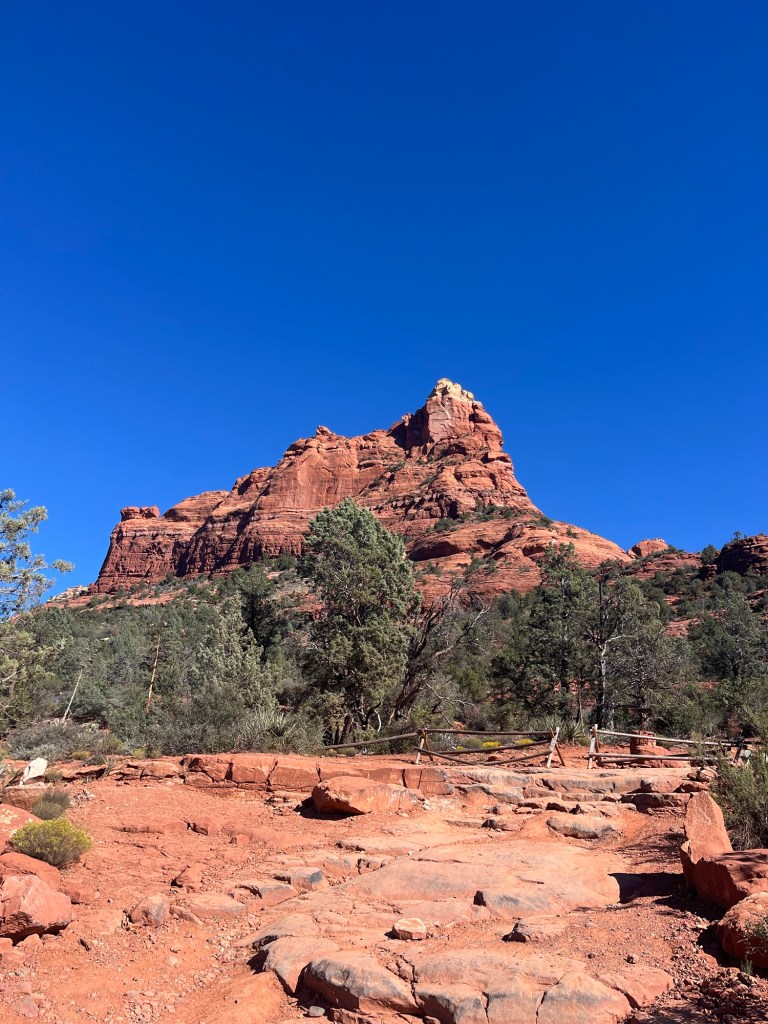
I love to hike, but I am married to a reluctant hiker. Translation: he actually likes to hike once I can get him on a trail. This may involve suggesting, asking, cajoling, and/ or answering many questions and providing hypothetical solutions. There is ritual involved with often repeated refrains.
For this trip, the suggestion…. “I really want to hike a trail while we are in Sedona at least one day.” “What day do you want to hike with me?” “Let’s take a pink jeep tour and scope out the place.” “Is today the day? Okay we can go tomorrow.”
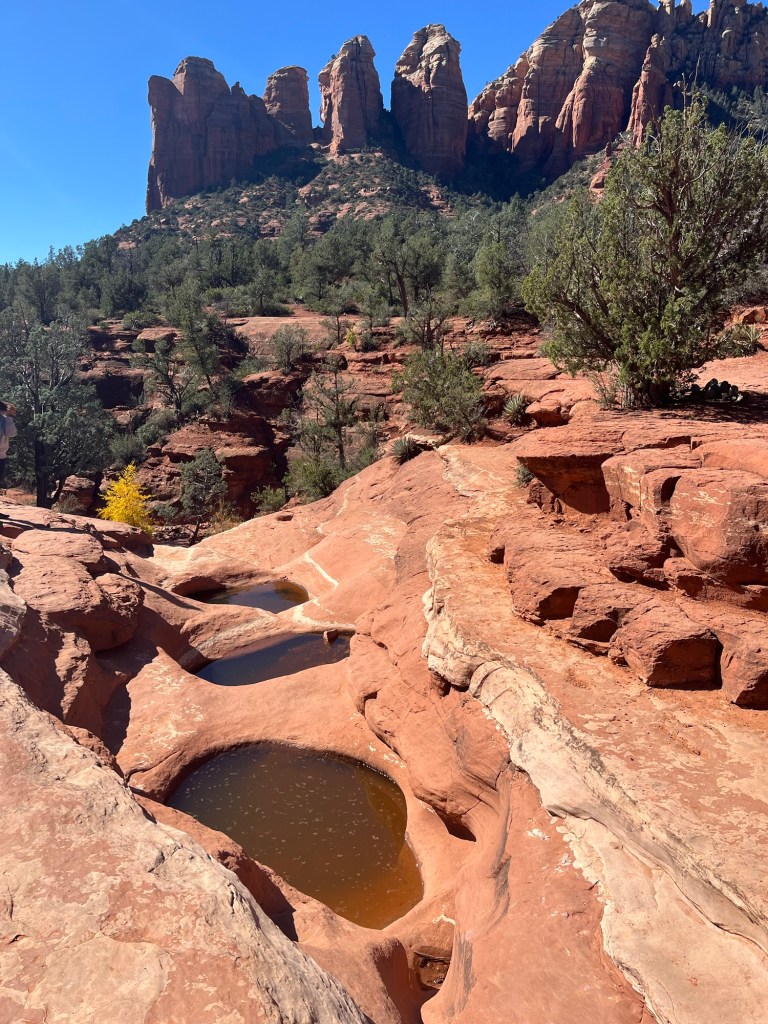
On the last day in Sedona it is finally “the long hike day”. I have scoped out two trails in two different parks. I figure a half hour drive between them will be an incentivized rest break. Plus, I will offer lunch.
He is surprisingly agreeable and asks “How far do you want to walk?” I answer, “I’d like to see the sacred pools.” “How far is that?” “It depends which route we take.” It always helps to give options, but he is smart and on to my tricks. “Which way is shortest?” “The shortest way may not be the most scenic.” “Yeah, but it is hot.” “That is why we are going early.” “How early? I don’t like early.” “Then we can go later .” “But then it will be hot.” And so it goes.
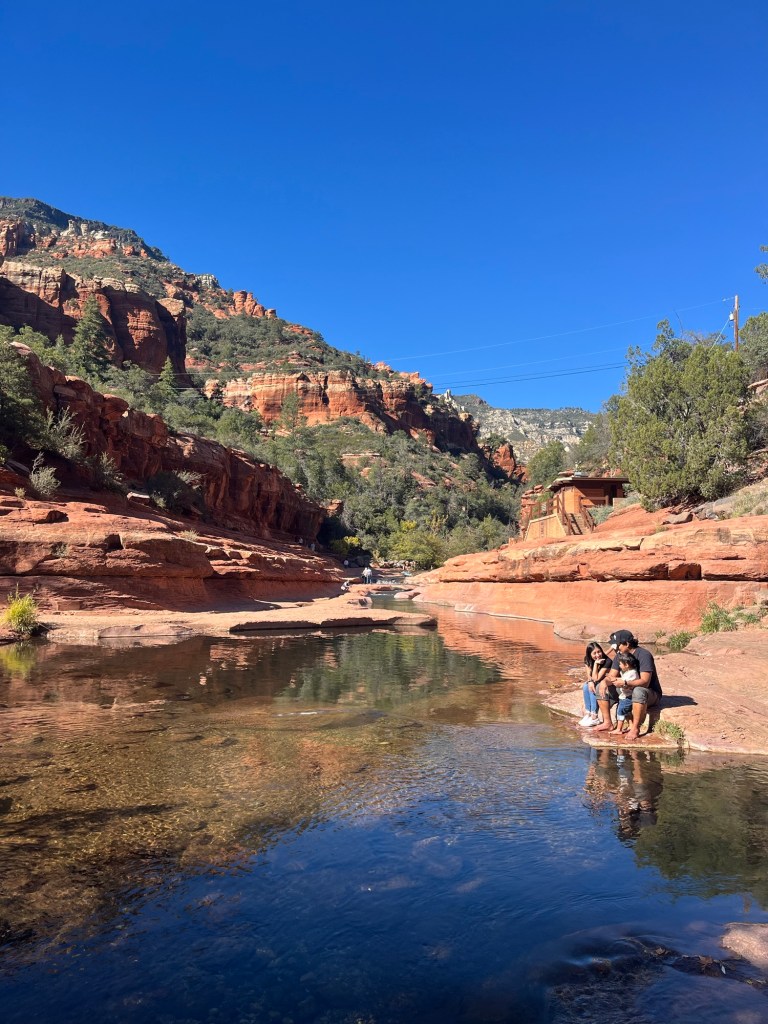
We drive to the trailhead and the lot is full. “Now what?” “We need to drive to the park we passed a while back and park there.” “That was like a mile ago.” “It was a half mile.” “But that will add another mile to the hike.” “Yep, it will.” “So we are doing this anyway?” “Yes”. Heavy sigh. “You can drop me off and come get me later.” “I am already parked now.”
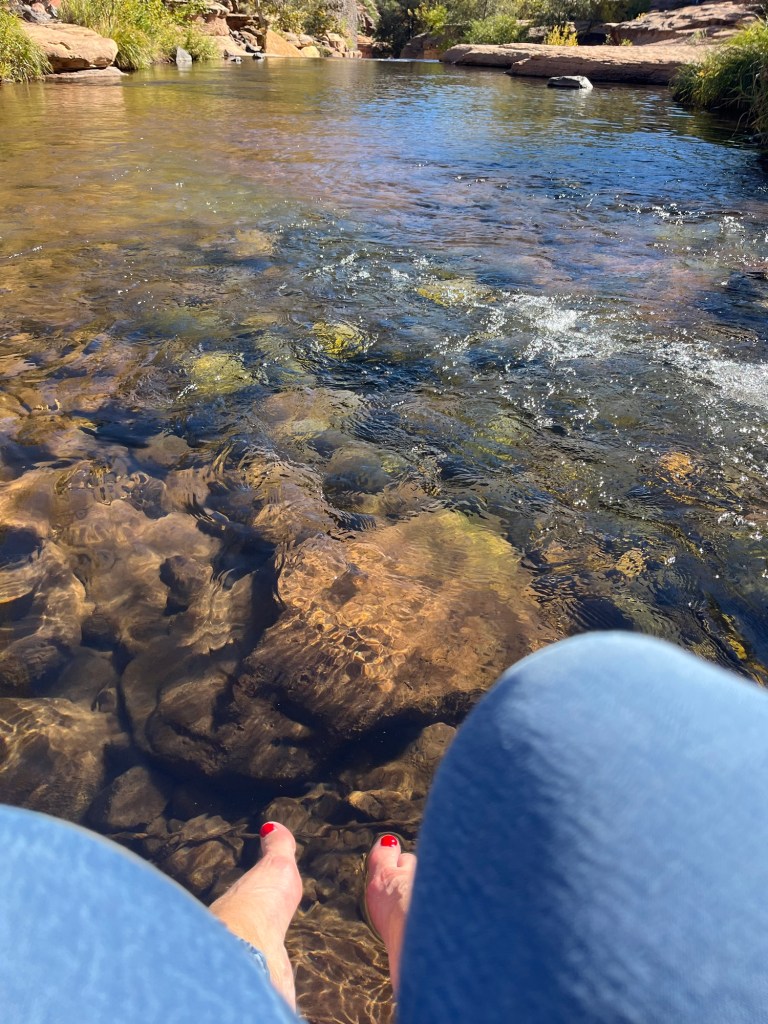
“It is hot.” “I am sorry.” “I have sweat everywhere my clothes are soaked.” “I am sorry.” “I am gonna stand here in the shade.” “Okay.” And so it goes.
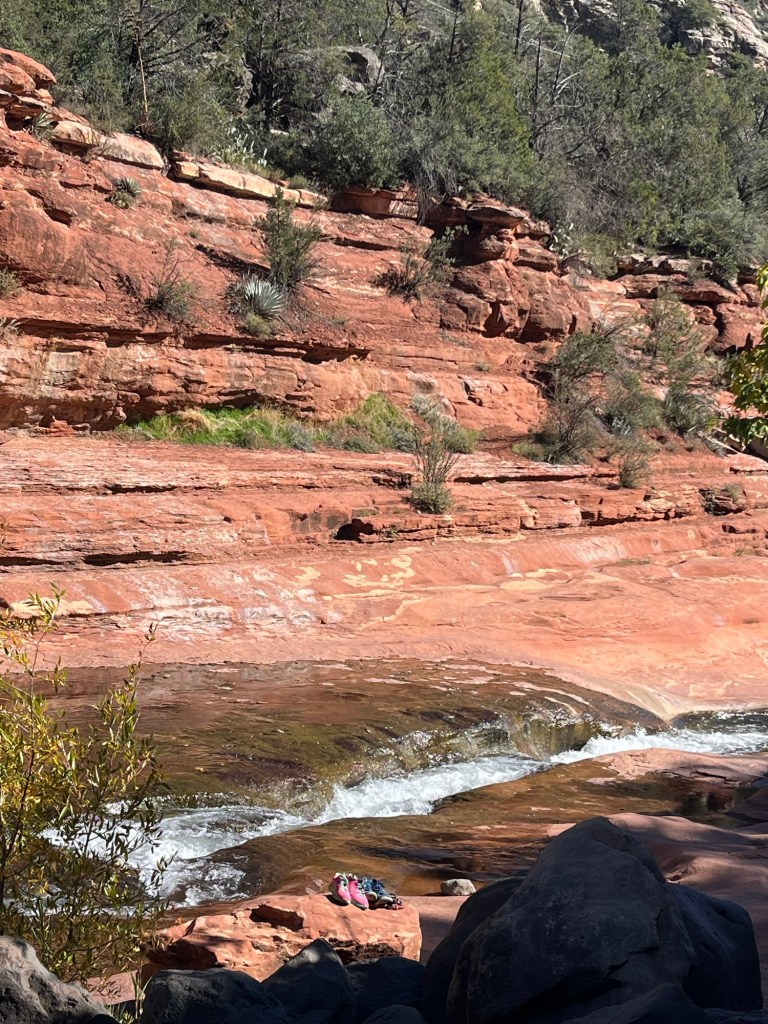
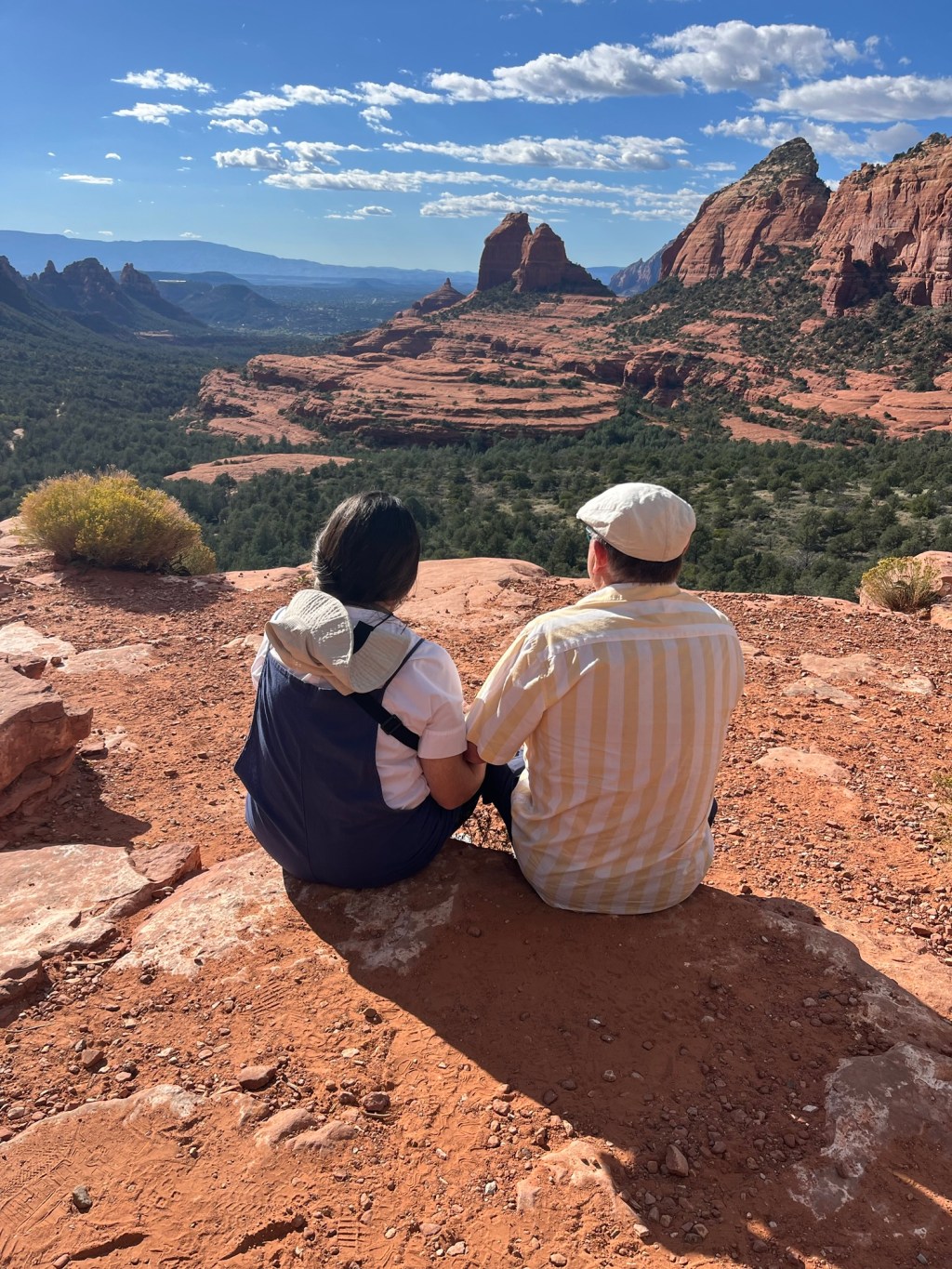
But also there is laughter and hand holding and beautiful scenery. He loves me enough to come along, even if it isn’t on his must do list. And when I turn into the hiker who never met a bend in the road I didn’t want to see beyond and the miles begin to accumulate, it is okay if he decides to sit out. For me the act of hiking is the important part, not the destination. I can go a few miles on my own and then loop back. We can take some time to sit in the shade or wade in the creek. But it is important that we share the moments, even if we drive each other crazy in the process.
“It is only a few miles.” “You said that three miles ago.” “Fifteen more minutes.” “Sure, and donkeys fly.” “Are you sure you are going the right way?” “It’s what the trail app says.” “Why is everyone else headed that way?” “I hate going uphill. Are you going to wait for me?”, says he. “Slow down, I can’t go downhill that fast,” says me. “Did you bring water?” “You shouldn’t be walking in those shoes, you’re going to turn an ankle.” “What are we doing for lunch?”
The new lines keep coming. But the song is as old as time. It is the language of life long love, a familiar duet performed among the red rocks. If you have been married for decades, you likely know the lyrics. Feel free to sing along.
Prisoner of Hopes
 Prisoner of Hopes