-
We Haven’t Got Munch Time: Travel Goals
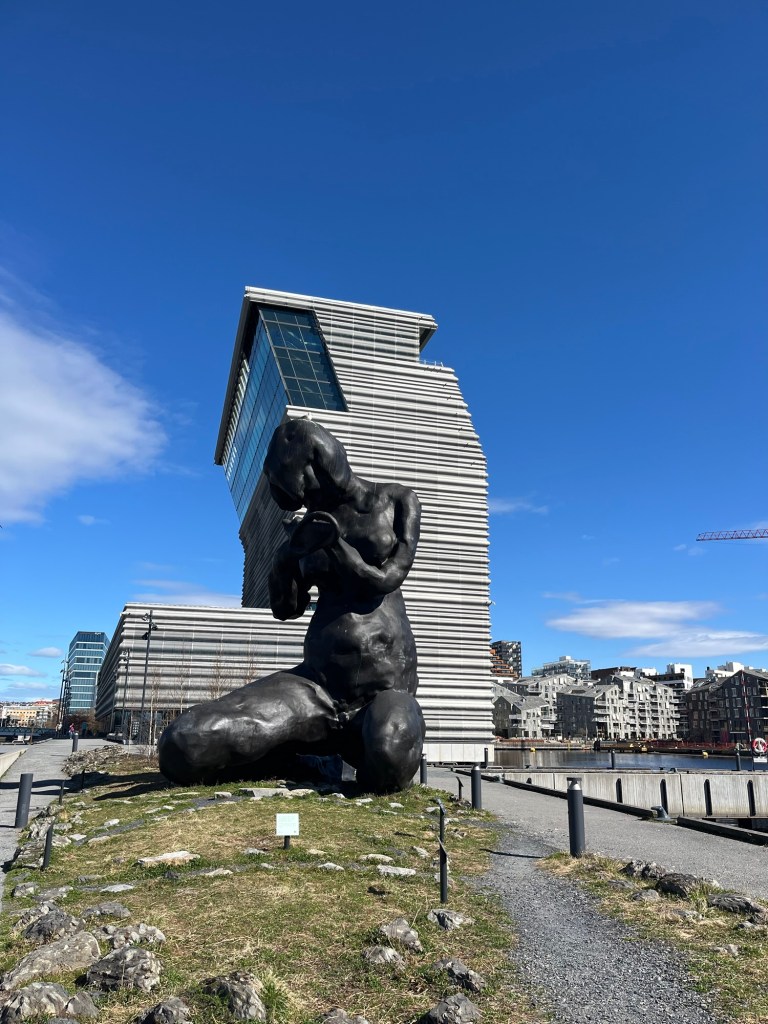
We have only a few hours before we leave Oslo for the airport. We have said goodbye to our apartment and turned in the keys. The hotel that we stayed at on our first nights in Norway graciously agrees to hold our luggage so we can zip across town to the Munch Museum.
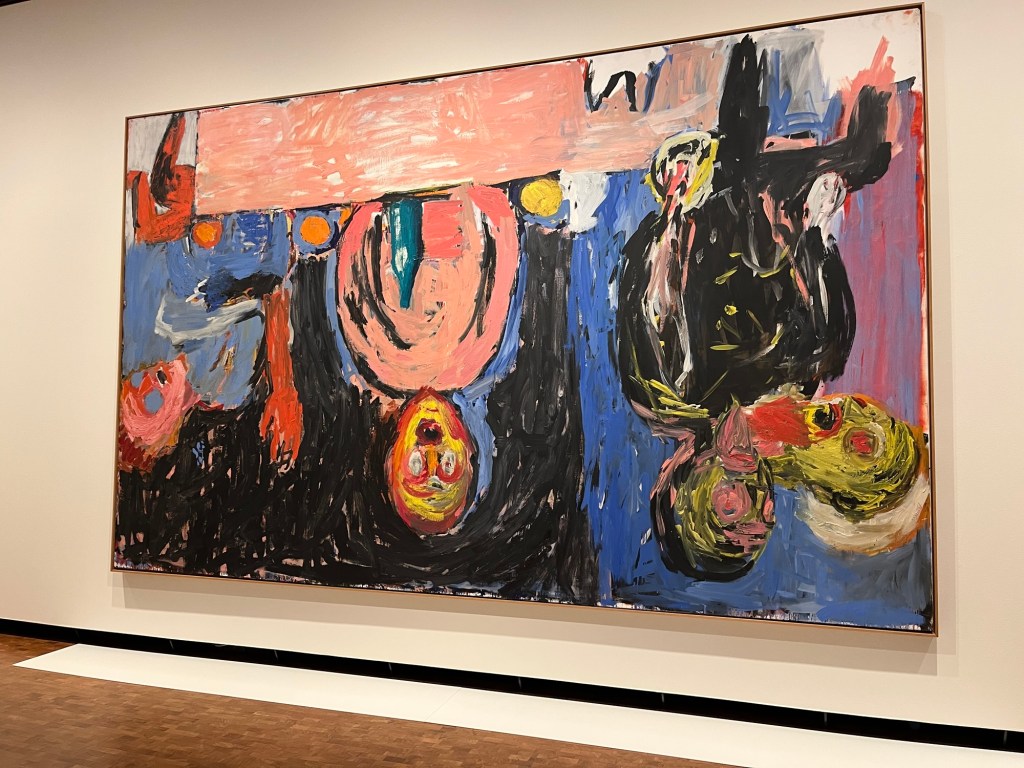
Munch is not for everyone. I am not sure why I am drawn to his bold and often bizarre style. I wasn’t going to visit as it is not my husband’s thing. But I have three final hours and here I am. I am standing in a gallery of upside down paintings by Bakelite, a German artist. Bold and extreme, his work is interesting but not for me.
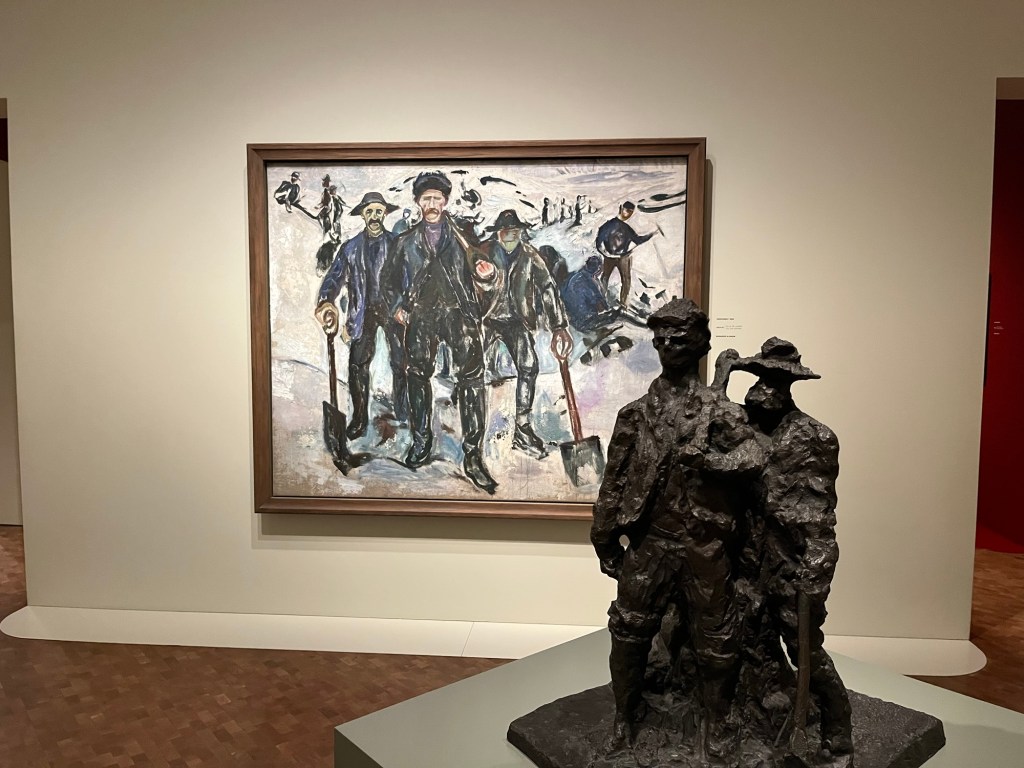
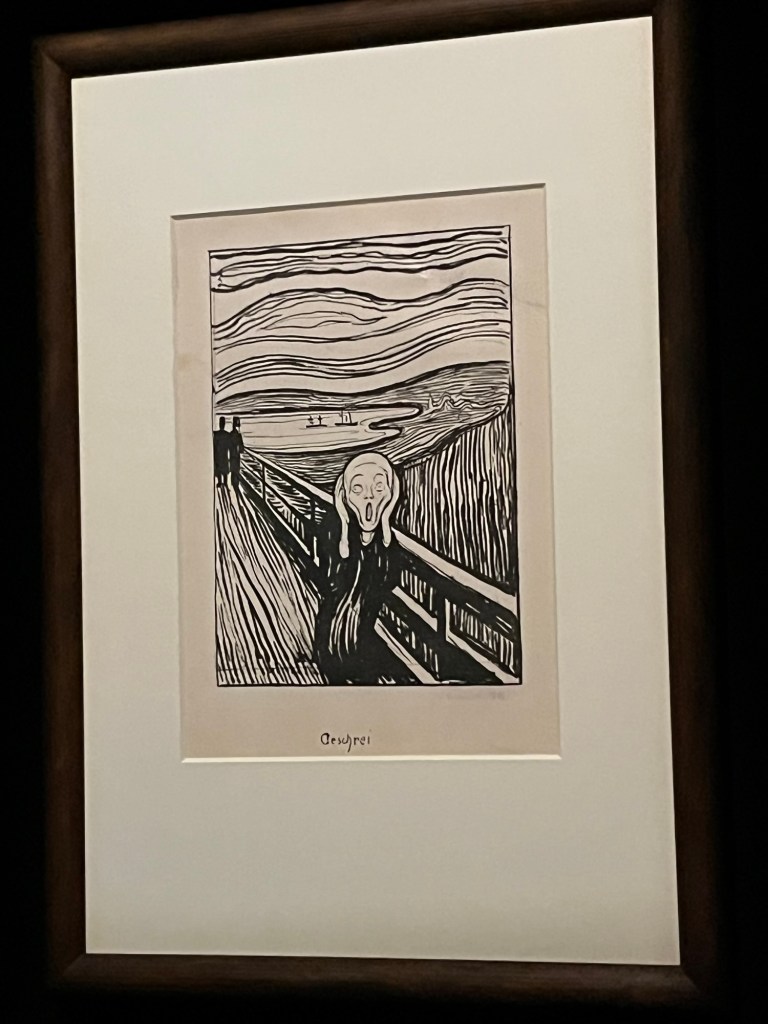
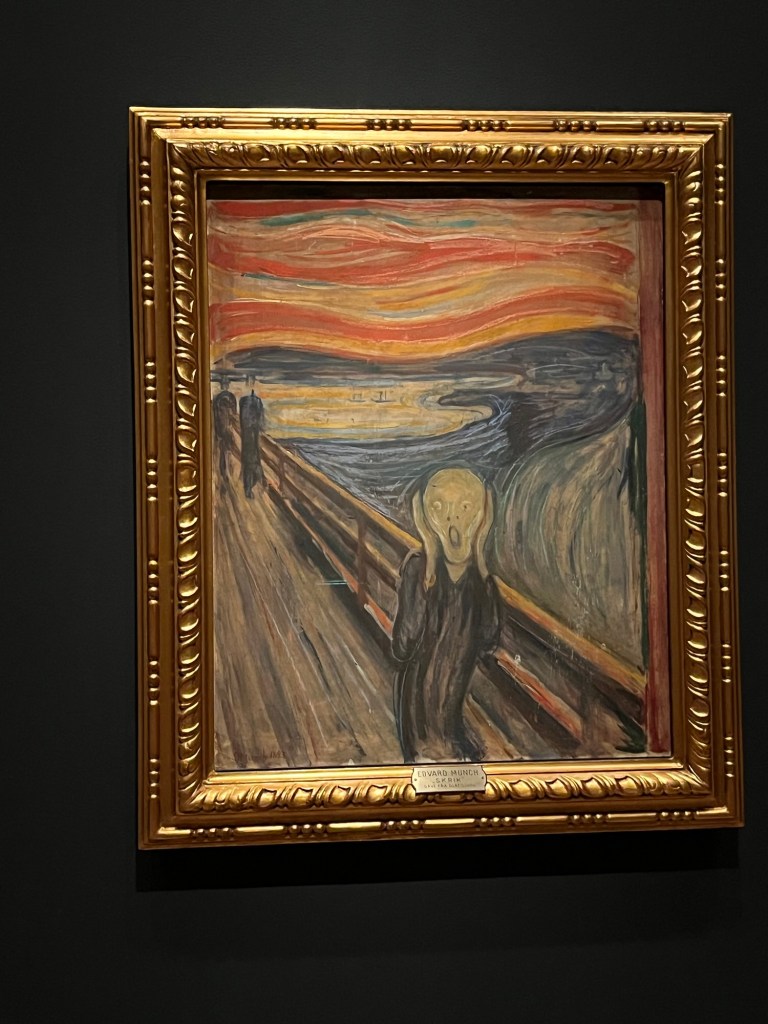
Munch is more subtle. His work is understated emotion. The pieces fluctuate from defined elegance to manic cries. The Scream is iconic. A visual display of internal anxiety. He said that he heard the scream of nature.
The museum houses pieces from childhood to bohemian adulthood to mental illness phases to recovery and old age. One room allows me to sit for a portrait while an automated easel allows me to converse with the artist while he works. I am intrigued and surrounded by his easels and brushes. I examine woodcuts and sculptures and paintings.

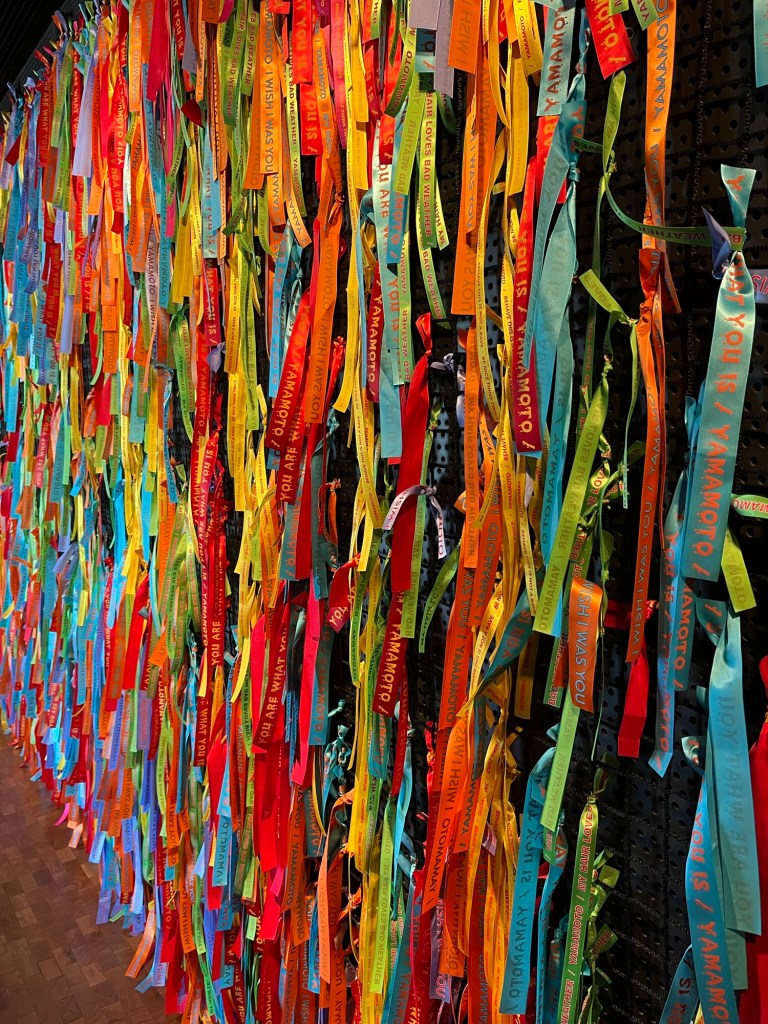
A few galleries exhibit new artists. One room was simply party streamers and a giant hill on which to recline. Modern art really isn’t for me. But Munch….. I internalize…. I feel….
Before I know it, my time with Munch is over. So is our time in Oslo. We board our train and arrive at the airport hotel. Our flight leaves before dawn and we want to sleep a bit. It is also our anniversary.
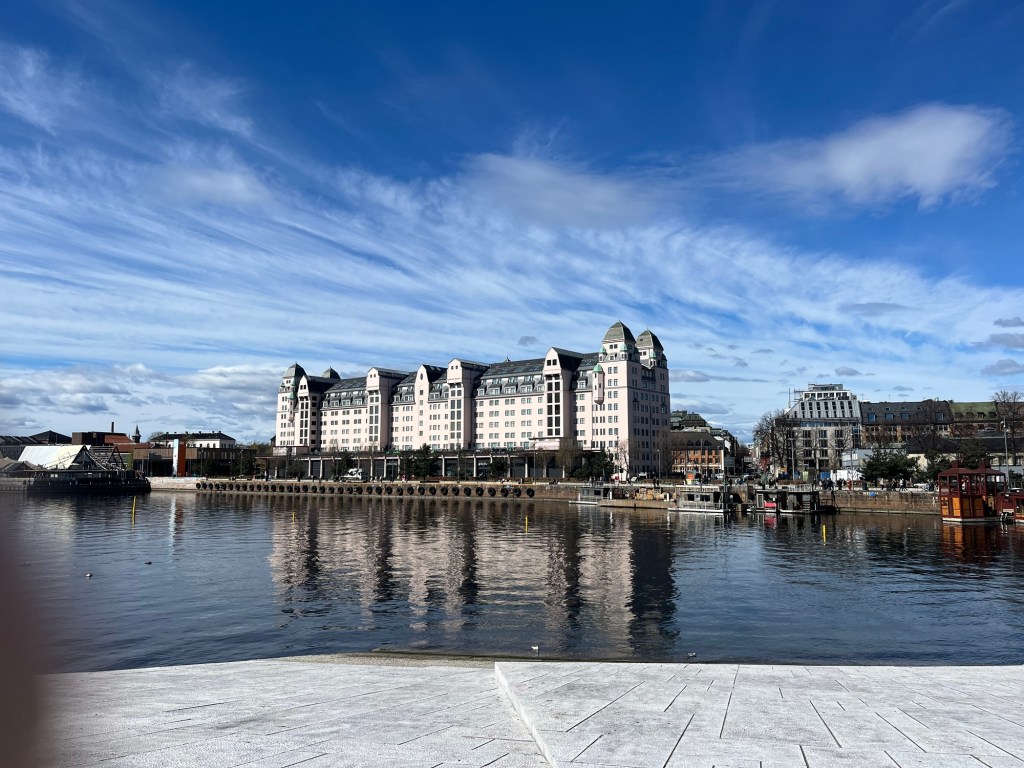
We celebrate quietly with a good meal in the hotel restaurant. We spend some time reviewing our weeks in Norway. We have been here forever and yet just arrived…. Long stays are like that. There is never enough time and yet….it will be nice to be home.

-
Final Impressions: Travel Goals
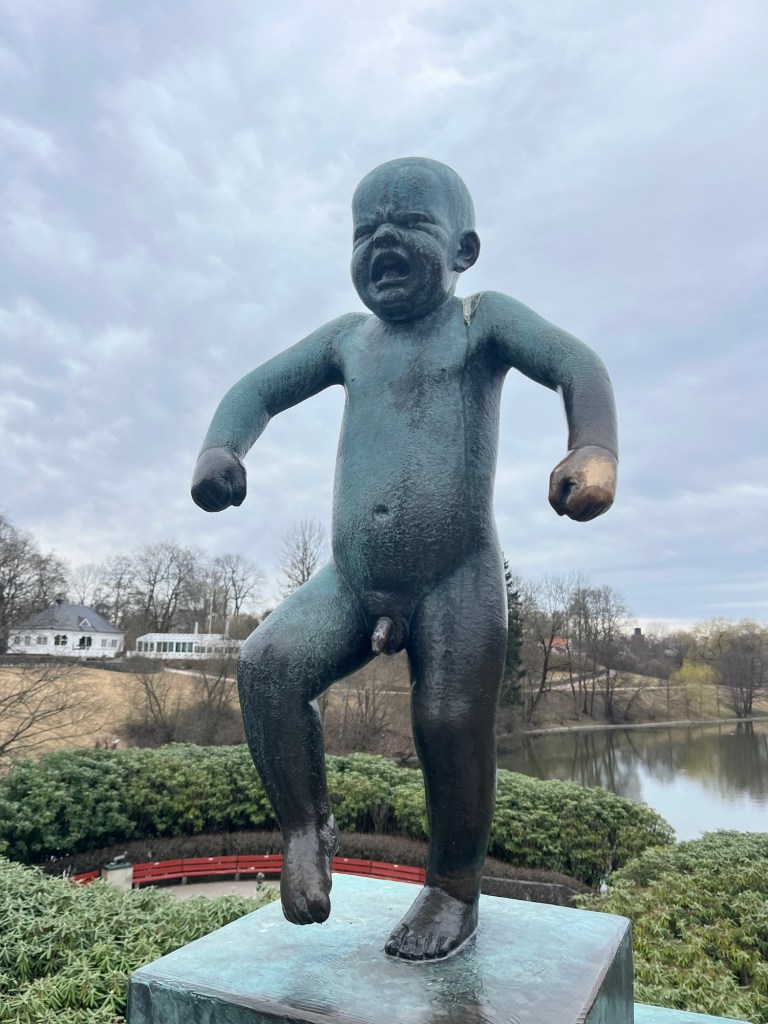
Last days in a place are always a little bitter sweet. I spend a little time either trying to figure out if there are places we need to see before we go or places we need to revisit. Today feels random. I want to return to Frogner park to get a picture of the “angry baby”. Somehow when we were there before, I forgot to get a picture. Perhaps I was overwhelmed by the hundreds of statues surrounding it.
It is very cold this morning and I underdressed for the weather. The coffee shop doesn’t open until 10:00. So I freeze in the park. I won’t miss the cold weather or the late coffee service, but the public walking spaces will definitely be missed. I wish I lived in a walkable city. There aren’t that many options at home.

Since we are in Frogner, we decide to visit the Oslo City Museum. It is in an old mansion. As a local history museum, it has some interesting features. Artifacts from “Kristiana” line the first galleries. Paintings and documents tell the story of the old city. We see smiles and the excess of the 1920’s. We hear tales of fire and rebuilding. When the Nazis take over, the city shuts down. Then came hardship and rebuilding. It is the story of resilience and resistance in a city I have come to love.
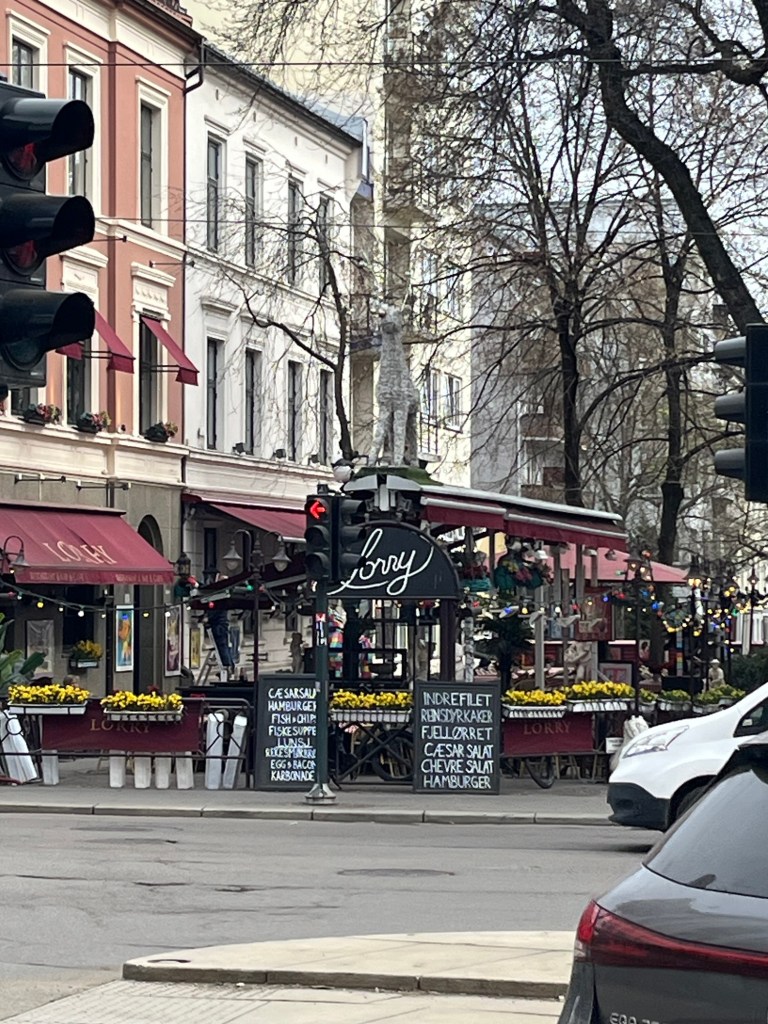
Afterwords, we walk through vibrant neighborhoods and arrive at Aker Brygge. The harbor is quiet today. It is cold and damp. The food trucks that usually line the corner have stayed home today. The harbor feels cold and empty. So we walk on, along the docks, until we reach the Astrup Fearnley gallery.

I don’t really like modern art. So the Astrup Fearnley is on my “only if you have time” list. Looks like I have time after all. My husband sits this one out. I am on my own.The first gallery makes me question my choice. Enlarged and cut up objects are regrouped like grotesque paper dolls. As usual, I don’t get it.
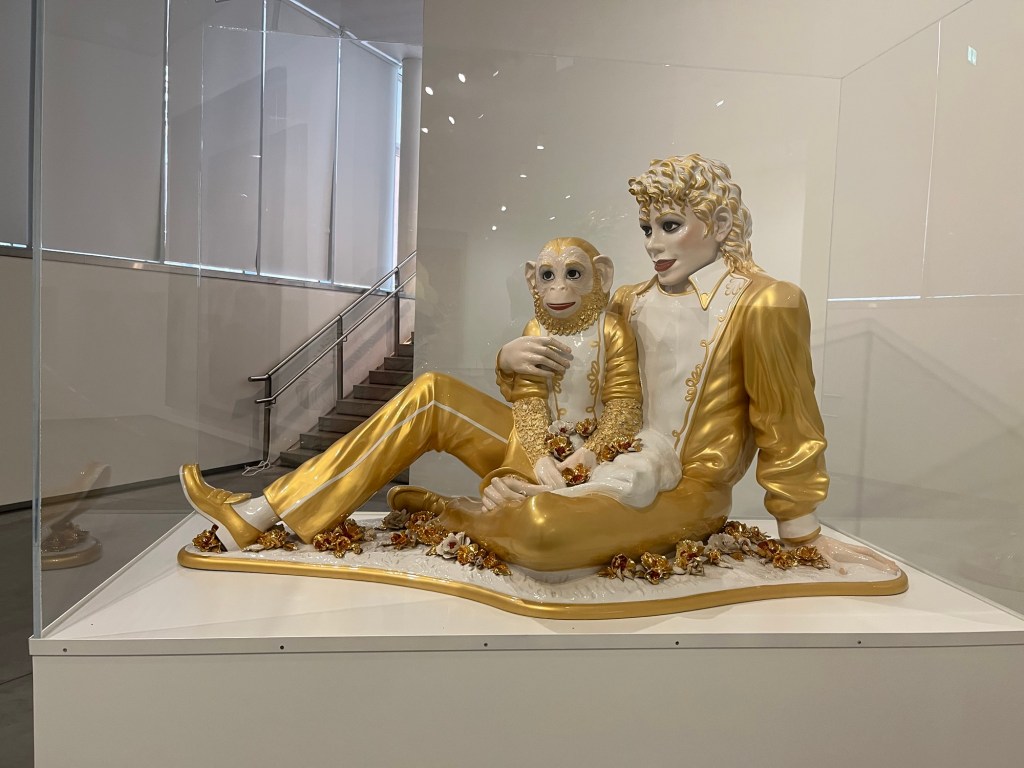
In the next gallery, a golden Michael Jackson sits with a monkey while a troll strolls the gallery with gum stuck to his foot. I don’t get it. Down the hall, an area with chairs all in a row sit in muted grey with artificial clouds hanging above. It reminds me of airlines and I begin to think about flight check in…and suddenly a large plastic door slides open (think sideways plane window shade). The inside is brightly lit and a large plush unicorn lays looking back at me. What on earth? Before I can react, the door closes. I have to get out of here….
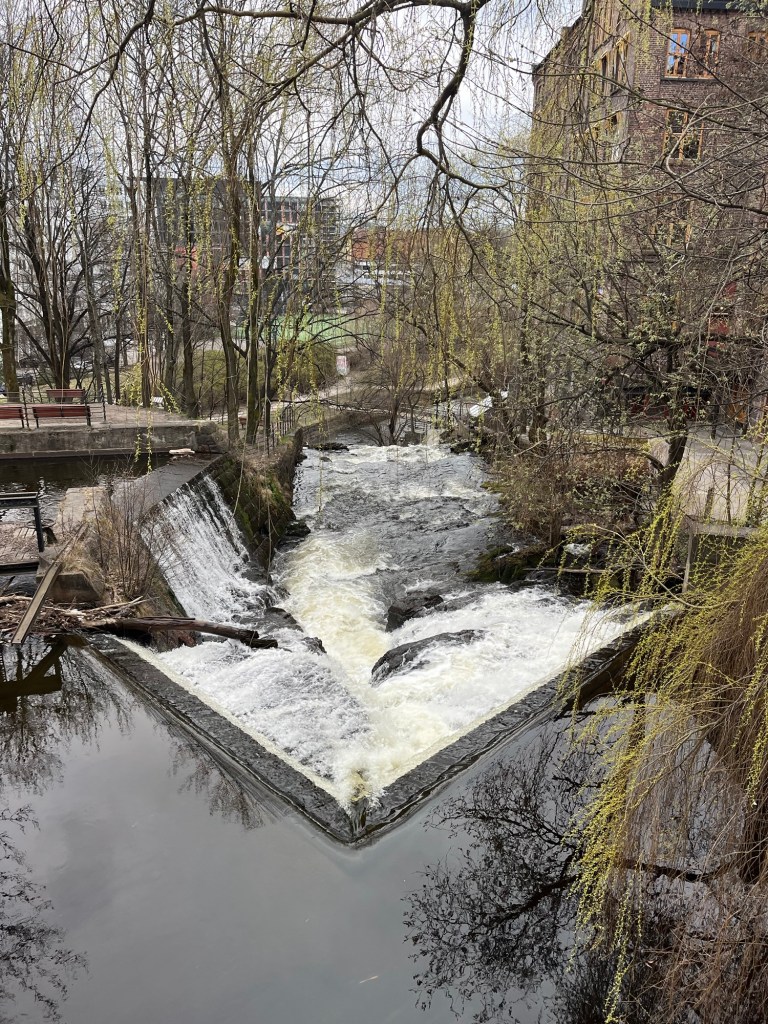
Outside, the weather has thankfully improved. I want to walk along the Akerselva one last time. The river runs along its course, by former factories now converted into shops, and over waterfalls. Not many people are out today so we walk easily along the paths. I won’t miss dodging electric scooters. But I will miss this ritual of afternoon walks through the neighborhood.

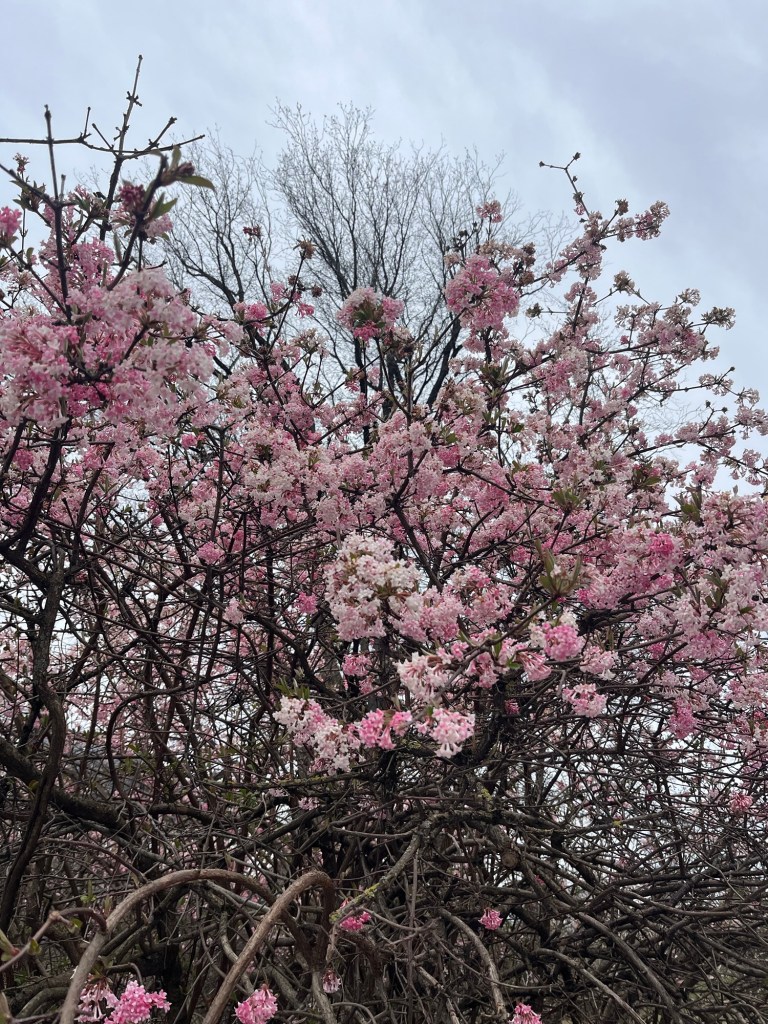
Grunerlokka has been a home away from home. Goodbye preschool children in your yellow vests. Goodbye favorite park. Goodbye botanical garden with your glorious blooms. It is time to pack. Our adventure is almost over. The sun is setting for us in Oslo.
-
History and other Unexpected Encounters: Travel Goals
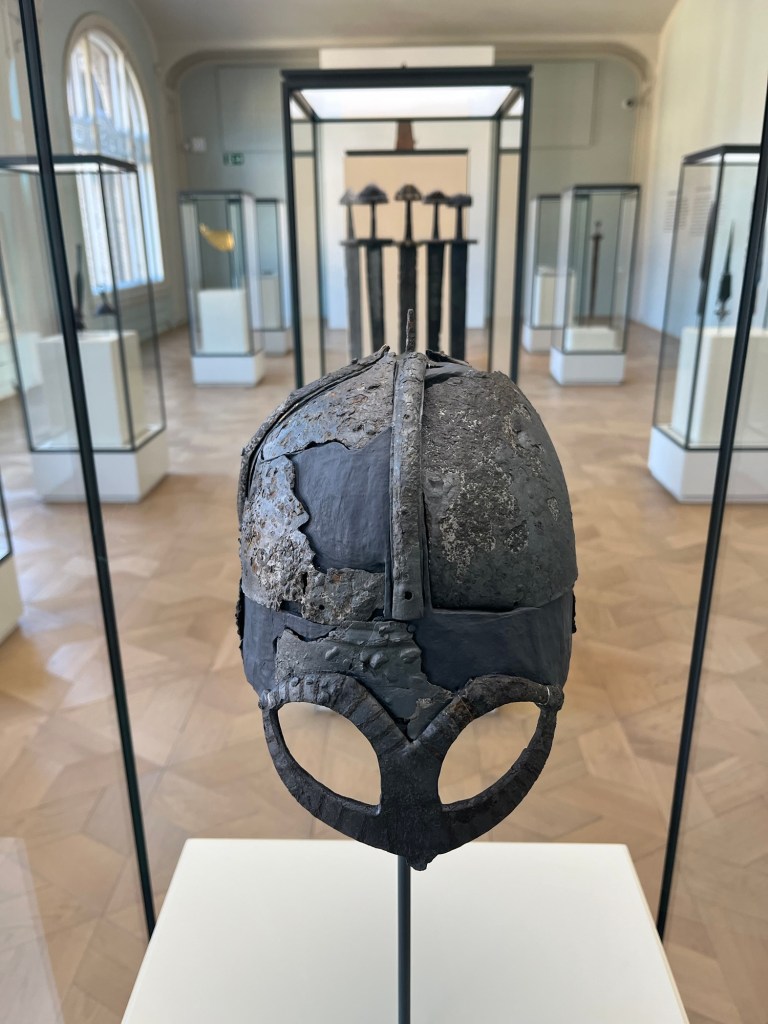
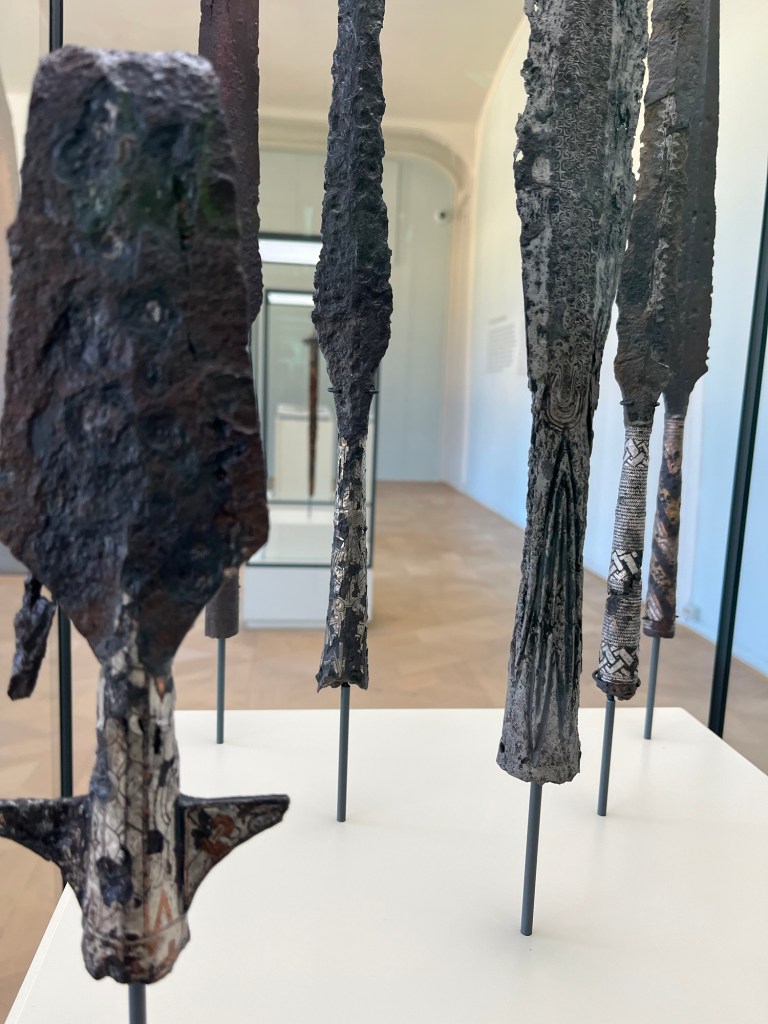
Travel brings many joys, but for me finding new (to me) and unexpected experiences is what it is all about. In the University of Oslo’s history museum, we encounter a lot of surprises. For example, did you know that Viking weapons were painted with bright enamel? The spear shafts were actually ornately patterned. I never knew that. I feel the same way I felt the day I discovered that Roman statues were brightly painted and not the plain dull stone we see today. Like someone let me in on a secret. You are welcome. Now you know it too.
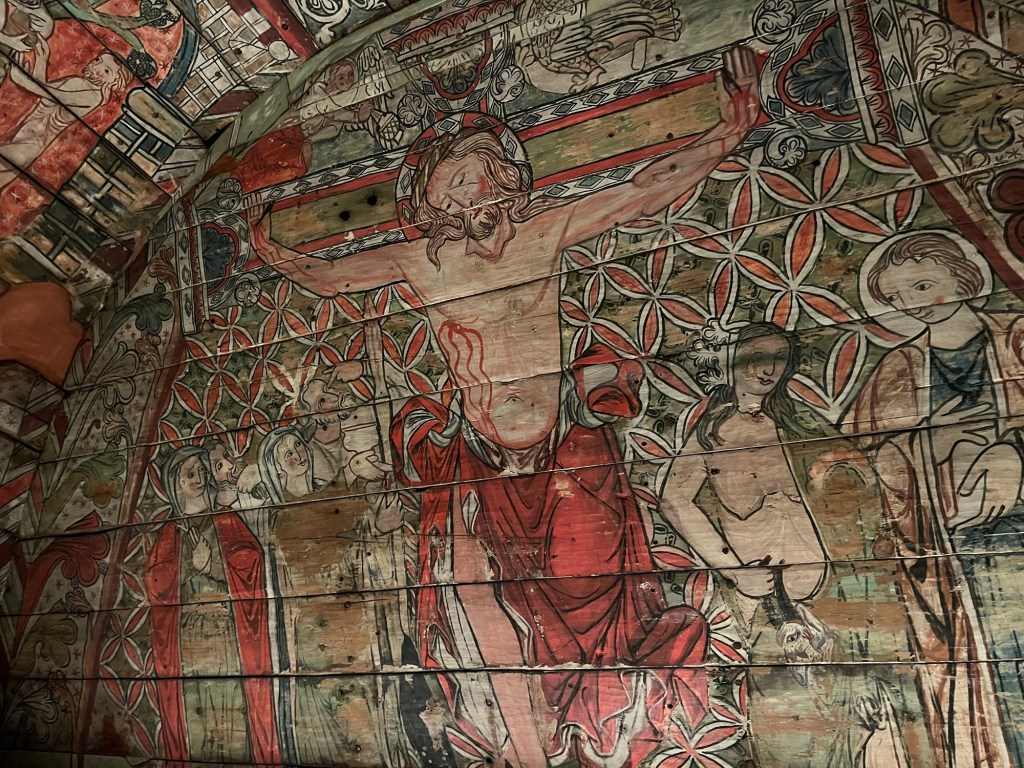
Church architecture is also fascinating to me. Local artifacts shed light on my Christian faith as I compare my traditions to that of others. The Viking manuscript call Jesus the Head Chieftain from Galileeland. That translation is as valid as the medieval term “lord”. Which begs the deeper question, what does it actually mean to call Jesus Lord? Modern Christians miss much of the significance.
The only figure we see as much as Jesus in the wonderful wooden churches and museum exhibits is St. Olav. The Norwegian king and miracle worker was sainted in the 1100’s. Since then, he has made appearances in church decor across Norway. Less noticeable (than say Italian churches) is Mary. Perhaps it is because Norway followed the Lutherans away from the Catholic Church.
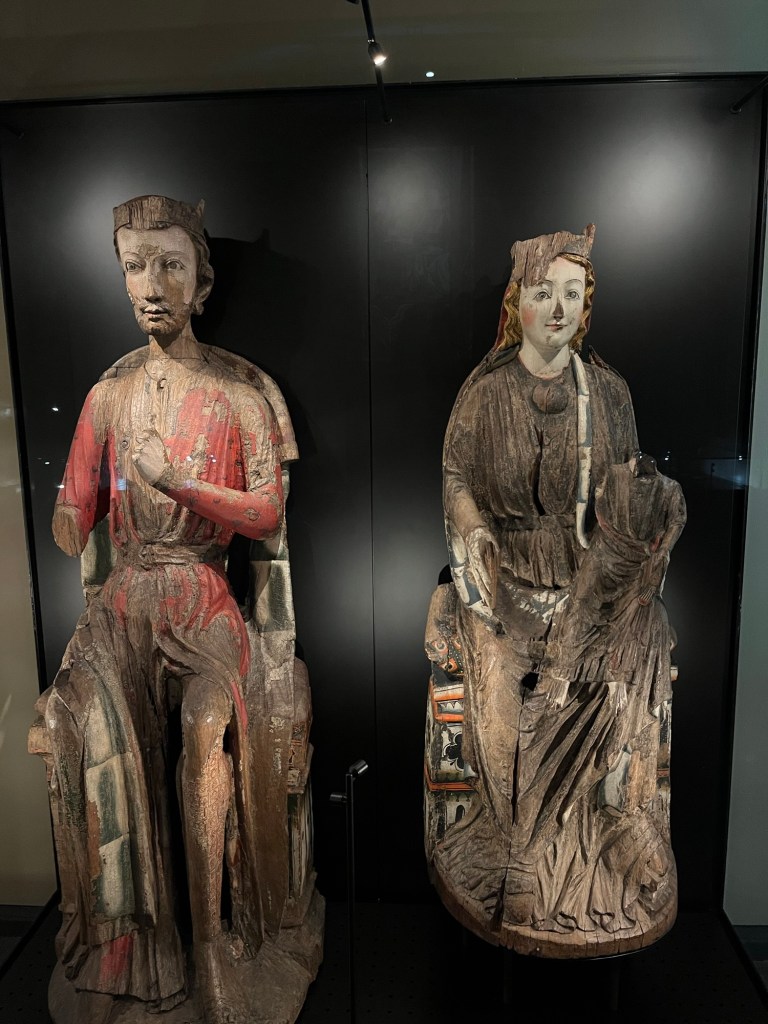
Wood is clearly the material of choice in this land of endless forest. I am surprised at how skillfully it is carved, inlaid, and painted. Viking art is primal yet sophisticated. It is earthy and raw and wonderful. I am drawn to it as I am drawn to the forest. I feel God in the forest and I am moved by the earthy simplicity of religious art.
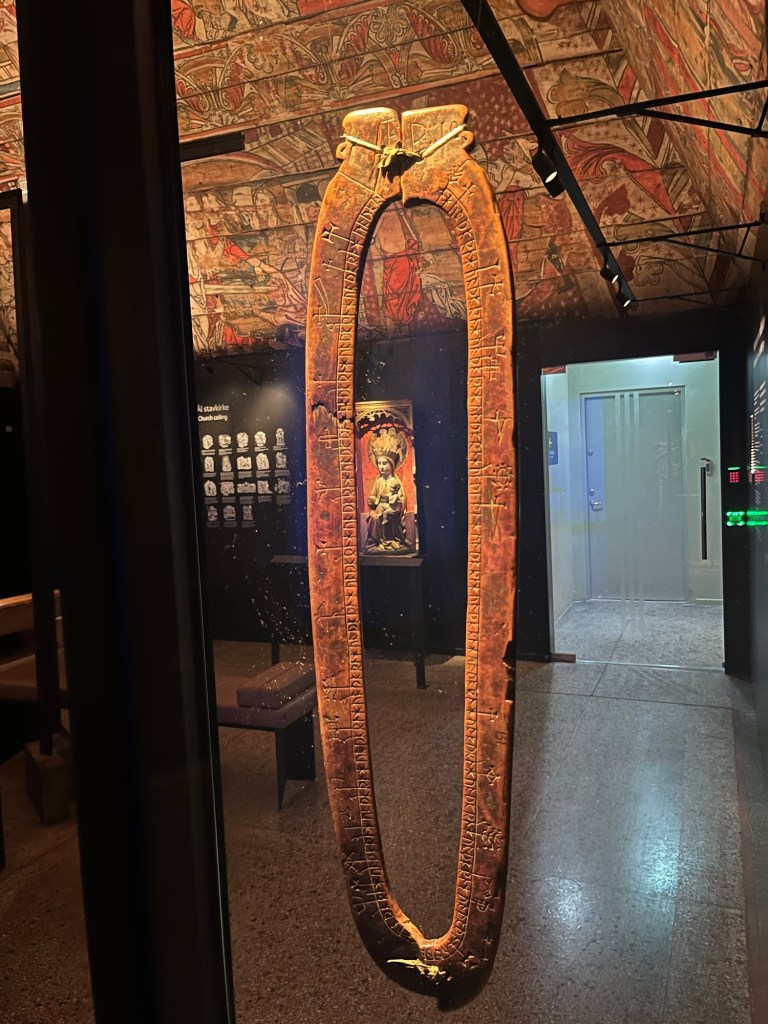
I see for the first time a primstav (sometimes called a runestav). It is a wooden perpetual calendar with markings for each day based on the phases of the moon. One half is days surrounding winter and the other records the summer days. Because they were farmers, the Vikings used the primstav to plan crops…. and raids probably. The primstav was widely in use in Norway until the mid 1600’s, replaced by what we know as calendars.
Across town, we visit the Bible Museum. I am very familiar with Biblical history and the museum frankly looks underwhelming. The admission is as much as the world class museum a few blocks away and the interior looks like a run down five and dime. I realize in that moment that I am now a museum snob.
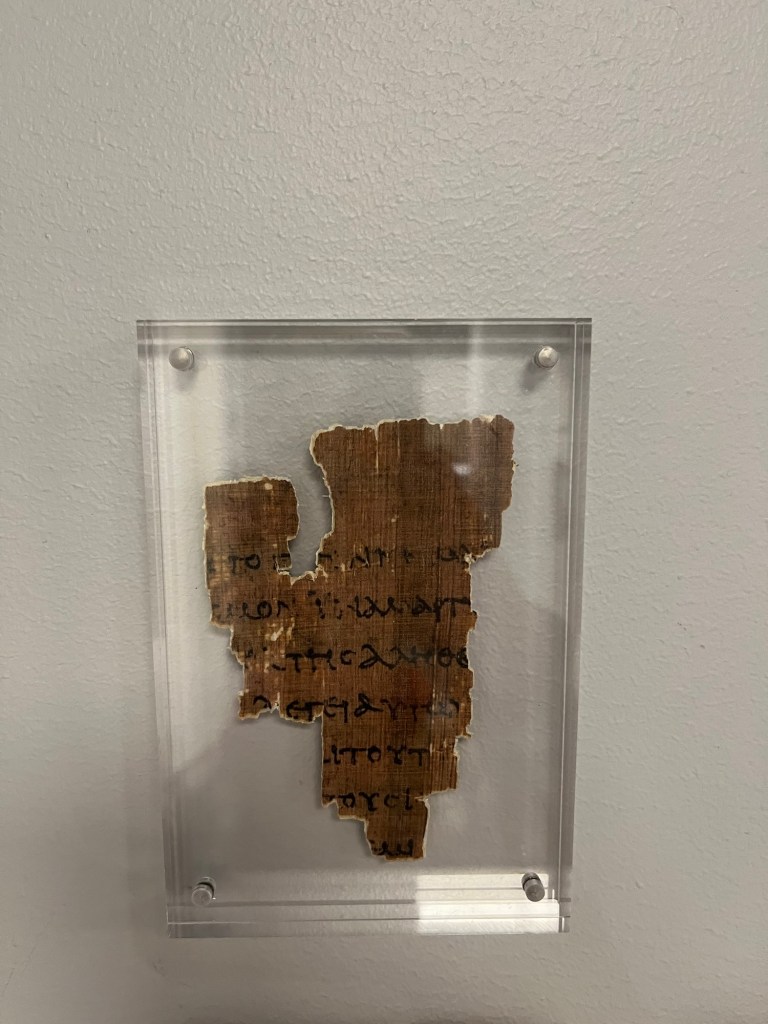
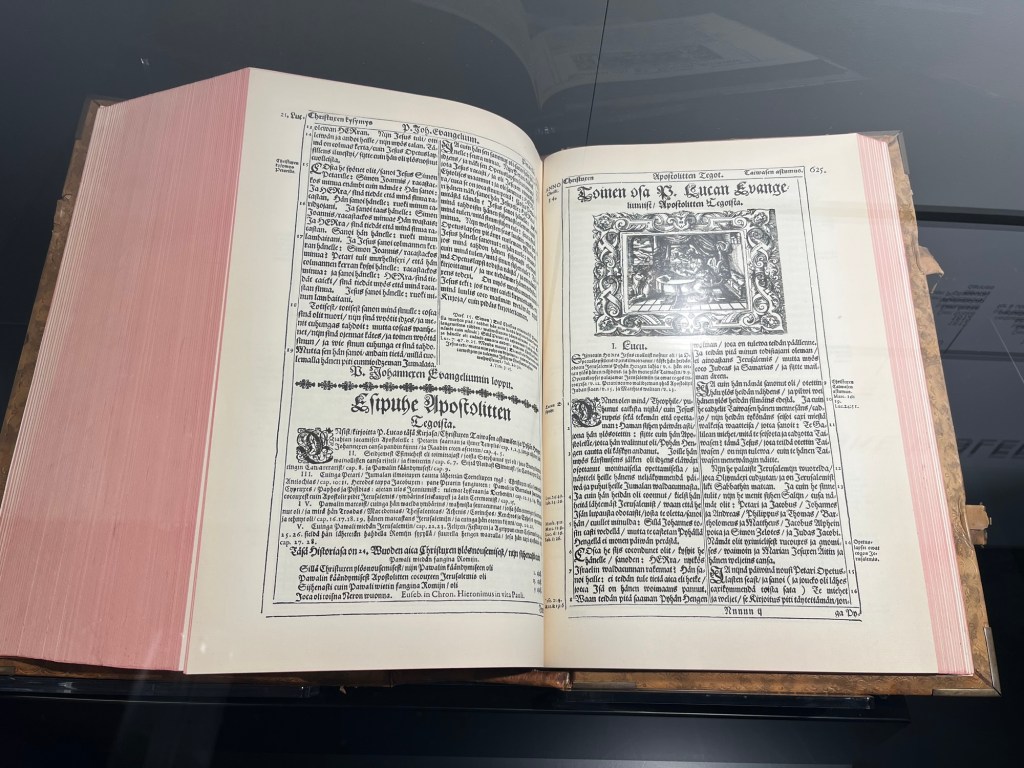
Except….. as I dutifully perused the dime store display cases I am excited, and getting more joyful by the second. There in front of me are pages from the original Gutenberg Bible. Papyrus from an earliest known copy of John. A First century Psalter. But my mind is blown by the Geneva Bible and others from the 1500 and 1600’s. They look so modern, so different than I imagined. When I taught about Calvin, and Moore I pictured archaic texts.
These books could be on any modern library shelf. Why do I picture the past as less than or other? Time and again I see that life was much more modern and history much more complex than we suppose. Pieces of the past lie in simple glass cases. Religious history within reach…..so much joy and sorrow caused by these books…. I take in my new ideas and ponder.
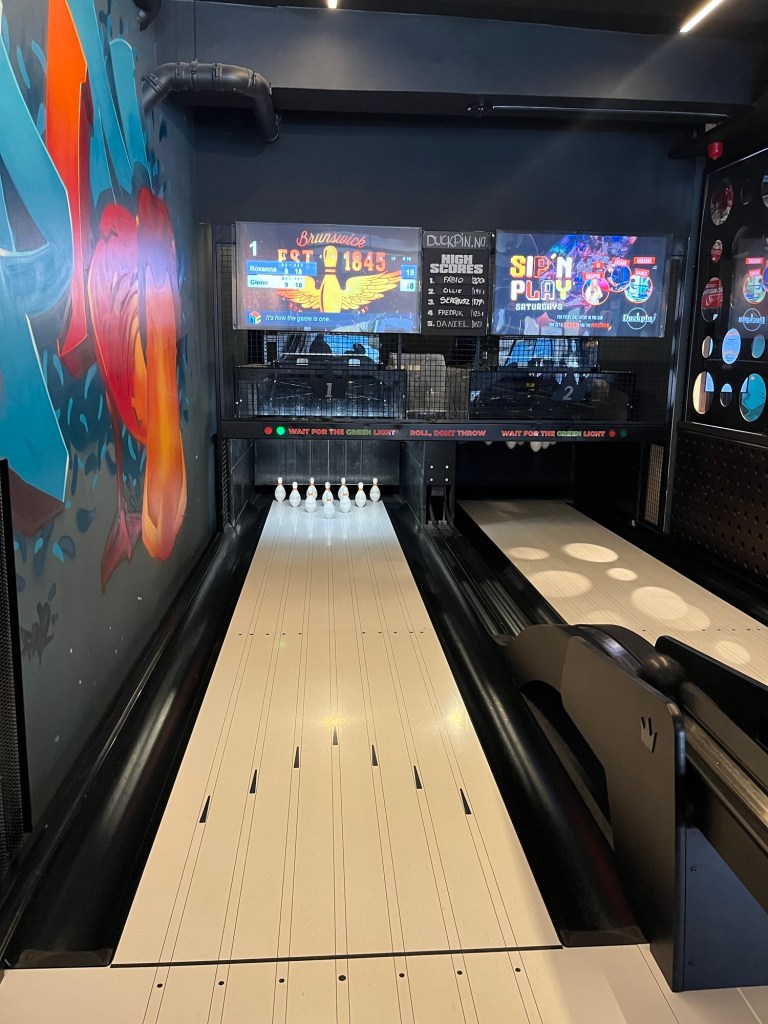
Not all travel encounters are educational. Some are just plain fun. After so many scholarly pursuits, we try duck pin bowling. It is another entirely new experience and I love it. The ball fits in my hand and is not heavy like a regular bowling ball. The pins are small and attached by wire. It is not a power game. The pins don’t fall as you would expect, so you need finesse. I try to spin the ball. It works… It is pure joy to find something new. Perhaps that is secret to childhood happiness, the joy of discovery.
-
Ships Ahoy: Travel Goals

The Bygdoy maritime museum complex is an all day adventure. We opt to visit all three museums in the complex. We start with the Norwegian Maritime Museum where we get to see a man building a Viking ship using ancient methods (and a few power tools). It is fascinating to see the overlapping construction and to know that these ships crossed oceans.

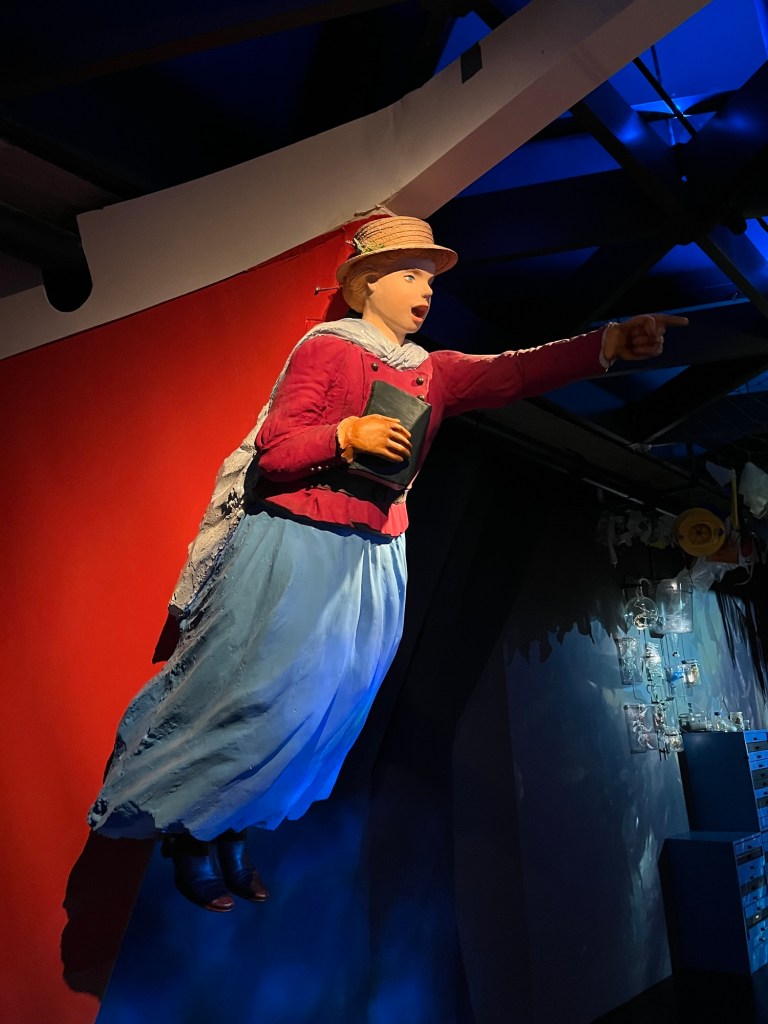
Other galleries have maritime art, model ships, and boat artifacts. We see lighthouse lenses and walk on an early ferry boat. Following a timeline on the floor, we walk through maritime history. In the children’s area, we adventure under the sea with a popular character from Norwegian children’s literature.
In a smaller annex across the street, we get up close and personal with the small fishing boats that were used for centuries by families along the Norwegian coastline. The boats are shallow and cramped. I think they would be alarming to sail on a clear day and unimaginable in a storm. No wonder so many were lost at sea. The boats have been used across centuries. Clearly I am no mariner.
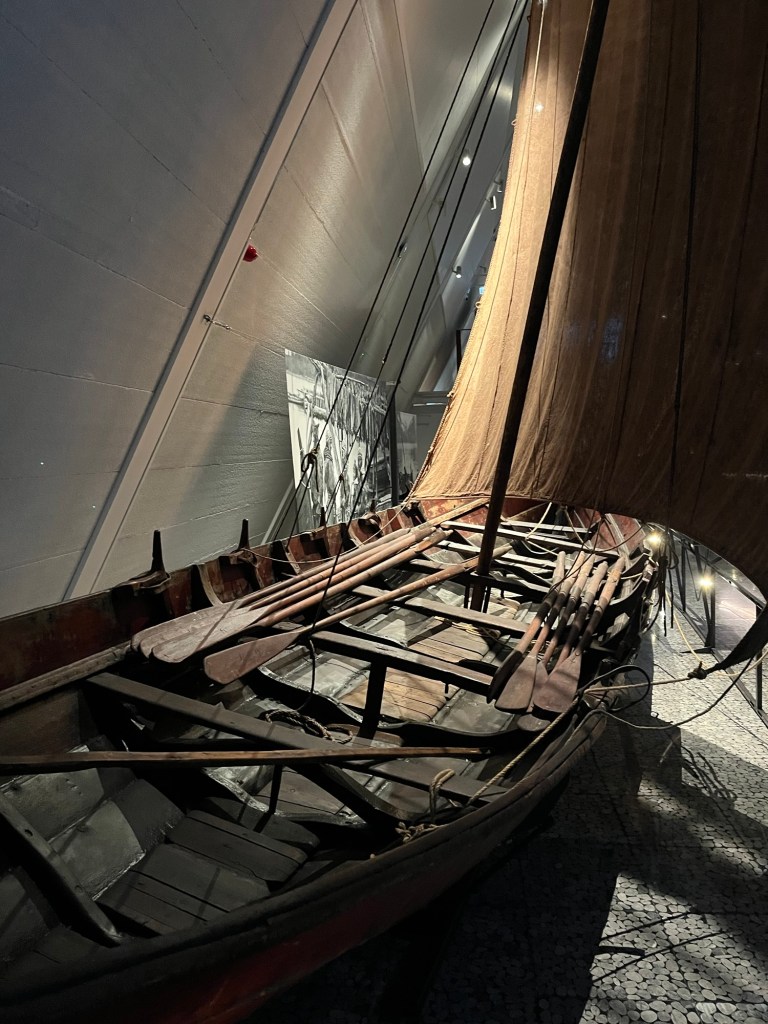
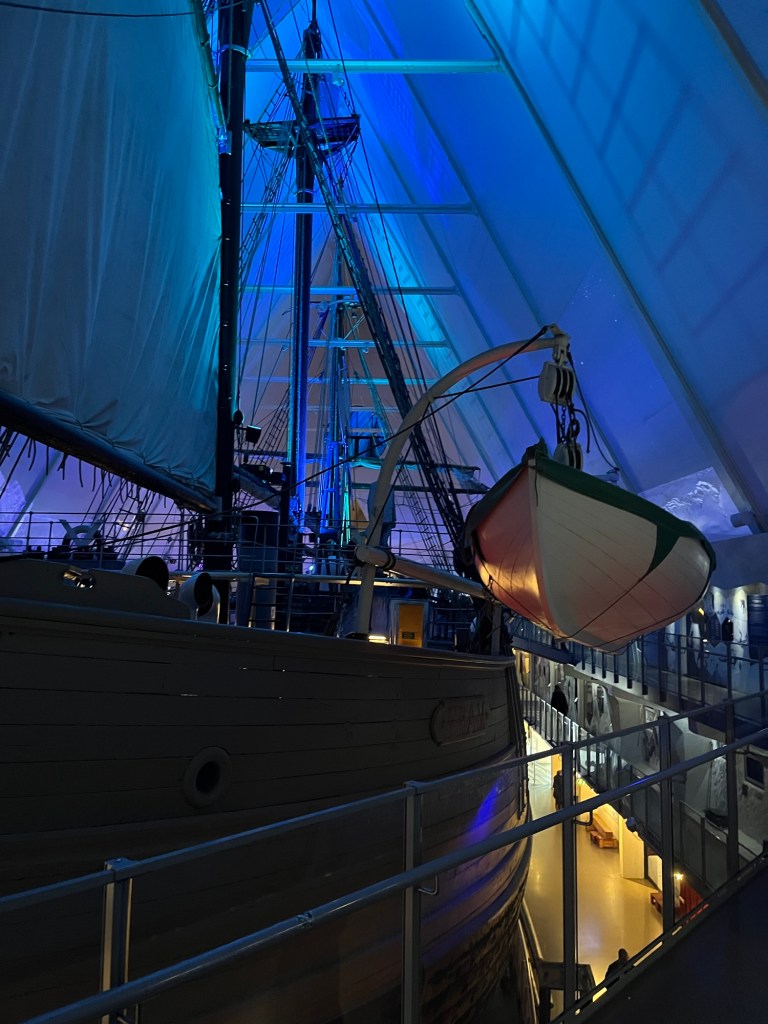
The Fram museum is dedicated to the polar expeditions of Roald Amundsen. We are able to board both the Fram (the ship used to help Amundsen be the first to reach the South Pole) and the Gjoa. We see his plane he tried to fly over the North Pole and kayaks and supply sleds. The man was obsessed.

I don’t know what makes a person want to face death in order to be the “first”. Early plans included letting the boat get stuck in the ice in the hope that the current would take them to the pole. Trapped in ice on one expedition, the men face death but for the hospitality of the arctic inhabitants. There were polar bear encounters and endless injuries, but they endured. You have to be a special kind of crazy to set out in a wooden boat amidst glaciers and then to trek over the ice for days pulling the supplies that keep you alive behind you.
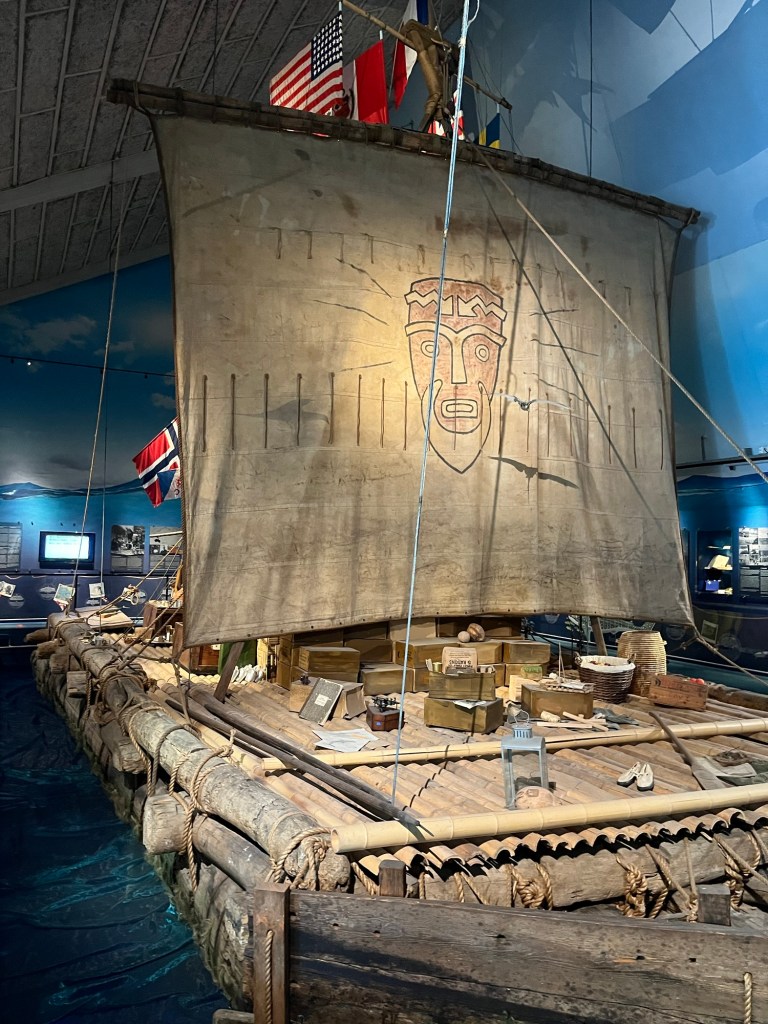
We leave the arctic explorers behind and head across the street to the Kon Tiki museum for a different kind of crazy. This small museum houses the Kon Tiki raft that Thor Heyerdahl and crew floated across the Pacific Ocean from Peru to Tahiti, just to prove it is possible. 101 days on a raft. . In the ocean… To show that maybe Tahitians came from South America.
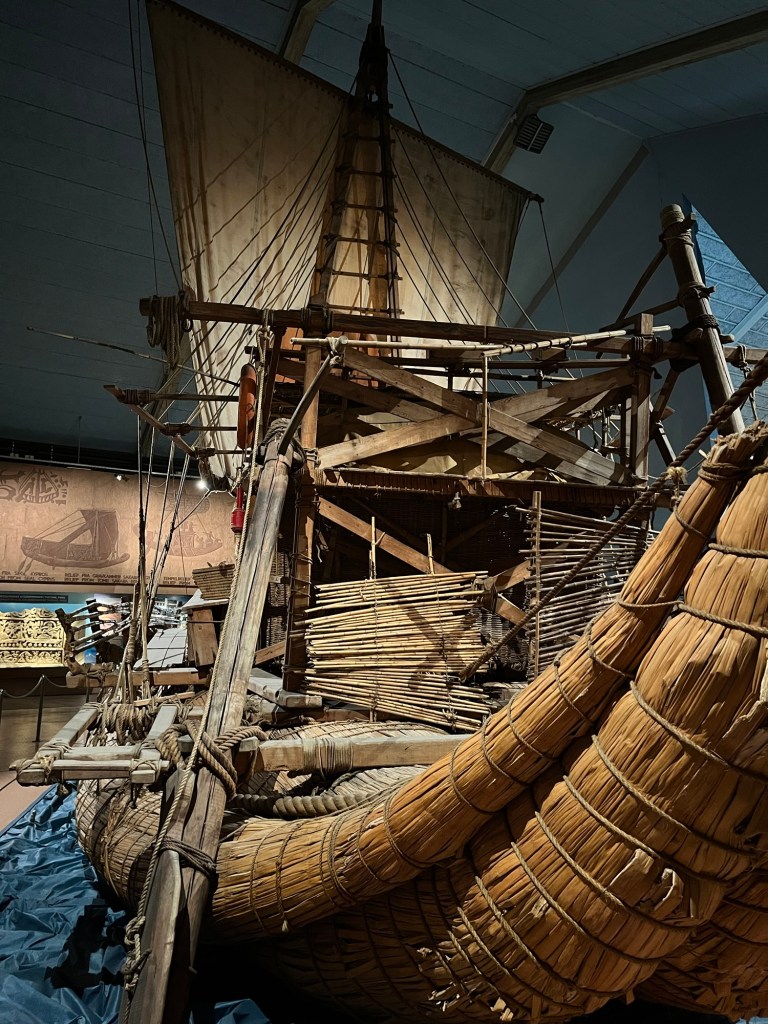
I guess it is a visceral desire to explore. An obsession. Not content with his success, Heyerdahl built another boat out of reeds and sailed from North Africa to Barbados. Explorers must explore. I don’t really get it. Wanderlust I understand. Risking your life to prove a point…not so much.
The sea does have a timeless allure. It pulls us with its beauty and promise of what lies on the horizon. Thankfully they have invented sonar, powerful engines and stabilizers. Even landlubbers like me need a little ocean voyage every now and then. I just like mine from a modern cruise ship.

-
Viking Venture: Travel Goals

Sometimes I just wake up feeling like a kid. On these days I forget the scholarly pursuits and the to do lists and just look for pure fun. We decide to check out Viking World. This small attraction behind Oslo City Hall is a series of video and vr experiences. Interactive computer simulations explain the history of the Vikings with video and photos to swipe and move about on large screens.
There is a 360 degree surround movie that puts you in the center of a Viking Village. It reminds me of the 360 degree theater attractions that used to be popular in American theme parks. This one has stunning views of Norway and Viking life.
But the biggest draw is a virtual reality simulation in which we participate in a Viking raid. I am in a boat, rowing silently up the fjord. We are attacked. Suddenly, arrows fly. Villages are burned. But I emerge unscathed, unlike many of many of my fellow boatmen.

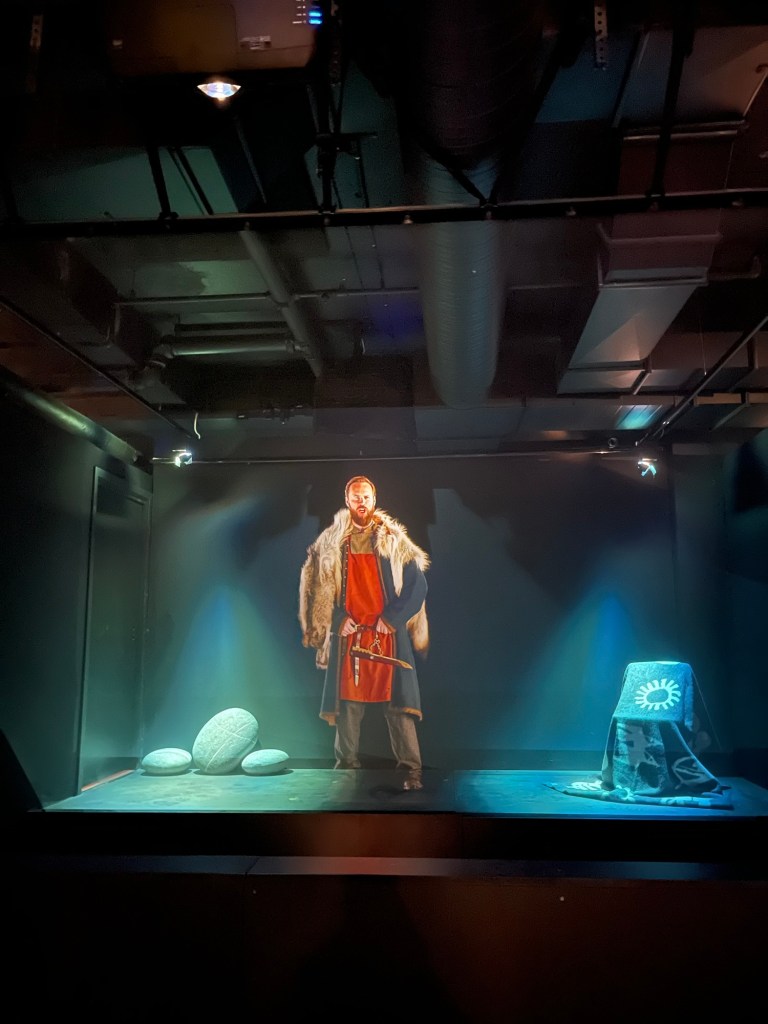
After the raiding, we get up close and personal with hologram Viking villagers. We see ships and swords and helmets. We read numerous timelines until we are saturated with all things Viking.
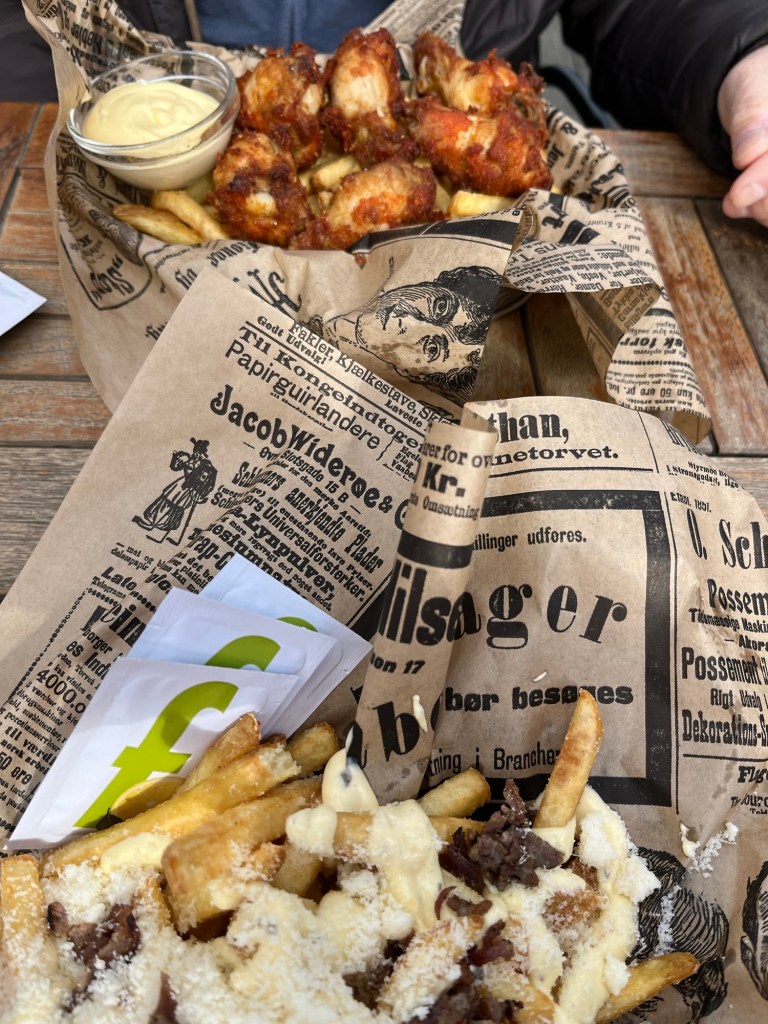
By the end of the Viking experience we have worked up an appetite and decide to stroll the dock lands near Aker Brygge. There are several restaurants with outdoor seating, but I am intrigued by Lektern. The restaurant is situated across two boats. Music is playing and people are everywhere enjoying the cool but bright afternoon. It looks like my kind of place (outdoor eating and music). I order the truffle fries and am rewarded with the yummy goodness.
After our snack, we continue down the pier to The Salmon, a restaurant and interactive display area that explains the importance of the Norwegian salmon farms that dot the coastline. We are informed about the industry including the need to protect against the fish against salmon lice. We also learn that the fish are humanely sedated prior to being killed. I guess the fish simply fall asleep and never know they are headed to my stomach.

A small park near the Astrup Fearnley museum is the perfect place to take in the setting sunlight along the fjord. It is amazing how much we do on days when we do nothing. If I really were a kid, this is the part of the day when mom would be standing on the porch yelling for me to come home…..

-
Ekenberg Park: Travel Goals

I love the great outdoors. Find me a forest and l am one happy girl. So when I read that Eckenberg Park has sculptures in a forest, I am intrigued. It is a beautiful sunny day in Oslo and it is unusually warm for the season ……so it seems like a great way to spend the day.
We start at the small museum and visitor center. Outside ate sculptures by Renoir and Dali. Inside we learn the history of the park from its days as a farm, a public playground. a Nazi cemetery, a hide out for drugs and prostitution, and finally back to a public playground. Now it holds miles of hiking trails and public art.
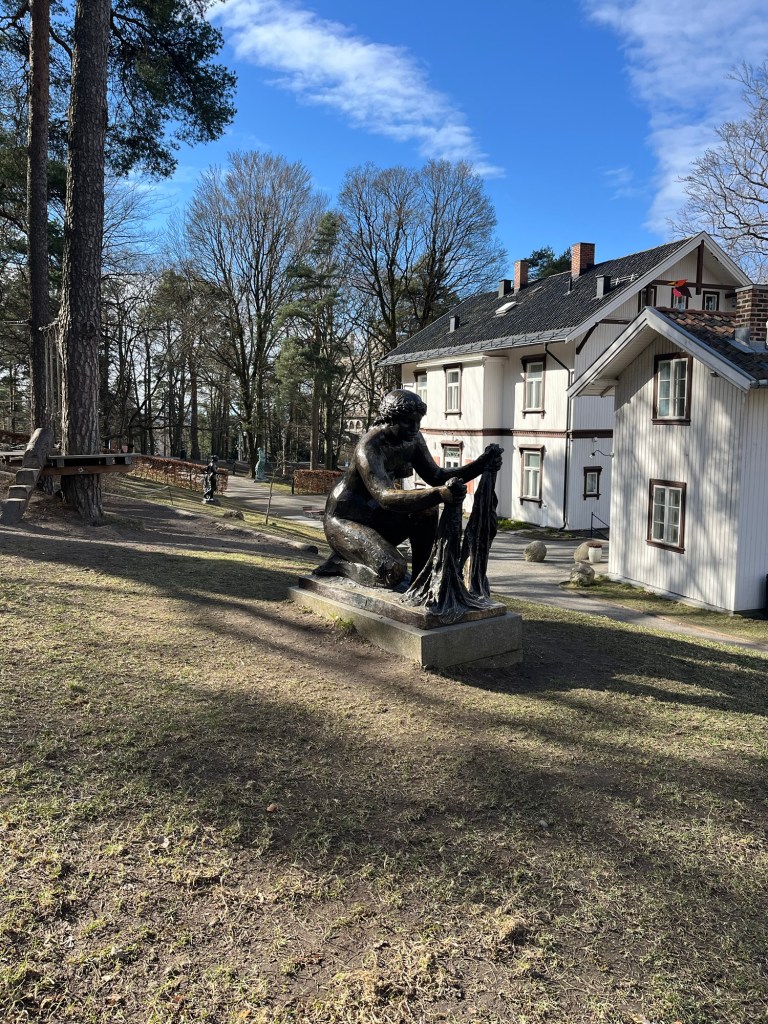
In the museum yard, I take a ride on the small zip line. Then we start a hike to over 60 sculptures throughout the park. Some are beautiful. Others are strange. A few are almost obscene. Each has a message if you slow enough to notice.
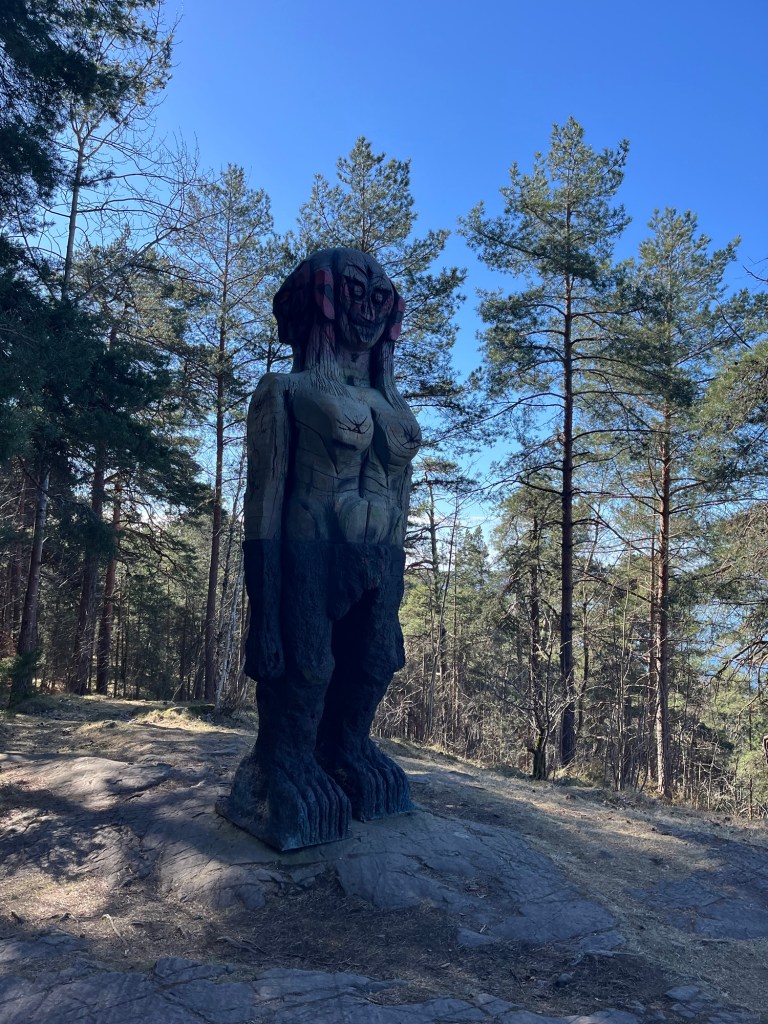
We stop in the old Nazi cemetery. The bodies have long been removed and the symbols of Nazi power torn down. The open parkland is full of playful dogs. People sit on wooden platforms interspersed with art. The sculptures are all faces and forms of death. Not exactly a cheery spot for relaxation. Wooden stairs mark the entrance. A panel informs guests of the park’s ignoble past.

At the top of the park, families enjoy a petting zoo. Several take riding lessons on a trail ride through the park. Horses stand stoically, waiting for a rider. A large barn is full of giggling children.
We walk on by, opting for mini-golf. 36 holes of fun. Well, mostly fun. The mole hills are no fun. But my licorice icecream is wonderful. It almost takes away the sting of defeat. He wins again.
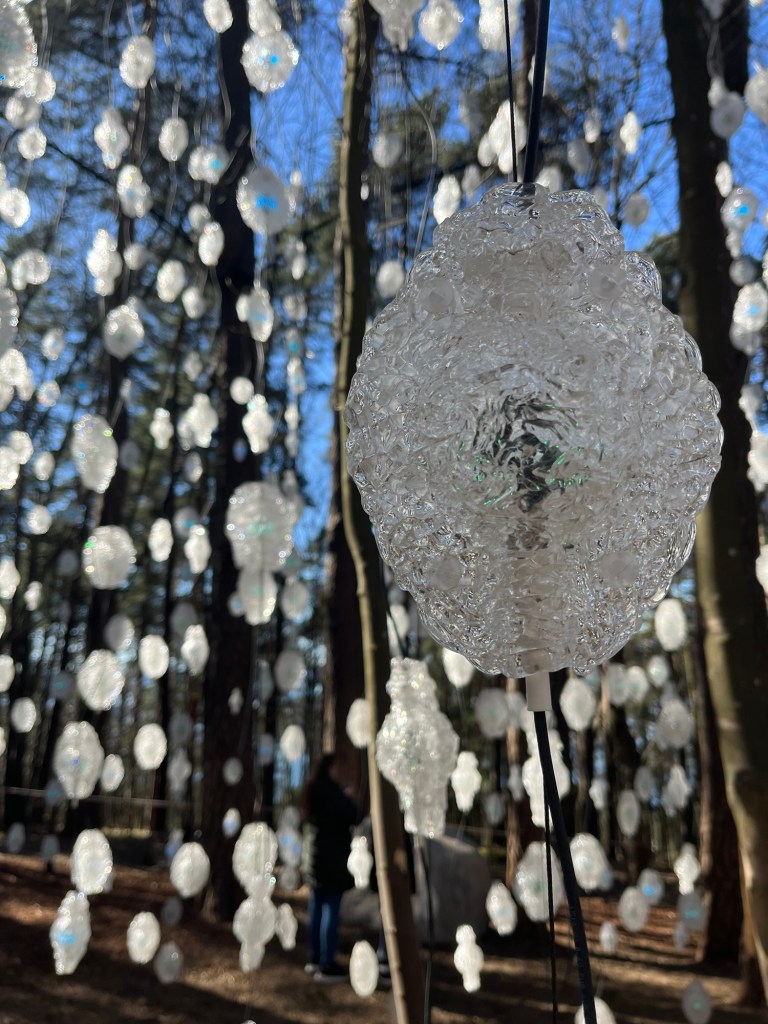
A leisurely walk down hill takes us past a snowflake forest full of colorful lights. Another grove of trees is lined with under wear. There are sculptures of tourists and whimsical mobiles. Towards the end of the walk, we stumble upon a statue of a woman defecating on communism. There are strange things in these woods.
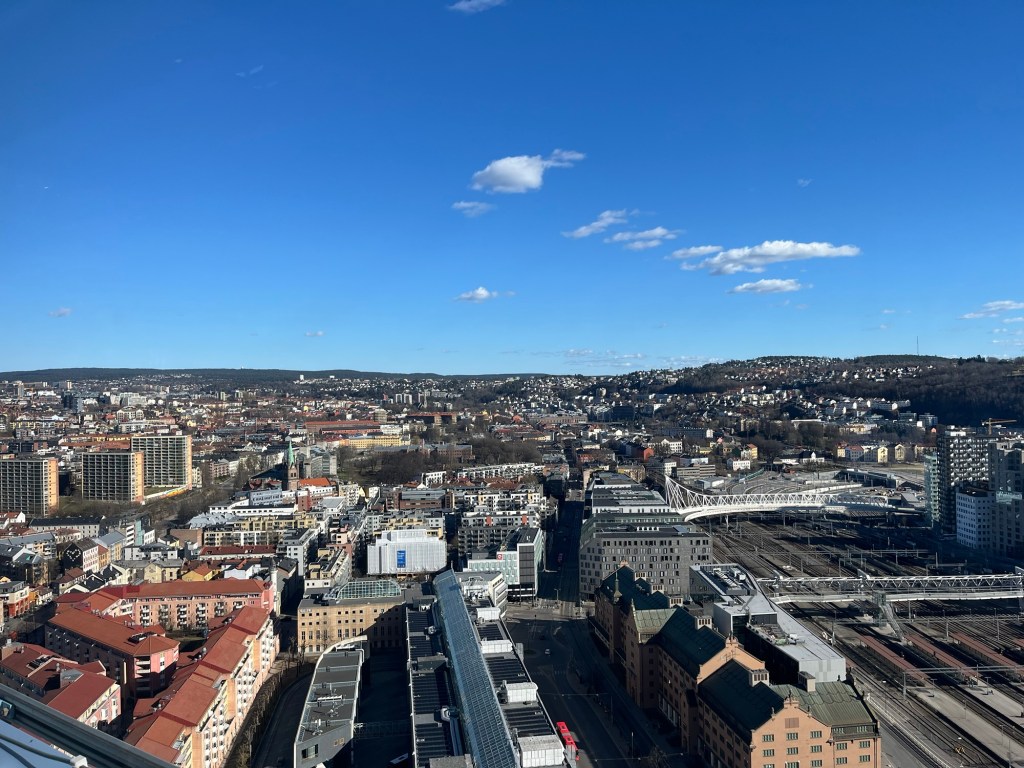
We end our day at the Radisson Blu Sky Bar. A window seat fifty stories high gives us great aerial views of Oslo. For the cost of an appetizer, we have the best seat in the house. Everyday should be a walk in the park. Today was that and more.
-
Books, Crockery, and Sunshine: Travel Goals
I love libraries. Maybe because I am a woman of a certain age who devoured every book I could get my hands on over the last half century. Libraries are places of mystery and opportunity. The national library of Norway is a bibliophile’s dream. It has a coffee shop and restaurant. There are reading rooms and specialty collections. It even has a special map center and a rare documents exhibit. I am giddy.
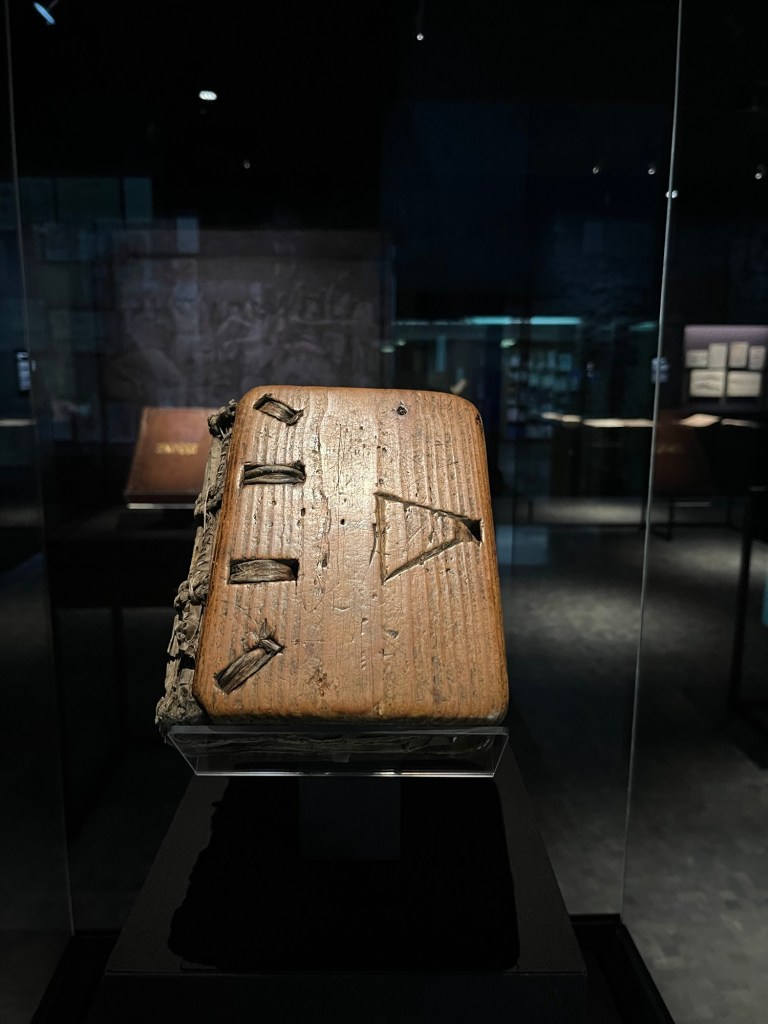
The rare documents exhibit has a variety of media across from across the centuries. I fall in love with a Viking era Bible. There are also early Gutenberg press samples. We watch early Norwegian cinema and see the original Viking sagas. There are numerous examples from the Nazi years of egregious propaganda. There are photo books of Oslo citizens from the 1800’s found in a photography shop. Less fun, I find a moving photo of over 1700 Jewish citizens standing on the boat that will take them to Auschwitz. Some of the small children are smiling, excited to be on a boat. Their parents eyes are heart breaking.
I wonder what causes a person to become so callous that they can no longer see humanity. How do we get to a place where entire groups of people are considered expendable and without rights? Evil writ large just a few generations removed.

Our next stop is the Queen Sonia Art Stables. The Norwegian Queen has turned the palace stables into a gallery to exhibit items from the royal collections to the public. I think we are going to see a large collections of artifacts (based on online photos of past visits). After we pay, we realize that we are just going to see the royal China. It is displayed in one big room.

So, we join a dozen senior ladies in oohing and ahhing over porcelain. There are some interesting dishes. I have never seen a fish plate with holes in the bottom to allow the juices to flow out. There is also a meat plate with channels to collect the grease.

Because the stable takes a lot less time that we anticipated (you can only stare at plates for so long), we take a stroll through the park. Children have designed art pieces for a contest the royal family created. Winners ideas were manufactured and installed in the parkland surrounding the palace. There is a melting starfish with eyes, a rainbow, a fox, a rabbit, and a variety of other shapes.
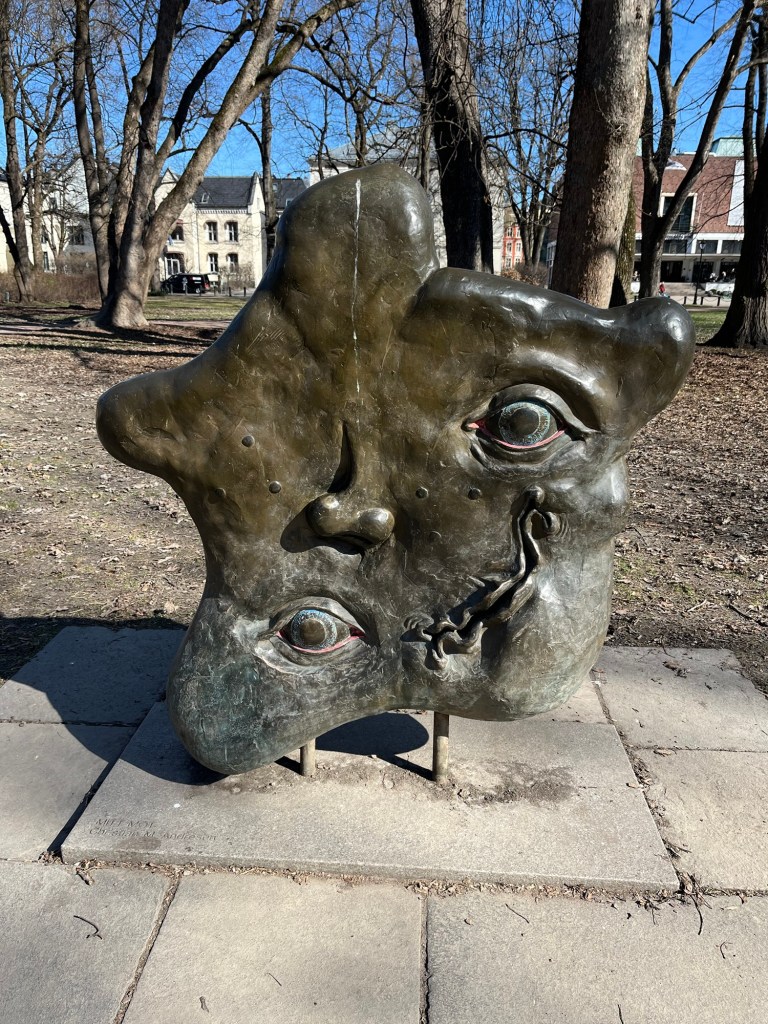
We play among the sculptures, posing and trying to guess what they might be. We hear music and walk down the central stairs. A stranger comments that we make him happy as we dance together in the park. Happiness breeds happiness I suppose.

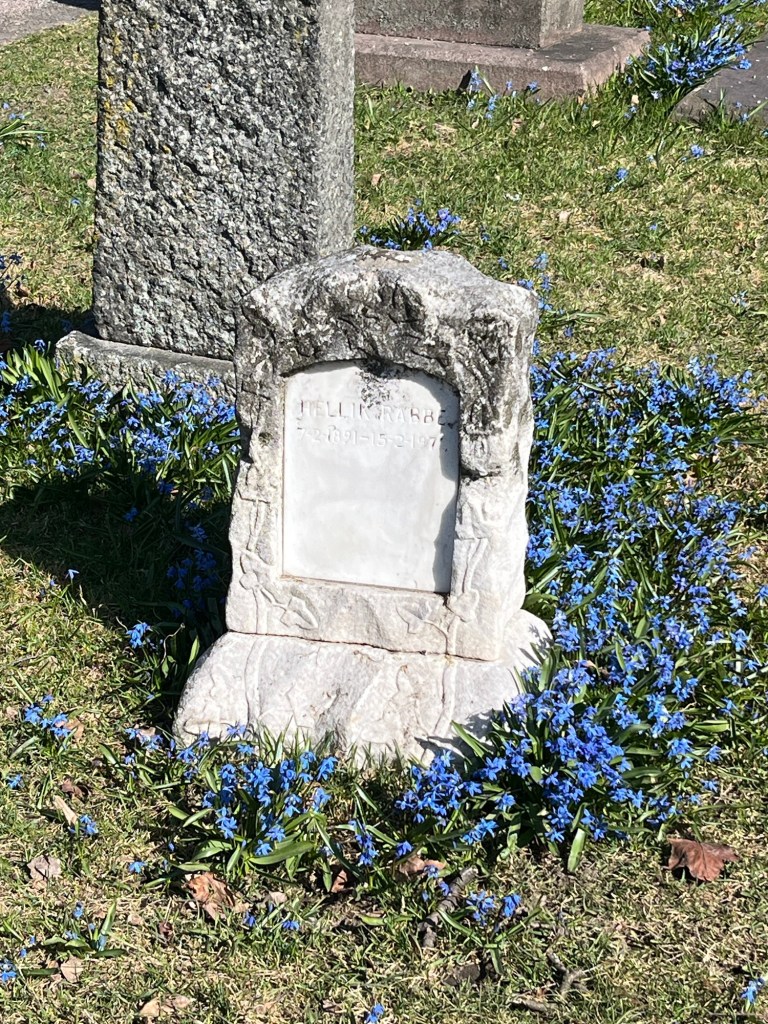
It is a beautiful day and so we continue walk. Locals are strolling the paths and using the benches in a graveyard to catch some sun. The small hill inside a perfect place to view the city. Bluebells line the hillsides, creating a brilliant blue carpet.
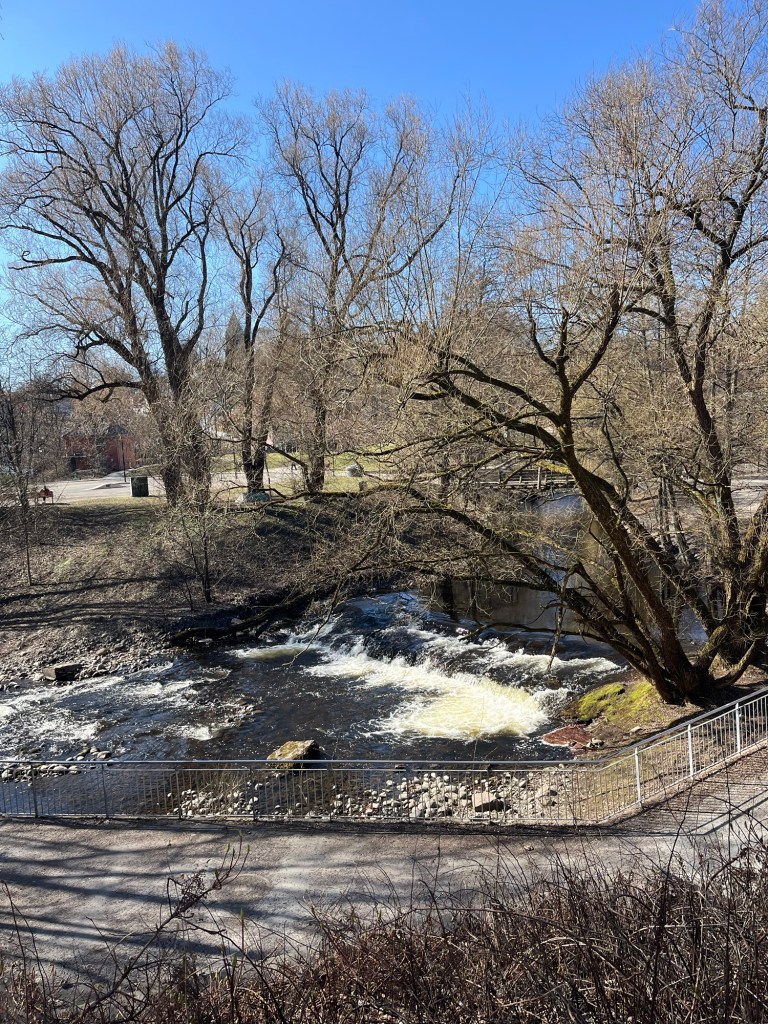
Nearby is our neighborhood of Grunalokka. We walk across the bridge and along the river taking in waterfalls as we go. A lovely cafe sits against the hillside, so we stop for a beverage and to people watch.
Construction walls along the river are filled with colorful graffiti. Dogs play in the park. Parents push baby carriages. Scooters and bicycles zip by. Every one in Oslo appears in the park when the sun is shining.

Mathallen or Oslo’s food hall is just across the river. A small bridge takes us to the foodie favorite. A fish market, a butcher, Italian, Asian…. If you want to try food, this is a great place. We decide on gelato. Ice cream is the best fuel for a stroll in the park.
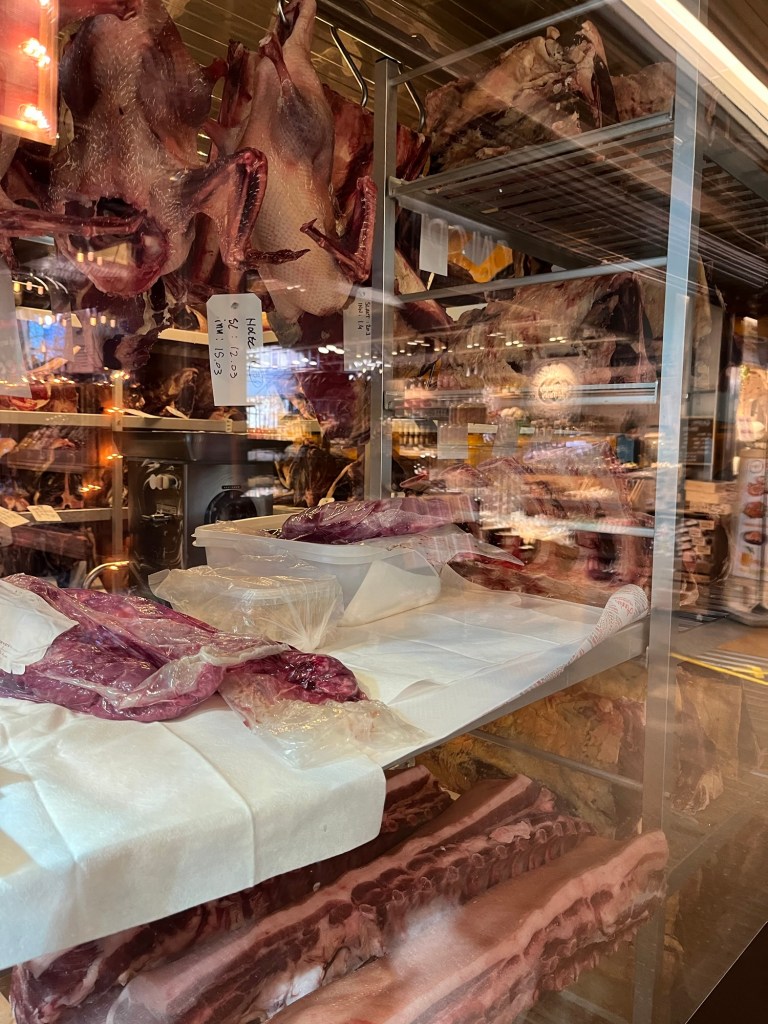
This day is a strange mix of whatever feels right in the moment. We walk home through Sofienberg park as the sun moves lower in the sky. Joyful. Thankful.
-
Forest Bathing: Travel Goals

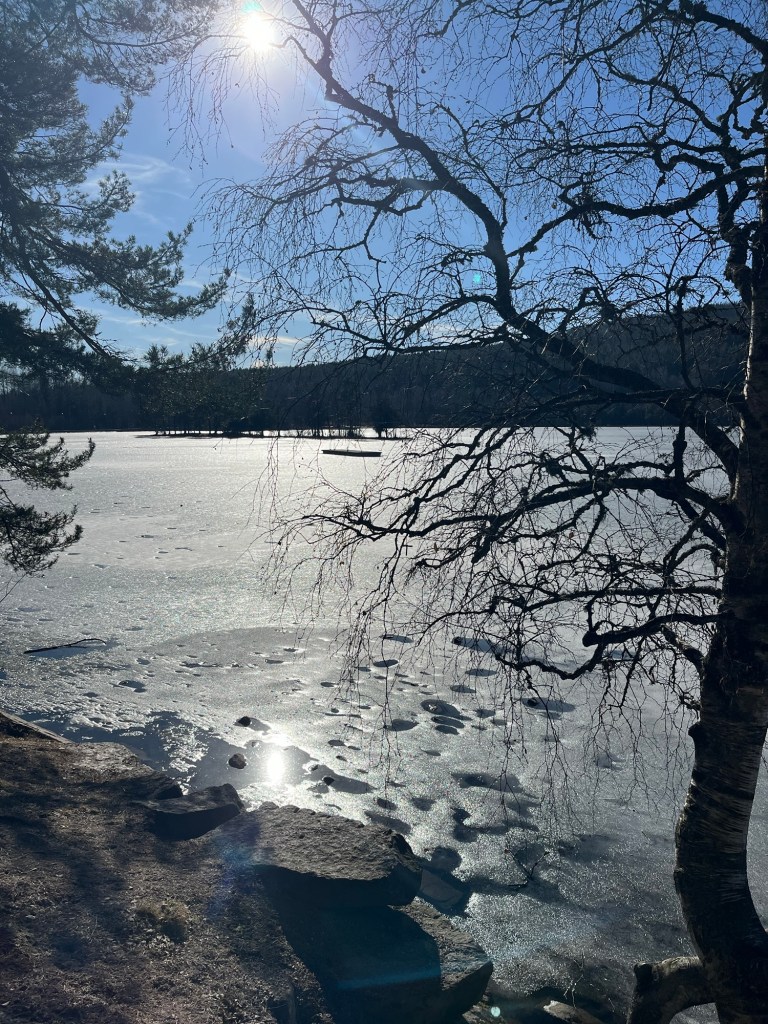
Nothing seems as good for my soul as a long walk in the woods. The sun is shining on the frozen lake. The water is warming and thawing slowly. But the forest calls me to its shadows.

Buds are appearing on the branches. Crocus and bluebells make their colorful entry to the forest floor. The stately fir trees stand in ancient rows. The ground is muddy as it thaws, but leaves absorb the damp, making a squishy carpet on which to walk.

In the shadows of the trees, it is cool. An icy chill lingers. In the sun, it is almost hot and requires the removal of my jacket. The sunlight dapples the landscape and clouds provide a moving picture of light. People move joyfully through the trees. Birds sing. A breeze blows across the ice. My soul heals.
-
The National Treasures: Travel Goals
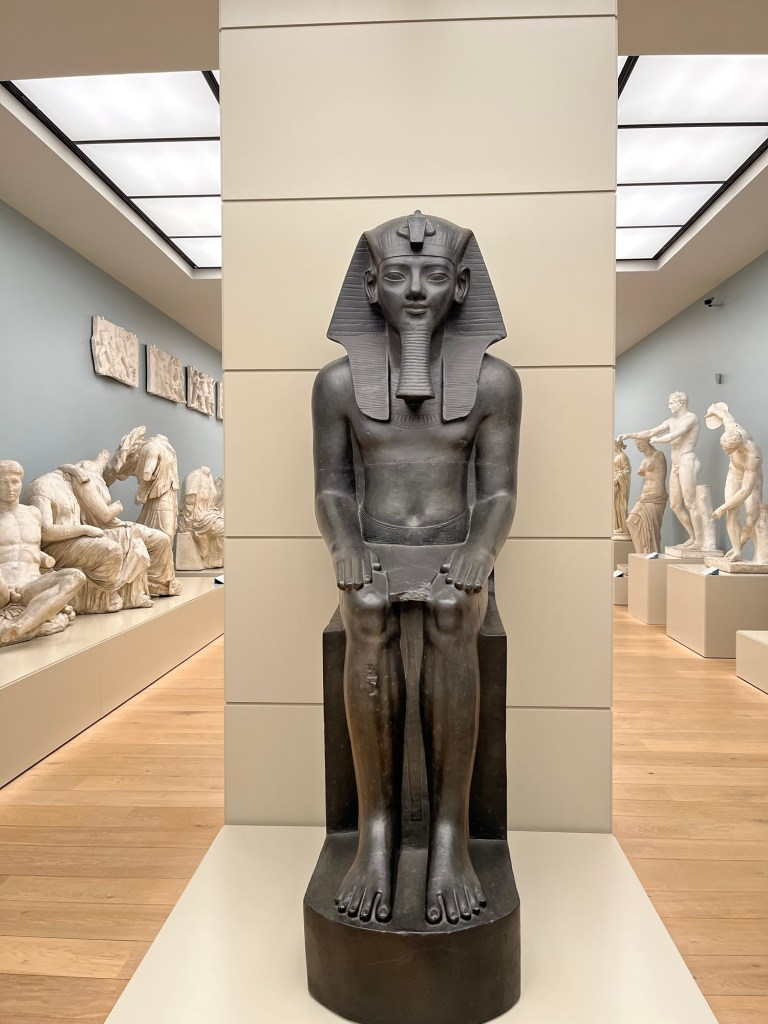
When I visit national museums in capital cities, I begin to understand the culture a little more deeply. What do they treasure and what do they wonder about? Why is there a large gallery of sculptures that are only copies of pieces found elsewhere in the world? What artifacts were deemed worthy of keeping?

The national gallery of Oslo is so large it takes the better part of a day to visit. Its collection is vast and eclectic. The museum, oddly, doesn’t have the best collection of Norwegian folk art that we encounter on this trip. But it does have some stunning pieces. The leather tool work on a set of dining chairs catches my attention. I have admired a similar set at Akershus castle. But here, the exhibit shows us how the leather is embossed and overlaid in gold leaf and dyes. Incredible artistry and innovation in the Middle Ages.

Another gallery displays gowns of the current and past queens. I don’t like a single gown of Queen Sonya’s. I’m not sure what that says about either my or the current queen’s fashion sense. However, Queen Maude (from the 1920’s) was an art deco maven. Her gowns and her taste in furnishings was exquisite. At least in my humble opinion. We marvel at her incredibly small waist that I could likely put my hands around. I shudder as I consider the self torture required to “train” that shape.
Exhibits continue to highlight household items from each decade. We watch newsreels from a telephone box and wander through pop culture icons. Some are familiar to us, most are not.
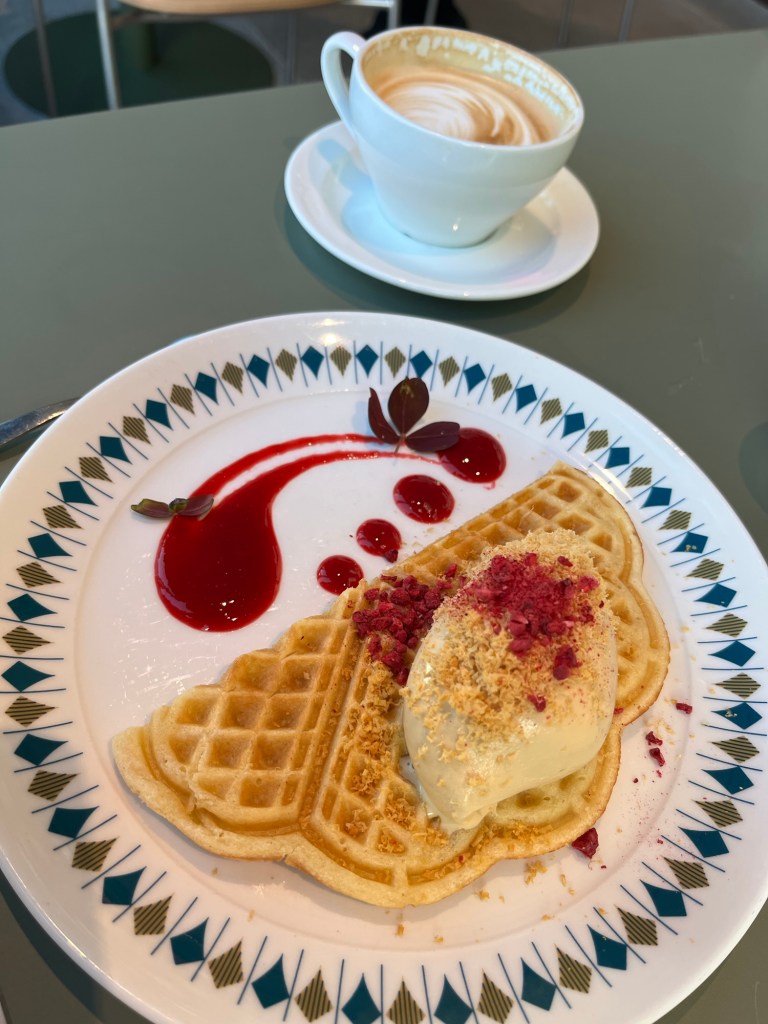
About halfway through the museum, we decide to stop for a vaffle with brown cheese. Brown cheese is creamy like butter and melts in your mouth. Perhaps not the healthiest of lunches, but when in Norway…..
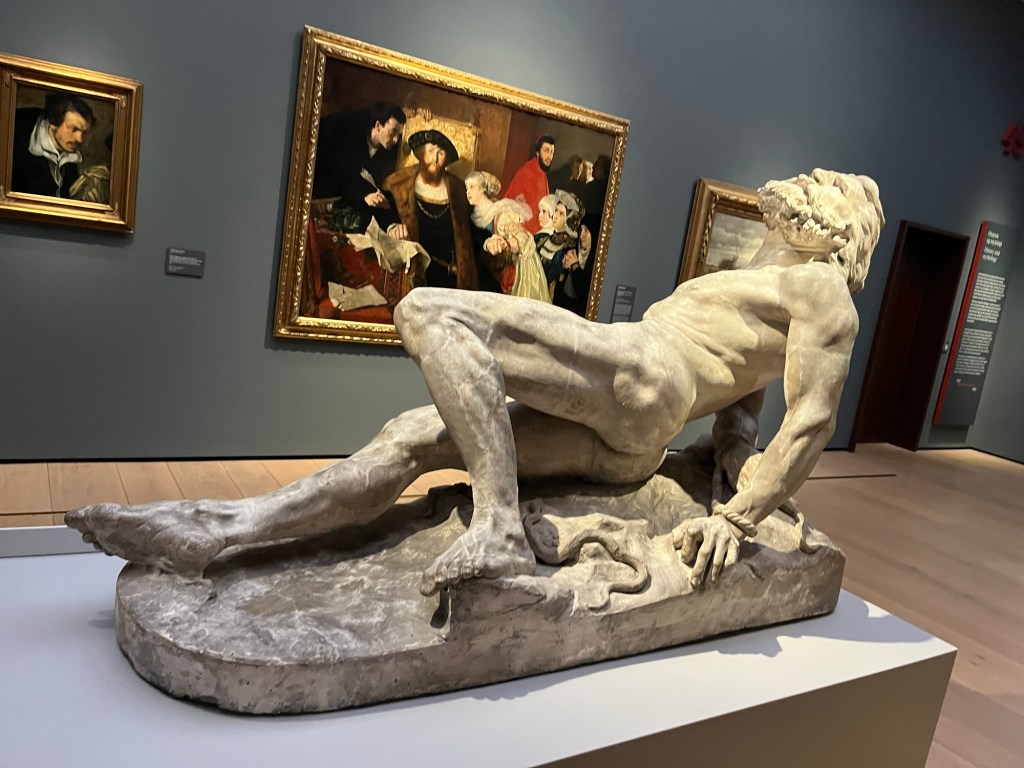
The afternoon is devoted to more modern art. The galleries are filled with Norwegian artists and important European paintings. We see Dutch masters and the great impressionists. There are Dali’s and Picasso’s. There are modern installations from unknown artists that I didn’t like. It is hard to call empty walls and child like streaks of paint art. Ok maybe it is art, but definitely not talent.
Surprisingly, I grow very fond of Edvard Munch, famous for “The Scream”. Munch began painting as a child and went through many iterations. His paintings are not beautiful but they are emotionally haunting in a way I didn’t expect. They speak to me.
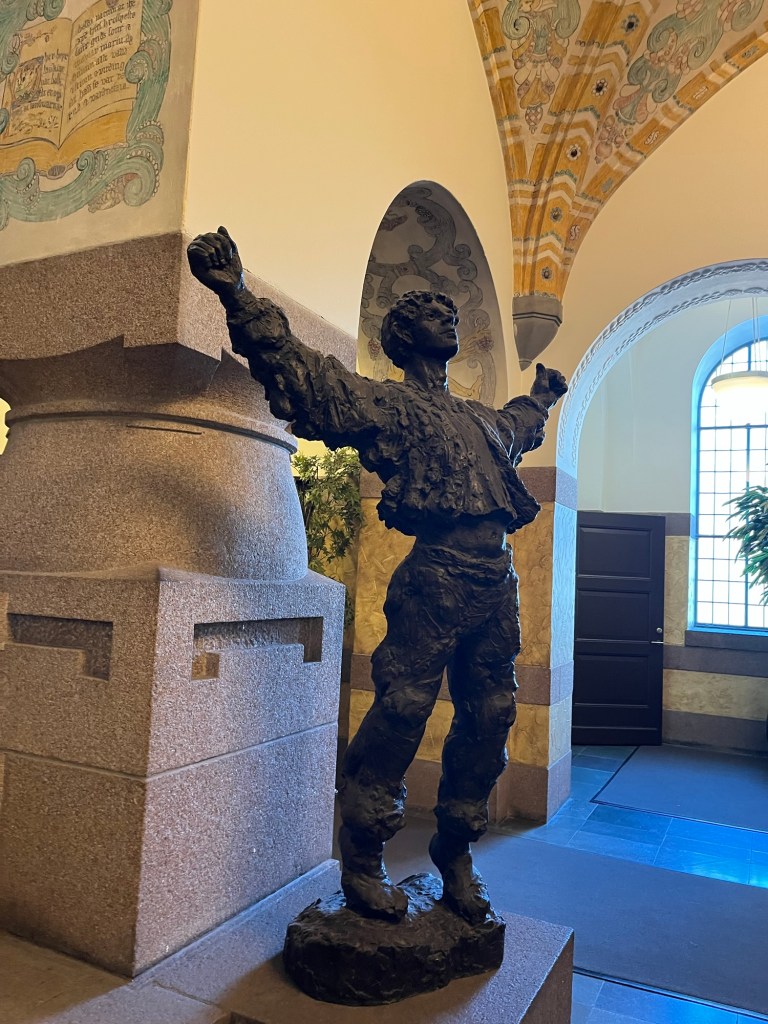
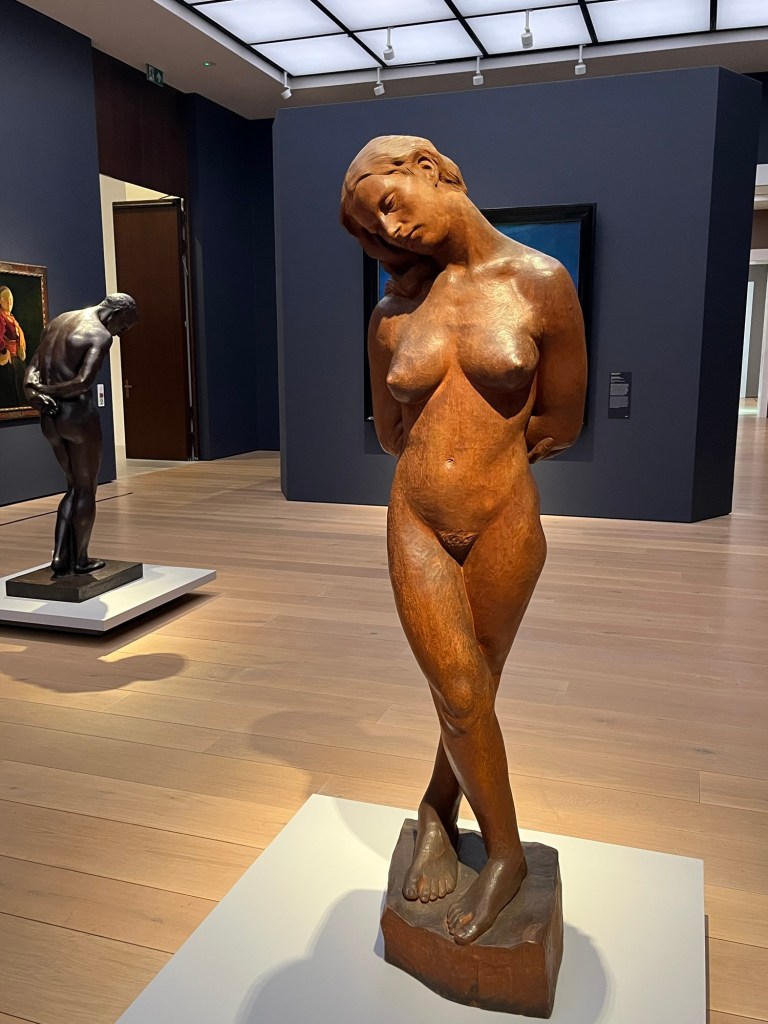
Norway’s most famous sculpture Gustav Vigelund is also on full display. You can recognize Vigelund because his subjects are always fully nude and usually carved in some form of motion. The bronze statue in the museum seems demure compared to the hundreds of statues scattered through the parks of Oslo.
Just when we thought we had seen it all, we realize there is a large special exhibit on gothic themes of life and death throughout history. While often macabre, the exhibit holds many surprises. My favorite unexpected treasure is a Van Gogh of a skeleton smoking a cigarette.
I love visiting world class museums. In every encounter, I find something I never knew existed. An that discovery is always worth the price of admission.

-
We were In The Neighborhood: Travel Goals

When the day’s agenda only involves walking across the street, you can afford to sleep in. This is why retired individuals should consider a long stay in a destination. We can linger over coffee and pastry. We can sleep in if we want or spend an hour talking to strangers.
Today, we move slowly after spending fourteen hours adventuring to Lillehammer. A slow start feels right. After a four minute walk, we arrive at the Oslo Natural History Museum complex. It is located within the grounds of the Botanical Garden.
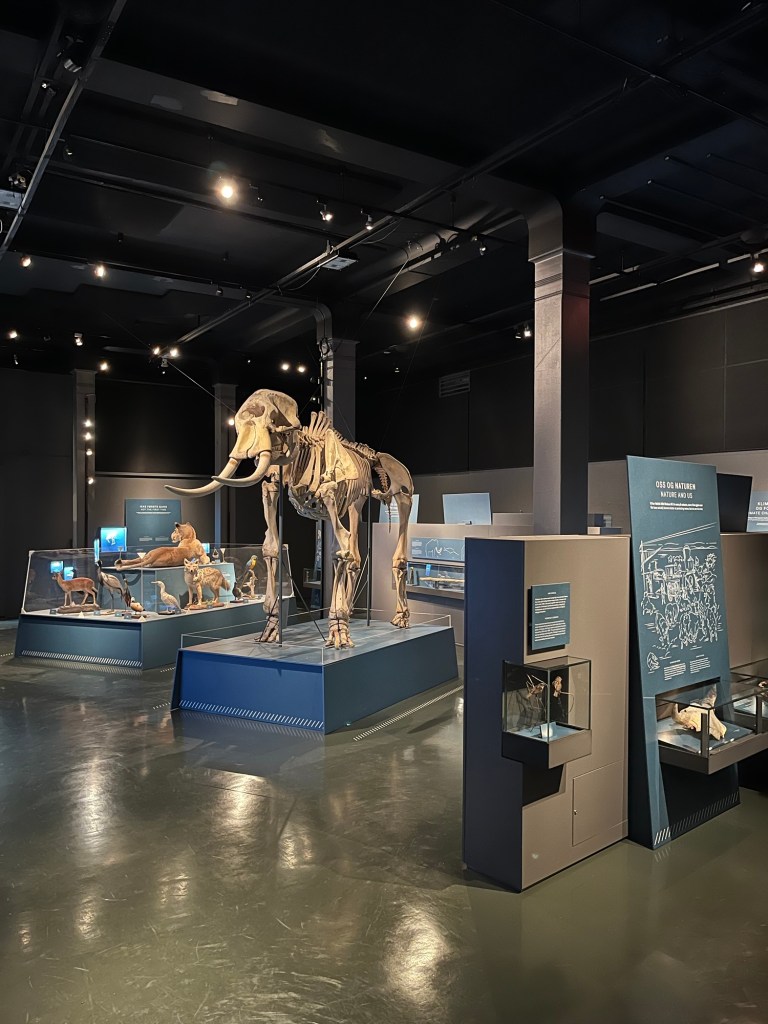
There are several buildings that make up the museum complex. In the first building, we find a very large collection of skeletal and stuffed animals. The taxidermy and artistic settings of the arctic are very well done. Other settings can be sketchy. It is interesting to see the animals from your home, represented elsewhere. It makes me wonder what our zoos and science centers get “almost” right.
The center is full of preschoolers running to and fro and squealing in delight at each new encounter. I would be annoyed if they weren’t so cute. Try as I might, I can’t turn off the school administrator in me. I will always love children and when they are around I go into supervision mode. It takes real effort to remain detached and enjoy the museum instead of chasing the little guy hanging from the display case.

Building two is a geology lesson in rocks and prehistoric bones. The dinosaurs loom large in the gallery. But there are also giant sloths, mammoths, and sea creatures. Who doesn’t love to wander around with dinosaurs? We reminisce about our son’s love of dinosaurs and the many trips we took during his preschool years to allow him to see his precious triceratops.

Upstairs we encounter planet Earth. Models demonstrate currents, wind, magnetic charges, and a variety of other variables that support human life. We also find endless cases of rocks. I shudder as I think about the horrible geology teacher I had in college. In his exams, he wanted us to identify rocks by sight and by “tasting” them. No sir, I don’t want to lick a rock, especially if said rock has been licked by all of your other students. While my husband is learning about rock formations, I am imagining my rebuttal to Dr. Williams. Of course, I returned to reality in time to enjoy the gemstone collection.
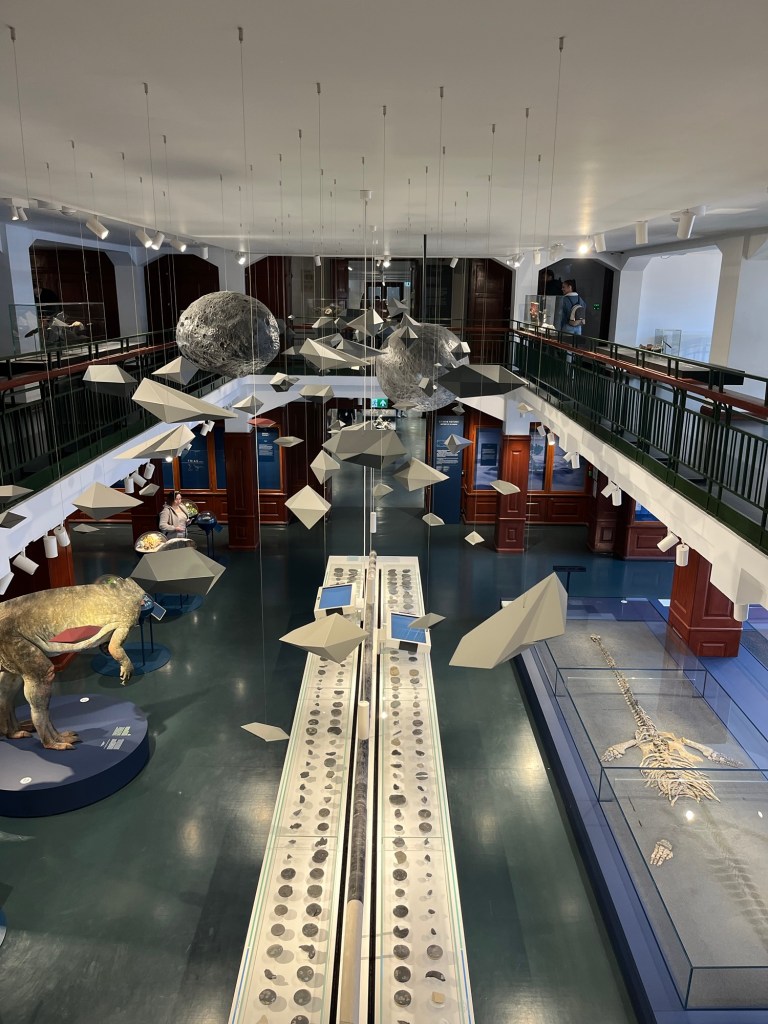
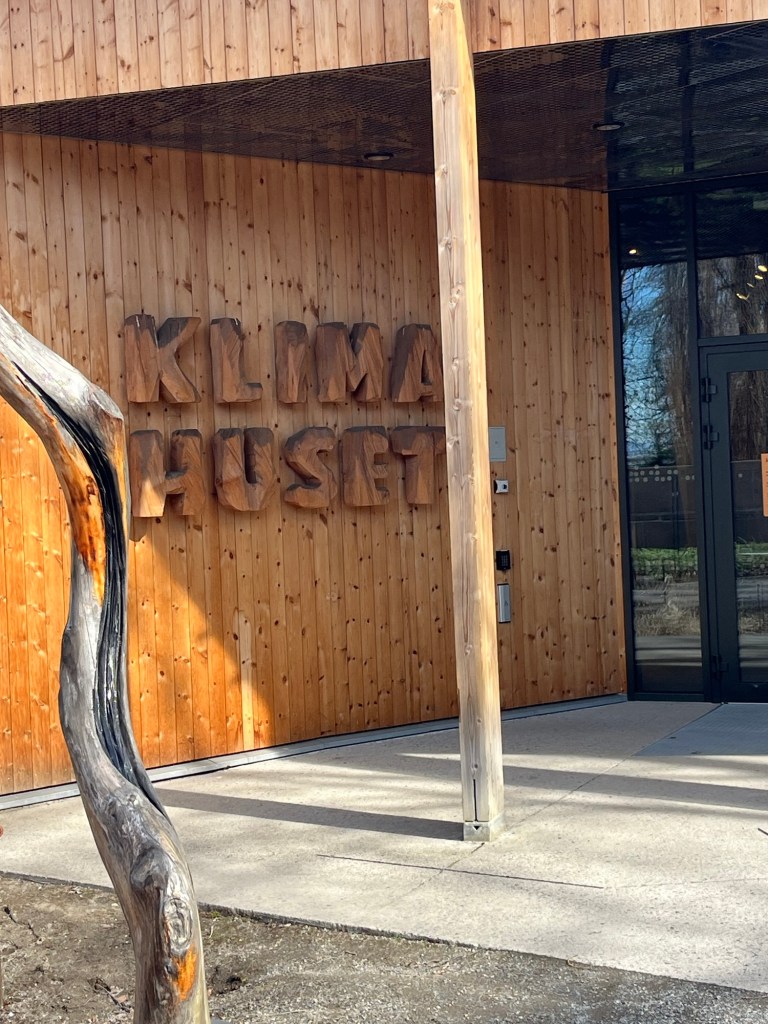
The last building is the climate house, a beautiful building dedicated to helping people understand climate variables and issues impacting life on the planet. Here we encounter many high school students. Some are engaged while others stared at themselves in their cell phones. I guess selfie obsession is universal. I have seen this field trip play out many times.
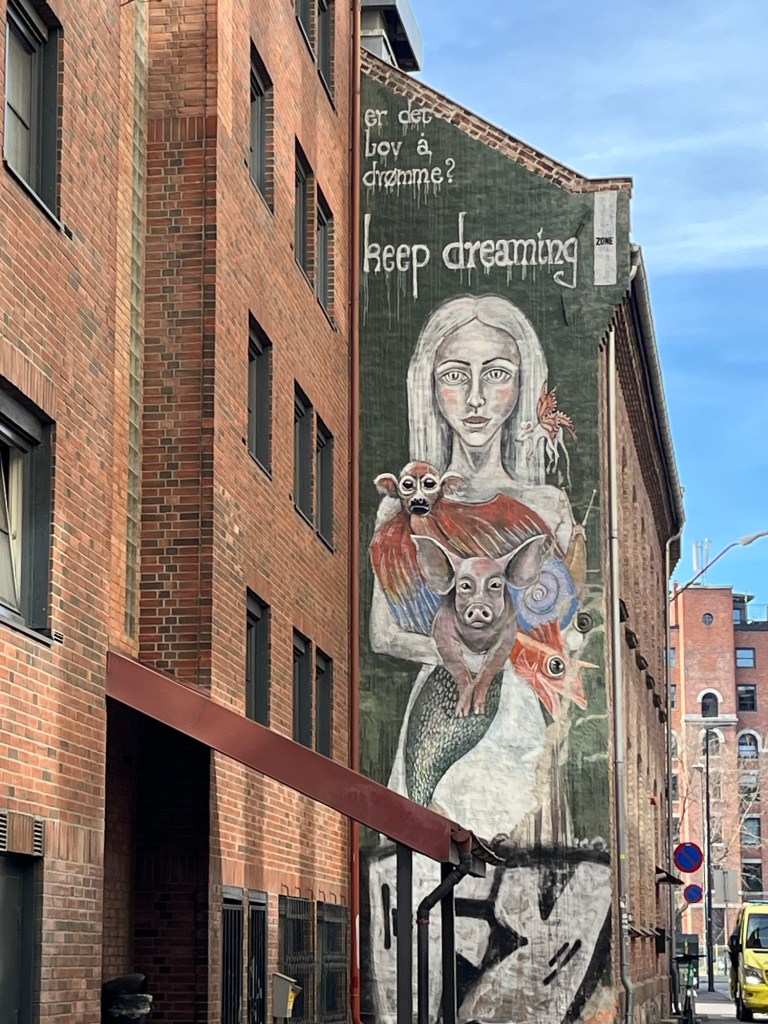
By late afternoon we are tired of indoor spaces. We take a new route out of the park and find ourselves in a new neighborhood. Multicultural and bustling, it is my kind of place. Eventually, hungry and concerned about walking too far afield, we take a short cut back toward home. We stop at the Ali Baba steakhouse for Turkish/Mediterranean dinner. Sometimes the best things turn up in your own neighborhood.
-
Subscribe
Subscribed
Already have a WordPress.com account? Log in now.
 Prisoner of Hopes